
Now Reading: Memory Distortion Explained: Why Memories Change, Shift, and Become Inaccurate Over Time
-
01
Memory Distortion Explained: Why Memories Change, Shift, and Become Inaccurate Over Time
Memory Distortion Explained: Why Memories Change, Shift, and Become Inaccurate Over Time
Many people think of memory as a recording device that stores experiences exactly as they happened.
Modern cognitive psychology tells a very different story.
Memory is not a perfect archive. Instead, it is a dynamic and reconstructive process that changes each time information is stored, recalled, interpreted, or updated.
This phenomenon is known as memory distortion.
Memory distortion occurs when a remembered event differs from what actually happened. The memory may contain missing details, altered information, emotional exaggerations, or entirely new elements that were never part of the original experience.
These distortions are surprisingly common and affect everyone.
Rather than indicating a faulty brain, memory distortion is often a natural consequence of how memory systems operate.
Understanding memory distortion helps explain eyewitness errors, disagreements about past events, inaccurate childhood memories, and even everyday misunderstandings.
It also provides important insight into how memory influences learning, decision-making, and personal identity.
What Is Memory Distortion?
Memory distortion refers to any change, alteration, or inaccuracy that occurs within a stored memory.
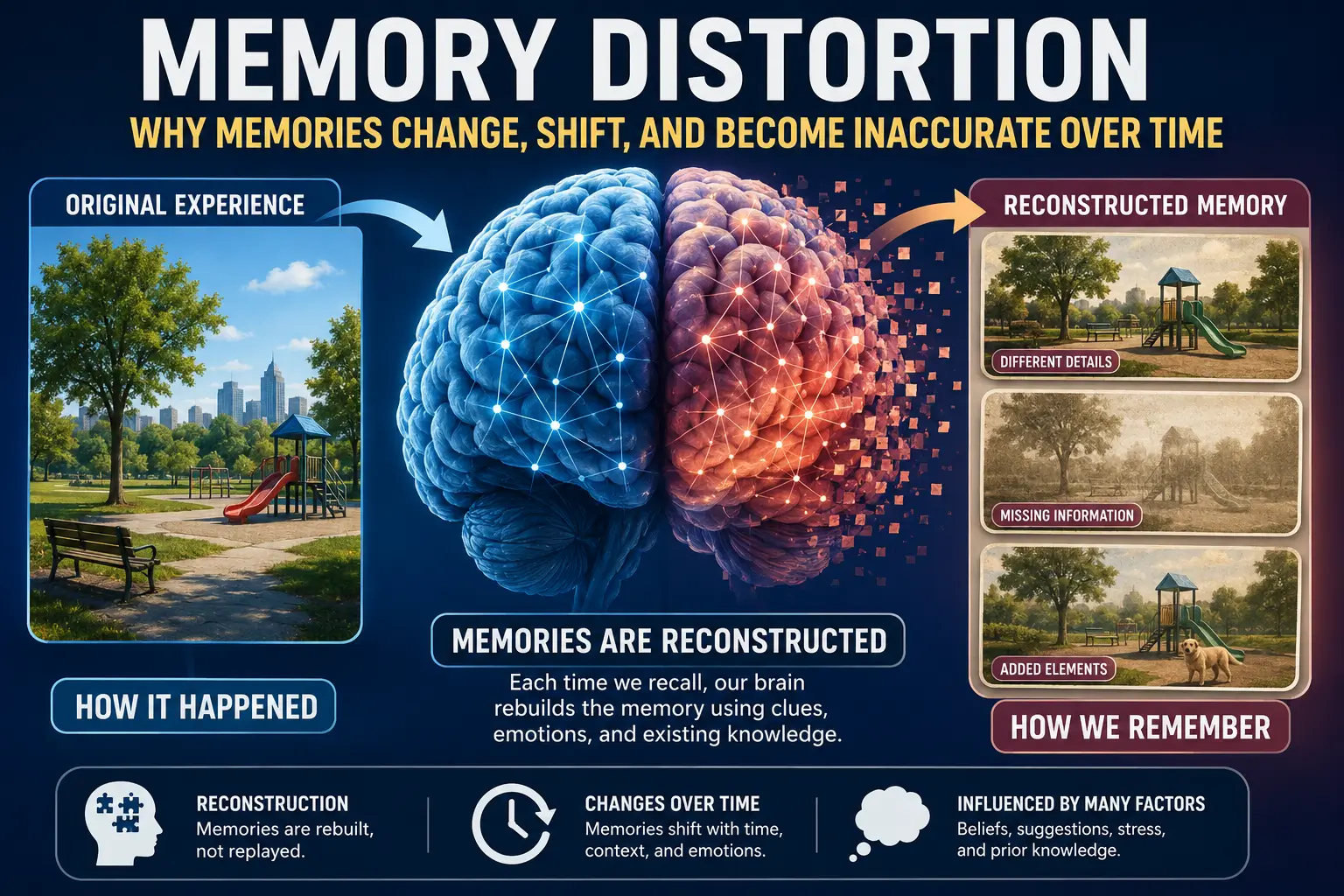
When people recall an event, they do not simply replay a recording.
Instead, the brain reconstructs the memory using stored information, current knowledge, emotional state, expectations, and contextual cues.
This reconstruction process is efficient, but it is not perfect.
As a result, memories can gradually drift away from the original experience.
Some distortions are minor and involve small inaccuracies.
Others can significantly alter a person’s recollection of events.
Why Does Memory Distortion Occur?
Memory distortion occurs because memory was never designed to function as a perfect recording system.
The brain prioritizes meaning, patterns, and useful information over exact detail preservation.
Several psychological processes contribute to distortion:
- Reconstruction during recall
- Interference from similar memories
- Emotional influences
- Suggestion and misinformation
- Memory reconsolidation
- Incomplete encoding
- Changes in personal beliefs and knowledge
Each time a memory is retrieved, it becomes temporarily flexible before being stored again.
This process can introduce subtle modifications over time.


The Reconstructive Nature of Memory
One of the most important discoveries in memory research is that remembering is a reconstructive process.
Rather than retrieving a complete record, the brain pieces together fragments of information from different sources.
These fragments may include:
- Original sensory information
- Knowledge acquired later
- Emotional reactions
- Expectations and assumptions
- Related experiences
The result often feels completely accurate, even when certain details have changed.
This helps explain why two people can remember the same event differently while both feel confident in their recollections.
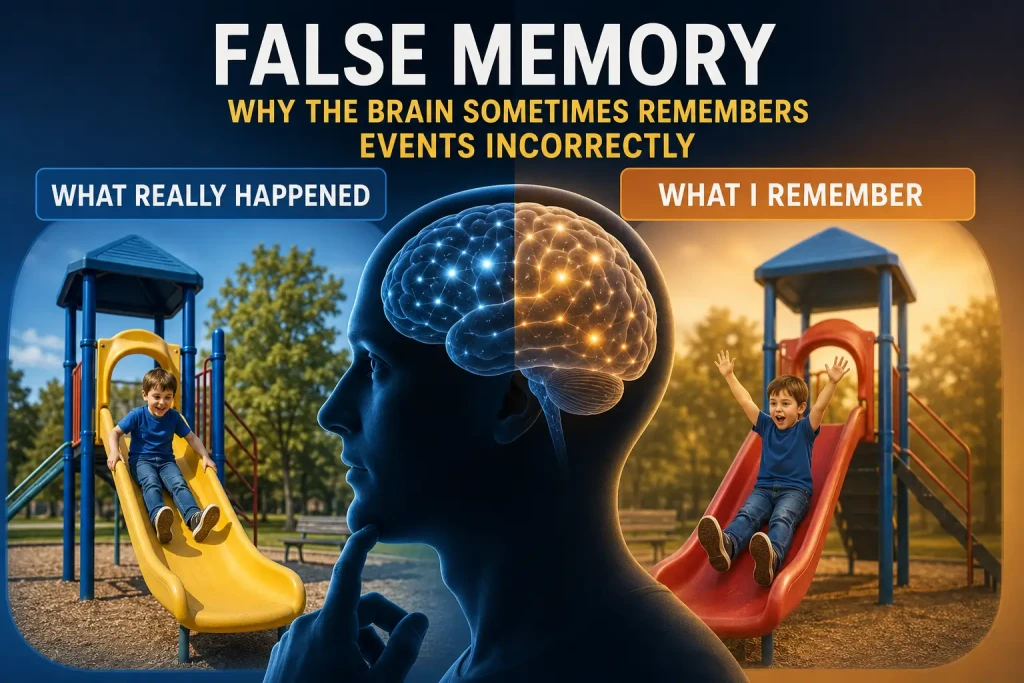
Memory Distortion and False Memories
Memory distortion and false memories are closely related concepts.
A distorted memory contains altered details from a real event.
A false memory goes further by creating a memory of something that never happened or happened very differently than remembered.
Research has repeatedly shown that false memories can be surprisingly vivid and convincing.
Individuals often express strong confidence in memories that contain substantial inaccuracies.
This relationship explains why understanding memory distortion is essential for understanding false memory formation.
The Role of Memory Reconsolidation
Scientists once believed that memories became fixed after consolidation.
Research now shows that memories can become flexible again when they are recalled.
This process is known as memory reconsolidation.
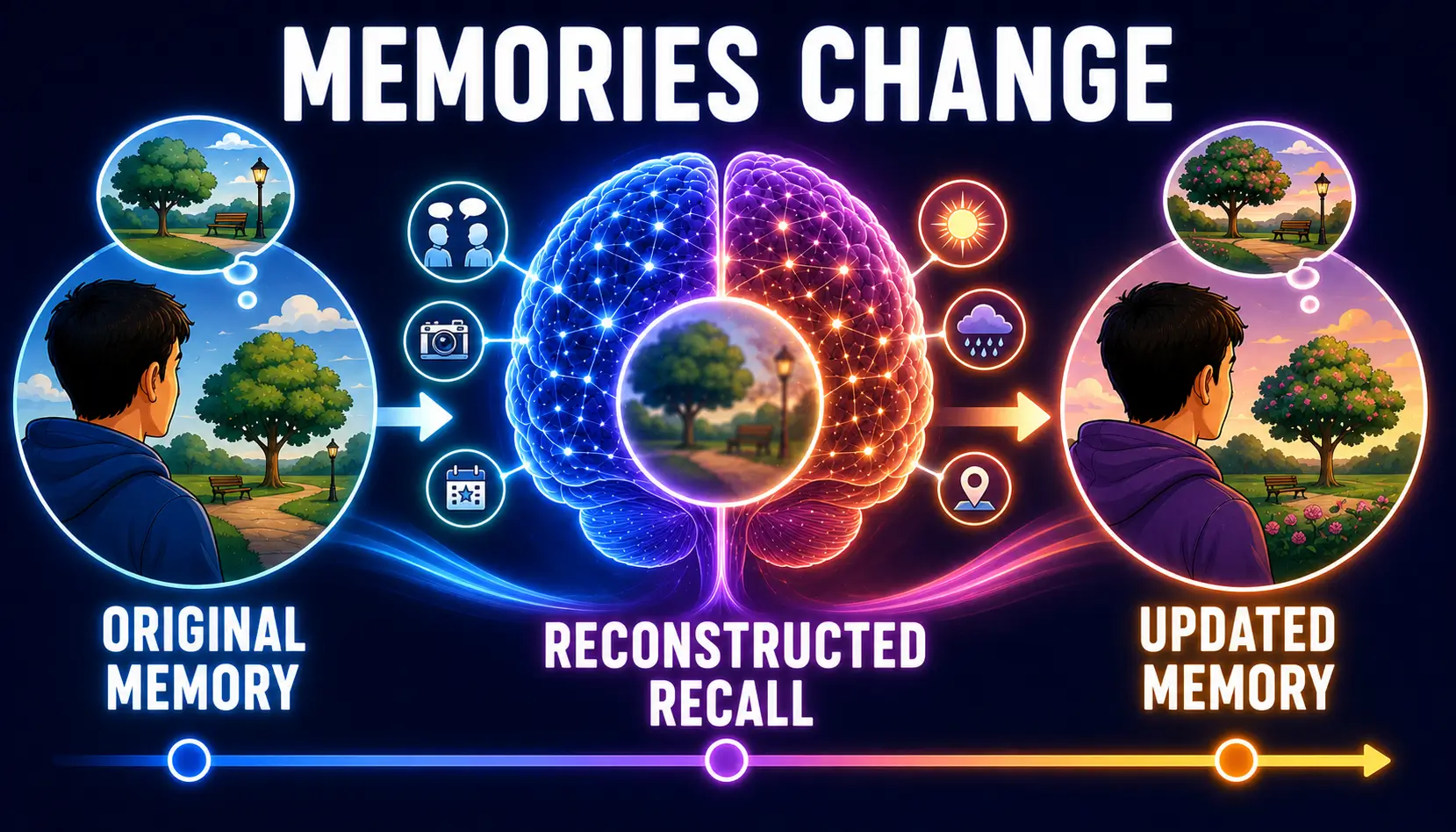
When a memory is reactivated, it enters a temporary state where modifications can occur before it is stored again.
Reconsolidation helps explain why memories may gradually change over time.
New information, emotions, interpretations, and experiences can become integrated into older memories during this process.
How Emotions Influence Memory Distortion
Emotion plays a powerful role in shaping memory.
Emotionally significant events are often remembered more vividly than ordinary experiences.
However, vividness does not guarantee accuracy.
Strong emotions can increase confidence in a memory while simultaneously increasing the likelihood of distortion.
Stress, fear, anxiety, excitement, and personal significance can all influence how events are encoded and later reconstructed.
This explains why highly emotional memories sometimes contain inaccuracies despite feeling exceptionally real.
Memory Distortion and Eyewitness Testimony
One of the most important real-world applications of memory distortion research involves eyewitness testimony.
Psychological studies have shown that eyewitness memories can be altered by:
- Leading questions
- Post-event information
- Social influence
- Media exposure
- Repeated recall
Even subtle wording changes can influence what people remember.
These findings have significantly influenced legal procedures and the evaluation of witness evidence.
Memory Distortion vs False Memory
Although the two concepts are related, they are not identical.
Memory distortion refers to changes within an existing memory.
False memory refers to remembering an event that never occurred or remembering it in a substantially inaccurate way.
In many cases, memory distortion serves as a pathway that eventually contributes to false memory formation.
Understanding this distinction helps researchers better understand how memory errors develop over time.
Source Monitoring Errors and Memory Distortion
Another major cause of memory distortion involves source monitoring errors.
Source monitoring refers to the ability to identify where information originated.
For example, people may forget whether they:
- Personally experienced an event
- Read about it
- Saw it in a movie
- Heard it from someone else
- Imagined it themselves
When source monitoring fails, details from different sources can become mixed together, leading to inaccurate recollections.
This process is one of the most common contributors to memory distortion in everyday life.
Examples of Memory Distortion in Everyday Life
Memory distortion occurs far more often than most people realize.
Common examples include:
- Remembering conversations differently than other participants
- Misremembering dates and timelines
- Adding details that were never present
- Combining multiple events into a single memory
- Changing memories to fit current beliefs
- Overestimating personal performance or success
These distortions are usually not intentional.
Instead, they emerge naturally from the brain’s effort to create coherent and meaningful representations of past experiences.
Can Memory Distortion Be Reduced?
Completely eliminating memory distortion is unlikely because reconstruction is a fundamental feature of human memory.
However, several strategies may reduce inaccuracies:
- Recording important information promptly
- Using written notes and journals
- Avoiding exposure to misleading information
- Practicing careful reflection before recalling details
- Separating facts from assumptions
- Using multiple sources to verify events
While these techniques cannot guarantee perfect recall, they can improve memory accuracy and reduce susceptibility to distortion.
Why Memory Distortion Matters
Memory distortion affects learning, relationships, legal decisions, education, mental health, and personal identity.
Understanding how memories change helps people become more aware of the limitations of human recall.
It also highlights the remarkable flexibility of memory systems.
Rather than acting as a flaw, memory distortion often reflects the brain’s attempt to adapt old information to new knowledge and experiences.
By understanding this process, individuals can make more informed judgments about their own memories and the memories of others.
Readers interested in improving memory performance, recall accuracy, and long-term cognitive function can learn more about evidence-based approaches through Advanced Memory Formula, which focuses on supporting healthy brain function and memory performance as part of an overall cognitive wellness strategy.
FAQ
What is memory distortion?
Memory distortion occurs when a remembered event differs from what actually happened due to changes during encoding, storage, or retrieval.
Is memory distortion the same as a false memory?
No. Memory distortion involves alterations to a real memory, while false memories may involve remembering events that never occurred.
Why do memories change over time?
Memories can change because recall is reconstructive. New experiences, emotions, and information may influence how a memory is stored and retrieved.
Can emotional events become distorted?
Yes. Emotional memories often feel vivid and accurate, but research shows they can still contain significant inaccuracies.
What causes memory distortion?
Common causes include memory reconsolidation, interference, source monitoring errors, emotional influences, and exposure to misleading information.
Related Topics
- False Memory Explained: Why the Brain Sometimes Remembers Events Incorrectly
- Memory Reconsolidation Explained: How Recalled Memories Can Change
- Autobiographical Memory Explained: How Personal Experiences Shape Identity and Recall
- Retrieval Failure Explained: Why Information Exists in Memory but Cannot Be Recalled
Scientific Sources
https://www.apa.org/monitor/2017/03/cover-memory
https://www.ncbi.nlm.nih.gov/books/NBK557525/
https://www.ncbi.nlm.nih.gov/pmc/articles/PMC3183109/
https://www.britannica.com/science/memory-abnormalities