
Now Reading: Distributed Practice: Why Spacing Out Learning Improves Memory and Long-Term Retention
-
01
Distributed Practice: Why Spacing Out Learning Improves Memory and Long-Term Retention
Distributed Practice: Why Spacing Out Learning Improves Memory and Long-Term Retention

Why do students often forget information shortly after studying it?
One major reason is that learning is frequently concentrated into a single session rather than distributed across time.
Research consistently shows that spreading study sessions over multiple days produces stronger long-term retention than trying to learn everything at once.
This approach is known as distributed practice.
Distributed practice is one of the most well-established findings in learning science and has been supported by decades of cognitive psychology research.
Whether you are preparing for exams, learning a language, developing professional skills, or studying complex concepts, distributed practice can dramatically improve learning outcomes.
What Is Distributed Practice?
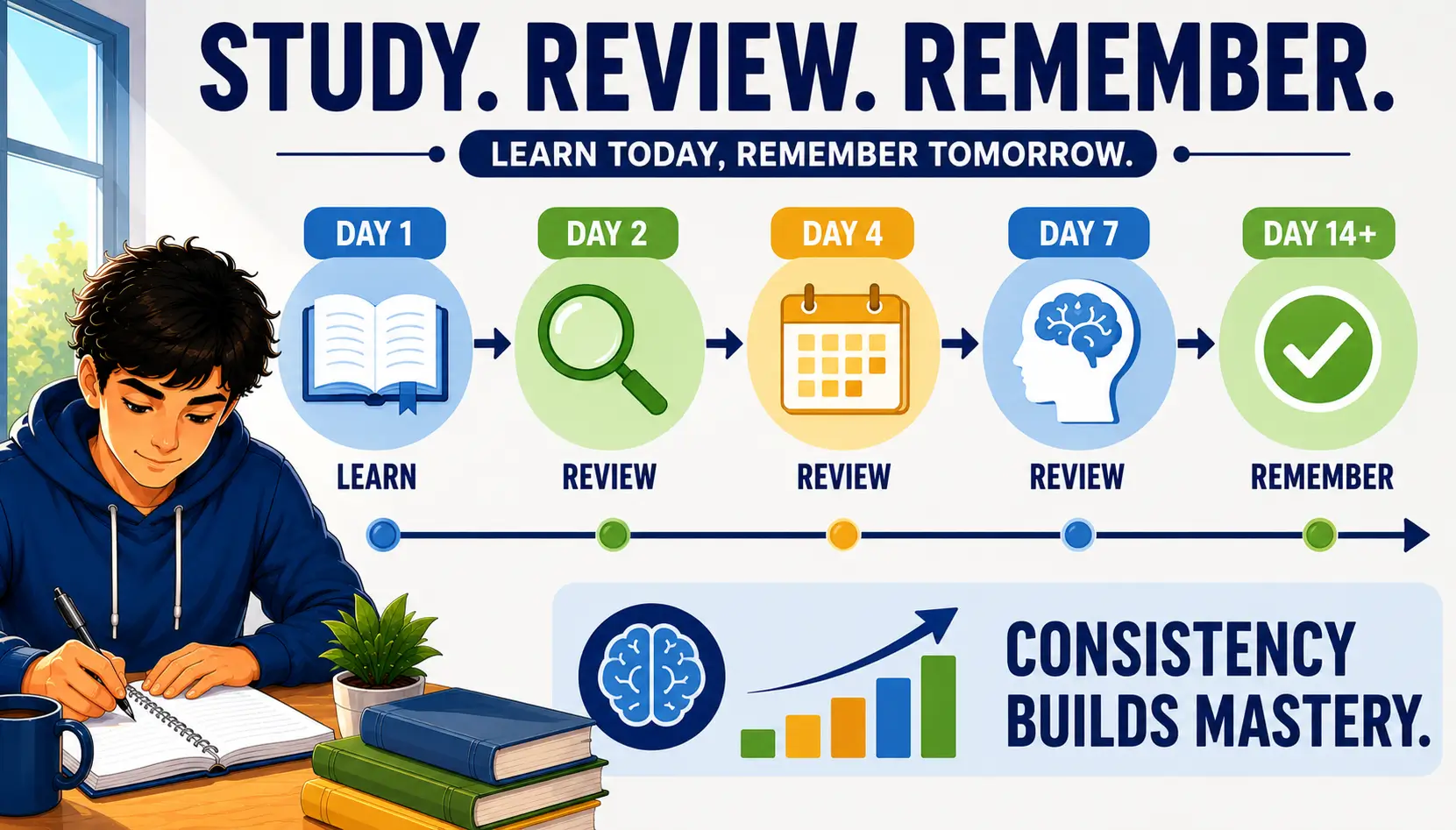
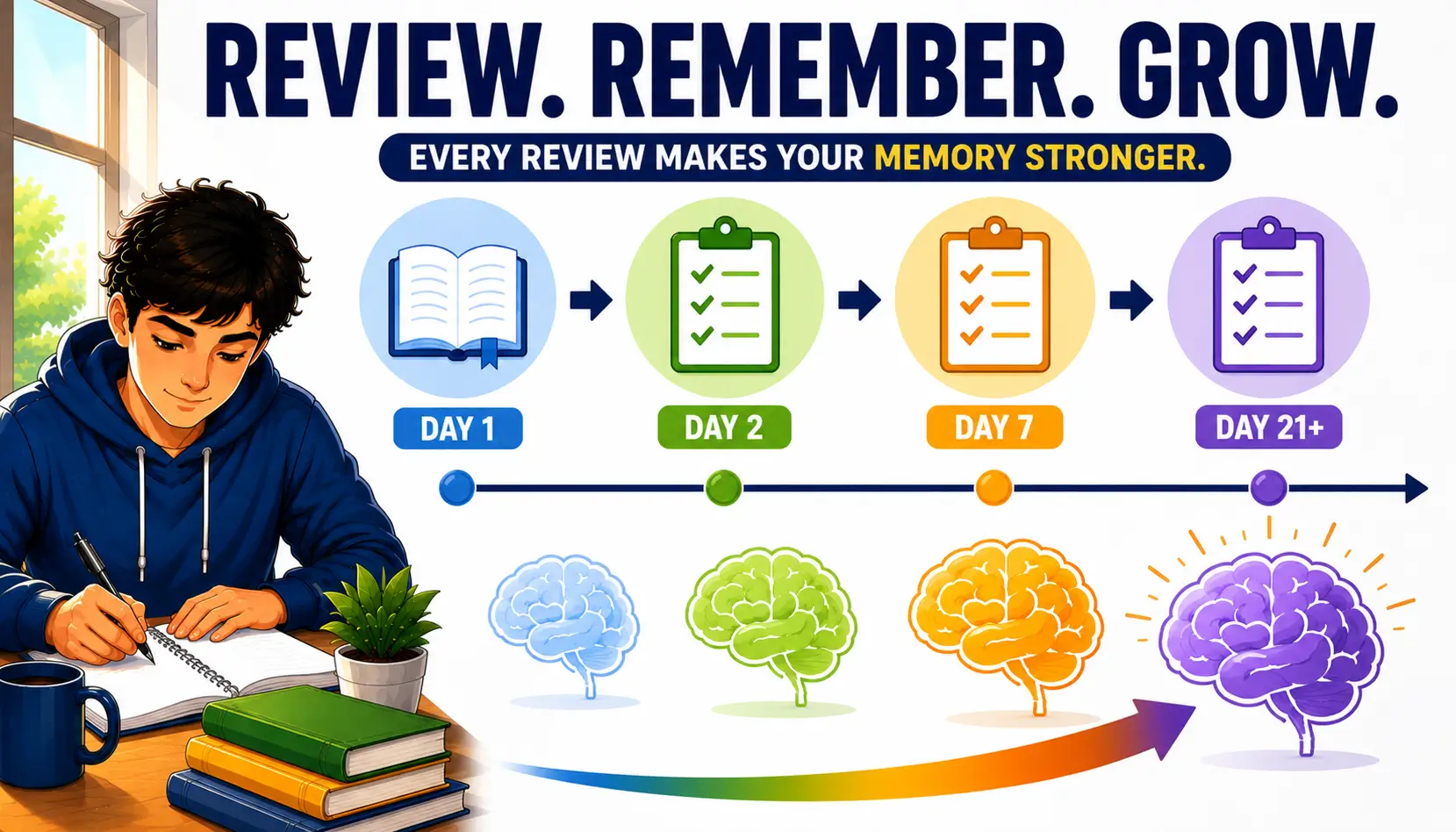
Distributed practice refers to a learning strategy in which study sessions are spaced apart over time instead of being completed in one large block.
Rather than spending six hours studying in a single day, a learner might study for one hour across six different days.
Although both approaches involve the same total study time, distributed practice consistently produces superior retention.
This phenomenon is often called the spacing effect.
The principle forms the foundation of many effective learning systems, including Spaced Repetition.
Why Cramming Feels Effective but Often Fails
Cramming can create the illusion of learning.
Immediately after a long study session, information may feel familiar and easy to recognize.
However, familiarity is not the same as durable memory.
Without repeated retrieval and reinforcement, information often fades rapidly.
This pattern is explained by the Ebbinghaus Forgetting Curve, which shows how memory naturally declines over time.
Distributed practice combats this decline by strengthening memory each time information is revisited.


The Science Behind the Spacing Effect
Researchers have studied distributed practice for more than a century.
Numerous studies have demonstrated that spaced learning improves both immediate performance and long-term retention.
Each review session forces the brain to reconstruct and strengthen memory traces.
This process creates more durable learning than continuous repetition within a single session.
Distributed practice also supports memory consolidation, the process through which temporary learning becomes long-term memory.
Readers interested in this process can learn more in Memory Consolidation Explained.
How Distributed Practice Improves Learning
For a broader memory-improvement framework that connects spacing with retrieval, sleep, and long-term recall, see How to Improve Memory.
Distributed practice improves learning through several important mechanisms:
- Strengthens long-term memory formation
- Reduces forgetting
- Encourages Active Recall
- Improves transfer of knowledge
- Enhances retention across longer periods
- Supports deeper understanding
These benefits explain why distributed practice is widely recommended by learning scientists and educational researchers.
Distributed Practice vs Massed Practice
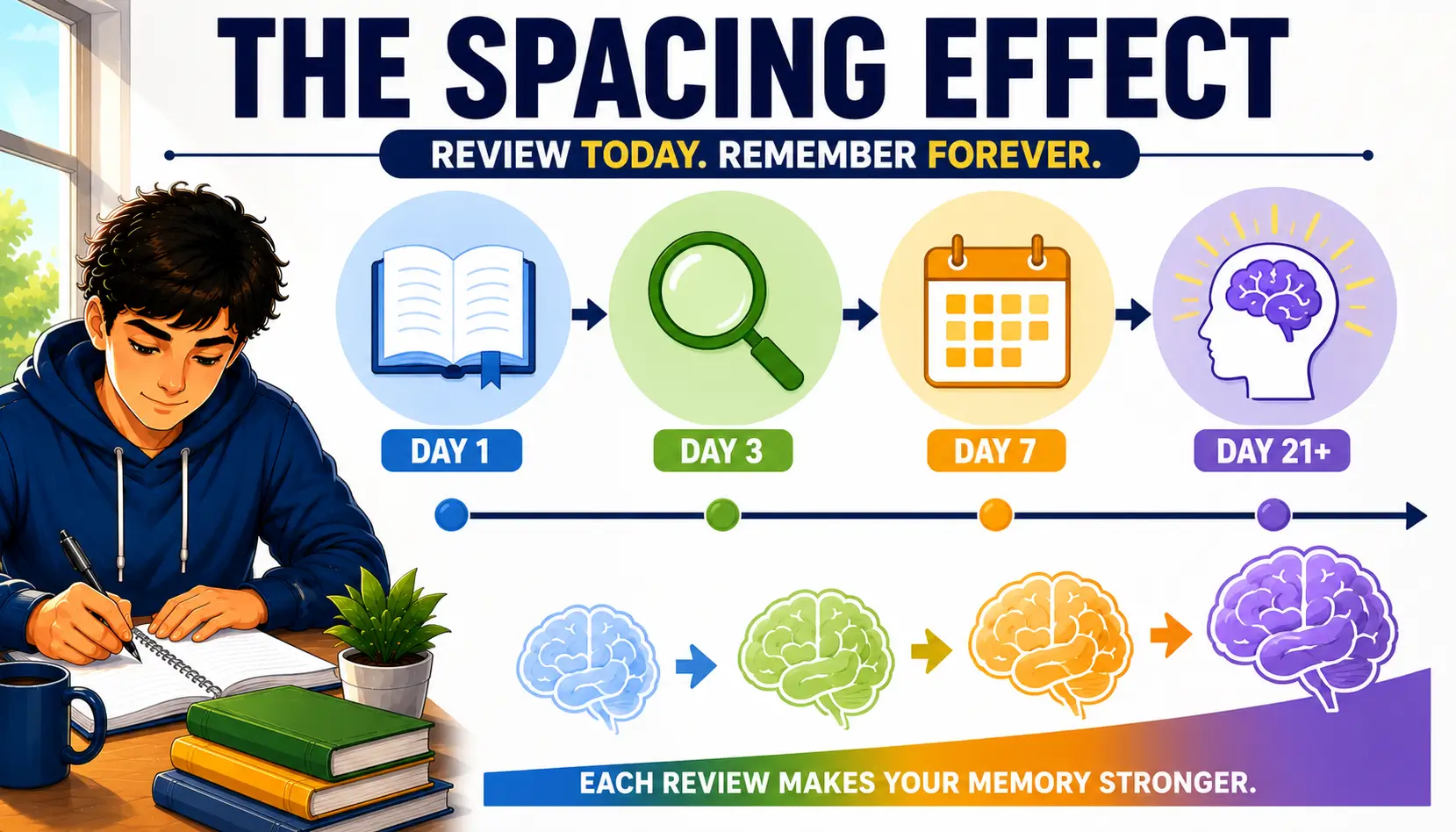
Learning scientists often compare distributed practice with what is known as massed practice.
Massed practice occurs when learning is concentrated into a single intensive session, such as cramming the night before an exam.
Distributed practice spreads learning across multiple sessions separated by time.
Research consistently shows that distributed practice produces stronger long-term retention despite sometimes feeling more difficult during the learning process.
This idea aligns with the concept of desirable difficulties, where certain learning challenges ultimately improve memory performance.
How to Use Distributed Practice Effectively
Spacing works best when it fits your real routine, which is why Best Time to Study is a useful companion for deciding when review sessions should happen.
Applying distributed practice does not require complicated systems.
Simple adjustments can significantly improve learning outcomes.
Effective strategies include:
- Reviewing notes one day after learning.
- Scheduling multiple study sessions throughout the week.
- Combining review with Active Recall.
- Using flashcards across multiple days.
- Returning to older material regularly.
These methods help keep information active while strengthening long-term memory pathways.
Many learners combine distributed practice with Active Recall for even greater benefits.
Distributed Practice and Academic Performance
Students often focus on studying harder when they encounter difficulties.
However, research suggests that studying smarter frequently produces better results.
Distributed practice allows learners to spend less time relearning forgotten material and more time building deeper understanding.
Over weeks and months, these improvements can accumulate into substantial gains in academic performance.
The strategy has been successfully applied across subjects including mathematics, science, language learning, medicine, and professional training.
Frequently Asked Questions
What is distributed practice in learning?
Distributed practice is a study strategy that spreads learning sessions across time instead of concentrating them into one large study session.
Is distributed practice the same as spaced repetition?
They are closely related. Distributed practice is the broader learning principle, while spaced repetition is a structured system built on that principle.
Why does distributed practice improve memory?
Spacing learning sessions forces the brain to repeatedly retrieve information, strengthening memory traces and reducing forgetting.
Is distributed practice better than cramming?
Research consistently shows that distributed practice produces superior long-term retention compared to cramming.
Learning More by Studying Less Intensely
One of the most surprising findings in learning science is that effective learning does not always require longer study sessions.
By distributing practice across time, learners can improve retention, strengthen memory, and reduce the need for constant relearning.
Combined with Active Recall, Retrieval Practice, and quality sleep, distributed practice becomes one of the most powerful tools available for long-term learning success.
Many learners also explore evidence-based approaches that support cognitive performance and memory function. Learn more here: Advanced Memory Formula.