
Now Reading: Generation Effect Explained: Why Creating Information Improves Memory
-
01
Generation Effect Explained: Why Creating Information Improves Memory
Generation Effect Explained: Why Creating Information Improves Memory
Imagine studying a list of unfamiliar concepts. You read each definition carefully, highlight the important words, and review the material several times. Everything feels familiar. Yet when someone asks you to explain the concepts without looking at your notes, you struggle to remember them.
Now imagine a different approach. Instead of reading every answer immediately, you receive a clue and try to produce the answer yourself. You complete a missing word, work out a relationship, or formulate a definition before checking the correct response.
Both approaches expose you to information. But they do not necessarily produce the same memory outcomes.
Research in cognitive psychology has repeatedly found that information people generate themselves can be remembered better than comparable information they simply read. This phenomenon is known as the generation effect.
The generation effect offers an important lesson about learning: what you do with information during a learning experience can influence how well you remember it later.
However, the effect is more nuanced than the familiar advice to “learn actively.” Its strength depends on the learning task, the relationship between the information and the learner, and the conditions under which generation occurs.
This guide explains what the generation effect means, how psychologists study it, what scientific evidence reveals, and how to apply its principles without confusing it with other learning techniques.
What Is the Generation Effect in Psychology?
The generation effect is a memory phenomenon in which information produced by a learner is often remembered better than equivalent information presented for passive reading.
In a classic experimental task, a participant might encounter one of two conditions:
- Reading condition: The participant reads a complete word pair, such as “hot–cold.”
- Generation condition: The participant sees “hot–c___” and must produce the opposite word, “cold.”
Later, participants complete a memory test. Under many experimental conditions, the generated words are remembered more successfully than the words that were simply presented.
Notice what makes this comparison interesting. The target word is the same in both conditions. The difference lies in how the learner encounters it.
In the reading condition, the answer is supplied. In the generation condition, the learner must construct the answer from available information.
That distinction helps researchers investigate how the activities performed during learning influence memory.
The phenomenon is closely connected to memory encoding, the process through which information is initially transformed into a representation that can potentially be stored and retrieved.
The Original Generation Effect Experiment
The generation effect became a major topic in memory research following a landmark 1978 paper by psychologists Norman Slamecka and Peter Graf, titled The Generation Effect: Delineation of a Phenomenon.
Across five experiments involving 96 undergraduate participants, the researchers compared memory for words that participants generated with memory for words they read.
The tasks used relationships between words, allowing researchers to control the target responses while varying how participants encountered them.
For example, a participant might generate an antonym or another related word using a cue and partial information.
The experiments examined performance using different memory tests, including free recall, cued recall, and recognition.
The researchers consistently observed a memory advantage for generated target words under the conditions they tested.
Importantly, their results did not establish that every form of self-directed learning is superior to every form of reading. The experiments investigated specific generation tasks under controlled conditions.
Nevertheless, the findings demonstrated that generating information can change how effectively it is remembered.
Original research:
https://doi.org/10.1037/0278-7393.4.6.592


Why Does Generating Information Improve Memory?
There is no single universally accepted explanation for the generation effect. Researchers have proposed several mechanisms, and different explanations may account for different aspects of the findings.
1. Generation Encourages Meaningful Processing
When learners generate an answer, they may need to consider the relationship between a cue and the information they are trying to produce.
For example, completing the phrase “an animal that produces wool: s____” requires more than visually recognizing a printed word. The learner must use meaning and existing knowledge to identify “sheep.”
This can encourage semantic processing: considering what information means and how concepts relate to one another.
The connection is especially relevant to Levels of Processing Theory, which examines how different forms of processing influence memory.
However, meaningful processing alone does not explain every generation effect. Some generation tasks involve relatively simple operations, and effective reading can also involve deep processing.
2. Self-Generated Information Can Become More Distinctive
Generated information may stand out because the learner performs a specific mental operation to produce it.
Instead of encountering a completed answer, the learner experiences the process of arriving at that answer.
This can create additional features associated with the learning episode, potentially making the target more distinguishable from other studied information.
Distinctiveness is one proposed explanation, but its contribution depends on the experimental conditions and the type of memory being measured.
3. Generation Can Strengthen Relationships Between Ideas
Many generation tasks require learners to connect new material with existing knowledge.
Generating the opposite of a word, completing a meaningful phrase, or identifying an example from a definition involves relationships between concepts.
These relationships can provide useful information during later retrieval.
For instance, remembering that a particular term was generated as the opposite of another word may help reconstruct the answer.
Related principles appear in Elaborative Rehearsal, where meaningful connections help support learning.
Still, the generation effect should not be reduced to a single claim that creating more associations always produces better memory.
4. Generation May Change What Receives Attention
Producing an answer requires attention to the target information and the operation needed to construct it.
This may make generated items more prominent during encoding.
However, an important qualification is that attention devoted to one item may come at the expense of other information.
For example, a learner might remember a generated word while failing to remember the exact context in which it appeared.
Researchers therefore distinguish memory for the target item from memory for associated contextual details.
What Does Scientific Research Say About the Generation Effect?
The generation effect has been investigated for decades, including through systematic reviews and meta-analyses.
The 2007 Meta-Analysis: Evidence Across 86 Studies
In 2007, Sharon Bertsch and colleagues published a meta-analytic review in Memory & Cognition.
The researchers examined 445 effect sizes from 86 studies and reported an overall effect size of approximately 0.40, indicating an average advantage for generation over reading across the studies analyzed.
That figure is a standardized effect size, not a claim that generation improves memory by 40%.
The researchers also found substantial variation associated with factors that moderated the effect.
This matters because the practical value of generation depends on how the learning task is designed.
Research:
https://pubmed.ncbi.nlm.nih.gov/17645161/
The 2020 Meta-Analysis: Generation Constraints Matter
A later meta-analysis examined 126 articles, encompassing 310 experiments and 1,653 effect estimates.
This review evaluated multiple theoretical explanations and investigated how generation constraints influence memory outcomes.
Generation constraints describe how much freedom participants have when producing information.
For example, completing a word from a tightly specified clue differs from generating an original example with several possible correct answers.
The review found that generation constraints significantly moderated the magnitude of the generation effect.
It also emphasized the importance of distinguishing memory for generated items from memory for contextual information.
These findings challenge overly simple explanations suggesting that all generation tasks work equally well.
Research:
https://pubmed.ncbi.nlm.nih.gov/32671573/
Generation Effect Examples in Everyday Learning
The experimental generation effect was originally demonstrated using controlled memory tasks. Nevertheless, its principles can inform practical study activities.
The following examples illustrate how learners can incorporate self-generation into their routines. They should be understood as applications inspired by the research, rather than proof that every activity produces the same benefit measured in laboratory experiments.
Example 1: Vocabulary Learning
Instead of repeatedly reading a vocabulary list, learners can use clues to generate target words.
For example:
- Read: “Abundant means plentiful.”
- Generate: “A synonym for abundant beginning with p is ______.”
The second activity requires the learner to produce “plentiful” rather than simply recognize it.
After attempting the answer, the learner should check the correct response.
Example 2: Learning Scientific Definitions
Instead of memorizing a complete definition immediately, a student might read a short explanation and then construct a definition in their own words.
For example, after learning about memory consolidation, the student could complete:
“Memory consolidation refers to the process by which newly acquired information becomes…”
The learner then compares the generated explanation with a reliable definition to identify missing or inaccurate details.
Example 3: Mathematics and Problem Solving
Students can attempt to generate an intermediate step or solution before viewing a worked example.
This may encourage active processing, but it is important to recognize that solving a complex problem involves more than the classic generation effect.
For beginners, attempting an unfamiliar problem without adequate guidance can create excessive cognitive demands.
Guided examples and progressively reduced assistance may therefore be more appropriate than asking learners to discover every solution independently.
Example 4: Learning Through Personal Examples
After reading about a psychological principle, learners can create an example from everyday life.
For the generation effect itself, a learner might describe how filling in a missing term differs from rereading a completed sentence.
Producing a personal example can support understanding, although this broader educational activity should not be treated as identical to the original word-generation experiments.

Generation Effect vs. Active Recall
The generation effect and active recall are closely related, but they are not interchangeable concepts.
The generation effect concerns the memory advantage that can occur when information is generated rather than supplied during learning.
Active recall generally involves attempting to retrieve previously learned information from memory.
Consider the following examples:
- Generation: A student sees “hot–c___” and generates “cold” while first encountering the material.
- Active recall: A student studies the definition of a term and later tries to recall it without looking.
Both activities involve producing information, but their timing and experimental definitions differ.
Generation can occur during initial encoding, while active recall is commonly used after information has already been studied.
To explore the broader learning strategy, read our guide to Active Recall.
Generation Effect vs. Retrieval Practice
Retrieval practice involves attempting to recover previously encountered information, often through quizzes, flashcards, or self-testing.
The generation effect does not necessarily require the target answer to have been studied beforehand. A learner may generate a response from a clue using existing knowledge.
Retrieval practice, by contrast, is typically concerned with retrieving material after an earlier learning opportunity.
The distinction matters because evidence supporting one technique should not automatically be treated as evidence for every version of the other.
Both can form part of an effective learning routine, especially when learners receive accurate feedback and revisit important material over time.
When Does the Generation Effect Work Best?
The generation effect is not equally strong in every situation. Research indicates that task design, response constraints, material characteristics, and memory-test requirements can influence the results.
When the Learner Has Enough Knowledge to Generate a Response
Generating information is easier when learners possess relevant background knowledge.
A student who understands the relationship between two concepts can use that knowledge to construct an answer.
Without sufficient prior knowledge, however, a generation task may become little more than guessing.
This does not mean unsuccessful attempts are always useless. It means the learning activity should provide appropriate guidance and corrective feedback.
When the Task Requires a Meaningful Response
Generating a meaningful word, explanation, or relationship can engage processes relevant to later memory.
However, requiring more effort does not automatically produce a larger benefit.
Some difficult tasks demand substantial mental resources without producing useful understanding.
The goal should be productive engagement with the material, not difficulty for its own sake.
When the Generated Answer Is Checked
In practical learning situations, learners can produce incorrect answers.
If incorrect responses are never corrected, learners may retain misconceptions or develop incomplete understanding.
Providing the correct answer after an attempt helps learners evaluate what they generated and adjust their knowledge.
Feedback is especially important when applying generation-based activities outside tightly controlled laboratory tasks.
When Generation Is Combined With Later Review
Generating an answer once does not guarantee permanent retention.
Even successfully encoded information can become difficult to retrieve over time.
For durable learning, generation-based activities can be followed by spaced review and later testing.
Our guide to Spaced Repetition explains how distributing review sessions over time can support long-term retention.
When Can the Generation Effect Be Less Helpful?
One of the most important lessons from generation-effect research is that the memory advantage has boundaries.
Remembering the Answer Is Not the Same as Remembering Its Source
A learner may remember information they generated but have weaker memory for surrounding details, such as where the information appeared or which source presented it.
Researchers distinguish between item memory, which concerns the target information, and context memory, which concerns associated details.
The benefits of generation for these outcomes are not always identical.
A 2017 study by McCurdy, Leach, and Leshikar investigated generation constraints and found that lower-constraint tasks improved item and context memory relative to higher-constraint tasks in their experiments.
This reinforces the importance of how generation activities are structured.
Research:
https://doi.org/10.1016/j.jml.2016.06.007
When Beginners Face Excessive Difficulty
Students encountering a completely unfamiliar subject may lack the knowledge required to generate accurate answers.
For example, asking someone with no understanding of chemistry to independently derive a complicated reaction mechanism may produce confusion rather than meaningful learning.
In such cases, a worked example or a guided explanation may be a better starting point.
Once the learner develops foundational knowledge, carefully designed generation tasks can become more appropriate.
When Generating Answers Replaces Understanding
A learner might successfully complete a word fragment without understanding the concept represented by the word.
For instance, filling in the missing letters of a scientific term does not necessarily demonstrate an ability to explain the underlying process.
Generation tasks should therefore match the learning objective.
If the goal is conceptual understanding, learners need opportunities to explain relationships, identify examples, and apply ideas—not merely reconstruct terminology.
How to Apply the Generation Effect: A Practical Study Method
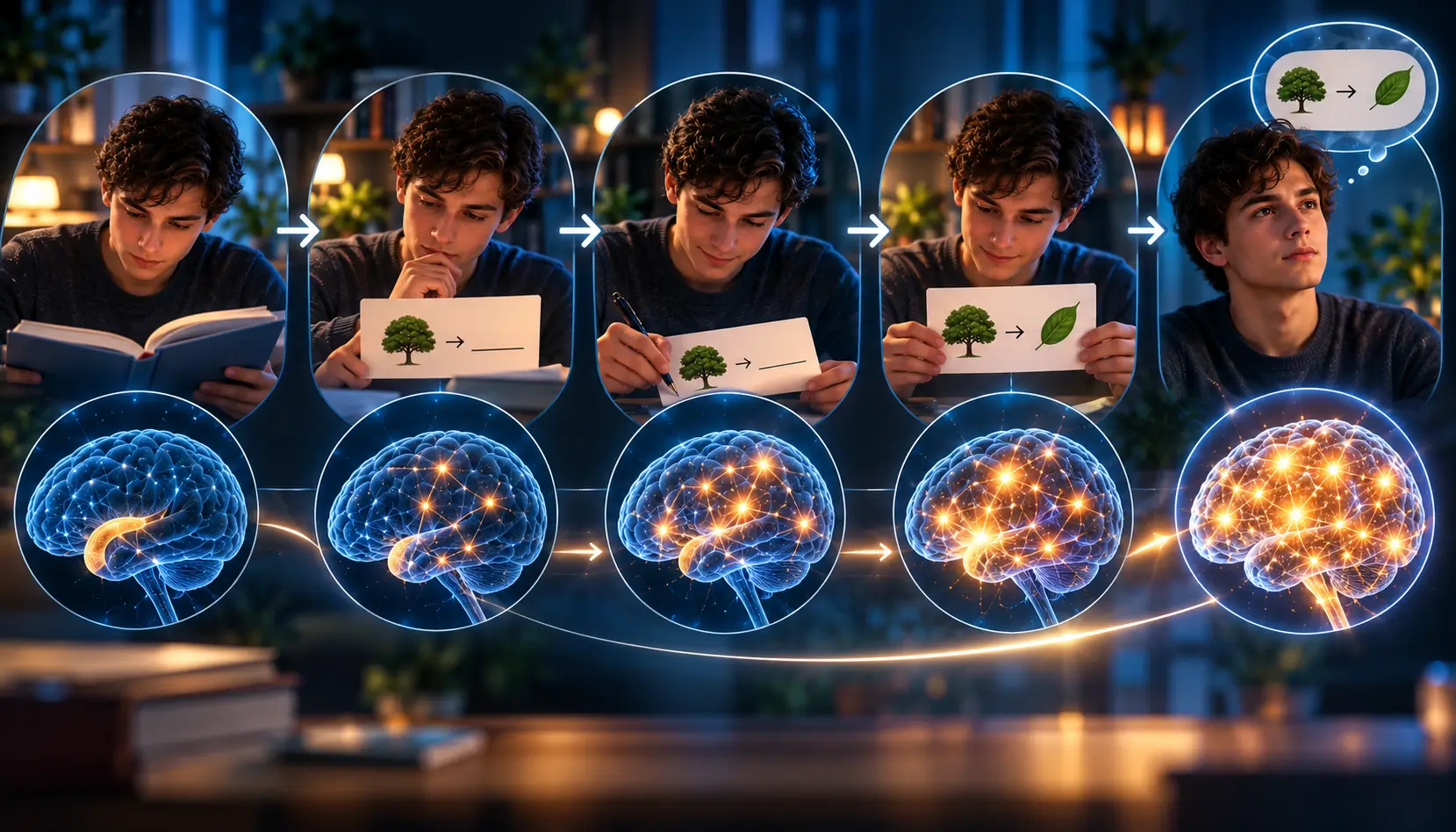
A useful way to apply the principle is to build short generation opportunities into normal study sessions.
Step 1: Learn the Basic Concept
Begin with a reliable explanation, worked example, or introductory lesson.
Identify the central ideas and unfamiliar terms. For complex material, avoid expecting yourself to generate answers before you have enough information to work with.
Step 2: Replace Selected Answers With Clues
Turn a small number of important facts into generation prompts.
Examples include:
- Complete a partially presented definition.
- Generate an antonym or synonym from a cue.
- Identify a concept from a short description.
- Supply a missing step in a familiar procedure.
Choose prompts that require useful thinking rather than random guessing.
Step 3: Produce the Answer Before Revealing It
Give yourself an opportunity to respond without immediately looking at the completed answer.
The response can be spoken, written, or mentally generated, depending on the task.
The essential feature is that the learner produces the target information rather than simply receiving it.
Step 4: Check Accuracy and Correct Mistakes
Compare your answer with the source material.
If your response is incomplete or incorrect, examine the missing information and clarify why the correct answer makes sense.
Do not assume that the effort of producing an answer makes it accurate.
Step 5: Test Your Memory Later
Return to the information after a delay and attempt to recall it.
This later activity introduces retrieval practice and helps determine whether the information remains accessible.
For a structured approach to studying, see How to Study Effectively.
Common Misconceptions About the Generation Effect
Misconception 1: Generating Information Always Improves Memory
Research supports an average memory advantage under many experimental conditions, not a universal guarantee.
The size and direction of the benefit can depend on the task, the material, and the type of memory being tested.
Misconception 2: More Mental Effort Always Means Better Learning
Effort can accompany productive processing, but effort alone is not evidence that learning has improved.
A confusing or poorly designed task can be difficult without helping the learner understand the material.
Misconception 3: Generation and Retrieval Practice Are Identical
Both can involve producing answers, but they represent different experimental comparisons and learning processes.
Generation often concerns producing target information during learning, while retrieval practice generally involves recovering previously encountered information.
Misconception 4: Reading Is an Ineffective Learning Method
Reading can support learning, especially when it involves attention, comprehension, and meaningful integration with existing knowledge.
The generation effect does not establish that reading should be abandoned.
Instead, it suggests that certain opportunities to generate information can provide additional memory benefits.
How the Generation Effect Fits Into a Broader Learning System
Effective learning usually requires several complementary processes.
First, information must be understood and encoded. Later, it must remain available and become accessible when needed.
Generation-based activities may support aspects of initial learning, but they do not replace later review, retrieval, or opportunities to apply knowledge.
A practical learning routine might involve:
- Reading a clear explanation to establish understanding.
- Generating selected answers or examples from meaningful clues.
- Checking responses and correcting mistakes.
- Practicing retrieval after a delay.
- Revisiting important material across multiple sessions.
This approach uses generation as one component of a broader learning process rather than treating it as a complete memory system.
Generation Effect and Long-Term Memory
Does generating information improve long-term memory?
The research supports memory benefits under a range of conditions, but the duration and generalizability of those benefits depend on how learning and testing are organized.
Generating an answer can influence how information is encoded. Whether that information remains accessible later also depends on factors such as subsequent practice, interference, and the retrieval conditions.
For example, a student may remember a generated term during an immediate test but struggle to retrieve it weeks later without further practice.
This is why generation should be combined with strategies designed to support durable retention.
Understanding Long-Term Memory helps explain why successful initial learning and lasting retention are related but distinct outcomes.
Supporting Memory Beyond Study Techniques
Learning methods are only one part of cognitive performance. Sleep, physical activity, stress management, and overall health can also influence how effectively people learn and remember information.
Readers exploring broader memory-support approaches may also wish to review the ingredients, evidence, and limitations of products marketed for cognitive health.
One such product is Advanced Memory Formula.
Affiliate disclosure: This is an affiliate link, and we may earn a commission if you purchase through it, at no additional cost to you. This product is not established as a way to reproduce the generation effect or replace evidence-based learning techniques.
Frequently Asked Questions About the Generation Effect
What is the generation effect in simple terms?
The generation effect is the tendency for people to remember certain information better when they produce it themselves rather than simply read it.
Who discovered the generation effect?
Norman Slamecka and Peter Graf published a landmark experimental investigation of the generation effect in 1978. Their work helped establish the phenomenon as an important topic in memory research.
What is an example of the generation effect?
A learner who completes “hot–c___” by producing “cold” may later remember the generated word better than someone who simply reads the completed pair “hot–cold.”
Why does the generation effect happen?
Researchers have proposed several explanations, including meaningful processing, distinctiveness, and the relationships formed during generation. No single explanation accounts for every finding.
Is the generation effect the same as active recall?
No. The generation effect concerns memory differences between generating and receiving information. Active recall generally involves retrieving previously learned material.
Can the generation effect help students?
It can inform useful study activities, such as completing definitions, generating vocabulary from clues, and producing examples. The effectiveness of a particular activity depends on the learner’s knowledge, the material, and the quality of feedback.
Does generating incorrect answers improve memory?
An unsuccessful attempt does not automatically improve learning. Feedback and correction are important, especially when learners are unsure of the answer. The outcomes depend on how the task is designed.
Does the generation effect work for complex subjects?
Generation-based activities can be incorporated into complex learning, but the evidence from simple word-generation experiments should not be assumed to apply unchanged to every advanced task. Beginners may benefit from guidance before attempting independent generation.
Scientific References
1. Slamecka, N. J., & Graf, P. (1978). The generation effect: Delineation of a phenomenon. Journal of Experimental Psychology: Human Learning and Memory.
https://doi.org/10.1037/0278-7393.4.6.592
2. Bertsch, S., Pesta, B. J., Wiscott, R., & McDaniel, M. A. (2007). The generation effect: A meta-analytic review. Memory & Cognition.
https://pubmed.ncbi.nlm.nih.gov/17645161/
3. Theories of the generation effect and the impact of generation constraint: A meta-analytic review (2020). A theoretical and quantitative examination of generation-effect mechanisms and task constraints.
https://pubmed.ncbi.nlm.nih.gov/32671573/
4. McCurdy, M. P., Leach, R. C., & Leshikar, E. D. (2017). The generation effect revisited: Fewer generation constraints enhances item and context memory. Journal of Memory and Language.
https://doi.org/10.1016/j.jml.2016.06.007
Final Thoughts: Learning Through Generation
The generation effect reveals an important principle of human memory: the way information is produced and processed during learning can influence how successfully it is remembered.
Decades of research support a memory advantage for self-generated information across many experimental settings. At the same time, findings about task constraints, contextual memory, and different learning conditions show why the effect should not be oversimplified.
For learners, the most useful lesson is not to turn every study session into a difficult guessing exercise.
It is to introduce carefully chosen opportunities to produce meaningful answers, check their accuracy, and revisit important information later.
Sometimes, the difference between recognizing an answer and generating it is precisely the difference that makes a learning experience more memorable.