
Now Reading: Short-Term Memory: Capacity, Duration, and How It Supports Learning
-
01
Short-Term Memory: Capacity, Duration, and How It Supports Learning
Short-Term Memory: Capacity, Duration, and How It Supports Learning
Imagine hearing a phone number and remembering it just long enough to dial it.
Or reading a sentence and holding the first few words in mind while processing the last ones.
These everyday experiences depend on a cognitive system known as short-term memory.
Although short-term memory lasts only briefly, it plays a crucial role in learning, comprehension, reasoning, and decision-making.
Without it, many simple mental tasks would become surprisingly difficult.
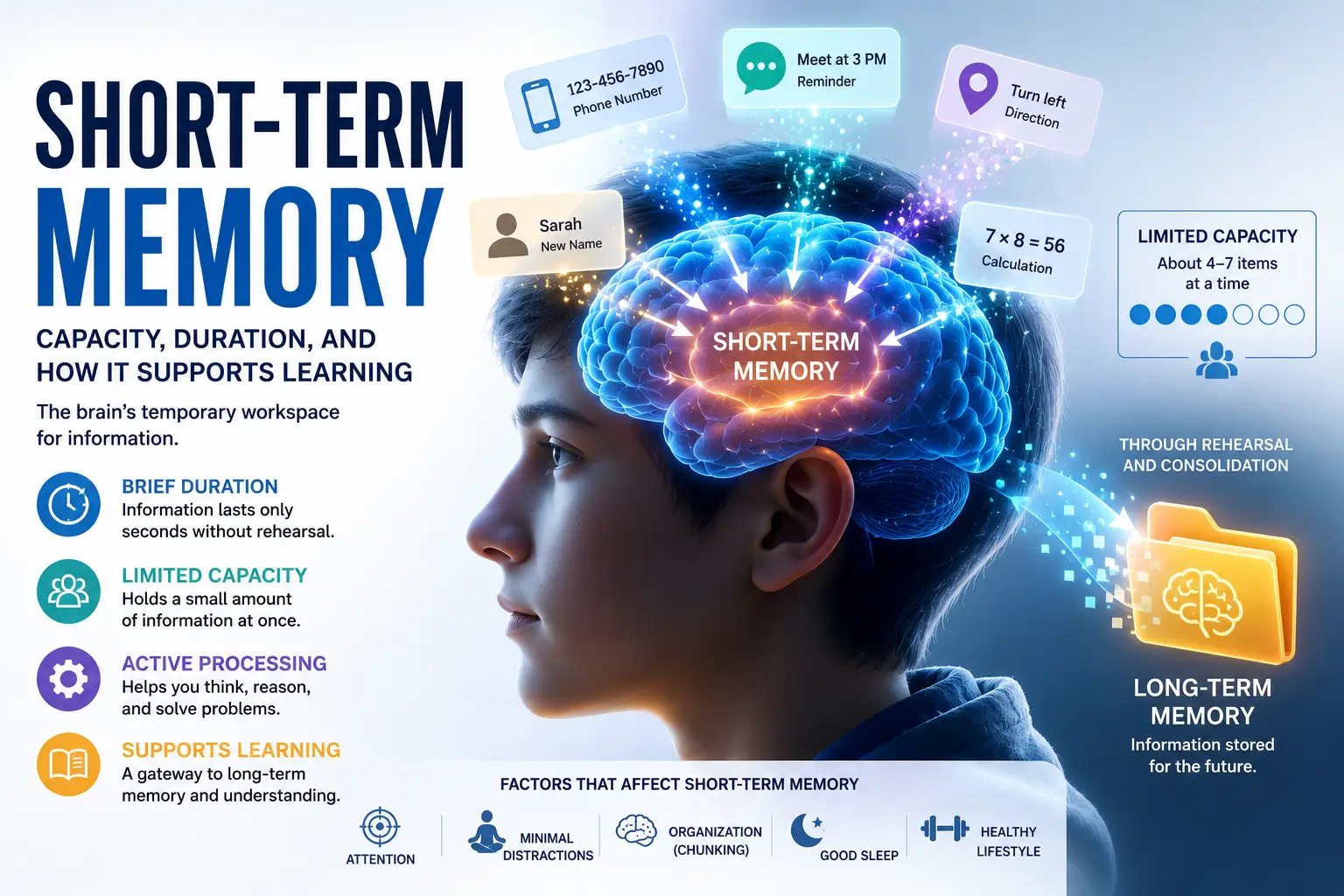
Short-term memory acts as a temporary holding area for information.
It allows the brain to retain information for immediate use before it is either forgotten or transferred to more durable memory systems.
Understanding how short-term memory works can help explain why people forget information so quickly and how effective learning strategies overcome these limitations.
What Is Short-Term Memory?
Before information reaches short-term memory, it is briefly registered in sensory memory, which captures incoming visual and auditory input for an instant.
Short-term memory is a temporary memory system that stores information for a brief period of time.
Its primary function is to keep information available long enough for immediate use.
Unlike Long-Term Memory, which can retain information for years, short-term memory operates on a much shorter timescale.
Information may remain available for only seconds unless it is actively maintained.
This temporary storage helps support many everyday cognitive activities.
Why Short-Term Memory Matters
Although its duration is limited, short-term memory is essential for daily functioning.
People rely on it constantly when:
- Following instructions
- Reading text
- Performing calculations
- Remembering names briefly
- Holding information during conversations
- Making decisions
Short-term memory provides the temporary mental space needed to process incoming information.
Without it, learning and comprehension would become much more difficult.


🔬 The Science Behind Short-Term Memory
Research suggests that short-term memory functions as a temporary storage system with limited capacity and duration.
Information can be maintained briefly through attention and rehearsal, but without reinforcement it is often forgotten quickly.
Short-term memory is considered one of the foundational components of human cognition because it supports learning, reasoning, and information processing.
Source: https://www.ncbi.nlm.nih.gov/books/NBK547689/
Short-term memory keeps information available long enough for the brain to use it.
How Long Does Short-Term Memory Last?
One of the defining characteristics of short-term memory is its limited duration.
Without active rehearsal, information often disappears within seconds.
This explains why a phone number may be forgotten moments after hearing it.
The brain constantly receives new information.
Short-term memory helps manage that information temporarily before it is replaced or transferred elsewhere.
How Much Information Can Short-Term Memory Hold?
Short-term memory is also limited in capacity.
Researchers have long observed that people can only maintain a relatively small number of items simultaneously.
When too much information enters the system at once, performance often declines.
This limitation helps explain why information overload can interfere with learning.
It is also one of the reasons techniques such as Chunking are so effective.
Short-Term Memory vs Long-Term Memory
Short-term memory and long-term memory serve different functions.
Short-term memory focuses on temporary storage.
Long-term memory focuses on durable retention.
For example:
- Remembering a verification code briefly uses short-term memory.
- Remembering your childhood address uses long-term memory.
These systems work together continuously.
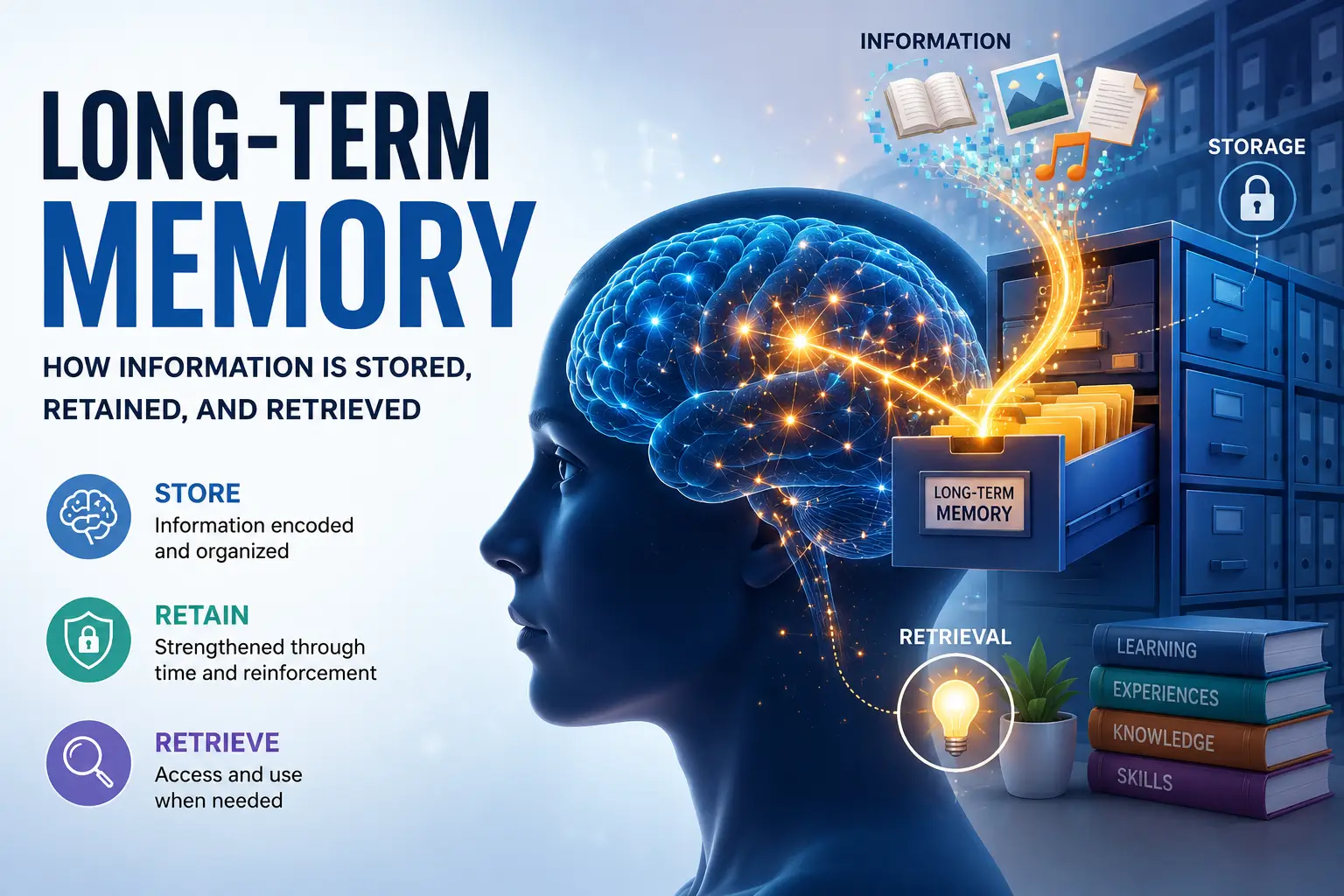
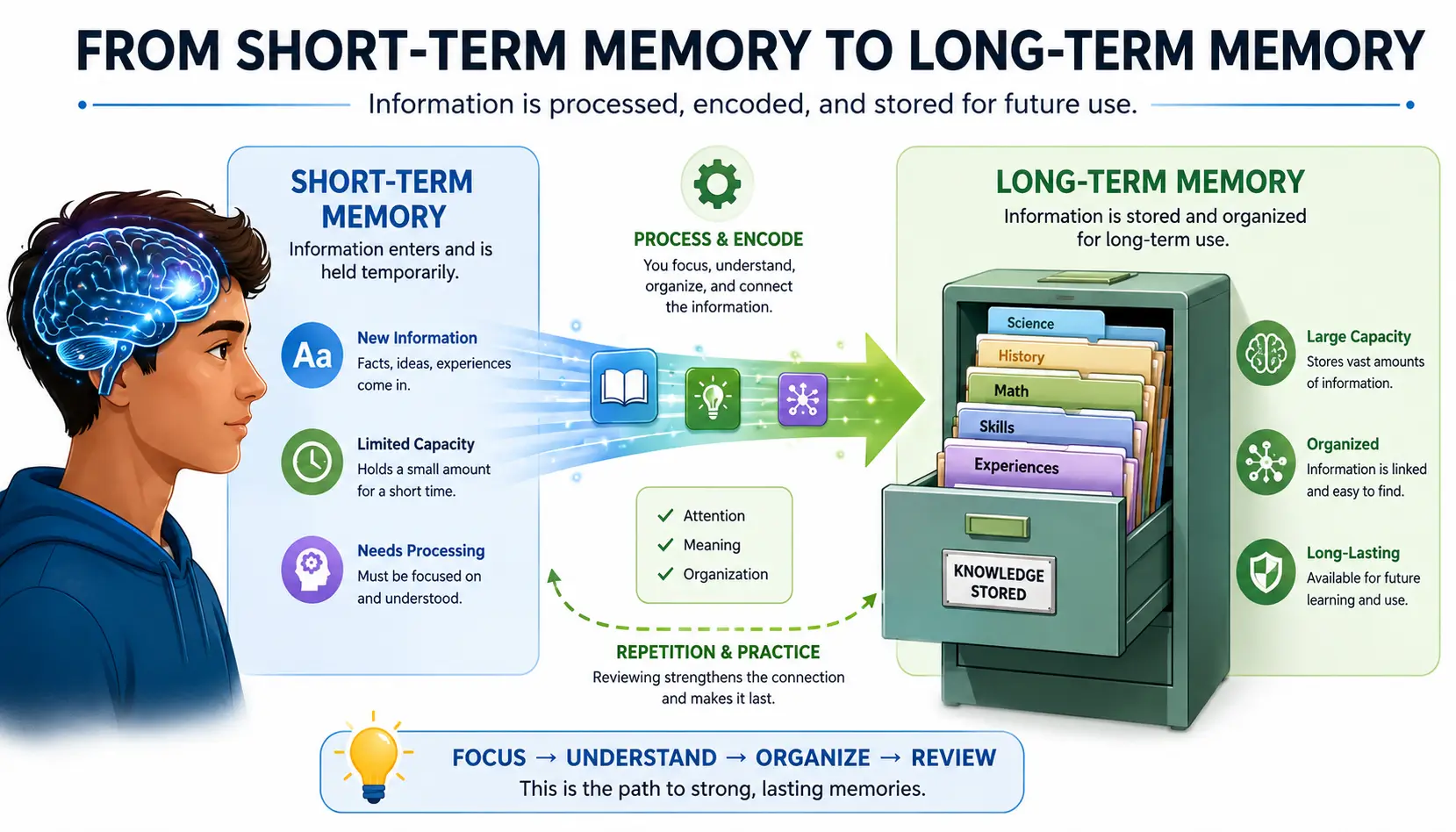
Information often begins in short-term memory before moving into Long-Term Memory.
Short-Term Memory vs Working Memory
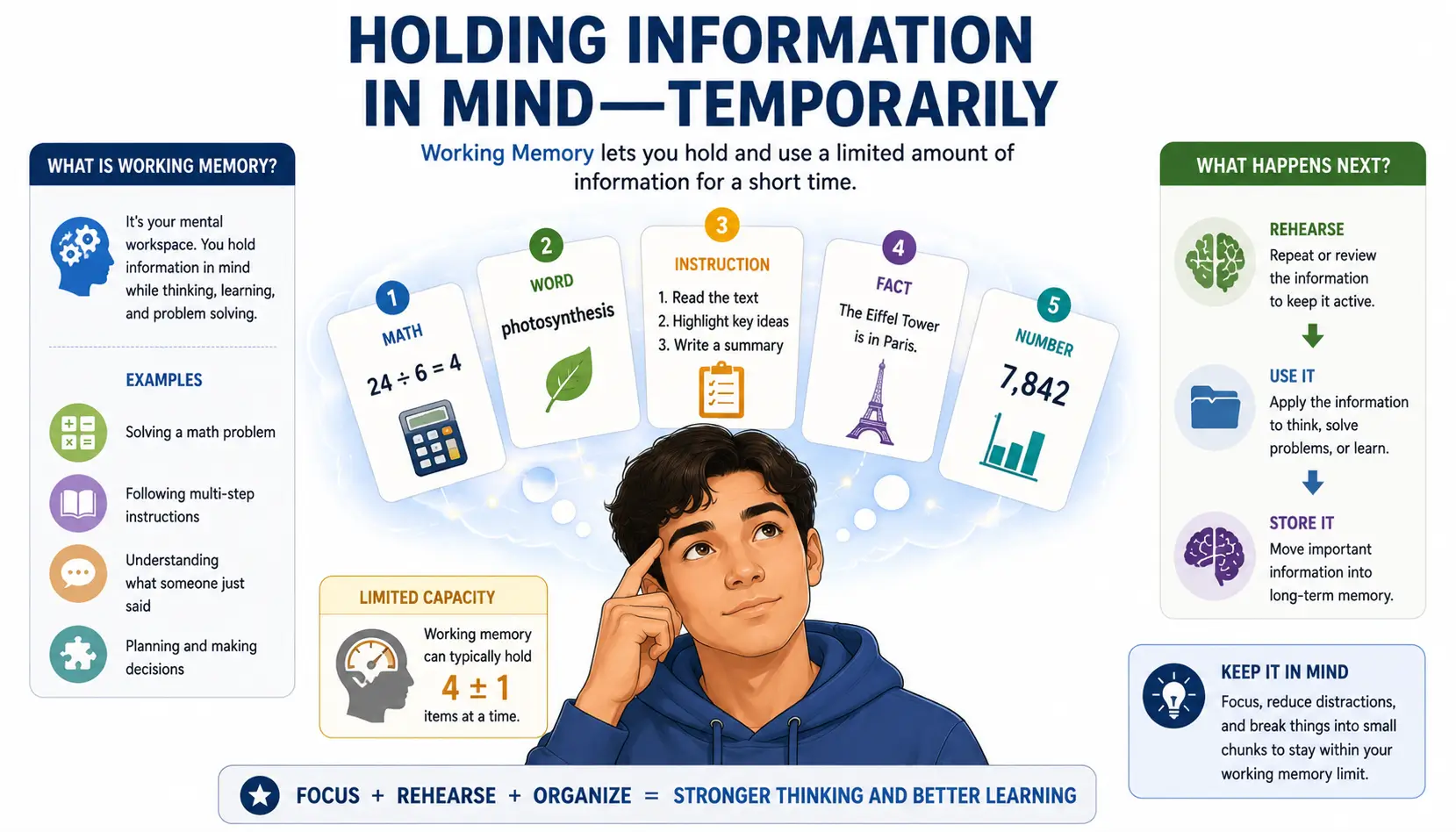
Although closely related, short-term memory and Working Memory are not identical.
Short-term memory primarily stores information temporarily.
Working memory not only stores information but also actively manipulates it.
For example:
- Remembering a number uses short-term memory.
- Mentally reversing that number uses working memory.
This distinction is important because many complex learning activities depend on working memory rather than simple storage alone.
How Information Moves Beyond Short-Term Memory
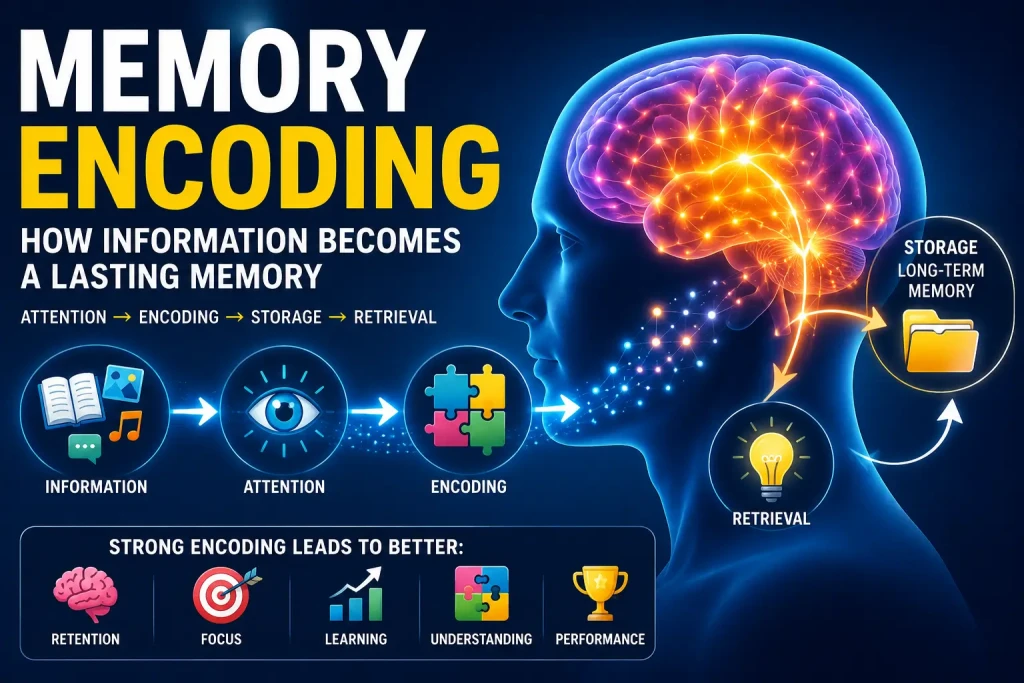
For temporary information to become more durable, it must first undergo memory encoding, which transforms input into a form the brain can store.
Information stored briefly is not guaranteed to become a lasting memory.
For information to remain available in the future, additional processing is often required.
This is where Memory Consolidation becomes important.
Consolidation helps stabilize information and support its transfer into long-term memory systems.
Without consolidation, many experiences would simply fade away.
Why We Forget So Quickly
Forgetting is a natural consequence of short-term memory’s design.
The system was not created to store information permanently.
Instead, it functions as a temporary workspace that prioritizes immediate needs.
As new information arrives, older information is often displaced.
This constant turnover helps explain why temporary memories are so fragile.
How Short-Term Memory Supports Learning
Short-term memory serves as a gateway for learning.
Before information can become lasting knowledge, it typically passes through temporary memory systems first.
When learners pay attention to new information, short-term memory helps keep that information available for processing.
This temporary storage allows the brain to evaluate, organize, and connect ideas before deciding what should be retained.
Without short-term memory, effective learning would be extremely difficult.
Cognitive Load and Short-Term Memory
One reason learning sometimes feels overwhelming is that short-term memory has limited capacity.
When too much information is presented at once, the system becomes overloaded.
This idea forms the foundation of Cognitive Load Theory.
According to cognitive load theory, learning improves when information is organized in ways that respect the limits of human memory.
Reducing unnecessary complexity helps preserve mental resources for meaningful learning.
How Chunking Improves Short-Term Memory
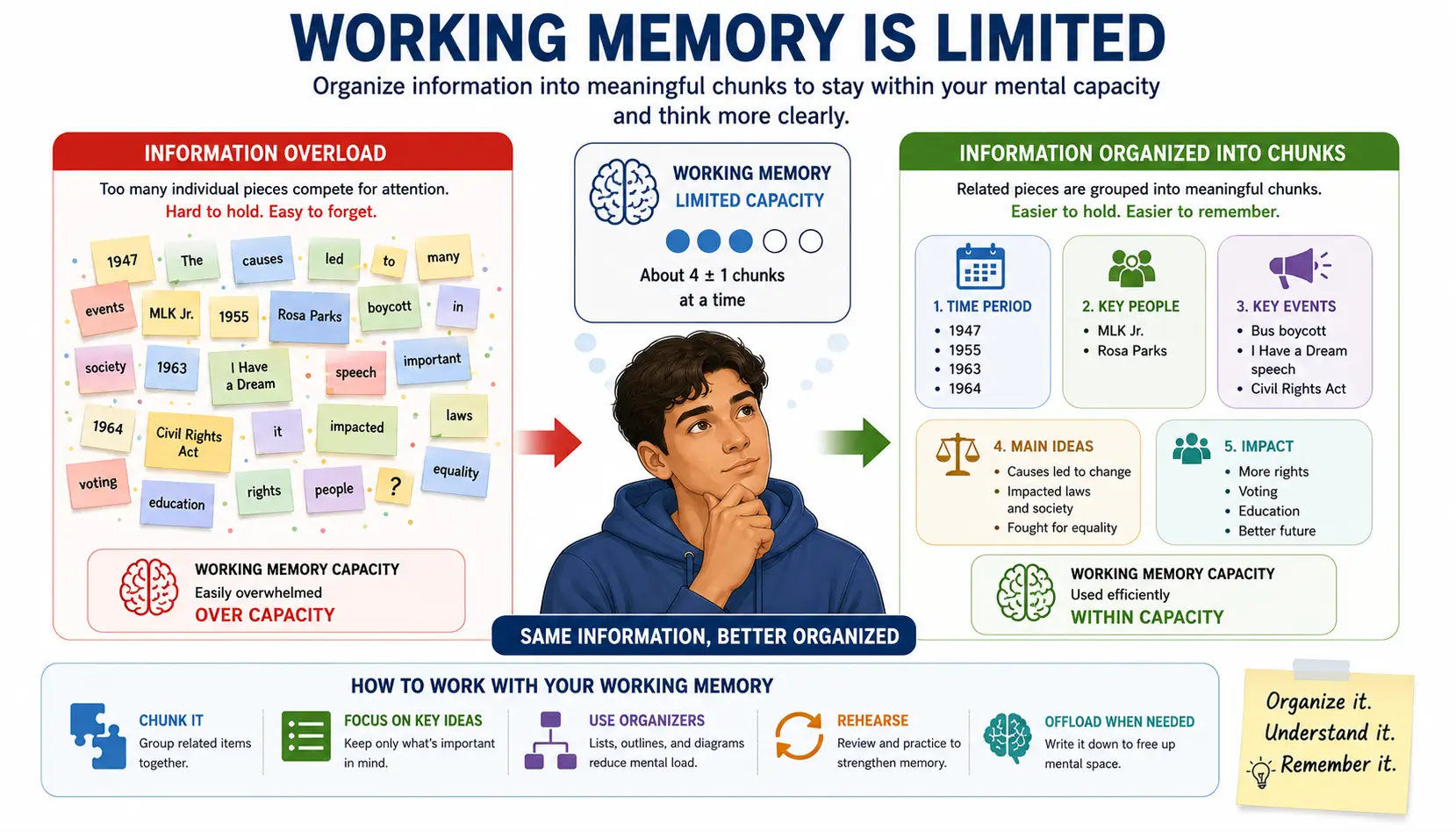
One of the most effective ways to overcome memory limitations is through Chunking.
Chunking involves grouping multiple pieces of information into larger meaningful units.
For example:
- Remembering 1-9-4-5-2-0-2-6 individually is difficult.
- Remembering 1945 and 2026 as two meaningful chunks is easier.
Chunking allows learners to use short-term memory more efficiently.
This is one reason experts often appear to remember far more information than beginners.
They organize information into meaningful structures.
The Relationship Between Attention and Short-Term Memory
Because distraction quickly disrupts temporary storage, many of the same principles also apply to how to focus on studying during demanding learning tasks.
Attention and short-term memory are closely connected.
Information that never receives attention rarely enters memory successfully.
Likewise, distractions can quickly interfere with temporary storage.
Maintaining focus helps protect information while it is being processed.
This is one reason multitasking often reduces learning efficiency.
Divided attention creates competition for limited cognitive resources.
Can Short-Term Memory Be Improved?
While capacity limits are largely part of normal human cognition, people can often improve performance through better learning habits.
Strategies that support short-term memory include:
- Reducing distractions
- Using chunking techniques
- Taking organized notes
- Practicing active recall
- Improving sleep quality
- Managing cognitive load
These approaches help maximize the effectiveness of temporary memory systems.
Short-Term Memory and Active Recall
Many learners associate memory improvement with long-term retention.
However, Active Recall also supports the transition from short-term memory into long-term storage.
Each retrieval attempt encourages deeper processing.
The more actively information is used, the more likely it is to survive beyond temporary storage.
Retrieval helps transform fragile information into durable knowledge.
Short-Term Memory and Long-Term Memory Work Together
Short-term memory is not an isolated system.
It works continuously alongside Long-Term Memory.
New information enters temporary storage.
Previously learned knowledge is retrieved from long-term memory.
Together, these systems support comprehension, learning, reasoning, and decision-making.
Effective learning depends on the interaction between both systems.
Supporting Memory Beyond Temporary Storage
Short-term memory is only one part of a much larger cognitive system.
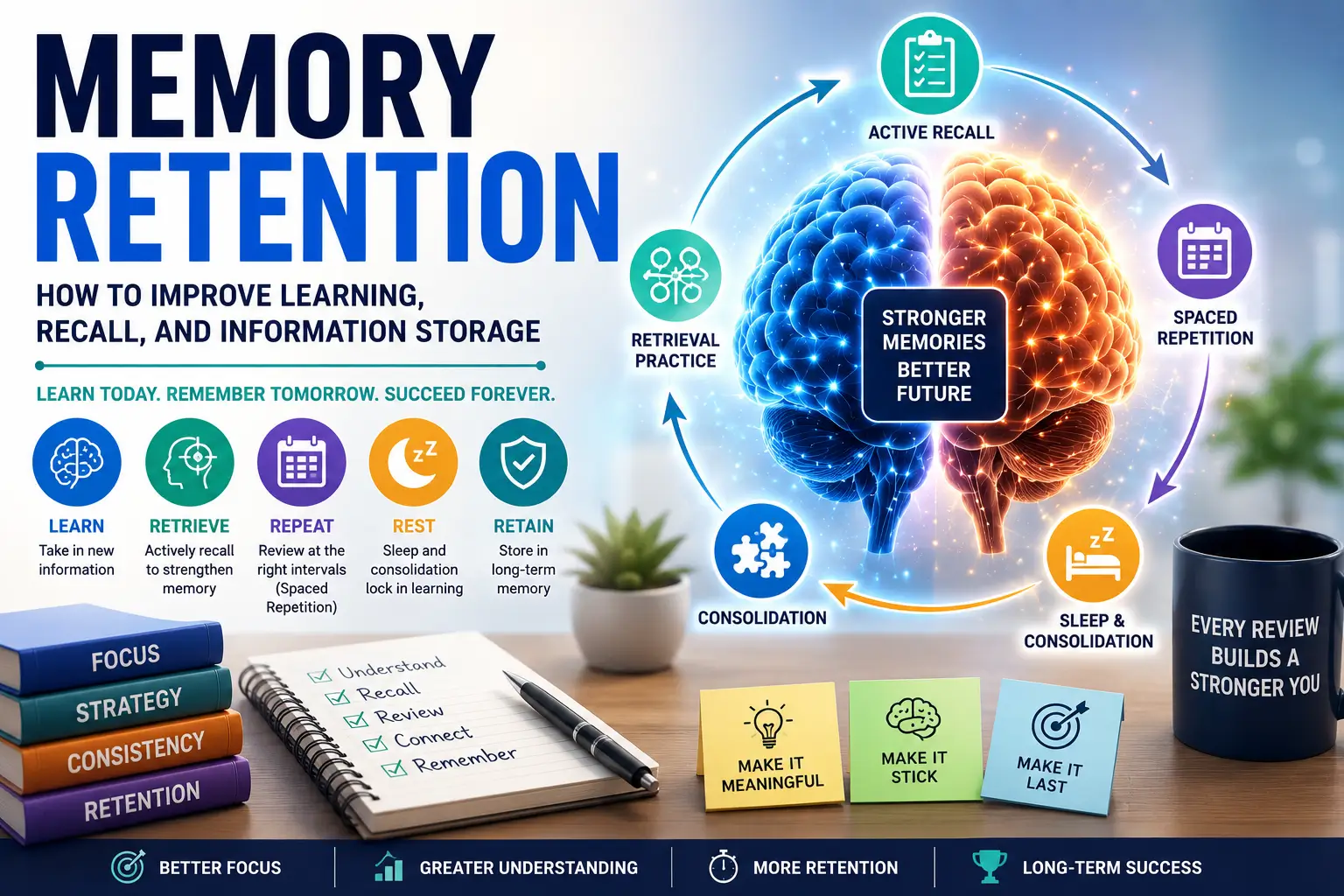
Long-term retention depends on additional factors such as consolidation, retrieval practice, sleep, and overall cognitive health.
Many learners combine evidence-based learning strategies with broader approaches that support long-term brain performance.
Readers interested in memory-supportive nutritional strategies can learn more about Advanced Memory Formula.
The Brain’s Temporary Workspace
If you want the bigger picture of how short-term storage connects to encoding, consolidation, retrieval, and forgetting, start with the complete guide to memory.
Short-term memory may be limited, but it is essential.
It provides the temporary workspace needed for learning, reasoning, communication, and decision-making.
Although information remains there only briefly, that brief period is often the first step toward lasting knowledge.
Every long-term memory begins as information held temporarily in short-term memory.
Understanding these limitations can help learners use more effective strategies, reduce cognitive overload, and improve overall learning performance.