
Now Reading: Autobiographical Memory Explained: How Personal Experiences Shape Identity and Recall
-
01
Autobiographical Memory Explained: How Personal Experiences Shape Identity and Recall
Autobiographical Memory Explained: How Personal Experiences Shape Identity and Recall

Most people can instantly remember certain moments from their lives.
A first day at school. A graduation ceremony. A family vacation. A difficult breakup. A major achievement.
These memories often feel different from ordinary facts and information.
You may forget a phone number within minutes, yet vividly remember an important life event from years ago.
This ability comes largely from a memory system known as autobiographical memory.
Autobiographical memory allows people to remember experiences from their own lives. It helps create a personal history, supports a sense of identity, and connects past experiences to present decisions.
Without autobiographical memory, life would feel less like a continuous story and more like a collection of disconnected moments.
Researchers consider autobiographical memory one of the most important memory systems because it influences learning, relationships, emotional development, and self-understanding throughout life.

What Is Autobiographical Memory?
Autobiographical memory refers to memories about your own life.
It includes experiences you have personally lived through, as well as important knowledge about yourself.
Examples include:
- Your first day at university
- A memorable vacation
- Your wedding day
- A childhood birthday party
- Your first job interview
- An important conversation
These memories are different from general knowledge.
Knowing that Paris is the capital of France involves semantic memory.
Remembering your trip to Paris involves autobiographical memory.
In other words, autobiographical memory focuses on events that happened to you personally.
Why Autobiographical Memory Matters
Autobiographical memory does much more than preserve personal stories.
It plays a major role in how people understand themselves.
When you think about your past experiences, you begin to build a sense of identity.
You remember challenges you overcame, mistakes you learned from, and achievements that shaped your confidence.
These experiences help answer questions such as:
- Who am I?
- How did I become this person?
- What experiences influenced my values?
- What lessons have I learned from the past?
For this reason, autobiographical memory is often considered a foundation of personal identity.


Autobiographical Memory and Episodic Memory
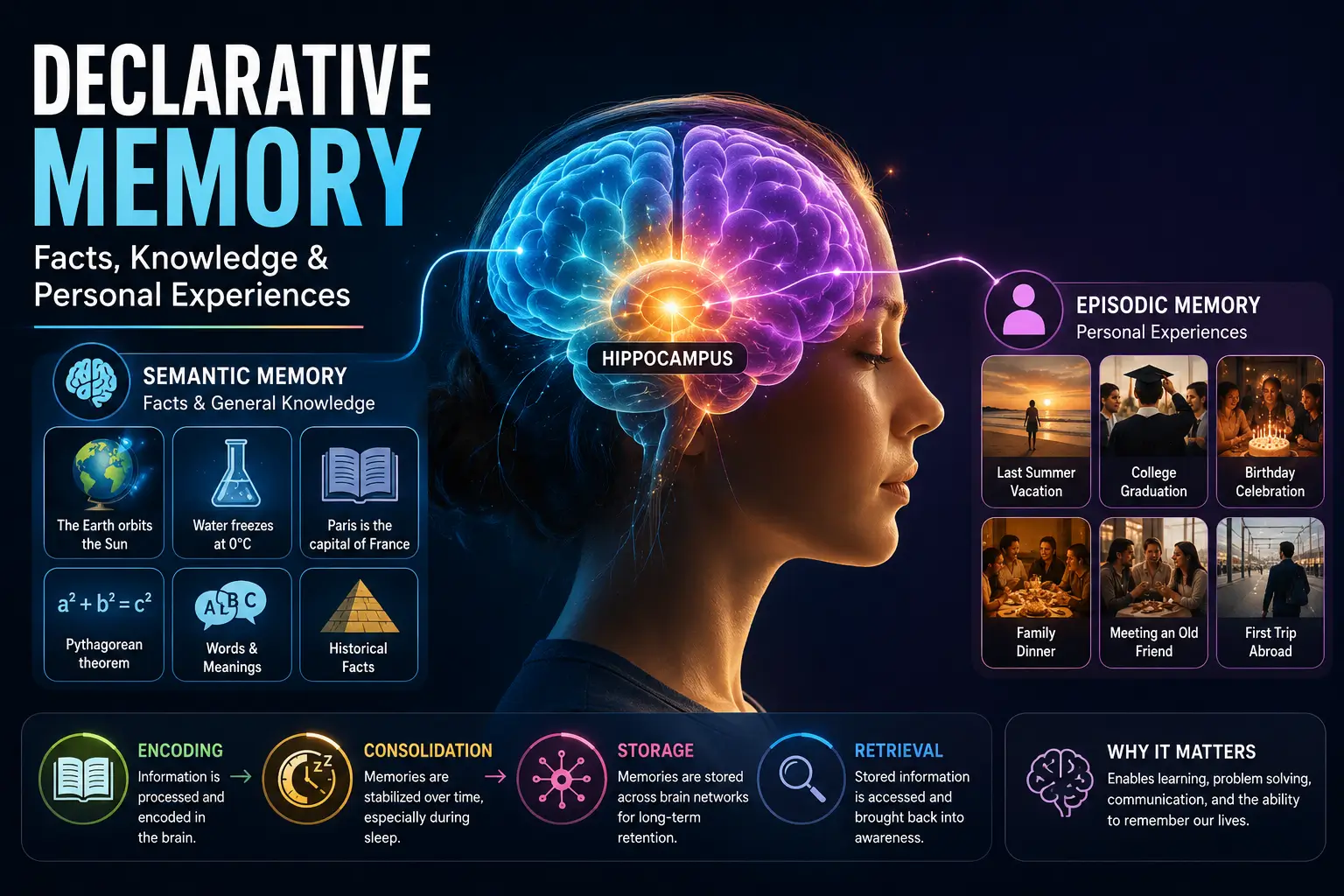
Autobiographical memory is closely related to episodic memory, but the two terms are not identical.
Episodic memory refers to specific events that occurred at a particular time and place.
Autobiographical memory is broader.
It includes both individual experiences and personal knowledge accumulated across a lifetime.
For example:
- Remembering your graduation ceremony is episodic memory.
- Knowing which university you attended is autobiographical knowledge.
Together, these memories help create a coherent life story.
The Two Main Components of Autobiographical Memory
Researchers typically describe autobiographical memory as containing two major components.
Personal Experiences
This component contains specific life events.
These memories often include details about:
- Where something happened
- When it happened
- Who was involved
- What emotions were experienced
- What was seen, heard, or felt
These experiences form many of the memories people associate with their personal history.
Personal Knowledge
Autobiographical memory also contains information about yourself that is not tied to one particular event.
Examples include:
- Your date of birth
- Your hometown
- The schools you attended
- Your profession
- The places you have lived
This information becomes part of the larger narrative people maintain about their lives.
How Autobiographical Memories Are Formed
Like other forms of long-term memory, autobiographical memories develop through a series of cognitive processes.
The process often begins when an event captures attention and receives meaningful processing.
Information about the experience is then encoded into memory.
Readers interested in this stage can explore Memory Encoding.
Once encoded, the memory must be stabilized through memory consolidation.
During consolidation, neural pathways become stronger and the memory becomes more resistant to forgetting.
Sleep plays a particularly important role during this stage.
Research consistently shows that adequate sleep supports the formation and stabilization of long-term memories.
Why Emotional Events Are Often Easier to Remember
Emotion has a powerful influence on autobiographical memory.
Events associated with strong emotions are often remembered more vividly than ordinary experiences.
A surprise celebration, a major achievement, or a stressful life event may remain accessible for years because emotional arousal strengthens memory formation.
This relationship helps explain why people often remember emotionally significant experiences in remarkable detail.
In some cases, highly emotional events can produce flashbulb memories, which are vivid recollections of important moments.
However, vivid memories are not always perfectly accurate.
Even emotionally powerful memories can change over time.
Why We Remember Some Experiences and Forget Others
Not every life event becomes a lasting autobiographical memory.
Many experiences are forgotten within days, weeks, or months, while others remain accessible for decades.
Researchers have identified several factors that increase the likelihood of long-term retention.
These include:
- Emotional significance
- Personal importance
- Novelty
- Attention during the event
- Repeated recall
- Social discussion
Events that combine several of these factors often become some of the most memorable moments in a person’s life.
This is one reason major life milestones tend to remain accessible for many years.
Childhood Amnesia: Why Early Memories Are Rare
Most adults can remember very little from the first few years of life.
This phenomenon is known as childhood amnesia.
Although young children are constantly learning, many early experiences fail to become stable autobiographical memories that can later be recalled in adulthood.
Researchers believe several factors contribute to childhood amnesia.
- Ongoing brain development
- Immature memory systems
- Limited language abilities
- An incomplete sense of self
As children grow and develop a stronger understanding of themselves and the world around them, autobiographical memory becomes increasingly organized and accessible.
Autobiographical Memories Can Change Over Time
Many people assume that autobiographical memories function like recordings stored in the brain.
Research suggests memory works differently.
When people remember an event, they reconstruct it using stored information, current knowledge, emotions, and expectations.
As a result, memories can sometimes change.
Small details may be forgotten, altered, or unintentionally replaced with new information.
This does not mean memory is unreliable.
Instead, it reflects the flexible nature of human cognition.
Readers interested in this topic may enjoy Memory Reconsolidation Explained: How Recalled Memories Can Change.
Each time a memory is retrieved, it becomes temporarily vulnerable to modification before being stored again.
How Retrieval Cues Trigger Personal Memories
Personal relevance also shapes recall, which is why the Self-Reference Effect is a strong related concept for understanding why self-linked information is often easier to remember.
Autobiographical memories are often activated by retrieval cues.
A retrieval cue is anything that helps bring a stored memory back into awareness.
Examples include:
- A familiar song
- An old photograph
- A particular scent
- A meaningful location
- A conversation with a friend
Many people have experienced a situation where a song instantly brings back memories from years earlier.
Others may revisit a childhood location and suddenly remember events they had not thought about in decades.
These experiences demonstrate the power of retrieval cues and the Encoding Specificity Principle.

How Autobiographical Memory Influences Daily Life
For a wider overview of how autobiographical memory fits into the full memory system, read the Complete Guide to Memory.
Autobiographical memory affects far more than storytelling.
People rely on past experiences when making decisions, solving problems, and navigating social situations.
Personal memories help individuals evaluate risks, anticipate outcomes, and learn from previous successes and failures.
For example, someone who previously struggled during an important exam may adjust their study habits in the future.
Likewise, positive experiences often encourage people to repeat behaviors that produced successful outcomes.
In this way, autobiographical memory helps transform experience into practical knowledge.
Autobiographical Memory and Identity
Perhaps the most important function of autobiographical memory is its role in creating a sense of identity.
People often think of themselves through the stories they tell about their lives.
Memories provide continuity between the past, present, and future.
They help explain:
- Where we came from
- What we have experienced
- What we value
- How we have changed over time
Without autobiographical memory, maintaining a stable sense of self would become extremely difficult.
This is why researchers frequently describe autobiographical memory as one of the foundations of personal identity.
Can Autobiographical Memory Be Strengthened?
Although people cannot control every aspect of memory formation, several habits may support stronger autobiographical memory.
- Paying attention during important experiences
- Reflecting on meaningful events
- Discussing experiences with others
- Maintaining healthy sleep habits
- Keeping journals or personal records
- Practicing regular retrieval
Journaling is particularly interesting because it encourages both reflection and retrieval.
Revisiting important experiences can strengthen memory traces and make future recall easier.
Sleep also remains one of the most important factors supporting long-term memory formation.
Scientific Research on Autobiographical Memory
Research suggests autobiographical memory contributes to many aspects of human cognition, including identity formation, emotional regulation, social interaction, and future planning.
Scientists have also discovered that some of the same brain regions involved in remembering the past become active when people imagine future events.
This finding suggests autobiographical memory may help individuals mentally simulate possible futures using experiences from the past.
Rather than serving as a simple archive, autobiographical memory appears to function as a dynamic system that helps people learn, adapt, and make decisions throughout life.
Readers interested in supporting memory performance through both evidence-based learning strategies and nutritional support can learn more about Advanced Memory Formula.
FAQ
What is autobiographical memory?
Autobiographical memory is the memory system responsible for storing personal life experiences, events, and self-related knowledge.
How is autobiographical memory different from episodic memory?
Episodic memory refers to specific personal events, while autobiographical memory includes both those events and broader knowledge about one’s life.
Why are emotional experiences easier to remember?
Emotion often increases attention and strengthens memory consolidation, making emotionally significant events more likely to be remembered.
Why can’t most adults remember their earliest childhood experiences?
This phenomenon is called childhood amnesia and is thought to result from the ongoing development of memory systems during early childhood.
Can autobiographical memories change over time?
Yes. Research shows that memories are reconstructed during recall and can be modified whenever they are retrieved and reconsolidated. This reconstructive process can also contribute to memory distortion, where remembered details differ from the original experience.
Related Topics
- Episodic Memory Explained: How Your Brain Stores Personal Experiences
- Declarative Memory Explained: How the Brain Stores Facts, Knowledge, and Personal Experiences
- Flashbulb Memory: Why Emotional Events Feel So Vivid and Unforgettable
- Memory Reconsolidation Explained: How Recalled Memories Can Change
Scientific Sources
https://www.ncbi.nlm.nih.gov/books/NBK547682/
https://www.apa.org/topics/memory
https://www.frontiersin.org/articles/10.3389/fpsyg.2018.01734/full