
Now Reading: Attention Span Explained: How Long Can the Brain Stay Focused?
-
01
Attention Span Explained: How Long Can the Brain Stay Focused?
Attention Span Explained: How Long Can the Brain Stay Focused?

You open your laptop intending to finish one important task. A notification appears. You check it for a few seconds, return to your work, remember an email you meant to answer, notice another browser tab, and somehow find yourself reading something completely unrelated.
Ten minutes have passed.
You were technically sitting in front of the same task the entire time, yet your attention was somewhere else for much of it.
Experiences like this have helped create a popular belief that modern humans have extremely short attention spans. You may even have encountered claims that the average human attention span has fallen to eight seconds—supposedly making it shorter than that of a goldfish.
There is a problem with that comparison: human attention does not work like a simple countdown timer.
There is no universal number of seconds after which the brain automatically stops paying attention. A person may struggle to concentrate on an uninteresting presentation for several minutes yet remain absorbed in a novel, video game, conversation, hobby, or complex work project for much longer.
To understand attention span, we therefore need to ask a better question than simply, “How long can humans focus?”
We need to understand what attention actually is, why it fluctuates, what causes it to fail, and what allows the brain to sustain concentration when something matters.
Quick Answer
Attention span generally describes how long a person can maintain attention on a task or stimulus before attention significantly shifts or performance declines. There is no scientifically established universal human attention span. How long someone can remain focused depends on factors including the task, motivation, cognitive load, fatigue, sleep, distractions, emotional state, age, and individual differences.
What Is Attention Span?
Attention span is an informal term used to describe the length of time a person can maintain attention toward a particular activity, thought, or stimulus.
In cognitive psychology, however, researchers usually examine attention through more specific processes rather than treating “attention span” as one single mental ability.
One of the most relevant is sustained attention: the ability to maintain goal-directed attention over time.
Imagine proofreading a long document for small errors. At the beginning, you may notice mistakes quickly. After twenty or thirty minutes, however, your mind may begin wandering and subtle errors become easier to miss.
Researchers can study this change in performance by measuring reaction times, missed targets, false responses, and variability in behavior across time.
This provides something much more useful than asking someone how long they feel capable of concentrating.
Attention is also not an isolated system. Maintaining concentration requires coordination among several cognitive processes, including:
- selecting relevant information,
- suppressing distractions,
- maintaining goals in working memory,
- detecting important changes,
- monitoring performance,
- and redirecting attention when the mind wanders.
This is why attention can fail in several different ways. Sometimes an external distraction captures it. Sometimes thoughts generated internally pull it away. Sometimes fatigue reduces vigilance. And sometimes the brain simply determines that another stimulus is more important than the task currently being performed.
How Long Is the Human Attention Span?
This seemingly simple question does not have a single scientifically defensible answer.
You will sometimes see exact figures claiming that humans can focus for 8 seconds, 10 minutes, 20 minutes, or 45 minutes. These numbers can sound authoritative, but they often combine very different definitions of attention and very different experimental conditions.
Consider two situations.
In the first, you are monitoring a repetitive screen for a rare visual signal during a laboratory experiment.
In the second, you are watching the final twenty minutes of a close championship game involving your favorite team.
Both require attention, but the motivational significance, stimulation, predictability, emotional involvement, and cognitive demands are completely different.
Assigning both situations the same fixed “attention span” would tell us very little about how the brain actually works.
The “8-Second Attention Span” Myth
One of the most persistent claims on the internet is that humans now have an average attention span of approximately eight seconds, supposedly shorter than a goldfish.
This comparison should not be treated as an established finding of cognitive science.
Attention researchers do not generally define human attention as a single eight-second capacity, and comparing human sustained attention with an alleged goldfish attention span oversimplifies both human cognition and animal behavior.
The popularity of the statistic demonstrates something important about science communication: a memorable number can spread much faster than the complicated evidence behind the subject.
Expert Insight
When you encounter a claim that humans have a precise attention span—whether it is 8 seconds, 12 minutes, or another fixed number—the first question should be: attention to what? Sustained attention during a monotonous vigilance task is fundamentally different from attention during reading, conversation, gaming, studying, driving, or a personally meaningful activity. Context is not a minor detail; it is central to understanding attention.


Attention Is Dynamic, Not a Stopwatch
A more accurate model treats attention as a dynamic allocation of limited cognitive resources.
Your brain is continuously evaluating incoming information.
Is something changing?
Is there a possible reward?
Is something dangerous?
Has the current task become predictable?
Is an unresolved thought competing for attention?
Should cognitive resources remain where they are or move somewhere else?
What we experience as “losing focus” can therefore represent several different processes.
Your attention may be captured by a notification. Your mind may wander toward tomorrow’s responsibilities. Fatigue may reduce your ability to maintain task goals. Or prolonged repetition may make the current activity less stimulating, increasing the probability that unrelated thoughts enter awareness.
This distinction matters because improving attention is not simply a matter of forcing yourself to stare at something for longer.
The real goal is to create conditions that allow the brain to maintain useful engagement with the task.
A Real-World Example: Studying for an Exam
Imagine two university students studying the same chapter for forty minutes.
The first student keeps a phone beside the textbook. Messages appear every few minutes. Several browser tabs remain open. Music with lyrics plays in the background, and the student occasionally checks social media.
The second student puts the phone in another room, closes unrelated tabs, defines one specific learning objective, and periodically tests what has been learned using retrieval practice.
Both students can later say:
“I studied for forty minutes.”
But elapsed time tells us very little about the quality of attention during those forty minutes.
The important variable is not simply how long someone sits in front of information. It is how consistently cognitive resources remain aligned with the learning goal.
This is one reason attention and memory are so closely connected. Information that receives insufficient attention is less likely to be encoded effectively in the first place.
What Happens in the Brain When You Focus?
Attention does not reside in a single “focus center.” Instead, sustained concentration emerges from interactions among distributed brain networks.
Several regions are especially important.
Prefrontal Cortex
The prefrontal cortex contributes to goal maintenance, planning, behavioral control, and the regulation of competing responses.
When you decide to finish a report despite incoming distractions, prefrontal systems help maintain the task goal and organize behavior around it.
Parietal Cortex
Regions of the parietal cortex help orient attention toward relevant sensory information and prioritize particular locations or stimuli.
This becomes especially important when the environment contains far more information than the brain can process in detail simultaneously.
Anterior Cingulate Cortex
The anterior cingulate cortex is involved in monitoring conflict and performance. When competing responses arise—for example, continuing to study versus checking an incoming notification—control systems help detect and manage that competition.
Thalamus and Sensory Filtering
The thalamus plays an important role in coordinating and routing sensory information. Attention can influence which incoming signals receive priority for further processing.
Together, these systems allow the brain to amplify relevant information while reducing the influence of competing stimuli.

Why Attention Naturally Fluctuates
Even under ideal conditions, attention is not perfectly stable.
Research on sustained attention consistently shows that performance can fluctuate over time. During demanding or monotonous tasks, reaction times may become more variable, errors may increase, and periods of mind wandering may occur.
This phenomenon is often described as a vigilance decrement: a decline in the ability to detect important signals during prolonged monitoring.
But this does not mean the brain simply “runs out” of attention at a predetermined minute.
Performance reflects an interaction between task demands, arousal, motivation, fatigue, expectations, rewards, and the effort required to maintain cognitive control.
That is why you may struggle through ten minutes of an unengaging task in the afternoon but spend an hour deeply absorbed in a challenging activity that feels meaningful.
The brain’s capacity for attention is constrained—but the way those constraints appear depends heavily on context.
Attention Span vs. Concentration
The terms attention span and concentration are often used interchangeably, but they are not quite identical.
Attention span generally refers to the duration over which attention can be maintained, whereas concentration describes the intensity and stability of mental focus directed toward a task.
A person can therefore spend an hour “working” while repeatedly switching attention every few minutes. The duration is long, but concentration is fragmented.
Conversely, ten minutes of uninterrupted, highly focused problem solving may involve much stronger concentration despite lasting for less time.
This distinction will become especially important when we examine smartphones, notifications, multitasking, sleep, stress, and the modern digital environment.
What Actually Reduces Attention Span?
When people feel that their attention span has become shorter, they often assume something is permanently wrong with their ability to focus.
Usually, the situation is more complicated.
Attention is highly sensitive to the conditions in which the brain is operating. Sleep loss, stress, interruptions, boredom, excessive cognitive load, and constant task switching can all make sustained attention more difficult—even when the underlying capacity to focus remains intact.
This distinction is important.
A distracted brain is not necessarily a brain that has lost its ability to concentrate. Sometimes the environment is simply creating too much competition for limited cognitive resources.
Smartphones, Notifications, and Constant Interruptions
Modern digital environments create something previous generations rarely experienced: a nearly continuous stream of opportunities to redirect attention.
A smartphone can simultaneously contain messages, email, news, social media, entertainment, games, work applications, shopping, and notifications from dozens of services.
Each one represents a potential competing goal.
The problem is not necessarily the phone itself. The greater issue is the repeated interruption of sustained cognitive activity.
Imagine writing a difficult report.
You formulate an argument, hold several ideas in working memory, and begin connecting them into a coherent paragraph.
Then your phone vibrates.
You read the message for fifteen seconds and return to the document.
The interruption was brief—but the cognitive cost may last longer than the interruption itself.
You now need to reconstruct what you were thinking, retrieve the previous goal, and restore the mental context that existed before your attention shifted.
Repeat this process twenty times during an afternoon and the result can feel like an inability to concentrate, even though the deeper problem is fragmented attention.
Expert Insight
A useful way to think about digital distraction is not simply “screen time versus no screen time.” The more relevant question is how frequently an activity forces you to abandon one cognitive context and construct another. Ten uninterrupted minutes on a screen may place very different demands on attention than ten minutes containing fifteen switches between messages, social media, email, and work.
Multitasking Is Usually Task Switching
People often describe themselves as multitaskers, but many activities labeled as multitasking actually involve rapid task switching.
The brain may alternate between writing an email, reading a message, checking a spreadsheet, and returning to the email so quickly that the process feels simultaneous.
But attention has repeatedly changed targets.
Each switch requires cognitive control.
The brain must disengage from one goal, activate another, retrieve the relevant rules and information, and then repeat the process when returning to the original task.
This creates what researchers commonly call a switch cost.
For simple activities, the cost may be small. But when tasks require complex reasoning or substantial working memory, frequent switching can reduce speed and increase mistakes.
A Real-World Example: The Fragmented Workday
Consider an employee preparing a financial presentation.
During one hour, the employee:
- works on the presentation for six minutes,
- answers a message,
- returns to the presentation,
- checks email,
- opens a document requested by a colleague,
- returns to the presentation,
- responds to another notification,
- and checks the calendar.
At the end of the hour, the employee may genuinely feel mentally exhausted.
But exhaustion does not necessarily mean sixty minutes of intense concentration occurred.
Much of the cognitive effort may have been spent repeatedly reconstructing task context.
This helps explain why eliminating unnecessary interruptions can sometimes improve productivity without increasing total working time.
Mind Wandering: When the Distraction Comes From Inside
Not every distraction comes from a smartphone, noisy office, or browser notification.
Sometimes the brain distracts itself.
You may be reading a page and suddenly realize that your eyes have moved across several paragraphs while your thoughts were somewhere completely different.
Perhaps you were thinking about dinner.
Or tomorrow’s meeting.
Or a conversation from three days ago.
This phenomenon is known as mind wandering.
Mind wandering is extremely common and should not automatically be treated as a cognitive failure. Internally directed thought can contribute to planning, creativity, autobiographical reflection, and problem solving.
The difficulty arises when internal thoughts repeatedly replace attention during a task that requires sustained external focus.
For students, this can create an especially deceptive problem.
A student may spend forty minutes reading a chapter while encoding surprisingly little information because attention repeatedly drifted away from the material.
Again, time-on-task and attention-on-task are not the same thing.
Sleep and Attention Span
Sleep is one of the most important variables affecting sustained attention.
When sleep is insufficient, people often experience slower reactions, greater variability in performance, reduced vigilance, and more frequent lapses of attention.
This matters because people do not always accurately perceive the extent of their own impairment.
Someone may feel capable of continuing to work while objective performance has already begun deteriorating.
The consequences become particularly important during activities where even brief lapses matter, such as driving, operating machinery, or monitoring safety-critical systems.
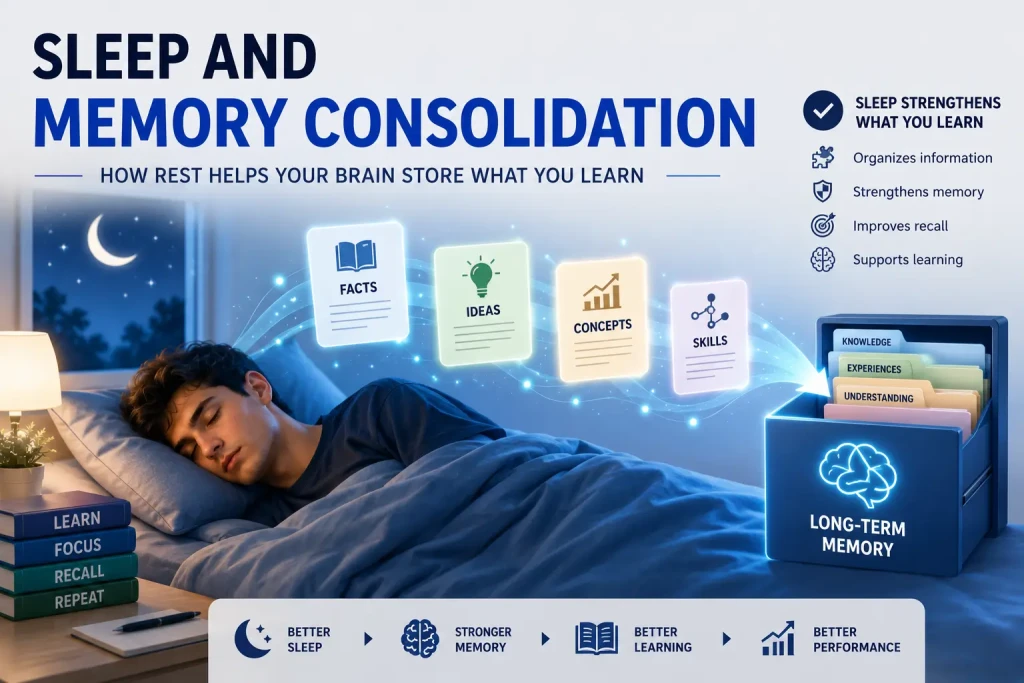
Sleep also connects attention directly to memory.
Effective learning requires information to receive sufficient attention during encoding. Sleep subsequently contributes to the consolidation of newly acquired memories. Consistently sacrificing sleep to gain additional study time can therefore interfere with more than one stage of learning.
Stress, Anxiety, and Competing Thoughts
Stress can sometimes sharpen attention temporarily, particularly when a threat requires immediate action.
But persistent stress can have the opposite effect.
Imagine attempting to study while waiting for the outcome of an important medical test, financial decision, job interview, or relationship conversation.
The book may be directly in front of you, yet part of your cognitive system repeatedly returns to the unresolved concern.
Working memory now has competition.
Instead of devoting its limited capacity entirely to the study material, the brain must also manage intrusive thoughts, emotional responses, and uncertainty.
This is one reason concentration difficulties during stressful periods should not automatically be interpreted as evidence of a permanently shortened attention span.
Boredom and Motivation
Attention is also influenced by how rewarding, meaningful, and challenging a task feels.
This explains an apparent contradiction many people experience:
“I can’t concentrate for twenty minutes while studying, but I can play a game for two hours.”
The contradiction largely disappears once attention is understood as dynamic rather than fixed.
Video games, sports, conversations, and engaging stories often provide frequent feedback, changing goals, novelty, uncertainty, and rewards.
A repetitive textbook chapter may provide far fewer immediate signals of progress.
That does not prove that the person’s brain has a twenty-minute attention limit.
It shows that motivation and task structure influence how readily attention is maintained.
Cognitive Load: When the Task Is Simply Too Demanding
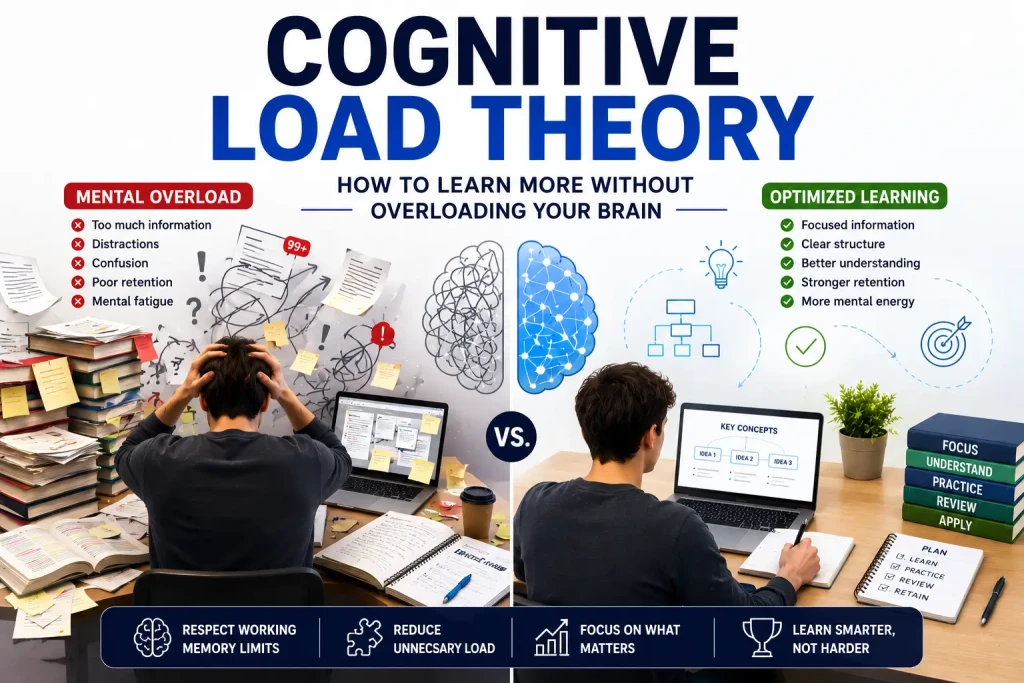
Sometimes concentration fails because too much information is competing for limited working-memory capacity.
Consider someone learning algebra for the first time.
If the learner must simultaneously remember a new formula, interpret unfamiliar symbols, understand instructions, perform calculations, and keep several intermediate results in mind, the cognitive burden can become overwhelming.
Once working memory becomes overloaded, attention may appear unstable because the learner repeatedly loses track of the task.
This is where cognitive load becomes important.
Breaking complex information into meaningful stages, mastering foundational concepts first, and removing irrelevant information can make sustained attention considerably easier.
In other words, improving concentration sometimes requires changing the task rather than trying harder.
Does Attention Span Change With Age?
Attention develops throughout childhood and continues changing across the lifespan, but age does not produce a simple linear “attention span” measured in minutes.
Children
Children are still developing executive-control systems that help maintain goals, resist distractions, and regulate behavior.
Younger children may therefore require shorter activities, greater variation, clearer feedback, and more external structure than adults.
However, children’s attention also varies dramatically depending on interest, familiarity, task difficulty, sleep, and environment.
Adolescents and Young Adults
Executive control continues developing through adolescence and into early adulthood. At the same time, academic demands increase and digital environments introduce more opportunities for interruption.
This makes it particularly important to distinguish developmental changes in attention from environmental patterns that repeatedly fragment attention.
Older Adults
Healthy aging can affect processing speed and some aspects of attentional control. Older adults may find certain situations involving multiple competing stimuli more demanding.
Yet experience and expertise can compensate substantially in familiar contexts.
An older expert may outperform a younger novice in a specialized task because decades of accumulated knowledge reduce the cognitive effort required to interpret relevant information.
Age therefore influences attention, but it does not determine a universal attention-span countdown.
Attention Span and Working Memory
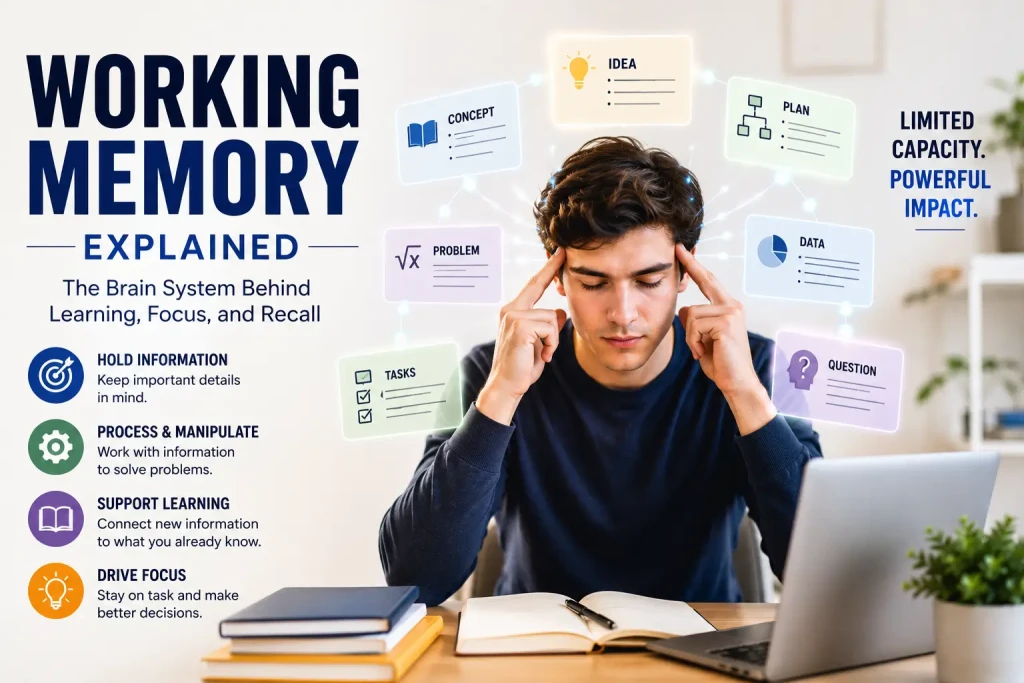
Attention and working memory are closely interconnected.
Working memory temporarily maintains information that is currently relevant to a task. Attention helps determine which information enters and remains active within that limited workspace.
Imagine calculating 37 × 14 mentally.
You need to retain intermediate values while continuing the calculation. If a notification interrupts you at the wrong moment, those temporary representations may disappear, forcing you to restart.
This interaction helps explain why interruptions are especially damaging during tasks involving reasoning, writing, mathematics, programming, and complex learning.
The more information you must actively maintain, the greater the potential cost of losing the current cognitive context.
Attention Span and Memory Formation
Attention also plays a fundamental role in memory encoding.
People sometimes describe forgetting information they never adequately attended to in the first place.
Imagine meeting someone at a crowded event.
They tell you their name while you are simultaneously thinking about what to say next, listening to another conversation, and looking for someone across the room.
Thirty seconds later, you cannot remember the name.
It may feel like a memory failure.
But the problem may have occurred earlier: the name never received enough focused processing to form a strong memory trace.
This distinction is crucial for learning.
Improving memory is not only about strengthening storage and retrieval. Sometimes the first intervention should be improving the quality of attention during encoding.
Practical Takeaway
Before concluding that your memory is poor, ask whether the information received focused attention when you first encountered it. Re-reading material while repeatedly checking notifications can create the illusion of studying without providing the stable attention needed for strong encoding.
This connection between attention, working memory, and long-term memory leads to a more useful question than “How long is my attention span?”
How can we design work and learning so that attention remains stable for longer—and what does scientific evidence actually suggest can improve focus?
That is where we go next.
Can You Improve Your Attention Span?
Attention is not a fixed resource that you either possess or lack.
Although individual differences matter, the conditions surrounding attention can be changed. Sleep, task structure, environmental distractions, practice, physical activity, and the way work is organized can all influence how successfully attention is maintained.
This means that improving attention is usually less about discovering a single “brain hack” and more about reducing unnecessary competition for cognitive resources.
A useful starting point is to stop asking:
“How can I force myself to concentrate longer?”
and instead ask:
“What repeatedly causes my attention to leave this task?”
That shift matters because different causes require different solutions.
If sleep deprivation is reducing vigilance, blocking social media will not solve the underlying problem. If notifications interrupt working memory every three minutes, drinking more coffee may simply produce a more alert but equally interrupted brain.
Improving attention therefore begins with identifying the bottleneck.
1. Remove Distractions Before They Require Self-Control
One of the most practical ways to protect sustained attention is surprisingly simple: make unnecessary distractions harder to access.
Imagine trying to write while your phone sits beside the keyboard.
Even if you successfully resist checking it, every notification or visual cue creates another opportunity for attention to shift.
A more effective strategy is environmental design.
- Put the phone outside immediate reach.
- Disable nonessential notifications.
- Close unrelated browser tabs.
- Use full-screen mode for demanding work.
- Keep only the materials required for the current task visible.
- Choose a quieter environment when possible.
None of these strategies increases the biological capacity of attention directly.
Instead, they reduce the number of competing signals demanding access to it.
This distinction is important because sustained focus becomes easier when the environment requires fewer acts of inhibition.
Expert Insight
Many productivity systems treat distraction as a failure of discipline. Cognitive science suggests a more useful approach: reduce the number of situations in which discipline is required. Designing an environment with fewer competing cues can be more reliable than repeatedly asking the brain to suppress attractive alternatives.
2. Work in Focused Blocks
Long periods of uninterrupted concentration can become increasingly difficult as fatigue accumulates.
For this reason, dividing demanding work into focused blocks separated by brief breaks can be useful.
The important point is that there is no scientifically established perfect interval for everyone.
Twenty-five minutes may work well for one person. Another may prefer forty-five minutes. Someone deeply engaged in a complex project may remain productive considerably longer.
The ideal block depends on:
- task difficulty,
- experience,
- motivation,
- fatigue,
- environment,
- and individual preference.
Rather than stopping automatically when a timer reaches an arbitrary number, pay attention to meaningful changes in performance.
Are you rereading the same paragraph?
Are errors increasing?
Are you repeatedly thinking about unrelated things?
Are you switching tabs without a clear reason?
These may be better signals that a short break is useful.
Does the Pomodoro Technique Improve Attention?
The Pomodoro Technique typically divides work into 25-minute periods followed by short breaks.
It can be useful, particularly for people who struggle to begin tasks or who benefit from clearly defined work periods.
But the familiar 25-minute interval should not be interpreted as proof that humans possess a 25-minute attention span.
The primary benefit of a structured timer may instead come from creating boundaries around work and distraction.
A timer says, in effect:
“For this period, I am doing one thing.”
That commitment can reduce impulsive task switching.
For highly demanding work, experiment with the duration rather than treating 25 minutes as a biological rule.
3. Take Breaks That Actually Interrupt the Task
Not every break provides the same kind of recovery.
Suppose you finish forty minutes of demanding work and immediately spend your five-minute break rapidly scrolling through social media.
You stopped working, but your brain is still processing a dense stream of changing information.
A different break might involve:
- standing up,
- walking briefly,
- looking away from the screen,
- drinking water,
- stretching,
- or simply allowing a few minutes without additional information.
The goal is not to create elaborate rituals. It is to temporarily reduce the demands associated with the primary task.
4. Protect Your Sleep
If someone wants to improve sustained attention, sleep deserves far more attention than most productivity tricks.
Insufficient sleep can impair vigilance, reaction time, working memory, and executive control. Even brief lapses become important when a task requires continuous monitoring.
For students, the tradeoff is especially relevant.
Staying awake several extra hours may create additional study time, but those hours can become progressively less productive as attention deteriorates. Sleep also contributes to memory consolidation after learning.
In other words, sleep supports both sides of the learning process:
- the ability to pay attention while information is being learned,
- and the stabilization of memories afterward.
5. Use Physical Activity to Support Cognitive Performance
Physical activity is usually discussed in relation to cardiovascular health, weight management, and physical fitness, but it is also associated with brain health and cognitive performance.
Research examining acute exercise has found that a single period of physical activity can influence aspects of executive function and attention, although effects vary according to exercise intensity, timing, fitness level, age, and the cognitive task being measured.
Regular physical activity is also associated with broader long-term benefits for cognitive health.
This does not mean that a short walk magically creates hours of concentration.
But for someone who has been sitting for several hours and experiencing increasing mental fatigue, movement can be a more sensible reset than adding another hour of passive screen time.
6. Train Yourself to Notice Mind Wandering
One challenge with mind wandering is that people often do not immediately realize it is happening.
You may read half a page before suddenly noticing that you cannot explain what you just read.
The useful skill is not eliminating every unrelated thought. That is unrealistic.
Instead, it is developing the ability to notice when attention has moved and deliberately return it to the intended target.
Mindfulness practices are interesting in this context because many involve exactly this cycle:
focus → notice distraction → redirect attention.
Research on mindfulness and attention has produced promising findings, but effects vary across studies, populations, training methods, and outcome measures. Mindfulness should therefore be viewed as one possible attention-training tool rather than a guaranteed cure for poor concentration.
7. Make Passive Learning More Active
Attention becomes particularly fragile during passive learning.
Reading page after page without interacting with the material provides few opportunities to determine whether attention has drifted.
Active learning changes that.
Instead of simply rereading, a student can periodically stop and ask:
- What was the main idea?
- Can I explain this without looking?
- How does this connect with something I already know?
- What would a test question about this section look like?
- Which part do I still not understand?
These questions force attention back toward the material while simultaneously engaging memory retrieval.
A Real-World Example: Two Hours of Studying
Imagine Student A spending two hours rereading lecture notes while periodically checking a phone.
Student B studies for less total time but works in distraction-reduced blocks, closes the notes periodically, recalls the main concepts from memory, and takes short breaks when performance begins declining.
Student A accumulated more study minutes.
Student B may have accumulated more high-quality cognitive engagement.
This is why measuring study success purely by hours can be misleading.
Attention quality matters.
8. Match Task Difficulty to Your Current Capacity
Tasks that are far too easy can produce boredom.
Tasks that are overwhelmingly difficult can produce frustration and cognitive overload.
Both conditions encourage disengagement.
Attention is often easier to maintain when a task is challenging enough to require active involvement but structured enough that progress remains possible.
For learning, this may mean mastering foundational concepts before attempting advanced problems.
For work, it may mean dividing a vague project into concrete actions.
“Work on presentation” creates an ambiguous goal.
“Write the three-slide explanation of the quarterly revenue change” creates a much clearer attentional target.
9. Use Caffeine Strategically, Not as a Substitute for Sleep
Caffeine can increase alertness and reduce feelings of fatigue, which can improve performance on some attention and vigilance tasks.
However, more is not necessarily better.
Excessive caffeine can produce restlessness, anxiety, sleep disruption, or physical discomfort—conditions that may themselves interfere with concentration.
Timing also matters.
Using caffeine late enough to disrupt sleep can create an unhelpful cycle:
poor sleep → daytime fatigue → more caffeine → poorer sleep.
Caffeine is therefore better understood as a temporary alertness aid than a replacement for adequate recovery.
10. Music Can Help—or Hurt—Depending on the Task
There is no universal “best music for concentration.”
Its effect depends partly on what you are doing.
For repetitive or familiar work, background music may improve mood or make the task feel less monotonous.
For language-heavy tasks such as reading difficult material or writing, music containing lyrics may compete with verbal processing for some people.
Individual differences also matter considerably.
The practical approach is therefore experimental rather than ideological.
Compare your actual performance under different conditions:
- silence,
- instrumental music,
- ambient sound,
- and music with lyrics.
Choose the environment that produces better comprehension and fewer errors—not simply the one that feels most productive.
Does Social Media Permanently Destroy Attention Span?
Claims that social media has permanently “destroyed” the human attention span go beyond what current evidence can establish.
There are reasonable concerns about digital environments that encourage frequent switching, rapid novelty, and repeated notifications. Heavy or problematic technology use can also coexist with sleep disruption and other factors associated with poorer cognitive performance.
But association does not automatically establish that social media has permanently damaged an individual’s attention system.
Usage patterns matter enormously.
Someone who watches a forty-minute educational lecture on a phone is having a fundamentally different attentional experience from someone switching between dozens of short videos, messages, and applications during the same period.
The better target is therefore not necessarily “screens.”
It is uncontrolled fragmentation of attention.
What About a “Dopamine Detox”?
The idea of a dopamine detox has become popular online, often accompanied by claims that avoiding smartphones, games, entertainment, or other rewarding activities can “reset dopamine” and restore attention.
This description is biologically misleading.
Dopamine is an essential neurotransmitter involved in learning, motivation, movement, reward processing, and many other functions. The brain cannot simply be detoxed from dopamine in the way the phrase implies.
However, some behaviors promoted under the dopamine-detox label may still be practically useful for a completely different reason.
If a person temporarily removes notifications, compulsive checking, and highly distracting activities, they may create longer periods of uninterrupted attention.
The benefit does not require a fictional dopamine reset.
It can be explained much more simply:
fewer interruptions create better conditions for sustained focus.
Expert Insight
Be cautious when neuroscience terminology is used to make ordinary behavioral advice sound more scientific. Turning off notifications may genuinely help concentration. You do not need to claim that it “resets dopamine receptors” to explain why. Good cognitive advice should remain useful even after exaggerated neuroscience language is removed.
Can Attention Be Trained?
People can certainly become better at performing specific attention-demanding tasks through practice.
The more difficult question is whether training one particular attention exercise produces large improvements across completely unrelated areas of life.
Evidence for broad transfer is much less straightforward.
Becoming excellent at a computerized attention task does not automatically mean someone will become dramatically better at studying, driving, reading, or resisting smartphone distractions.
This is why practical attention improvement should focus on the environments and behaviors where concentration actually matters.
If the goal is to read complex material more effectively, practice focused reading.
If the goal is to study better, combine distraction control with retrieval practice and appropriate breaks.
If the goal is deeper work, practice increasingly longer periods of uninterrupted work on meaningful tasks.
Evidence Summary: What Actually Seems to Matter?
When the research on attention is viewed as a whole, several conclusions are more defensible than the idea of discovering one universal concentration trick.
- There is no single scientifically established attention-span duration that applies to every person and every task.
- Attention is highly context dependent. Motivation, task difficulty, fatigue, emotional state, and environmental distractions all matter.
- Frequent task switching can impair efficiency, particularly when complex tasks require information to remain active in working memory.
- Sleep is fundamental. Productivity strategies cannot fully compensate for inadequate sleep and reduced vigilance.
- Removing unnecessary interruptions can protect sustained attention without requiring extraordinary willpower.
- Breaks can be useful, but there is no universally optimal focus-to-break ratio.
- Physical activity supports overall cognitive health and can influence aspects of attention and executive function.
- Mindfulness may help some aspects of attentional control, although results vary and exaggerated claims should be avoided.
- Active learning is generally more cognitively engaging than passive exposure.
- Popular claims about eight-second attention spans and dopamine detoxes oversimplify the science.
The larger lesson is surprisingly practical.
Improving attention is rarely about forcing the brain to concentrate indefinitely.
It is about protecting a limited cognitive system from unnecessary competition, giving it adequate recovery, and structuring tasks so that attention has a clear reason to remain engaged.
In the final section, we’ll examine when attention problems may represent something more than ordinary distraction, distinguish attention span from ADHD, answer the most common questions about focus, connect this topic with the broader MemoryPerformanceLab knowledge base, and review the scientific evidence behind the article.
Short Attention Span vs. ADHD: They Are Not the Same Thing
One of the most important misconceptions surrounding attention is the assumption that difficulty concentrating automatically means someone has attention-deficit/hyperactivity disorder (ADHD).
It does not.
Everyone experiences periods of poor concentration. Sleep deprivation, stress, anxiety, boredom, interruptions, emotional concerns, difficult tasks, and environmental distractions can temporarily make sustained attention much harder.
ADHD is different. It is a neurodevelopmental disorder involving persistent patterns of inattention and/or hyperactivity-impulsivity that interfere with functioning.
Importantly, ADHD cannot be determined by measuring how many minutes someone can concentrate.
There is no single “attention span test” that diagnoses ADHD.
Diagnosis involves a broader assessment of symptoms, their history, their impact on everyday functioning, and whether other conditions could better explain the difficulties.
Someone who frequently checks a phone while studying therefore should not conclude, “My attention span is short, so I must have ADHD.” Likewise, someone who can concentrate intensely on certain activities should not assume that ADHD is impossible.
If persistent attention difficulties are significantly interfering with school, work, relationships, or everyday responsibilities, discussing them with a qualified healthcare professional is more appropriate than attempting to self-diagnose from an online attention-span number.
Is There a Normal Attention Span by Age?
Search online and you will find charts claiming that a two-year-old should concentrate for a particular number of minutes, a ten-year-old for another number, and an adult for considerably longer.
These charts can appear precise, but they should be interpreted cautiously.
Attention develops during childhood, and older children generally become better at regulating behavior and maintaining goal-directed attention. However, there is no simple formula that converts age into a universally correct attention-span duration.
A child’s ability to remain engaged depends heavily on what the child is doing.
A seven-year-old may disengage rapidly from a repetitive worksheet yet remain absorbed much longer while constructing something, drawing, playing a game, listening to an interesting story, or completing an activity matched to their skill level.
The same principle applies to adults.
Age matters, but so do motivation, sleep, task difficulty, cognitive load, environment, interest, emotional state, and individual differences.
Expert Insight
Treat age-based attention-span charts as rough educational heuristics rather than biological countdown timers. Human attention is too context-dependent to be summarized reliably by a rule such as “age multiplied by X minutes.” Observing whether someone can sustain appropriate attention across different real-world situations is considerably more informative than comparing them with one arbitrary number.
Common Mistakes That Make Concentration Harder
Many attempts to improve attention focus on adding something: another productivity application, supplement, playlist, timer, or concentration technique.
Often the larger opportunity is removing behaviors that repeatedly destabilize attention.
Keeping Every Notification Enabled
Notifications deliberately compete for attention.
If an activity requires deep concentration, allowing every application to request immediate attention creates unnecessary cognitive competition.
Confusing Time Spent With Focused Work
Three hours sitting at a desk does not necessarily represent three hours of concentrated work.
A shorter session containing fewer interruptions can sometimes produce substantially more meaningful progress.
Trying to Work Through Severe Fatigue
When vigilance is deteriorating because of inadequate sleep, adding more working hours can produce diminishing returns.
Sleep is not wasted time removed from cognitive performance. It is one of the biological processes supporting that performance.
Using Breaks for More Cognitive Stimulation
Switching from a difficult document to a rapidly changing social-media feed technically changes activities, but it may not provide much relief from information processing.
Some breaks are more restorative when they actually reduce stimulation for a few minutes.
Expecting Perfect Concentration
Mind wandering is part of normal cognition.
The realistic goal is not uninterrupted attention every waking minute. It is becoming better at recognizing distraction and returning to the intended task before a brief lapse becomes twenty minutes of unrelated activity.
Searching for One Perfect Focus Interval
There is no universally optimal 20-, 25-, 45-, or 90-minute attention block.
Useful focus duration changes with the task and the person performing it.
A Practical Framework for Better Focus
If sustained attention has become difficult, start with the fundamentals before experimenting with complicated productivity systems.
- Define one task. Replace vague goals such as “study” with a concrete objective such as “learn and recall the five mechanisms in this chapter.”
- Remove obvious competing cues. Silence unnecessary notifications and close unrelated applications.
- Work uninterrupted for a realistic period. Choose a duration appropriate to the task rather than obeying an arbitrary universal number.
- Notice performance, not just the clock. Repeated rereading, errors, impulsive switching, and persistent mind wandering may indicate that attention is deteriorating.
- Take a genuine break when useful. Move, stretch, rest your eyes, or briefly step away from incoming information.
- Protect sleep and recovery. Do not expect productivity techniques to compensate fully for chronic fatigue.
- Make learning active. Retrieval, explanation, problem solving, and practice provide stronger attentional targets than endless passive rereading.
This framework is intentionally simple.
Good attention management is often less about maximizing concentration every second and more about repeatedly creating conditions in which meaningful concentration can occur.
What Attention Span Really Tells Us About the Brain
The popular image of attention as a mental fuel tank misses something important.
The brain is constantly deciding what deserves processing priority.
A notification may become important because it signals social information. A sudden sound receives priority because it might indicate danger. An unresolved concern repeatedly returns because the brain considers it relevant. A difficult problem demands working-memory resources because the solution has not yet become automatic.
Attention therefore reflects competition.
What we call a “short attention span” can sometimes be better understood as a situation in which too many internal and external signals are competing successfully against the intended task.
This perspective changes the solution.
Instead of attempting to become someone who can force unlimited concentration, we can reduce unnecessary competition, improve recovery, choose clearer goals, and structure difficult tasks around the actual limitations of human cognition.
Evidence Summary
Research on sustained attention provides a more nuanced picture than popular claims about shrinking human attention spans.
- Human attention does not have one universal duration. Sustained attention depends strongly on task characteristics and context.
- Performance can decline with time on task. Vigilance research demonstrates increasing response variability and attentional lapses during prolonged tasks.
- Sleep deprivation reliably impairs vigilant attention. The effect can become increasingly important across repeated sleep restriction.
- Switching tasks carries cognitive costs. Returning to a complex task is not always instantaneous or cost-free.
- Attention and working memory interact closely. Interruptions can be particularly disruptive when information must remain actively available.
- Mindfulness is not a guaranteed attention enhancer. Research findings vary, and meta-analytic evidence does not support treating it as a universal solution.
- Ordinary distractibility is not equivalent to ADHD. ADHD diagnosis requires a broader clinical evaluation rather than a single measure of concentration.
- Environmental design matters. Reducing avoidable interruptions can improve the conditions required for sustained attention without changing the brain’s fundamental capacity.
Frequently Asked Questions About Attention Span
What is the average human attention span?
There is no scientifically established average attention span that applies universally across tasks and people. How long attention can be maintained depends on factors such as task difficulty, motivation, sleep, fatigue, distractions, cognitive load, and individual differences.
Is the human attention span really eight seconds?
No strong scientific evidence establishes eight seconds as a universal human attention span. The popular claim that humans now have a shorter attention span than goldfish oversimplifies how attention is measured and should not be treated as an established cognitive-science finding.
How long can the brain stay focused?
There is no fixed limit. People can sometimes remain engaged for extended periods when a task is meaningful or stimulating, while attention may deteriorate much sooner during repetitive or demanding activities. Performance rather than an arbitrary number of minutes is a better indicator.
Can attention span be improved?
The conditions supporting sustained attention can often be improved. Adequate sleep, fewer interruptions, appropriate breaks, physical activity, active learning, clear task goals, and reducing unnecessary task switching can all support better concentration.
Does social media shorten attention span?
Digital environments can encourage frequent switching and expose users to repeated interruptions, but saying that social media permanently destroys the human attention span goes beyond the evidence. How technology is used matters considerably.
Does ADHD mean someone has a short attention span?
ADHD can involve persistent difficulties regulating attention, but it is much broader than simply being unable to concentrate for a particular number of minutes. Diagnosis considers patterns of symptoms, developmental history, impairment across daily life, and other possible explanations.
What is the difference between attention span and selective attention?
Attention span generally refers to maintaining attention over time. Selective attention describes prioritizing relevant information while filtering competing stimuli. The two processes interact, but they are not identical.
Why can I focus on games but not studying?
Attention depends partly on motivation, feedback, novelty, difficulty, rewards, and task structure. Games frequently provide rapid feedback and changing goals, while passive studying may provide fewer immediate signals of progress. This difference does not necessarily indicate a fixed inability to concentrate.
Does sleep affect attention span?
Yes. Sleep deprivation can impair vigilant attention, increase reaction-time variability, and contribute to attentional lapses. Consistent sleep is therefore one of the fundamental conditions supporting concentration.
Is multitasking bad for attention?
Many forms of multitasking actually require rapid switching between tasks. Switching carries performance costs, particularly when activities require complex reasoning or information to remain active in working memory.
Final Thoughts
Attention span is far more complicated than a stopwatch.
The brain does not simply focus perfectly until a predetermined limit is reached and then switch off.
Attention rises and falls according to what we are doing, how rested we are, how difficult the task is, what competing information is present, how motivated we feel, and how effectively cognitive control keeps the current goal active.
That is actually encouraging.
It means many everyday concentration problems are not necessarily evidence that our brains have permanently lost the ability to focus.
Sometimes the most effective intervention is remarkably ordinary: sleep better, remove unnecessary interruptions, stop switching tasks every few minutes, make learning active, take sensible breaks, and give important work a clear attentional target.
Understanding those mechanisms is much more useful than worrying about whether your brain supposedly has an eight-second attention span.
Related Topics
- Working Memory Explained: The Brain System Behind Learning, Focus, and Recall
- Cognitive Load Theory: How to Learn More Without Overloading Your Brain
- Memory Encoding: How Information Becomes a Lasting Memory
- Sleep and Memory Consolidation: How Rest Helps Your Brain Store What You Learn
- Retrieval Practice: Why Testing Yourself Improves Memory Retention
- Study Habits: The Daily Practices That Improve Learning, Focus, and Memory
- How to Focus on Studying: Science-Backed Strategies to Improve Concentration and Learning
- Selective Attention Explained: How the Brain Filters Information and Focuses on What Matters
Scientific References
Hudson AN, Van Dongen HPA, Honn KA. Sleep deprivation, vigilant attention, and brain function: a review.
https://pubmed.ncbi.nlm.nih.gov/31176308/
Oken BS, Salinsky MC, Elsas SM. Vigilance, alertness, or sustained attention: physiological basis and measurement.
https://pubmed.ncbi.nlm.nih.gov/16504542/
Kiesel A, Steinhauser M, Wendt M, et al. Control and interference in task switching—A review.
https://pubmed.ncbi.nlm.nih.gov/20025442/
Jha AP, Krompinger J, Baime MJ. Mindfulness training modifies subsystems of attention.
https://pubmed.ncbi.nlm.nih.gov/17672382/
Cásedas L, Pirruccio V, Vadillo MA, Lupiáñez J. Does mindfulness meditation training enhance executive control? A systematic review and meta-analysis of randomized controlled trials in adults.
https://pubmed.ncbi.nlm.nih.gov/31522148/
National Institute of Mental Health. Attention-Deficit/Hyperactivity Disorder (ADHD).
https://www.nimh.nih.gov/health/topics/attention-deficit-hyperactivity-disorder-adhd
Centers for Disease Control and Prevention. Diagnosing ADHD.
https://www.cdc.gov/adhd/diagnosis/index.html
National Heart, Lung, and Blood Institute. Sleep Deprivation and Deficiency.
https://www.nhlbi.nih.gov/health/sleep-deprivation