
Now Reading: State-Dependent Memory: How Your Physical and Mental State Influences Recall
-
01
State-Dependent Memory: How Your Physical and Mental State Influences Recall
State-Dependent Memory: How Your Physical and Mental State Influences Recall
Have you ever noticed that certain memories become easier to recall when you feel the same way you felt when they were formed?
Maybe a particular mood brings back a specific period of your life.
Or perhaps information learned while calm feels harder to retrieve when you are stressed.
This phenomenon is known as state-dependent memory.
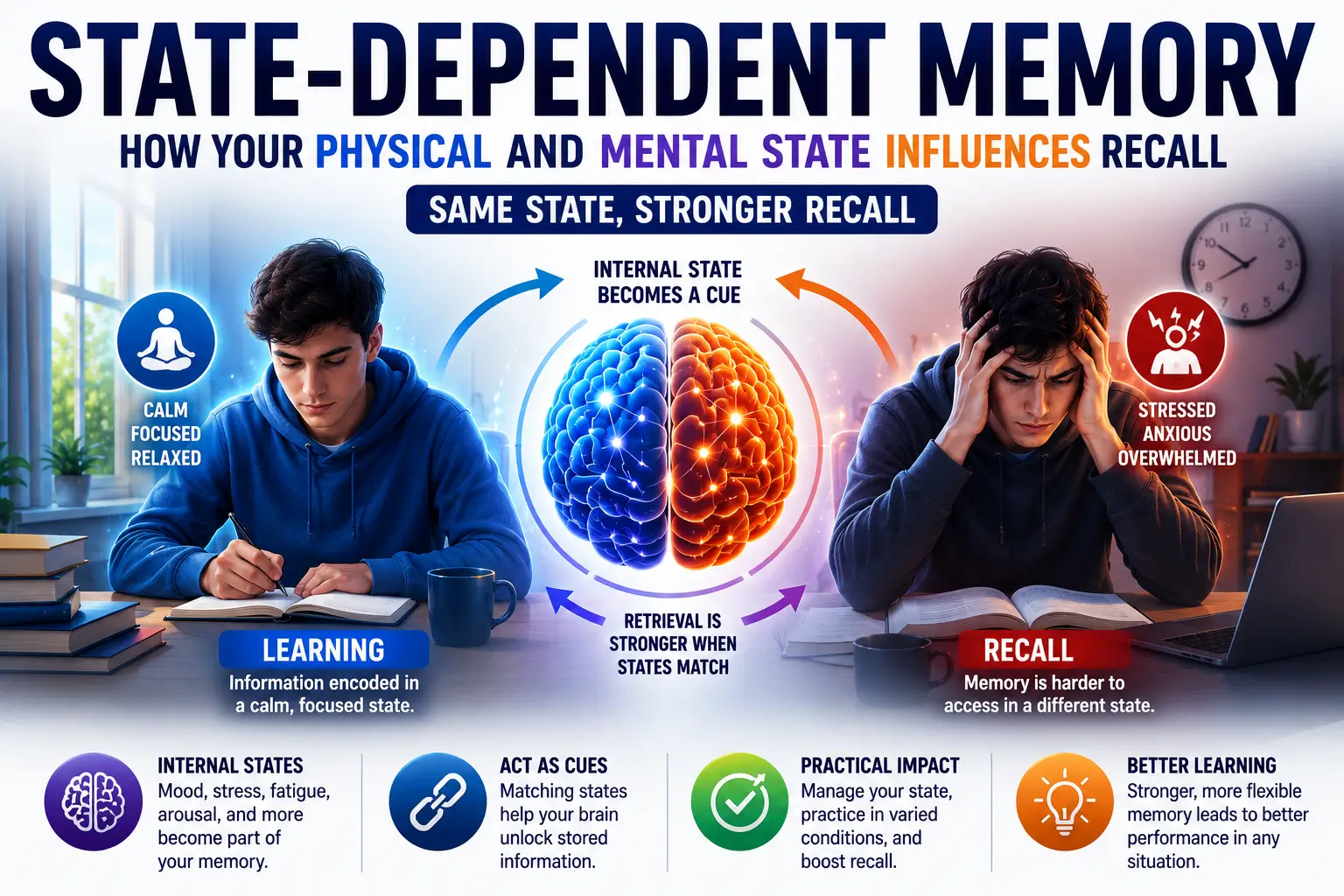
State-dependent memory describes the tendency to remember information more effectively when your internal physical or mental state during recall matches your state during learning.
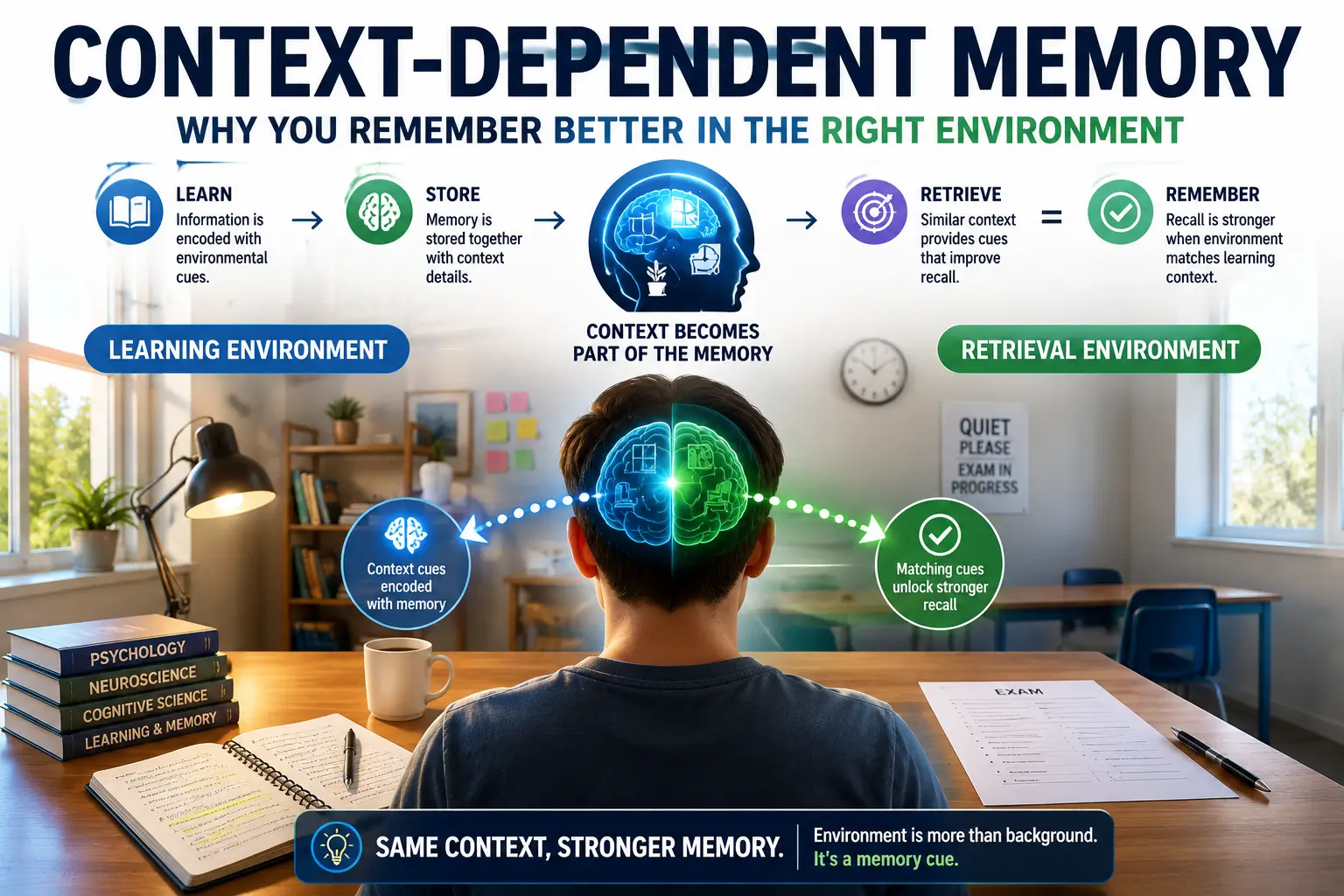
While context-dependent memory focuses on the external environment, state-dependent memory focuses on the internal environment of the body and mind.
Understanding this effect helps explain why mood, stress, fatigue, and physical condition can influence memory performance.
What Is State-Dependent Memory?
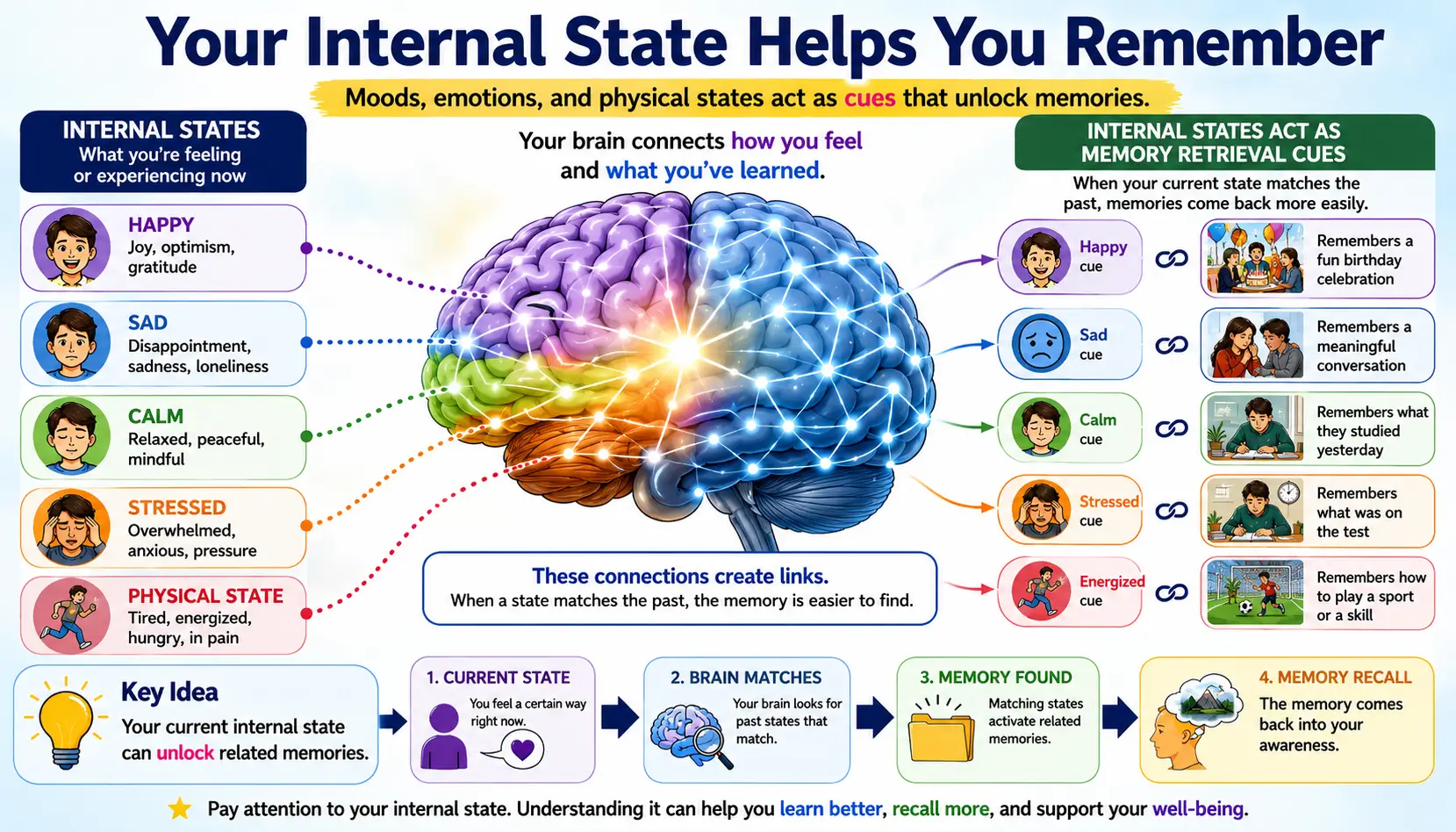
State-dependent memory is a memory phenomenon in which recall improves when a person’s internal state during retrieval matches the internal state present during learning.
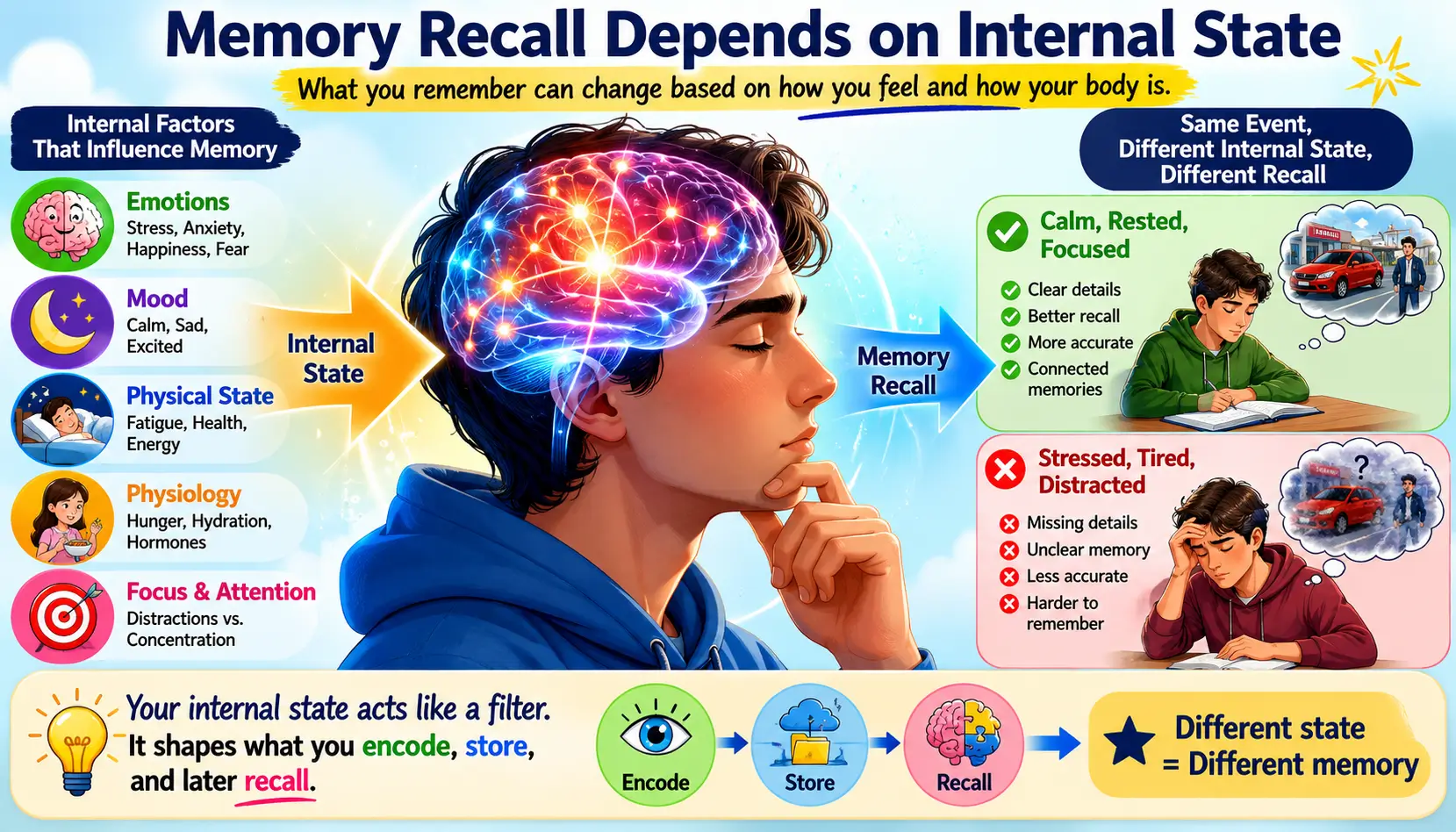
Internal state may include mood, stress level, fatigue, arousal, or physical condition.
When similar internal cues are present during both encoding and retrieval, the brain may access stored information more easily.
In this way, internal states can function as retrieval cues.
State-Dependent Memory vs Context-Dependent Memory
State-dependent memory is closely related to Context-Dependent Memory, but the two are not identical.
Context-dependent memory involves external cues such as location, environment, sounds, and surroundings.
State-dependent memory involves internal cues such as mood, alertness, stress, or physiological condition.
For example:
- Remembering better in the same classroom is context-dependent memory.
- Remembering better when in the same emotional state is state-dependent memory.


🔬 The Science Behind State-Dependent Memory
This mechanism is closely related to the Encoding Specificity Principle, which helps explain why matched internal conditions can support recall.
Research suggests that memory retrieval depends strongly on cues available during recall.
When internal cues present during learning are also present during retrieval, recall may improve.
This idea is connected to the broader encoding specificity principle, which explains why matching learning and retrieval conditions can support memory performance.
State-dependent memory demonstrates that the body’s internal condition can become part of the memory system.
Source: https://www.ncbi.nlm.nih.gov/pmc/articles/PMC7257511/
Sometimes memory depends not only on what you learned, but also on the state you were in when you learned it.
How Internal States Become Memory Cues
When information is encoded, the brain does not store it in isolation.
It may also encode aspects of the learner’s internal condition.
If a person is calm, tired, excited, stressed, or highly alert during learning, those states may become associated with the memory.
Later, returning to a similar state can help reactivate the memory network.
This makes internal state a potential retrieval cue.
Examples of State-Dependent Memory
State-dependent memory can appear in many everyday situations.
- Remembering emotional experiences more easily when in a similar mood
- Recalling stressful events more vividly when stressed again
- Finding certain memories easier to access when tired or relaxed
- Remembering practice routines better when in a similar physical condition
These examples show how internal cues may influence access to stored information.
Mood and Memory Recall
Mood can strongly influence what people remember.
When someone feels happy, positive memories may become easier to recall.
When someone feels sad, negative memories may become more accessible.
This does not mean mood controls memory completely.
However, emotional state can bias retrieval and influence which memories come to mind first.
Stress and State-Dependent Memory
Stress can affect memory in complex ways.
Mild arousal may sometimes increase attention and encoding.
High stress, however, can interfere with recall and working memory.
This is one reason students may understand material during study but struggle to retrieve it during a stressful exam.
Stress changes the internal state in which retrieval occurs.
State-Dependent Memory and Learning
State-dependent memory has important implications for learning.
If information is learned under one internal condition but retrieved under a very different condition, recall may become more difficult.
This helps explain why calm, focused studying is often more useful than chaotic or emotionally unstable learning conditions.
Stable internal states can support more reliable memory retrieval.
State-Dependent Memory and Memory Retrieval
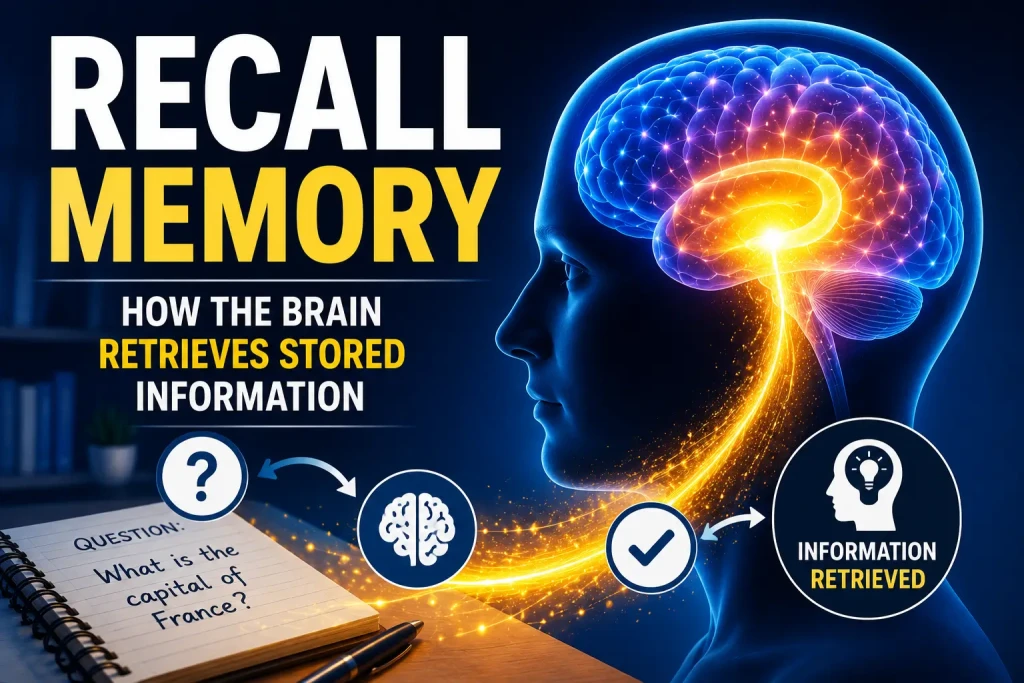
Internal states function as cues during recall. For a dedicated explanation of how cues trigger access to stored information, see What Are Retrieval Cues?.
State-dependent memory depends heavily on Memory Retrieval.
When internal cues match the original learning state, they may help activate stored memories.
When those cues are absent or very different, retrieval can become harder.
This shows how closely memory access depends on both stored information and available cues.
Can State-Dependent Memory Improve Recall?
In some situations, yes.
When learning and retrieval occur under similar internal conditions, recall may become more efficient.
This does not guarantee perfect memory, but matching internal states can provide additional retrieval support.
Researchers view internal states as another category of memory cues that can assist access to stored information.
The stronger the association between the state and the memory, the stronger the potential effect.
State-Dependent Memory and Exam Performance
Students sometimes experience situations where information feels familiar during study sessions but difficult to retrieve during exams.
One possible explanation involves differences in emotional and physiological states.
If studying occurs in a relaxed environment but testing occurs under significant stress, retrieval conditions may differ substantially.
This mismatch can make recall less efficient.
Managing stress effectively may therefore support better academic performance.
The Role of Attention During Encoding
State-dependent memory begins during encoding.
When information is first learned, the brain stores not only the content itself but also aspects of the surrounding internal state.
Attention, emotion, arousal, and physiological condition may all become associated with the memory.
These associations create potential retrieval pathways later.
Learn more in Memory Encoding: How Information Becomes a Lasting Memory.
State-Dependent Memory and Emotional Experiences
Many emotional memories demonstrate state-dependent effects.
People often notice that specific feelings trigger memories associated with previous experiences involving similar emotions.
This may occur because emotional states serve as retrieval cues.
The brain forms associations between emotional experiences and stored information.
Later, similar emotions can reactivate those memory networks.
State-Dependent Memory and Memory Reconsolidation
State-dependent memory may also influence Memory Reconsolidation.
When a memory is retrieved under a particular internal state, that state may become part of the retrieval experience.
The memory can then undergo reconsolidation and be stored again.
This process illustrates how retrieval, internal state, and memory updating may interact.
Memory is dynamic rather than static.
Can You Use State-Dependent Memory for Studying?
If you want to apply this idea without overrelying on mood or stress states, read How to Study Effectively for more flexible, evidence-based study methods.
Although learners should not rely exclusively on state-dependent memory, understanding the concept can be useful.
Several practical approaches may help:
- Study under conditions similar to those expected during testing.
- Practice retrieval in multiple situations.
- Develop consistent learning routines.
- Manage stress before important exams.
- Prioritize adequate sleep and recovery.
These strategies can help create more flexible and reliable recall.
Why Learning in Multiple Conditions May Be Better
While matching states can sometimes improve recall, learning exclusively in one state may create limitations.
Research suggests that studying across multiple environments and conditions can strengthen memory flexibility.
This approach creates a broader range of retrieval cues.
As a result, information becomes easier to access in different situations.
Strong learning systems rely on adaptable retrieval rather than dependence on a single state.
State-Dependent Memory and Long-Term Learning
Long-term learning benefits from repeated retrieval across various conditions.
When information can be recalled regardless of mood, environment, or stress level, memory becomes more durable.
This is one reason techniques such as Active Recall and Spaced Repetition are so effective.
They strengthen retrieval pathways under different circumstances.
Flexible retrieval is a hallmark of strong memory.
The strongest memories are not those tied to a single state, but those that remain accessible across many different states.
Supporting Better Memory Performance
State-dependent memory highlights the important relationship between internal conditions and recall.
Mood, stress, alertness, and physical state all influence how easily memories are accessed.
Understanding these effects allows learners to create more effective study habits and improve long-term retention.
Readers interested in supporting cognitive performance and memory health can learn more about Advanced Memory Formula.