
Now Reading: Memory Reconsolidation Explained: How Recalled Memories Can Change
-
01
Memory Reconsolidation Explained: How Recalled Memories Can Change
Memory Reconsolidation Explained: How Recalled Memories Can Change
Many people assume that memories are stored permanently and remain unchanged over time.
Modern neuroscience suggests something very different.
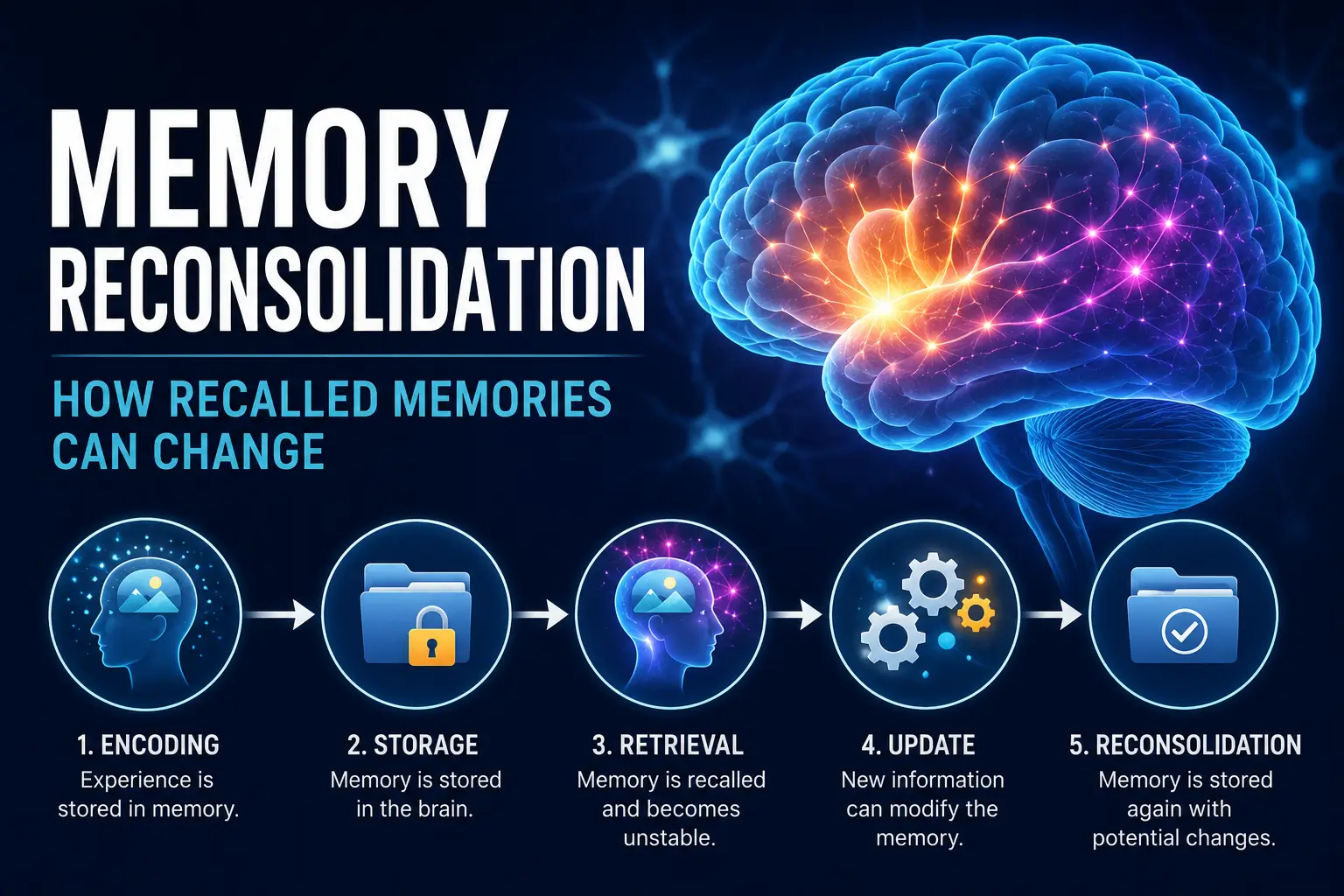
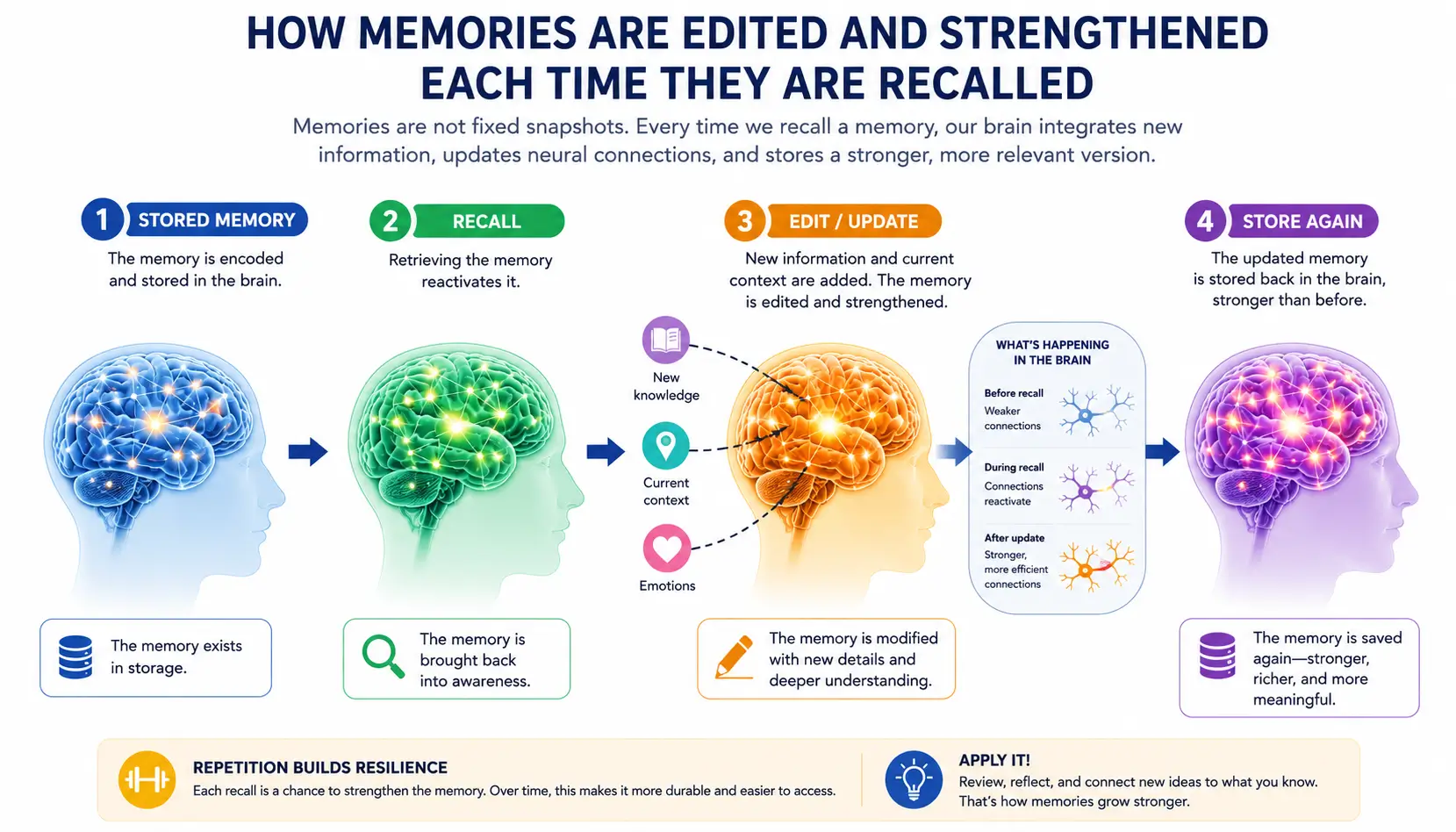
Research indicates that every time a memory is recalled, it can temporarily become unstable before being stored again.
This process is known as memory reconsolidation.
Memory reconsolidation helps explain why memories can evolve, strengthen, weaken, or even become distorted over time.
Rather than acting like a video recording, human memory behaves more like an active reconstruction process.
Understanding reconsolidation provides important insights into learning, memory improvement, and how experiences shape the brain.
What Is Memory Reconsolidation?
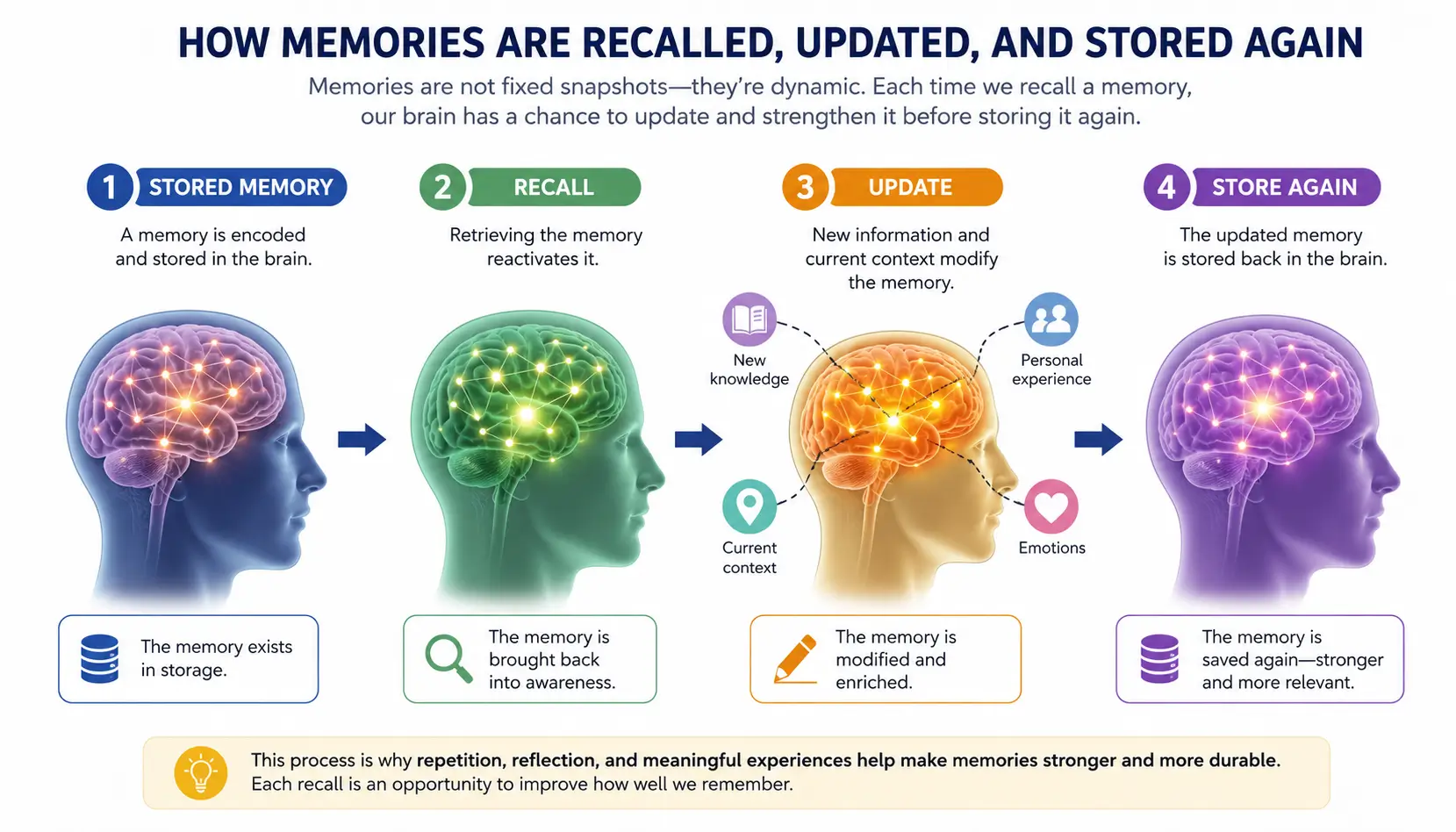
Memory reconsolidation is the process through which an existing memory becomes temporarily flexible after retrieval and is then stored again.
When a memory is recalled, it enters a brief period during which it can be modified.
After this period, the memory is reconsolidated and returned to long-term storage.
This means that remembering is not simply reading information from storage.
Remembering can actively influence the memory itself.
How Scientists Discovered Reconsolidation
For many years, researchers believed that memories became permanently fixed after consolidation.
However, studies in neuroscience began to challenge this assumption.
Researchers discovered that retrieved memories could become vulnerable to change.
Experimental evidence showed that recalled memories sometimes required stabilization again after retrieval.
This led to the development of reconsolidation theory.
Source: https://www.ncbi.nlm.nih.gov/pmc/articles/PMC4588064/


The Relationship Between Consolidation and Reconsolidation
Reconsolidation is closely connected to Memory Consolidation.
Consolidation occurs when newly learned information becomes stabilized in long-term memory.
Reconsolidation occurs when an existing memory is retrieved and then stored again.
Both processes help strengthen and maintain memory over time.
One creates the memory, while the other updates it.
Why Memory Reconsolidation Matters
Reconsolidation plays an important role in learning and adaptation.
If memories could never change, new experiences would have little influence on existing knowledge.
Reconsolidation allows the brain to integrate new information into previous memories.
This helps people update beliefs, refine skills, and adapt to changing environments.
Flexible memory systems support more effective learning.
The Reconsolidation Process
Although details continue to be studied, researchers generally describe reconsolidation as occurring in several stages.
- A memory is retrieved.
- The memory becomes temporarily unstable.
- New information may influence the memory.
- The memory is stored again.
- The updated memory becomes stable.
This process may occur many times throughout a person’s life.
Memory Retrieval Triggers Reconsolidation
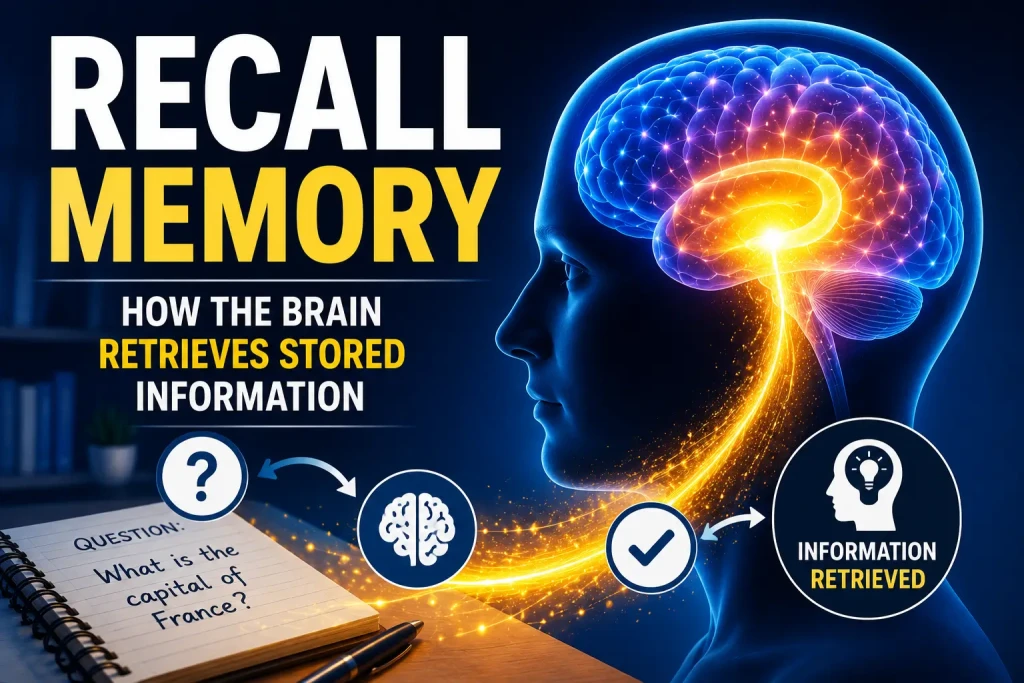
Reconsolidation begins with retrieval.
When the brain accesses stored information, the memory can temporarily become open to modification.
This is one reason retrieval plays such an important role in learning.
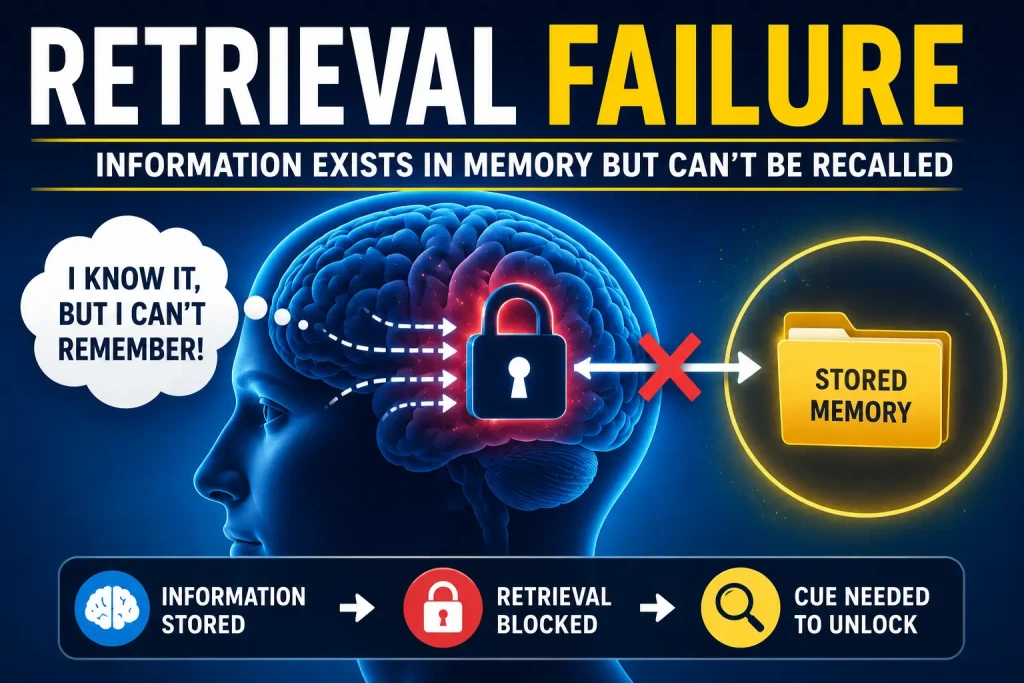
Learn more in Memory Retrieval Explained: How the Brain Accesses Stored Information.
Without retrieval, reconsolidation cannot occur.
Can Memories Change During Reconsolidation?
Yes.
Research suggests that memories may incorporate new details during the reconsolidation window.
Some changes improve memory accuracy, while others may introduce distortions.
This helps explain why people occasionally remember events differently over time.
Human memory is dynamic rather than static.
Reconsolidation and Learning
Every learning experience interacts with existing knowledge.
When students review previously learned material, retrieval may activate reconsolidation processes.
This creates opportunities to strengthen understanding and integrate new information.
Learning is often more effective when new concepts connect to existing memories.
Reconsolidation may help explain why review sessions can produce powerful learning gains.
Reconsolidation and Long-Term Memory
Long-term memories are not necessarily permanent records.
Instead, they may be continuously updated through retrieval and reconsolidation.
This ongoing process helps maintain relevant and useful knowledge.
It also allows memories to adapt as circumstances change.
Learn more in Long-Term Memory: How Information Is Stored, Retained, and Retrieved.
Memory Reconsolidation and False Memories
Because retrieved memories can absorb misleading details, this mechanism is closely related to false memory.
One of the most fascinating aspects of reconsolidation is its connection to false memories.
Because memories become temporarily flexible during retrieval, new information may sometimes become integrated into existing memories.
This does not mean memories are completely unreliable.
However, it does demonstrate that memory is a reconstructive process rather than a perfect recording system.
Researchers continue to study how reconsolidation contributes to memory accuracy and memory distortion.
How Reconsolidation Updates Knowledge
Memory reconsolidation allows the brain to update previously stored information.
Imagine learning a scientific concept that later requires revision because of new evidence.
Through retrieval and reconsolidation, new information can become integrated with existing knowledge.
This process helps maintain accurate and relevant mental models of the world.
Learning remains flexible because memories can evolve over time.
Reconsolidation and Emotional Memories
Emotionally intense recollections can feel unusually vivid, which makes flashbulb memory a natural companion topic here.
Reconsolidation is particularly important for emotional memories.
Experiences involving strong emotions are often stored more vividly than neutral events.
When emotional memories are recalled, reconsolidation may influence how those memories are maintained or modified.
This area has attracted significant attention from neuroscientists and psychologists.
Understanding emotional reconsolidation may help explain how people adapt to life experiences.
Reconsolidation and Trauma Research
Researchers have explored how reconsolidation may influence traumatic memories.
Some studies suggest that recalling certain memories under controlled conditions may create opportunities for modification during the reconsolidation window.
This remains an active area of scientific investigation.
While many questions remain, reconsolidation has become an important topic in memory and clinical psychology research.
Scientists continue to investigate how memory updating processes influence emotional learning.
Memory Reconsolidation vs Memory Retrieval
Although closely related, retrieval and reconsolidation are not identical processes.
Retrieval involves accessing stored information.
Reconsolidation occurs after retrieval and involves re-stabilizing the memory.
A simple way to think about the difference is:
- Retrieval opens the memory.
- Reconsolidation updates and stores it again.
Both processes play essential roles in long-term learning.
Reconsolidation and Effective Studying
Reconsolidation may help explain why active review strategies outperform passive rereading.
When learners actively retrieve information, previously stored memories become engaged.
This creates opportunities for strengthening and updating knowledge.
Evidence-based techniques such as Active Recall and Retrieval Practice may benefit from these mechanisms.
Retrieval is often one of the most powerful tools available for long-term learning.
Can Reconsolidation Strengthen Memory?
In many cases, yes.
Repeated retrieval followed by successful reconsolidation may strengthen memory traces.
This helps explain why reviewing information at appropriate intervals improves retention.
Learning is not simply about storing information once.
Strong memories are often built through repeated cycles of retrieval and reconsolidation.
The Dynamic Nature of Human Memory
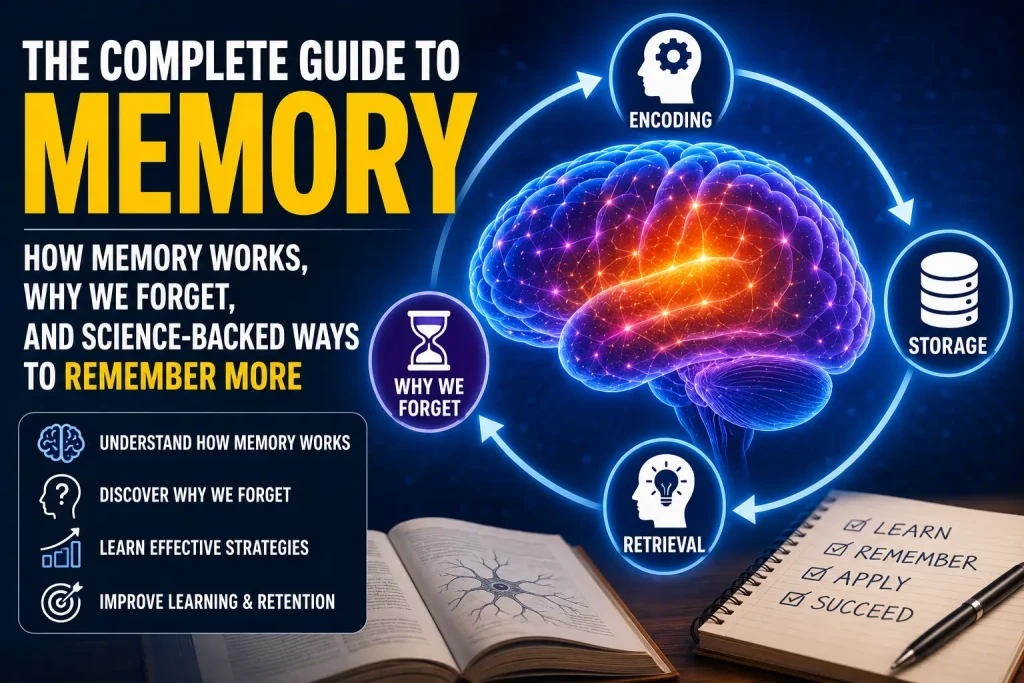
For a wider explanation of how memory can be stored, forgotten, updated, and improved, see the complete guide to memory.
Memory reconsolidation reveals that memory is not static.
Instead, memories remain active, flexible, and capable of change.
Each retrieval event may contribute to strengthening, updating, or refining stored information.
This flexibility allows humans to learn continuously throughout life.
Every time a memory is recalled, the brain may have an opportunity to update and strengthen it.
Applying Reconsolidation Principles to Learning
These benefits become stronger when review is spaced over time, which is why distributed practice fits naturally with reconsolidation-based updating.
Students, professionals, and lifelong learners can benefit from understanding reconsolidation.
Regular retrieval practice, spaced review, and active engagement with knowledge all encourage memory updating processes.
Rather than treating learning as a one-time event, effective learners revisit and refine information repeatedly.
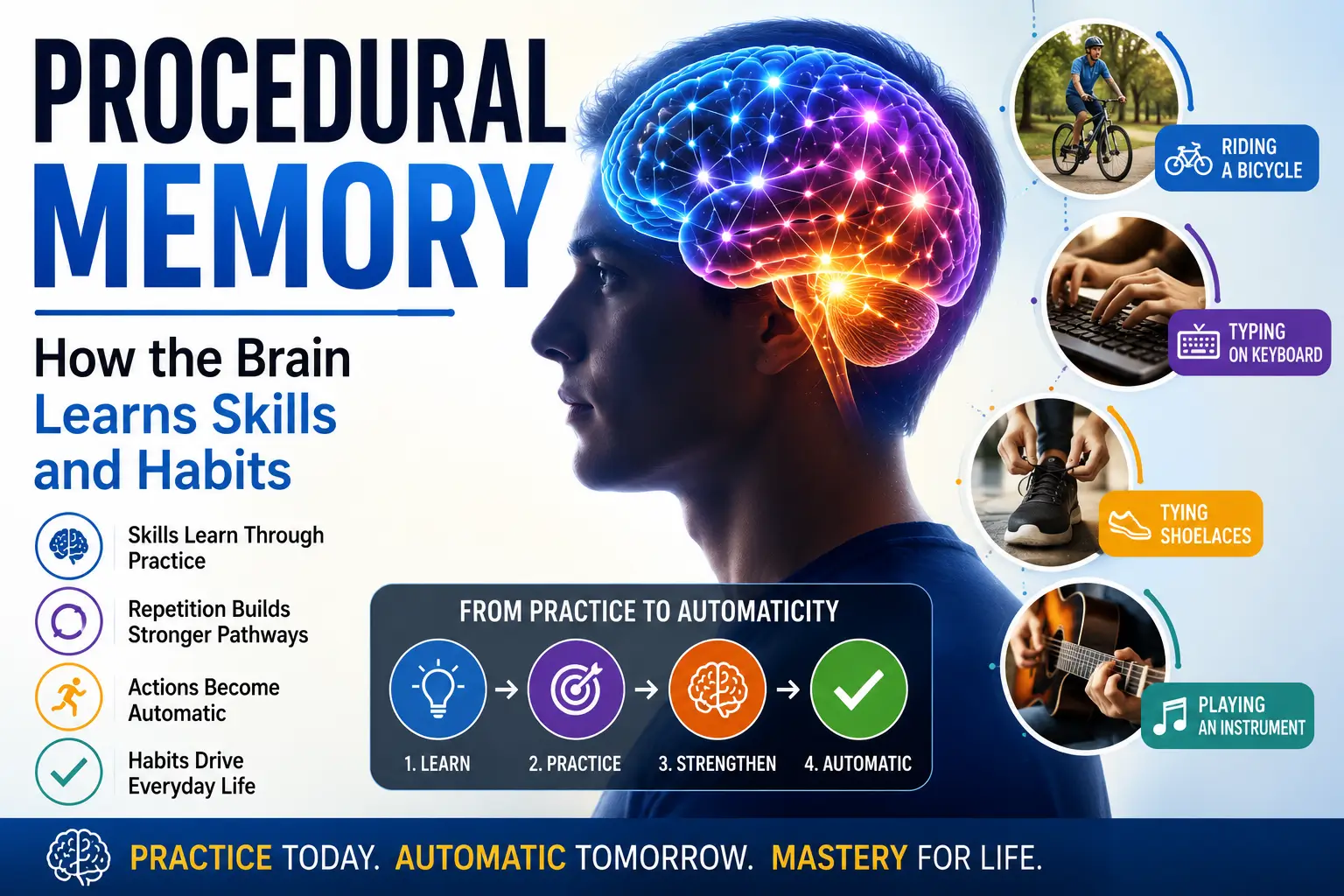
This approach aligns closely with how the brain naturally manages long-term memory.
Supporting Long-Term Brain Performance
Memory reconsolidation functions best when supported by healthy learning habits, quality sleep, effective retrieval practice, and overall cognitive wellness.
Many people combine evidence-based learning strategies with broader approaches that support memory performance and healthy cognitive aging.
Readers interested in memory-supportive nutritional strategies can learn more about Advanced Memory Formula.