
Now Reading: Cognitive Load Theory: How to Learn More Without Overloading Your Brain
-
01
Cognitive Load Theory: How to Learn More Without Overloading Your Brain
Cognitive Load Theory: How to Learn More Without Overloading Your Brain
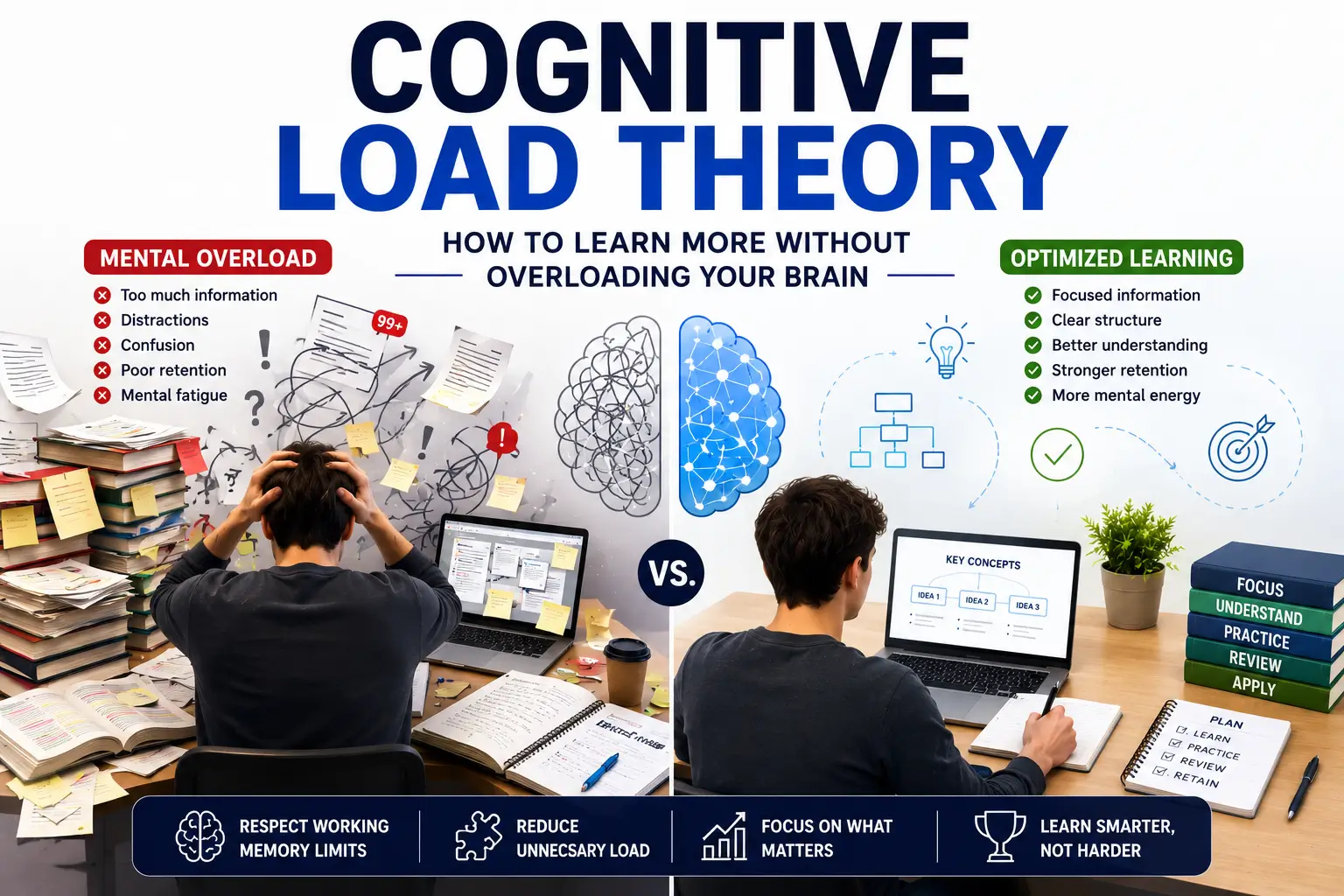
Have you ever read the same paragraph three times and still struggled to understand it?
Or watched an educational video that felt overwhelming despite your best efforts to focus?
If so, the problem may not have been your intelligence, motivation, or work ethic.
The problem may have been cognitive load.
Every learning task places demands on the brain.
When those demands exceed the brain’s processing capacity, learning becomes slower, more difficult, and less effective.
This idea forms the foundation of Cognitive Load Theory.
Originally developed by educational psychologist John Sweller, Cognitive Load Theory explains how mental resources are used during learning and why information overload can interfere with understanding.
The theory has become one of the most influential frameworks in modern education because it helps explain not only why people struggle to learn, but also how learning can be improved.
What Is Cognitive Load Theory?
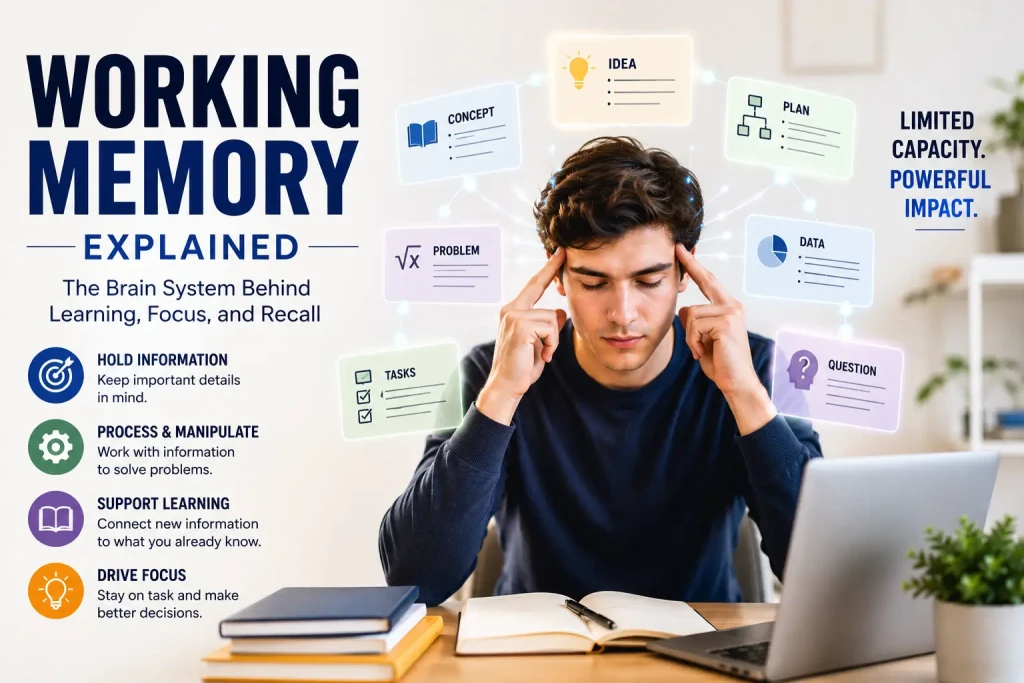
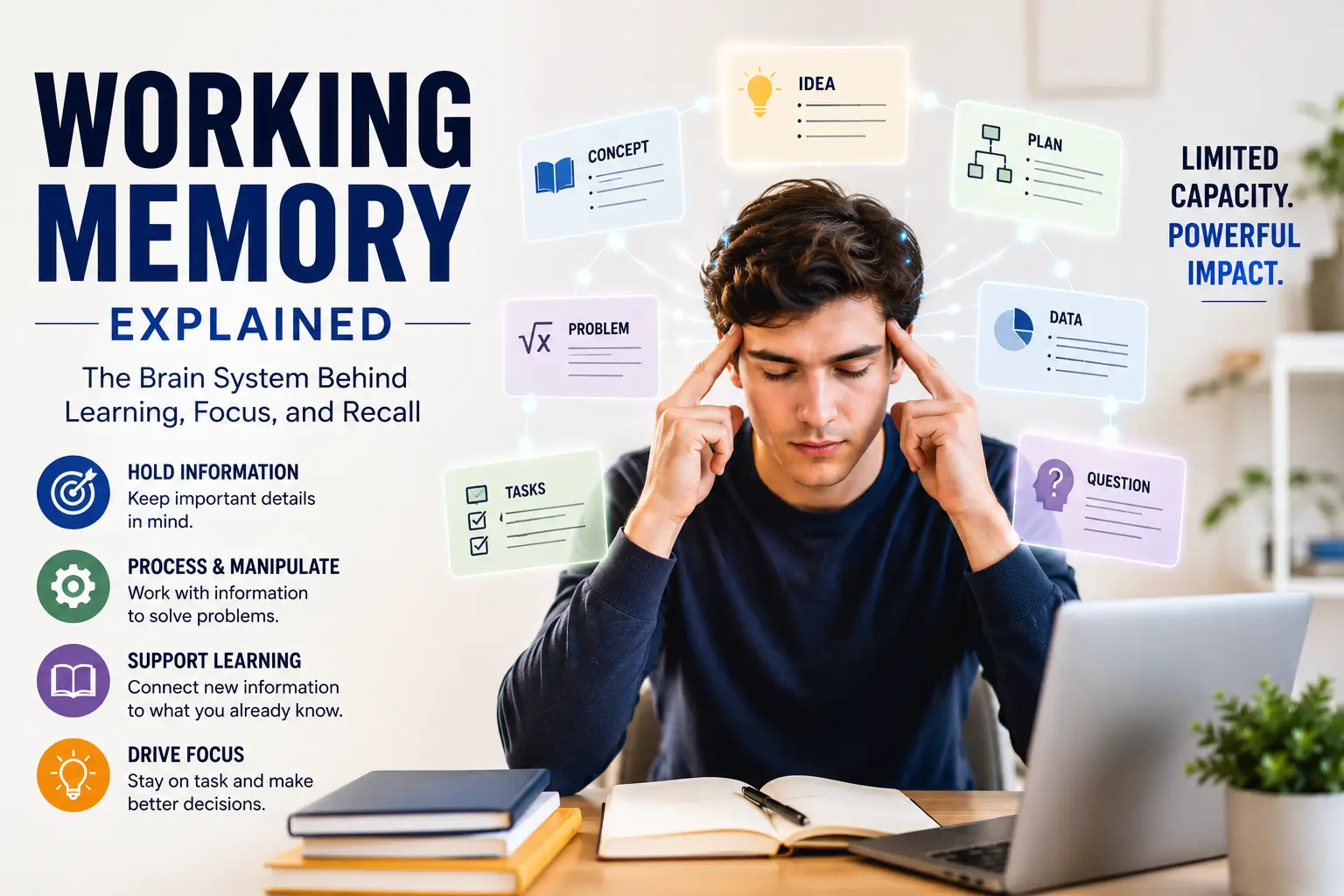
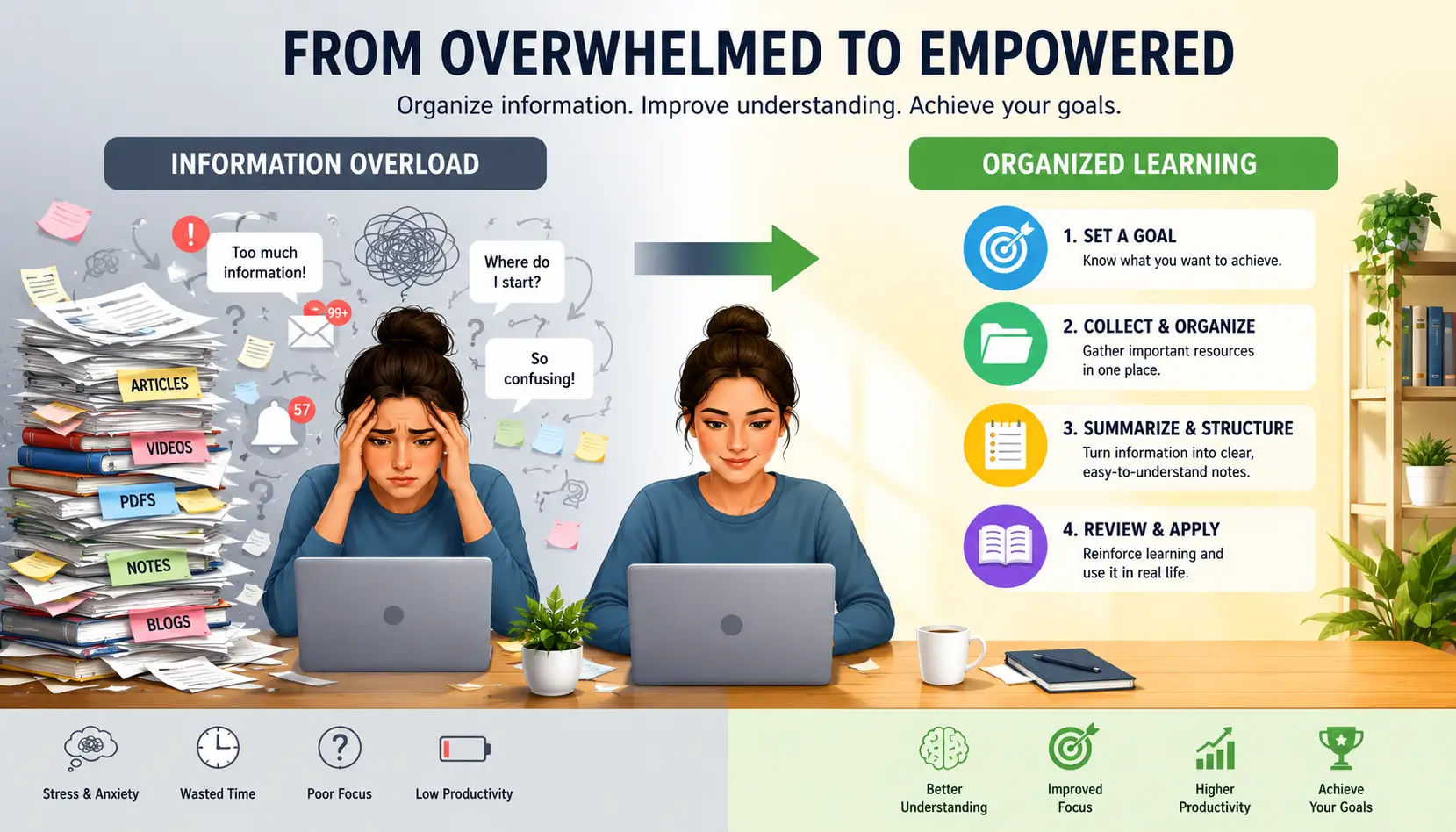
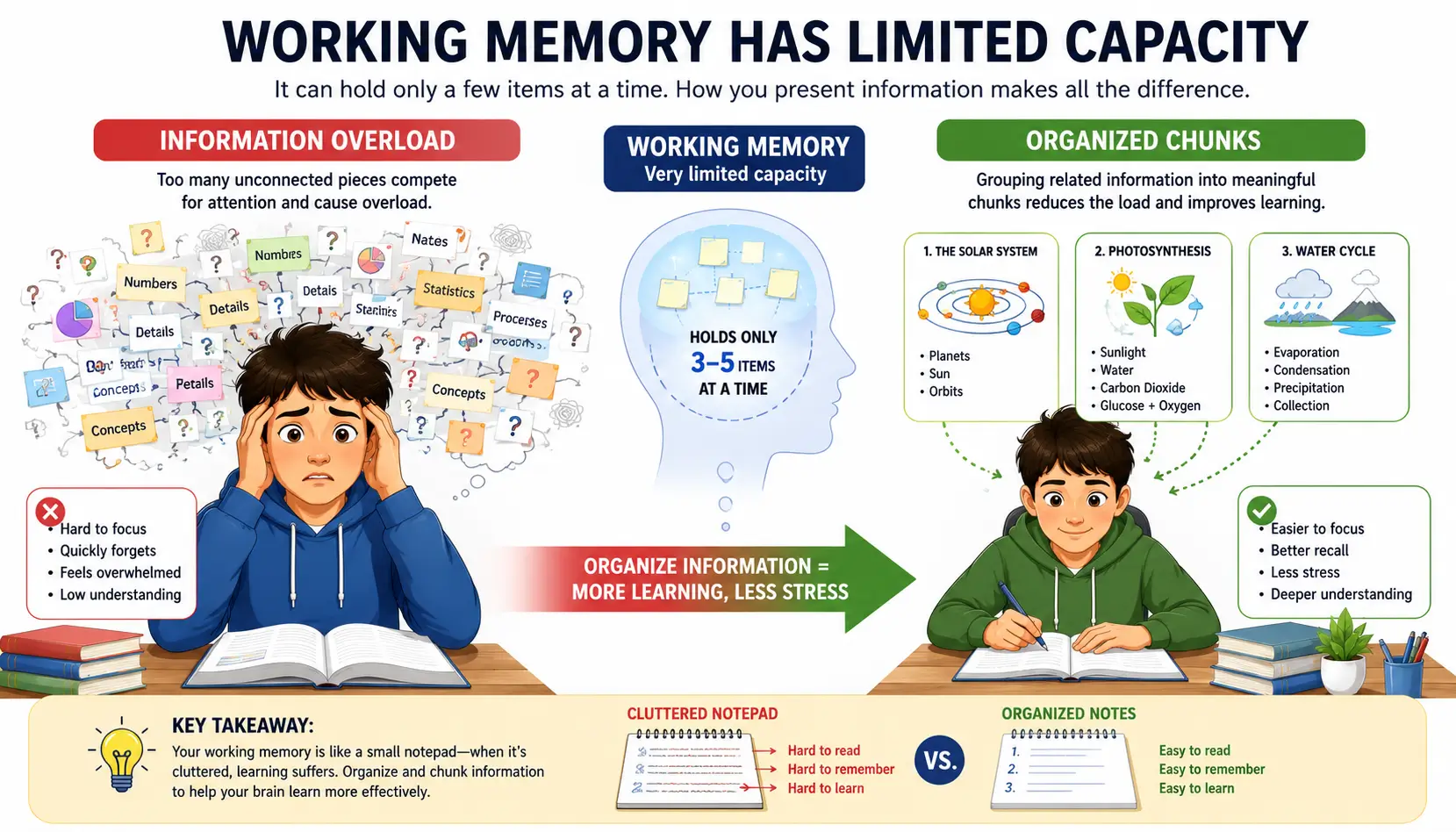
Cognitive Load Theory proposes that learning is limited by the capacity of Working Memory.
While the brain can store enormous amounts of information in long-term memory, working memory has a much smaller capacity.
It can only process a limited amount of information at any given moment.
When too much information arrives at once, learning becomes more difficult.
This situation is known as cognitive overload.
The goal of effective instruction is not simply to present information.
It is to present information in a way that working memory can successfully process.
Why Working Memory Matters
Imagine trying to juggle ten balls at the same time.
Eventually, something falls.
Working memory functions in a similar way.
<p>When too many elements compete for <a href=”https://memoryperformancelab.com/attention-span/”>attention</a> simultaneously, performance suffers.</p>
This limitation influences almost every learning experience.
Reading, listening, problem-solving, note-taking, and decision-making all depend on working memory resources.
When those resources become overloaded, comprehension declines.


🔬 The Science Behind Cognitive Load Theory
John Sweller first introduced Cognitive Load Theory in the 1980s to explain why some instructional methods were more effective than others.
The theory suggests that instructional design should respect the limitations of working memory while supporting the formation of long-term knowledge structures.
Research in educational psychology has repeatedly demonstrated that reducing unnecessary mental effort can improve learning outcomes.
Source: https://www.simplypsychology.org/cognitive-load-theory.html
The core message is straightforward:
Learning improves when mental resources are used efficiently.
The Three Types of Cognitive Load
Cognitive Load Theory generally divides mental workload into three categories.
Intrinsic Load
Intrinsic load comes from the complexity of the material itself.
Some subjects naturally require more mental effort than others.
For example, basic arithmetic creates less intrinsic load than advanced calculus.
The complexity is part of the content.
Extraneous Load
Extraneous load comes from how information is presented.
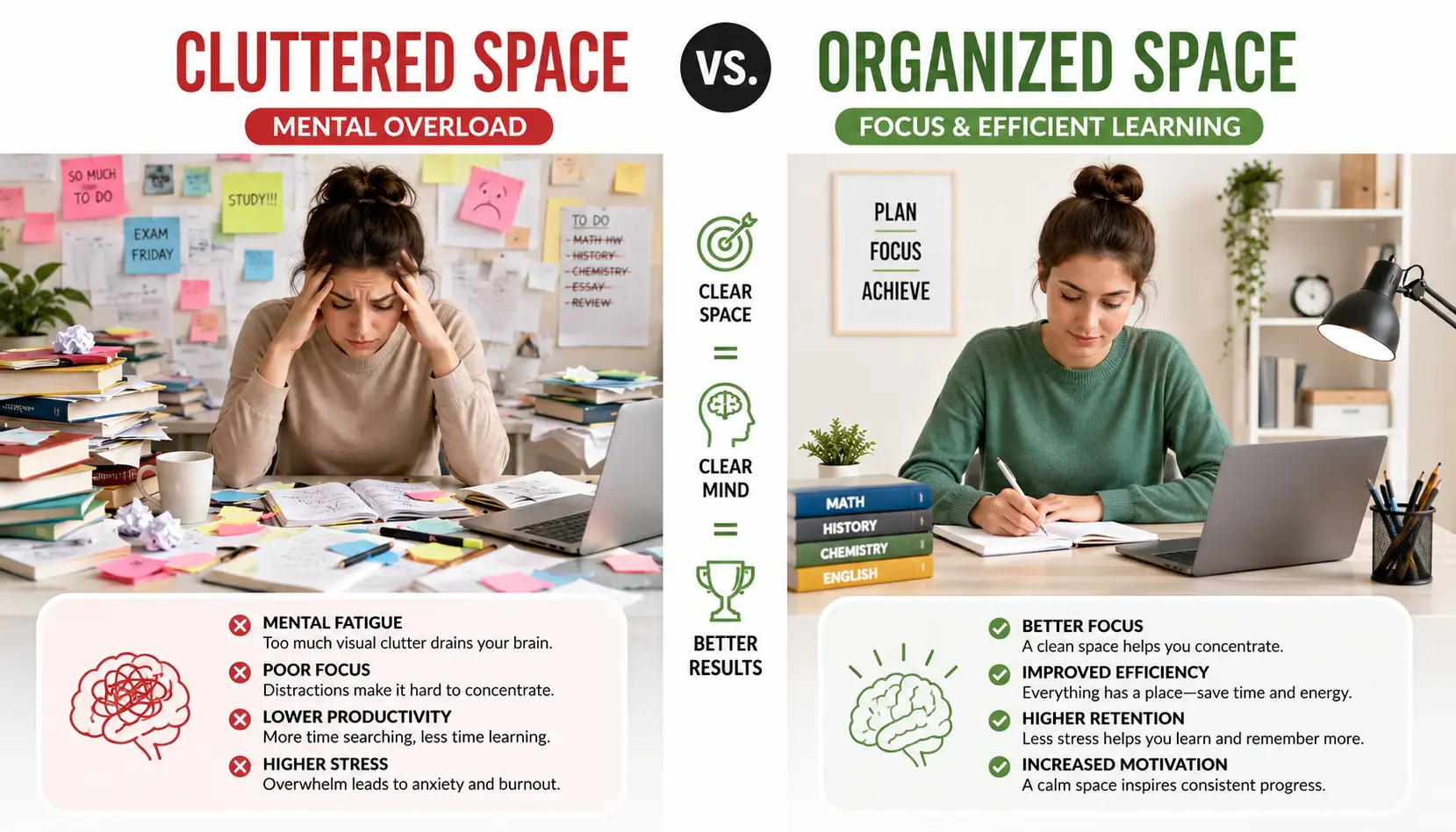
Poorly organized materials, confusing explanations, cluttered visuals, and unnecessary distractions all increase extraneous load.
This type of load does not contribute to learning.
It simply consumes mental resources.
Germane Load
Germane load refers to the mental effort invested in meaningful learning.
This is the productive type of effort.
It supports understanding, knowledge construction, and long-term retention.
Effective learning aims to reduce unnecessary load while encouraging germane load.
What Cognitive Overload Looks Like
Cognitive overload often feels familiar.
Common signs include:
- Difficulty concentrating
- Mental fatigue
- Confusion
- Frequent mistakes
- Forgetting recently learned information
- Difficulty following explanations
These symptoms do not necessarily indicate low ability.
They may simply indicate that working memory has reached its limits.
Why More Information Is Not Always Better
Many learners assume that more information automatically leads to more learning.
In reality, excessive information can sometimes reduce learning effectiveness.
When too many concepts compete for attention simultaneously, comprehension becomes harder.
This is one reason effective teachers often introduce complex topics gradually rather than all at once.
Learning benefits from structure.
Overload often creates confusion.
Cognitive Load Theory and Chunking
One of the most effective ways to reduce cognitive load is through Chunking.
Chunking groups individual pieces of information into larger meaningful units.
This reduces the burden placed on working memory.
Instead of processing ten separate elements, learners may only need to process two or three larger chunks.
The result is often greater efficiency and improved understanding.
Cognitive Load Theory and Dual Coding
Another strategy for reducing cognitive load involves Dual Coding Theory.
By combining words and visuals, learners can distribute processing across multiple systems.
This often makes information easier to understand and remember.
Rather than relying entirely on verbal explanations, visual representations help support comprehension.
The brain gains additional pathways for understanding information.
Why Experts and Beginners Experience Cognitive Load Differently
An interesting aspect of Cognitive Load Theory is that expertise changes how information is processed.
What feels overwhelming to a beginner may feel effortless to an expert.
This happens because experts have already developed extensive knowledge structures stored in long-term memory.
Those structures reduce the demands placed on working memory.
As knowledge grows, learning often becomes more efficient.
How to Reduce Cognitive Load While Learning
The goal of Cognitive Load Theory is not to eliminate mental effort.
Learning always requires effort.
The goal is to remove unnecessary effort so that more mental resources can be devoted to understanding.
Several evidence-based strategies can help achieve this.
These strategies make learning more efficient by protecting working memory from unnecessary overload.
Break Complex Information Into Smaller Parts
One of the simplest ways to reduce cognitive load is to avoid processing too much information at once.
Large topics become easier to understand when divided into smaller sections.
This approach allows working memory to focus on one concept at a time.
As understanding grows, those smaller concepts can gradually be combined into larger knowledge structures.
This is one reason well-designed courses introduce ideas progressively rather than all at once.
Use Visuals Strategically
Visual information can often reduce cognitive load when used correctly.
Charts, diagrams, illustrations, and concept maps can simplify complex relationships.
However, visuals should support learning rather than distract from it.
Overly complicated graphics may increase cognitive load instead of reducing it.
The most effective visuals are usually clear, focused, and directly connected to the learning objective.
Cognitive Load Theory and Interleaving
At first glance, Interleaving may appear to increase cognitive load.
Instead of studying one topic repeatedly, learners switch between related topics.
This often feels more difficult.
However, the additional challenge can improve long-term learning.
Interleaving encourages learners to discriminate between concepts and apply knowledge more flexibly.
The temporary increase in difficulty often produces stronger retention later.
This is an example of productive mental effort rather than unnecessary overload.
Why Simplicity Improves Learning
Many people associate complexity with intelligence.
Yet some of the most effective learning experiences are surprisingly simple.
Clear explanations reduce extraneous cognitive load.
Simple language allows working memory to focus on understanding rather than interpretation.
This principle helps explain the effectiveness of the Feynman Technique.
When information is explained clearly, comprehension often improves dramatically.
The Relationship Between Cognitive Load and Metacognition
Metacognition helps learners recognize when cognitive overload is occurring.
Self-aware learners often notice warning signs such as:
- Difficulty concentrating
- Repeated confusion
- Mental fatigue
- Declining performance
Recognizing these signals allows learners to adjust their approach.
They may simplify the task, take a break, review prerequisite knowledge, or reorganize study materials.
This ability to self-regulate can significantly improve learning efficiency.
Common Cognitive Load Mistakes
Multitasking During Learning
Many learners attempt to study while checking messages, browsing social media, or watching videos.
Each additional task competes for limited working memory resources.
The result is often reduced comprehension and retention.
Consuming Too Much Information at Once
Binge-learning can feel productive, but excessive information often overwhelms working memory.
Strategic breaks and distributed learning generally produce better results.
Ignoring Prior Knowledge
Learning becomes much harder when foundational concepts are missing.
Building knowledge progressively helps reduce unnecessary cognitive strain.
Confusing Difficulty With Learning
Not every difficult learning experience is beneficial.
Some difficulties strengthen learning.
Others simply overload working memory.
The challenge is distinguishing between productive effort and unnecessary complexity.
Cognitive Load Theory in Everyday Life
The principles of cognitive load extend far beyond education.
People experience cognitive overload when:
- Managing complex projects
- Making difficult decisions
- Learning new software
- Processing large amounts of information
- Working under stress
Understanding cognitive load can improve productivity, communication, and problem-solving in many areas of life.
The brain performs best when information is structured in a manageable way.
Supporting Cognitive Performance and Learning Efficiency
Cognitive load management is only one part of effective learning.
Sleep quality, attention, stress management, memory health, and physical well-being all influence cognitive performance.
For example, Working Memory functions more effectively when mental fatigue is reduced and cognitive resources are protected.
Many learners combine evidence-based study strategies with broader approaches that support long-term cognitive health.
Readers interested in memory-supportive nutritional approaches can learn more about Advanced Memory Formula.
Learning More by Overloading Less
Cognitive Load Theory offers an important reminder:
Learning is not just about how much information you receive. It is also about how much information your brain can successfully process.
By reducing unnecessary mental effort, organizing information effectively, and respecting the limits of working memory, learners can improve understanding, retention, and overall learning efficiency.
Sometimes the smartest way to learn more is not to add information.
It’s to remove the overload.