
Now Reading: Interleaving: The Study Technique That Improves Long-Term Learning
-
01
Interleaving: The Study Technique That Improves Long-Term Learning
Interleaving: The Study Technique That Improves Long-Term Learning
Imagine two students preparing for the same exam.
The first student spends three straight hours solving only algebra problems.
After that, they spend three hours on geometry and another three on statistics.
The second student takes a different approach.
They alternate between algebra, geometry, and statistics throughout their study session.
At first glance, the first method feels more efficient.
After all, focusing on one topic at a time seems organized and productive.
Surprisingly, learning research often points in the opposite direction.
The second approach is called interleaving, and it has been shown to improve long-term learning, problem-solving ability, and knowledge transfer.
Although interleaving often feels more difficult during study sessions, that difficulty may be exactly why it works.
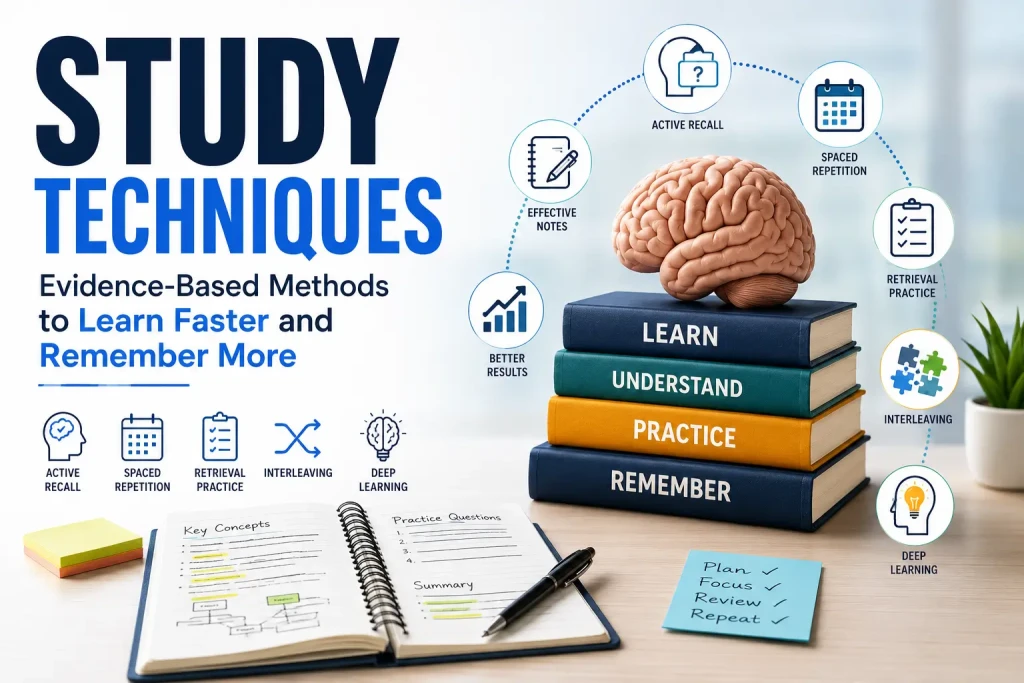
Rather than mastering information in isolation, learners become better at recognizing patterns, distinguishing concepts, and applying knowledge in new situations. This makes interleaving a useful addition to other evidence-based study techniques.
What Is Interleaving?
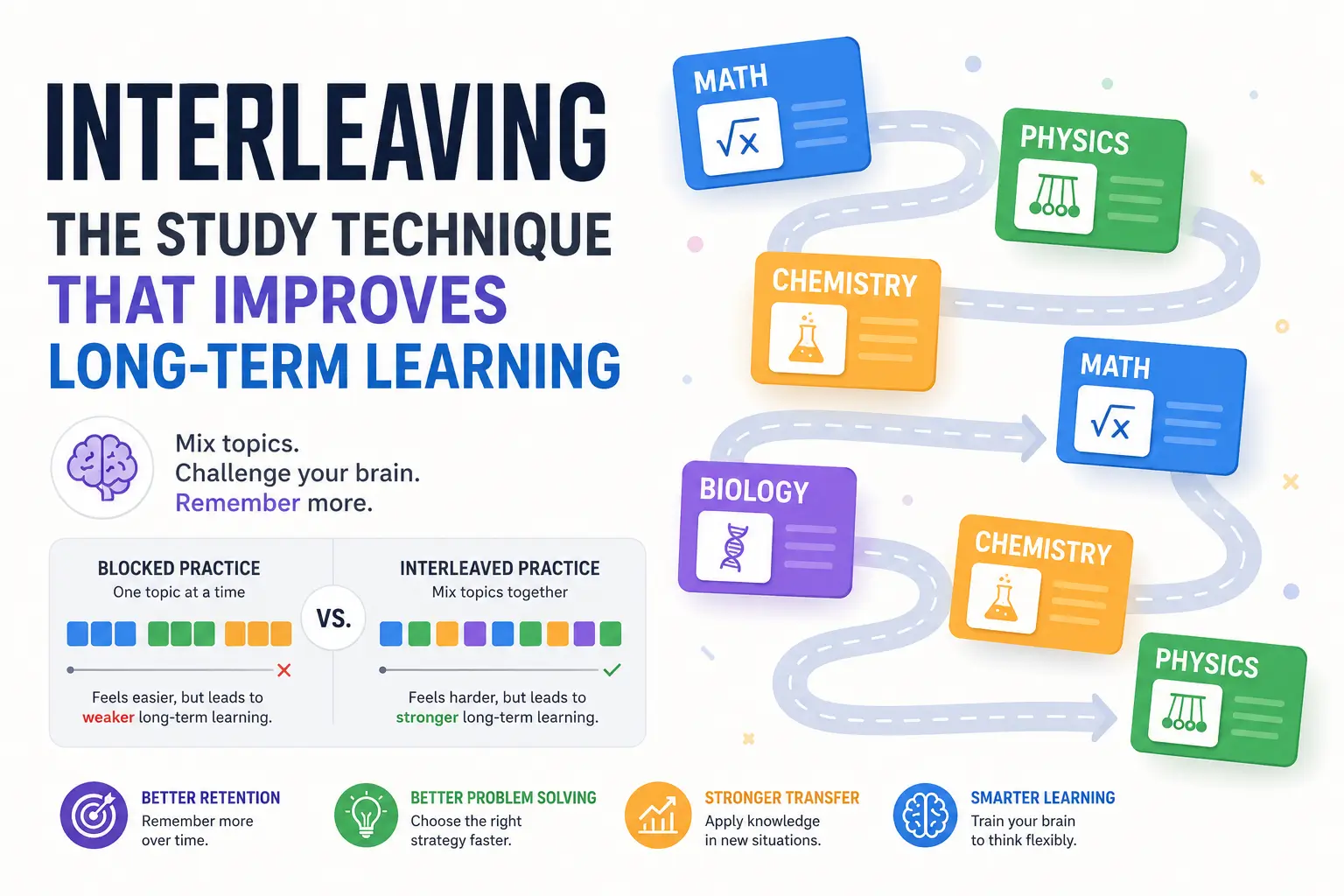
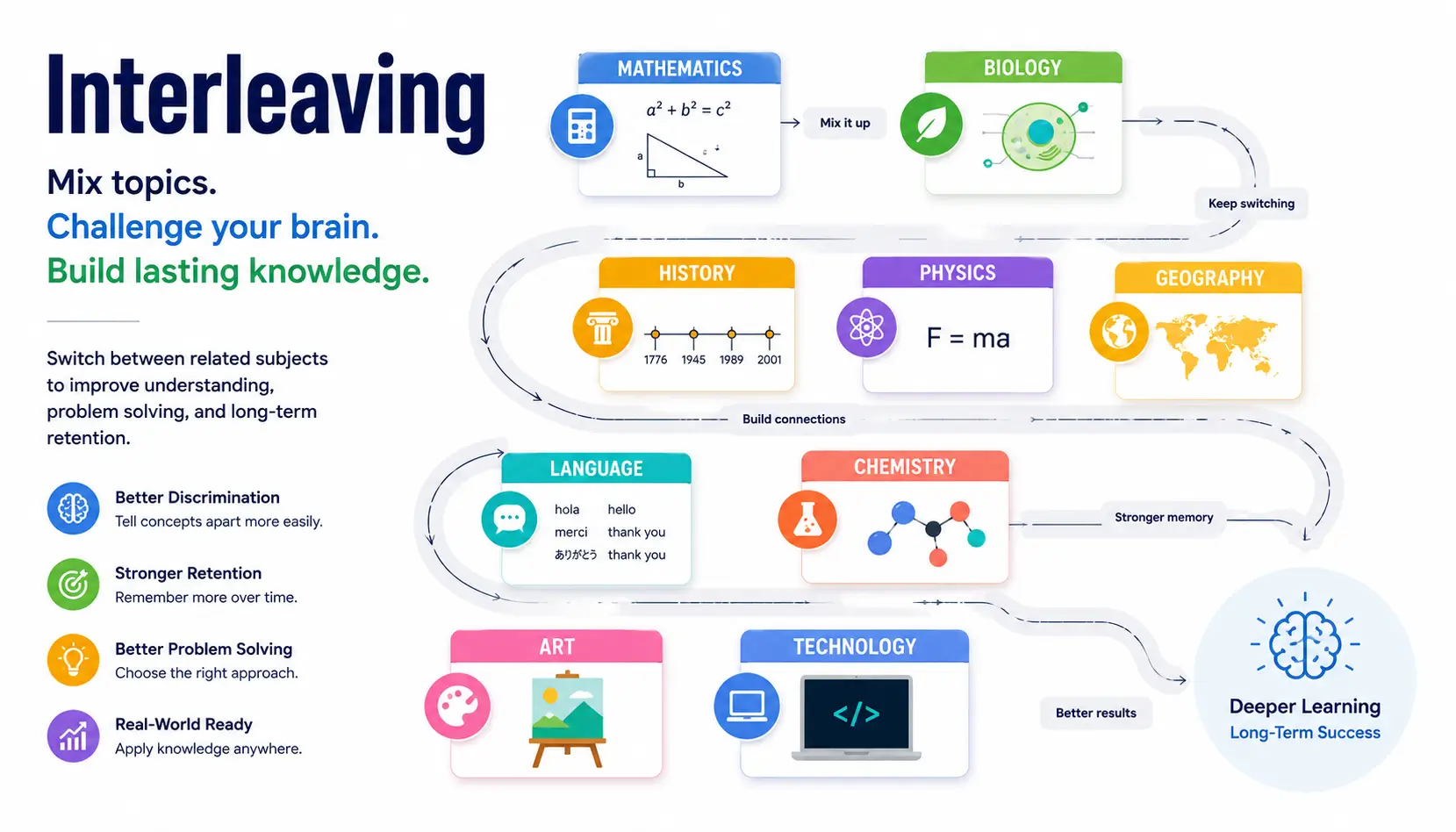
Interleaving is a learning strategy that involves mixing related topics, skills, or problem types during practice instead of studying one topic exclusively.
Most learners naturally use what researchers call blocked practice.
Blocked practice looks like this:
- Study Topic A
- Study Topic A
- Study Topic A
- Study Topic A
- Move to Topic B
- Repeat
Interleaving changes the sequence:
- Topic A
- Topic B
- Topic C
- Topic A
- Topic B
- Topic C
The learner repeatedly switches between related subjects or problem types.
This creates more cognitive effort but often leads to stronger learning outcomes.
Why Interleaving Feels Harder
One reason many learners avoid interleaving is that it feels less comfortable.
When you study a single topic repeatedly, performance improves quickly.
You begin recognizing patterns.
You become familiar with the material.
This creates confidence.
Unfortunately, confidence and learning are not always the same thing.
Interleaving constantly forces the brain to adapt.
You must determine which strategy, formula, or concept applies in each situation.
That extra effort often makes learning feel slower.
However, learning scientists frequently describe this kind of challenge as a desirable difficulty.
The struggle itself may strengthen retention.


Blocked Practice vs Interleaving
Consider learning different types of math problems.
With blocked practice, students solve twenty examples of the same problem type in a row.
Performance during practice often looks impressive.
The learner becomes highly familiar with the procedure.
However, real exams rarely organize problems this way.
Students must first identify what type of problem they are facing before deciding how to solve it.
Interleaving trains this skill directly.
By mixing problem types, learners practice selecting the correct strategy rather than simply repeating a known procedure.
This distinction can have a significant impact on long-term performance.
🔬 What Research Says About Interleaving
Research in cognitive psychology has repeatedly shown that interleaving can improve learning outcomes across a variety of subjects.
Studies involving mathematics, science, sports, and artistic skills have demonstrated benefits when learners mix practice rather than relying entirely on blocked repetition.
One influential line of research found that students often performed better on later tests when practice was interleaved, even though the learning process felt more difficult.
Source: https://www.apa.org/science/about/psa/2008/01/kornell
The key insight is important:
Learning strategies that feel easier are not always the most effective.
Why Interleaving Improves Learning
Researchers believe several mechanisms contribute to the effectiveness of interleaving.
Improved Discrimination
When multiple concepts are studied together, learners become better at recognizing the differences between them.
This makes it easier to choose the correct strategy later.
More Frequent Retrieval
Switching topics forces the brain to repeatedly reactivate previous information.
This process shares similarities with Retrieval Practice.
Reduced Illusions of Mastery
Blocked practice can create a false sense of competence.
Interleaving makes weaknesses more visible.
While this may feel uncomfortable, it often produces more realistic self-assessment.
Interleaving and Active Recall
Interleaving works especially well when combined with Active Recall.
Each time learners switch topics, they must retrieve information associated with that topic.
This repeated retrieval strengthens memory while improving flexibility.
Rather than memorizing information in a rigid sequence, learners build more adaptable knowledge structures.
Real-World Examples of Interleaving
Interleaving is useful far beyond academic learning.
For example:
- A language learner alternates vocabulary, grammar, and listening exercises.
- A musician practices scales, rhythm exercises, and song sections in the same session.
- An athlete rotates between different movement patterns.
- A programmer alternates algorithms, debugging, and project work.
The common principle is variety.
Rather than repeating one skill continuously, related skills are mixed together.
This helps create more flexible and transferable learning.
Interleaving vs Multitasking
It is important not to confuse interleaving with multitasking.
Multitasking involves attempting multiple activities simultaneously.
Interleaving involves switching attention between tasks intentionally.
The learner focuses fully on one activity before moving to the next.
The goal is not divided attention.
The goal is varied practice.
When Interleaving Works Best
Interleaving tends to work particularly well when concepts are related but distinct.
For example:
- Different math problem types
- Multiple language skills
- Related scientific concepts
- Different musical techniques
- Similar sports movements
If topics are completely unrelated, switching may become unnecessarily distracting.
The strongest results usually occur when learners alternate between concepts that are connected enough to create meaningful comparisons.
How to Use Interleaving in Your Study Sessions
The idea behind interleaving is simple, but many learners struggle when trying to apply it in practice.
The good news is that you don’t need to completely redesign your study routine.
Small adjustments can make a meaningful difference.
Instead of spending three hours on a single topic, divide your session into multiple blocks.
For example:
- 30 minutes of algebra
- 30 minutes of geometry
- 30 minutes of statistics
- 30 minutes of algebra review
The goal is not randomness.
The goal is strategic variation.
Related concepts should be mixed together in ways that encourage comparison and retrieval.
Interleaving and Spaced Repetition
Interleaving becomes even more effective when combined with Spaced Repetition.
The two techniques solve different learning problems.
Interleaving improves discrimination and flexible thinking.
Spaced repetition improves long-term retention.
Together, they create a powerful learning system.
Imagine studying three topics today.
Rather than reviewing them all tomorrow, spaced repetition schedules future reviews at strategic intervals.
When those reviews occur, interleaving can again be used to mix the topics.
This combination encourages both retention and adaptability.
Interleaving and Dual Coding
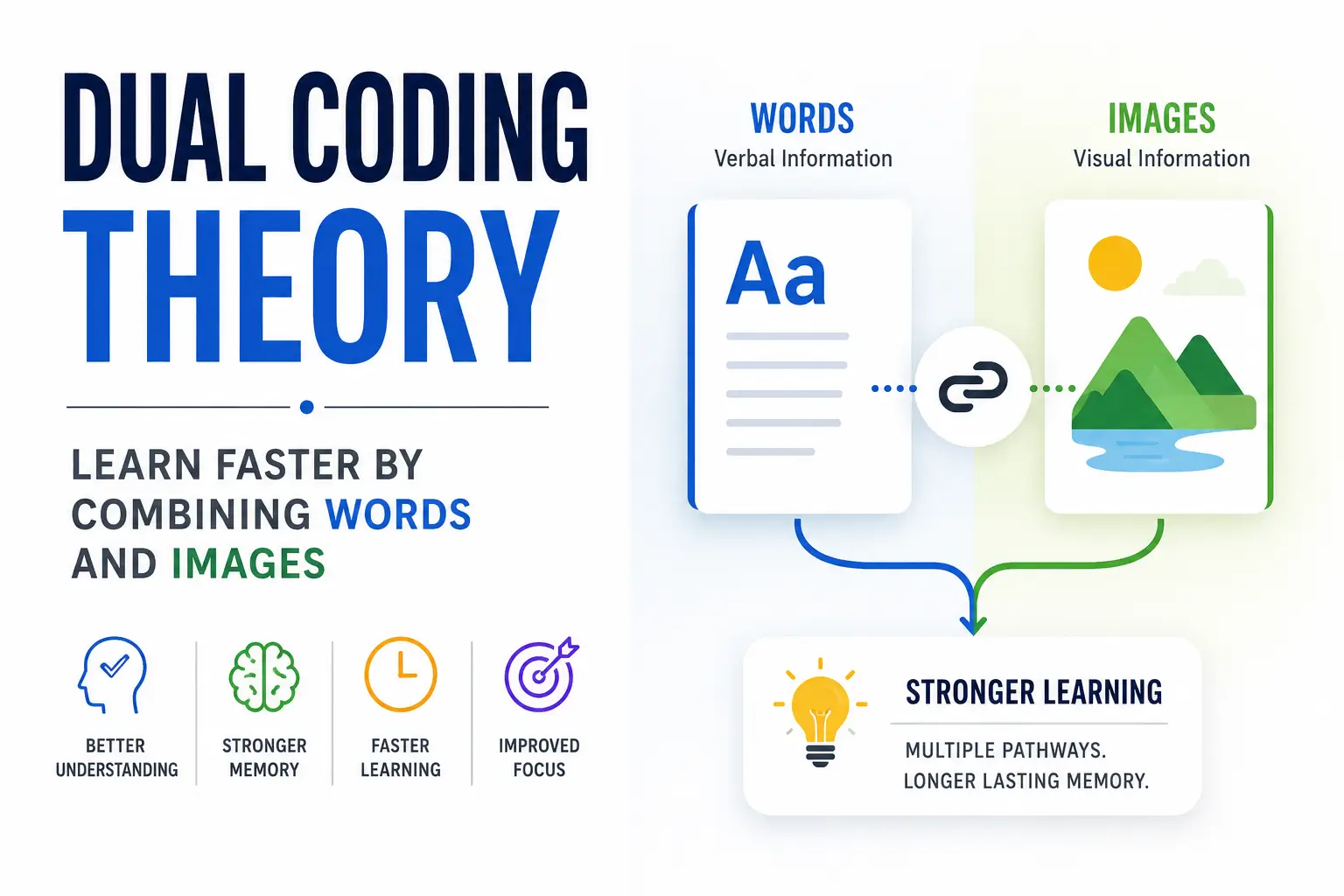
Another effective combination involves Dual Coding Theory.
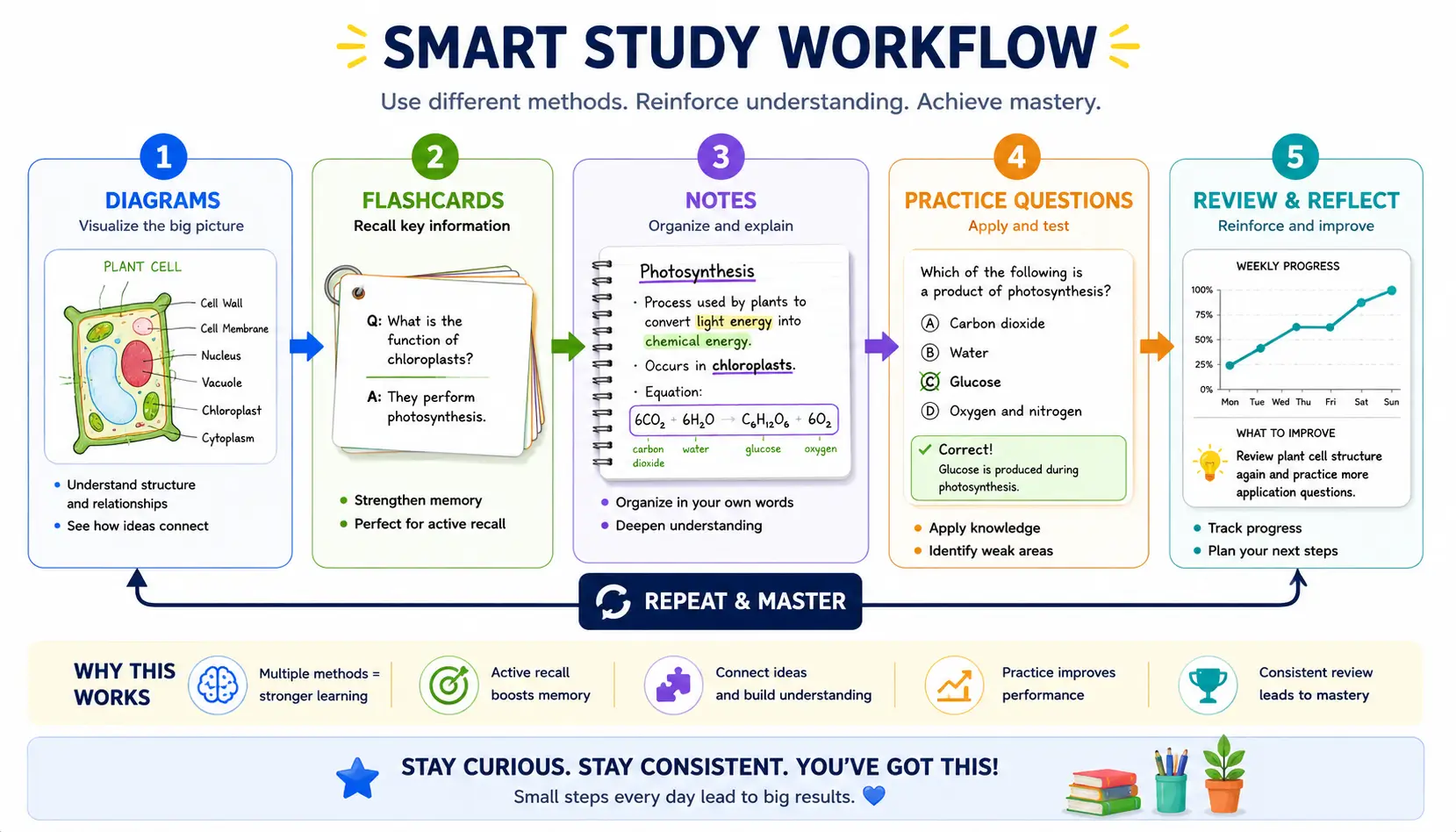
Instead of studying information in a single format, learners can alternate between:
- Text explanations
- Diagrams
- Visual summaries
- Concept maps
- Practice questions
Different representations help create richer mental models.
Interleaving adds variety to the learning process while dual coding strengthens understanding through multiple pathways.
The result is often deeper comprehension and improved recall.
Why Interleaving Improves Problem Solving
Many study techniques focus primarily on memorization.
Interleaving offers an additional benefit.
It helps learners decide when and how to apply knowledge.
Real-world problems rarely announce which solution strategy should be used.
You must recognize patterns and select the appropriate approach.
Interleaving develops exactly this skill.
By repeatedly switching between concepts, learners become better at identifying differences and similarities.
This often leads to stronger problem-solving performance.
Interleaving and Cognitive Load Theory
At first glance, interleaving seems as though it would increase mental overload.
After all, constantly switching topics sounds more demanding than focusing on a single subject.
In the short term, that is often true.
However, the relationship becomes more interesting when viewed through the lens of Cognitive Load Theory.
Effective learning is not simply about making tasks easy.
It is about directing mental effort toward activities that create lasting understanding.
The challenge created by interleaving often encourages deeper processing, which can lead to stronger learning outcomes.
The Role of Metacognition
Interleaving can also improve Metacognition, or the ability to think about your own thinking.
Because interleaving exposes strengths and weaknesses more clearly, learners gain a more realistic understanding of what they actually know.
This can be uncomfortable.
Blocked practice often creates an illusion of mastery.
Interleaving removes that illusion.
While this may reduce confidence temporarily, it often improves long-term performance.
In other words, interleaving helps learners become better judges of their own knowledge.
Common Interleaving Mistakes
Mixing Completely Unrelated Topics
Interleaving works best when concepts are related enough to benefit from comparison.
Switching between completely unrelated tasks may simply create distraction.
Switching Too Frequently
Changing topics every few minutes can reduce focus.
Most learners benefit from blocks that are long enough to allow meaningful engagement before transitioning.
Abandoning Topics Too Early
Interleaving should not replace learning fundamentals.
If a concept is completely unfamiliar, some focused study may be necessary before mixing it with others.
Confusing Difficulty With Failure
Interleaving often feels harder than blocked practice.
This does not mean it is less effective.
In many cases, the opposite is true.
Who Should Use Interleaving?
Interleaving can benefit almost anyone who needs to learn complex information.
It is particularly useful for:
- Students preparing for exams
- Language learners
- Professionals studying certifications
- Musicians
- Athletes
- Technical learners
The broader and more complex the subject matter, the more valuable interleaving often becomes.
This is especially true when learners need to apply knowledge flexibly rather than simply memorize facts.
Supporting Long-Term Cognitive Performance
Interleaving is one of many evidence-based learning strategies that improve memory and understanding.
However, learning performance is also influenced by sleep quality, physical activity, stress management, and overall cognitive health.
Successful learners often combine effective study methods with healthy daily habits that support brain function.
Readers interested in supporting memory and cognitive wellness can learn more about Advanced Memory Formula, which provides information about nutritional support for healthy memory function.
Learning Smarter, Not Just Harder
Interleaving challenges a common assumption about studying.
Many people believe that mastering one topic before moving to another is always the best approach.
Learning research suggests otherwise.
By strategically mixing related concepts, learners can improve retention, problem-solving ability, and long-term understanding.
The process may feel more difficult at first.
But that difficulty often signals deeper learning.
Sometimes the most effective learning strategy is not the one that feels easiest.
It is the one that prepares you to use knowledge when it truly matters.