
Now Reading: Sleep and Memory Consolidation: How Rest Helps Your Brain Store What You Learn
-
01
Sleep and Memory Consolidation: How Rest Helps Your Brain Store What You Learn
Sleep and Memory Consolidation: How Rest Helps Your Brain Store What You Learn
Have you ever studied something in the evening, gone to sleep, and found it easier to remember the next day?
Or noticed that after a poor night’s sleep, focusing and recalling information feels much more difficult?
These experiences are not coincidences.
They reflect one of the most important relationships in cognitive science:
The connection between sleep and memory consolidation.
For many years, researchers viewed sleep primarily as a period of rest.
Today, neuroscience tells a different story.
While the body recovers during sleep, the brain remains surprisingly active.
Some of the most important processes involved in learning and memory continue long after studying has ended.
This is one reason sleep is often considered an essential part of learning itself.
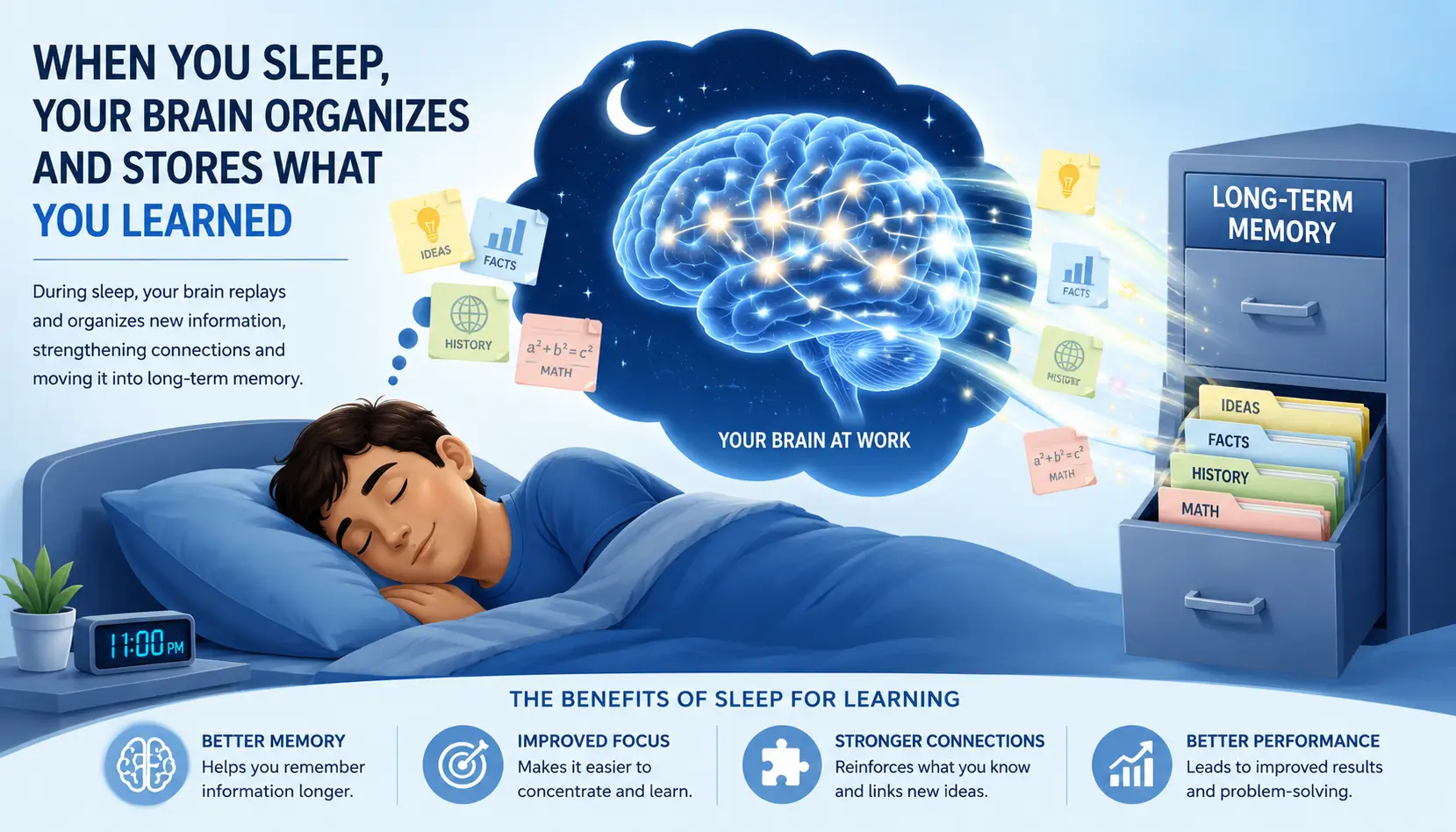
What Is Memory Consolidation?
Before understanding sleep’s role, it helps to understand Memory Consolidation.
Memory consolidation is the process through which newly learned information becomes stronger, more stable, and easier to retrieve.
When information is first learned, the memory is often fragile.
Without reinforcement, it may fade quickly.
Consolidation helps transform that fragile memory into something more durable.
The process continues after learning has ended and is heavily influenced by sleep.
Why Sleep Matters for Learning
Many people focus exclusively on study techniques.
They spend time choosing learning methods, creating flashcards, and reviewing notes.
These strategies are important.
However, learning does not end when the study session ends.
The brain still needs time to process and stabilize information.
Sleep provides that opportunity.
Researchers have found that people often perform better on memory tasks after sleep than after an equivalent period of wakefulness.
This suggests that sleep contributes directly to memory formation.


🔬 The Science Behind Sleep and Memory
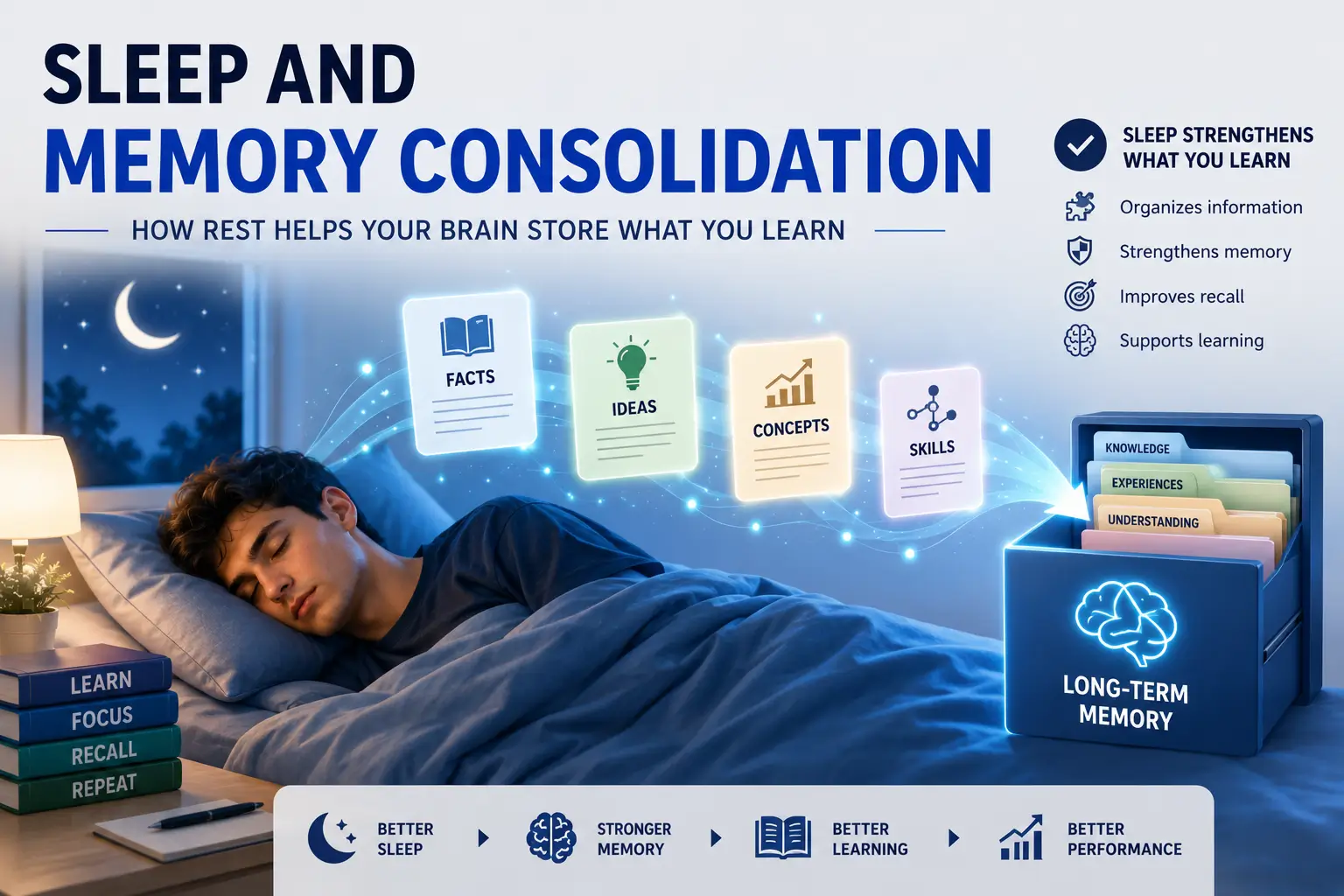
Research has shown that sleep supports multiple forms of memory, including declarative memory, procedural memory, and skill learning.
During sleep, the brain appears to reactivate and reorganize newly acquired information.
This activity may help strengthen memory traces and integrate new knowledge into existing memory networks.
Although researchers continue investigating the exact mechanisms, the connection between sleep and memory consolidation is one of the most consistently supported findings in cognitive neuroscience.
Source: https://www.sleepfoundation.org/how-sleep-works/memory-and-sleep
Learning happens during study. Memory strengthening often continues during sleep.
What Happens in the Brain During Sleep?
While sleeping, the brain does much more than rest.
Neural activity continues throughout the night.
Researchers believe that some recently learned information is replayed and reorganized during certain sleep stages.
This process may help stabilize memories and improve future recall.
Rather than being inactive, the sleeping brain remains deeply engaged in information processing.
In many ways, sleep can be viewed as part of the learning cycle.
Sleep and Long-Term Memory Formation
One of sleep’s most important functions is supporting long-term memory.
Information stored temporarily during the day may become more stable after sleep.
This transition helps explain why people sometimes remember material more clearly the following morning.
The memory has had additional time to consolidate.
Without adequate sleep, this process may become less effective.
The result can be weaker retention and more forgetting.
Sleep and Active Recall
Active Recall is one of the most effective learning techniques because it strengthens retrieval pathways.
Sleep complements this process.
After successful retrieval practice, sleep may help reinforce the memory traces that were activated during learning.
The combination of retrieval and sleep often creates stronger long-term retention than either strategy alone.
This is one reason many learners benefit from reviewing material before bed.
Sleep and Retrieval Practice
A similar relationship exists between sleep and Retrieval Practice.
Retrieval helps identify important information.
Sleep may then help stabilize that information through consolidation processes.
Together, these mechanisms create a powerful learning partnership.
One strengthens memory during study.
The other supports memory after study.
Can Sleep Improve Recall?
In many cases, yes.
People often report improved recall after sleeping.
Researchers have observed similar patterns in laboratory studies.
Although sleep does not magically create knowledge, it can help preserve and strengthen what has already been learned.
The result may be faster retrieval, greater accuracy, and stronger memory performance.
This makes sleep one of the most overlooked learning tools available.
Why Sleep Deprivation Hurts Learning
When sleep is restricted, both learning and memory can suffer.
Attention declines.
Working memory becomes less efficient.
Focus becomes harder to maintain.
New information may be encoded less effectively.
Even highly motivated learners often struggle when sleep quality is poor.
The problem is not effort.
The problem is that the brain is missing one of its most important recovery and consolidation processes.
Sleep and Working Memory
Sleep influences far more than long-term memory.
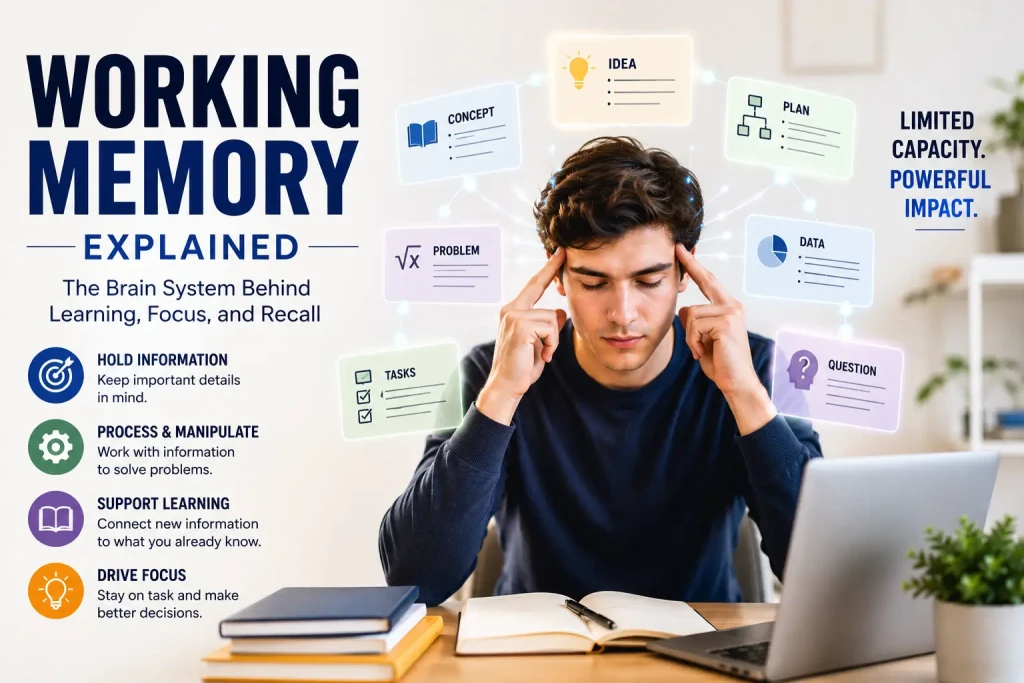
It also affects Working Memory, the mental system responsible for temporarily holding and processing information.
When people are sleep deprived, working memory performance often declines.
Tasks that require concentration, reasoning, and decision-making become more difficult.
This is one reason learners frequently feel mentally overwhelmed after a poor night’s sleep.
The brain has fewer cognitive resources available for learning and problem-solving.
Why Reviewing Before Sleep Can Be Effective
Many students instinctively review important material before bed.
Interestingly, research suggests there may be good reasons for this habit.
When information is studied shortly before sleep, there may be fewer competing experiences interfering with newly formed memories.
The information remains relatively fresh as consolidation processes begin.
This does not mean late-night cramming is ideal.
However, strategic review followed by adequate sleep can be an effective combination.
Sleep and Spaced Repetition
Spaced Repetition and sleep complement each other remarkably well.
Spaced repetition strengthens memory through strategic review intervals.
Sleep supports the consolidation of information reviewed during those intervals.
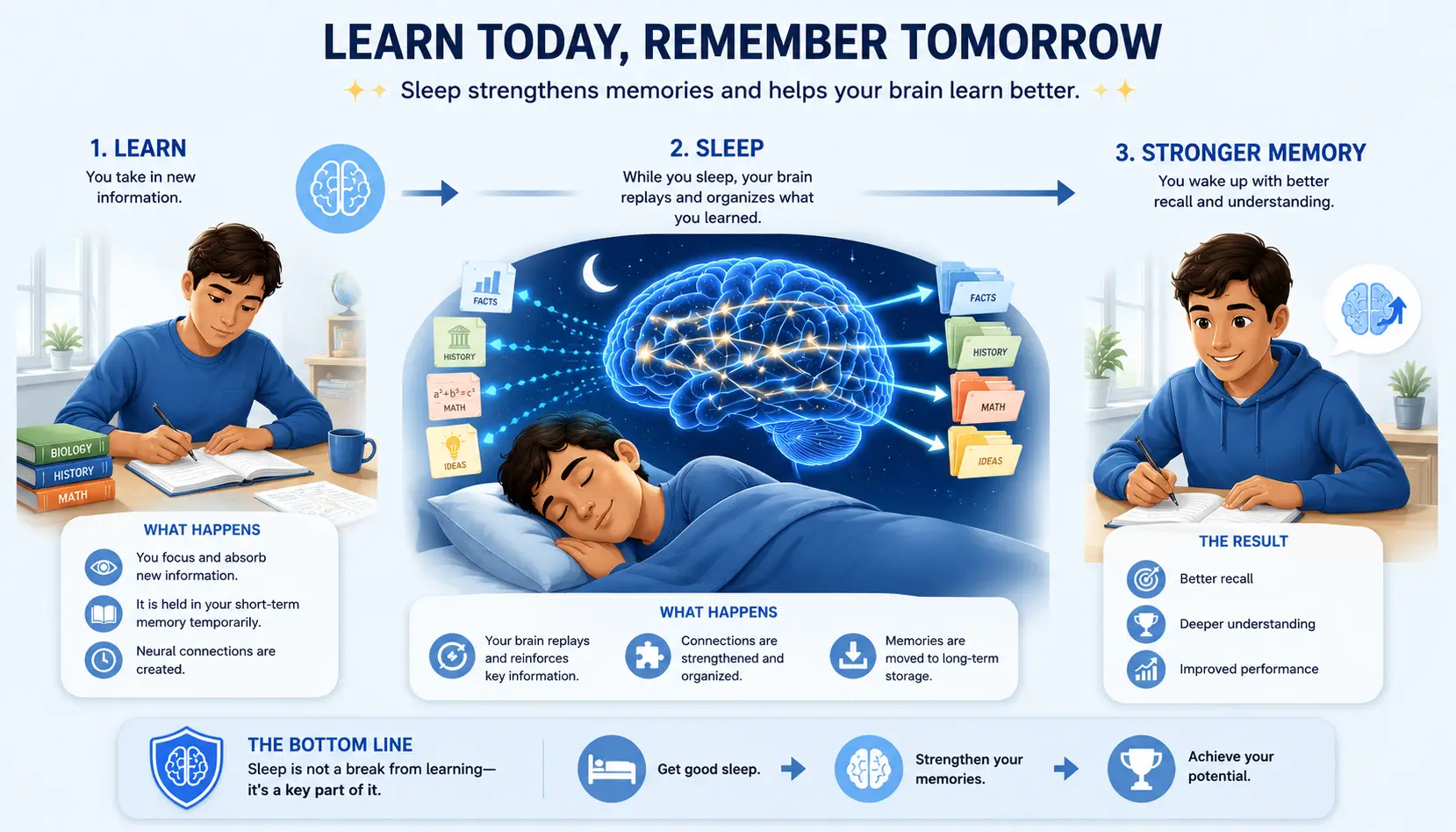
Together, they create a powerful cycle:
- Learn information
- Retrieve information
- Sleep
- Strengthen memory
- Review again later
This combination helps explain why distributed learning generally outperforms cramming.
Does More Sleep Always Mean Better Memory?
Not necessarily.
Sleep quality matters just as much as sleep quantity.
Spending many hours in bed does not automatically guarantee effective memory consolidation.
Factors such as sleep consistency, interruptions, stress levels, and overall sleep quality can influence cognitive performance.
The goal is not simply more sleep.
The goal is healthy, restorative sleep.
Common Sleep Mistakes That Hurt Learning
Sacrificing Sleep for Extra Study Time
This is one of the most common mistakes students make.
Extra study hours may appear productive, but sacrificing sleep can reduce the effectiveness of learning.
Without sufficient consolidation, newly learned information may be forgotten more easily.
Irregular Sleep Schedules
Constantly changing sleep schedules can interfere with consistent recovery and memory processes.
Regular sleep patterns generally support better cognitive performance.
Studying While Exhausted
Learning becomes significantly less efficient when attention and working memory are impaired by fatigue.
Sometimes the most productive decision is to sleep first and study later.
Sleep and Cognitive Load
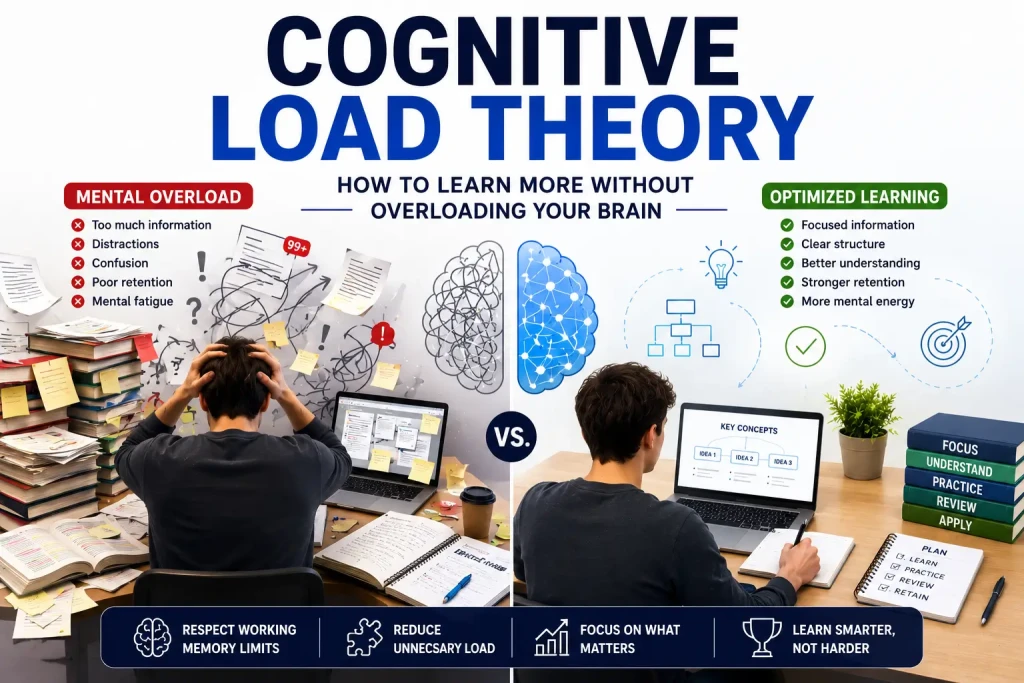
Sleep also interacts with Cognitive Load Theory.
When people are tired, mental resources become more limited.
Working memory capacity feels smaller.
Complex tasks require greater effort.
Information overload occurs more easily.
Adequate sleep helps protect cognitive resources and supports more efficient learning.
How to Support Sleep-Related Memory Consolidation
Although memory consolidation occurs automatically, several habits may help support the process.
- Maintain a consistent sleep schedule.
- Prioritize adequate sleep duration.
- Review important material before sleep.
- Use Active Recall during study sessions.
- Apply Spaced Repetition over time.
- Manage stress levels when possible.
These habits support both learning and long-term memory retention.
Small improvements in sleep quality can sometimes produce noticeable improvements in cognitive performance.
Supporting Memory Beyond Sleep
Sleep is one of the most powerful tools for memory consolidation, but it is not the only factor involved.
Learning strategies, nutrition, exercise, attention management, and overall cognitive health also influence memory performance.
Many learners combine evidence-based study techniques with broader approaches that support long-term brain health.
Readers interested in memory-supportive nutritional strategies can learn more about Advanced Memory Formula.
One of the Most Powerful Learning Tools Is Free
People often search for better study techniques, smarter flashcards, and more efficient learning systems.
These tools can certainly help.
However, one of the most effective learning aids is something many people overlook:
Sleep is not time away from learning. Sleep is part of learning.
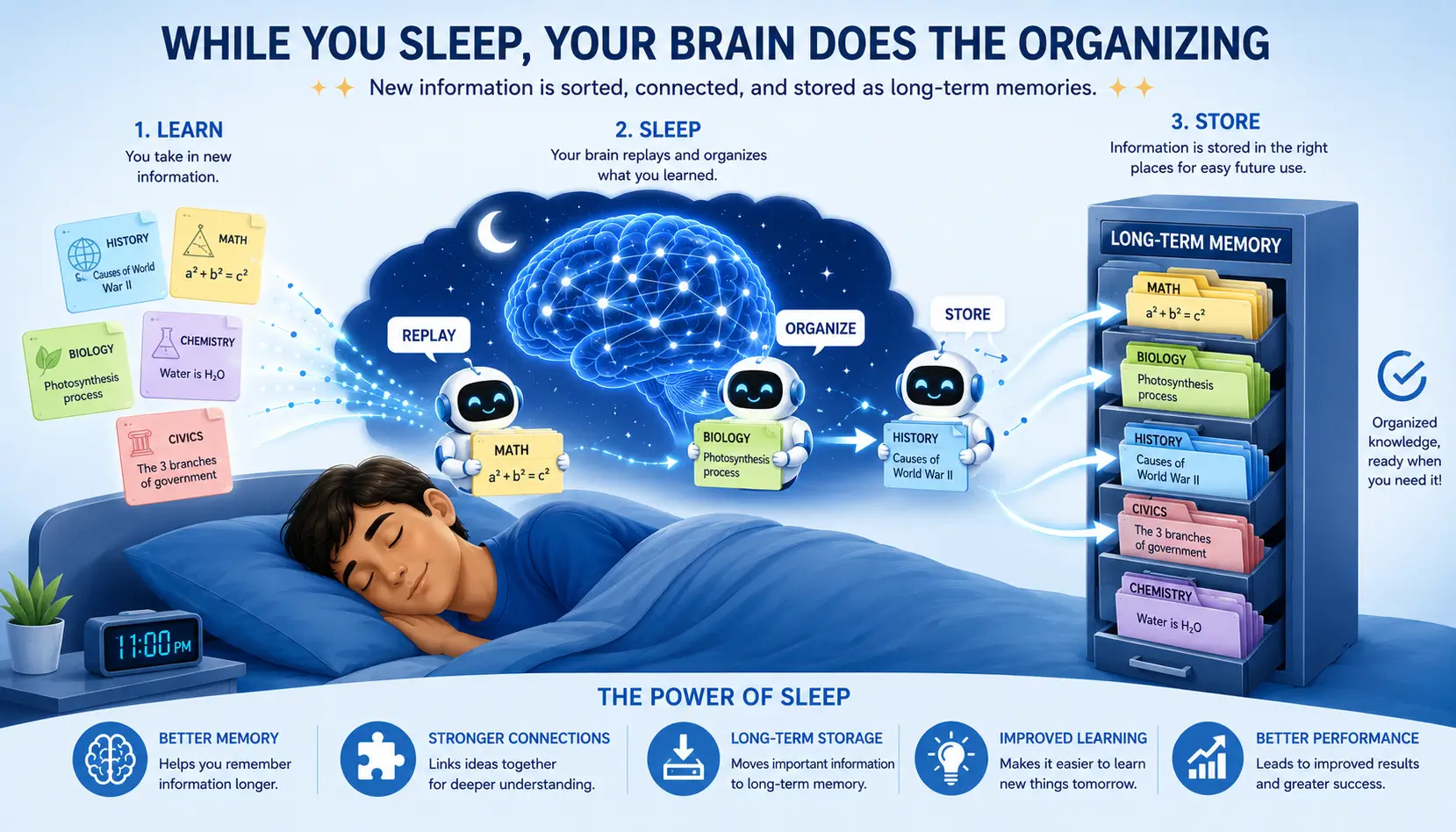
During sleep, the brain continues organizing, strengthening, and preserving the information acquired during the day.
Understanding this relationship can help learners make better decisions about studying, reviewing, and recovery.
Sometimes the best thing you can do for your memory is simply get a good night’s sleep.
Related Topics
- Memory Consolidation Explained: How Your Brain Turns Learning Into Long-Term Memory
- Working Memory Explained: The Brain System Behind Learning, Focus, and Recall
- Spaced Repetition: The Proven System for Remembering More in Less Time
- Active Recall: The Science-Backed Study Method for Long-Term Memory