
Now Reading: Metacognition: How Thinking About Thinking Improves Learning and Memory
-
01
Metacognition: How Thinking About Thinking Improves Learning and Memory
Metacognition: How Thinking About Thinking Improves Learning and Memory

Imagine two students preparing for the same exam.
Both spend the same amount of time studying.
Both read the same material.
Both complete the same assignments.
Yet one consistently learns faster, remembers more, and performs better.
Why?
The answer often has less to do with intelligence and more to do with awareness.
Highly effective learners pay attention not only to what they are learning but also to how they are learning.
They evaluate their understanding, monitor their progress, identify weaknesses, and adjust their study strategies when necessary.
This ability is known as metacognition.
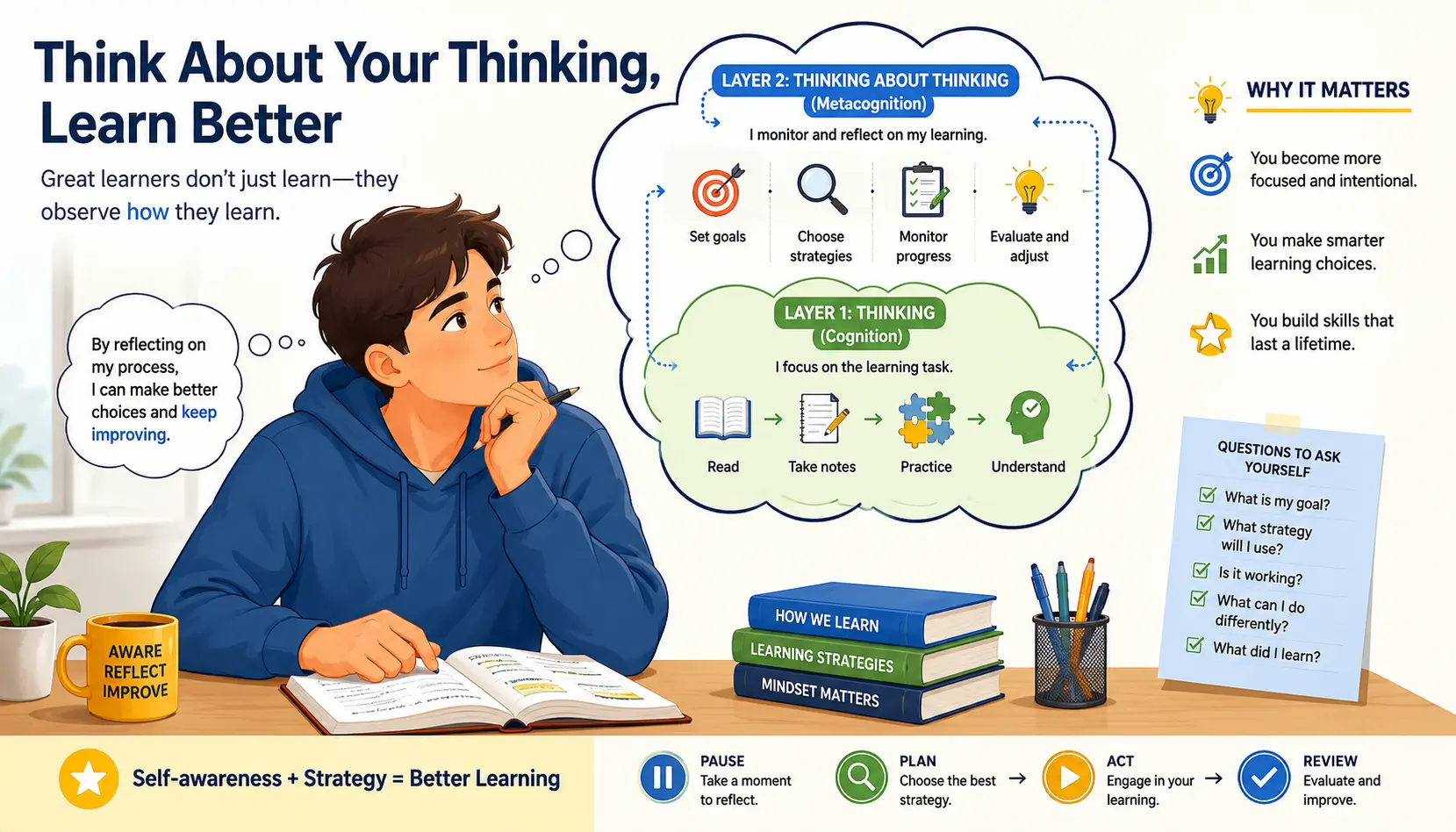
Metacognition is often described as “thinking about thinking.”
It is one of the most important skills in learning science because it helps learners become more intentional, efficient, and effective.
Rather than simply consuming information, metacognitive learners actively manage the learning process itself.
What Is Metacognition?
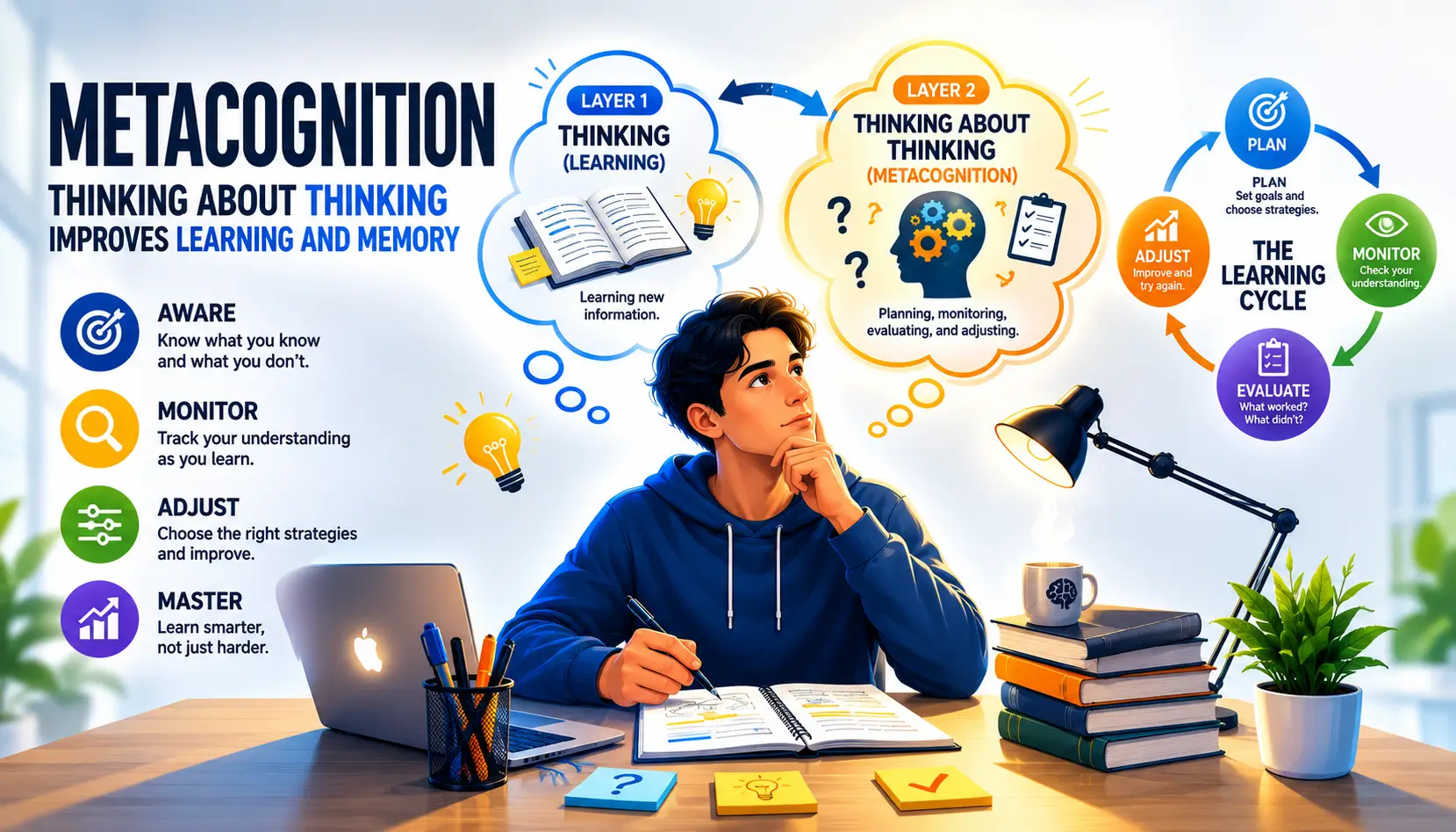
Metacognition refers to awareness and understanding of your own thought processes.
In simple terms, it means thinking about how you think, learn, remember, and solve problems.
Metacognition involves asking questions such as:
- Do I really understand this?
- What study method works best for me?
- Why am I struggling with this concept?
- What should I focus on next?
- How can I improve my learning strategy?
These questions help learners evaluate their own performance rather than studying blindly.
The result is often more efficient learning and stronger memory retention.
The Two Parts of Metacognition
Researchers often divide metacognition into two major components.
Metacognitive Knowledge
This refers to understanding how learning works.
Examples include:
- Knowing your strengths and weaknesses
- Understanding which study methods are effective
- Recognizing learning challenges
- Understanding task difficulty
Metacognitive Regulation
This refers to managing the learning process.
Examples include:
- Planning study sessions
- Monitoring progress
- Adjusting strategies
- Evaluating results
Together, these skills help learners make better decisions about how they learn.


Why Metacognition Matters
Many learners assume that studying longer automatically leads to better results.
Unfortunately, this is not always true.
Hours of ineffective studying may produce fewer results than a shorter session using evidence-based study techniques.
Metacognition helps learners recognize this difference.
Instead of asking:
“How much did I study?”
Metacognitive learners ask:
“How well did I learn?”
This shift in perspective often leads to smarter learning decisions.
🔬 The Science Behind Metacognition
Educational psychology research consistently shows that metacognitive skills are associated with improved academic performance.
Learners who monitor and regulate their thinking tend to make better strategic decisions and adapt more effectively to new challenges.
Rather than relying on intuition alone, they evaluate evidence from their own learning experiences.
Source: https://www.edutopia.org/article/teaching-students-how-learn
The key insight is simple:
The best learners do not just learn. They learn how they learn.
Metacognition and Active Recall
Metacognition works exceptionally well alongside Active Recall.
Active Recall helps strengthen memory through retrieval.
Metacognition helps determine whether retrieval is actually successful.
For example, a learner using Active Recall might discover:
- Which topics are easy
- Which topics are difficult
- Which information is frequently forgotten
- Where additional study is needed
This feedback loop helps guide future learning decisions.
The Illusion of Learning
This illusion can become especially strong when information feels familiar through recognition memory but cannot yet be recalled independently. One reason metacognition is so valuable is that learners are often poor judges of their own understanding.
Simply rereading notes can create a false sense of mastery.
The material feels familiar.
Recognition increases.
Confidence rises.
Yet actual recall may remain weak.
Metacognition helps expose these illusions.
Instead of relying on feelings, learners use evidence.
Can I explain the concept?
Can I answer questions about it?
Can I retrieve it without looking?
These questions provide far more accurate feedback.
Metacognition and Retrieval Practice
The relationship between metacognition and Retrieval Practice is particularly important.
Retrieval Practice generates feedback about what learners actually know.
Metacognition uses that feedback to improve future learning decisions.
Together, they create a powerful cycle of improvement.
Learning becomes less about guessing and more about evidence-based adjustment.
How Expert Learners Think Differently
Expert learners rarely assume they understand something simply because they have read it.
Instead, they constantly evaluate their own comprehension.
They monitor progress, identify weaknesses, and adapt strategies accordingly.
This habit often explains why some people continue improving rapidly while others plateau.
The difference is not always knowledge.
Sometimes it is awareness.
How to Develop Metacognitive Skills
The good news is that metacognition is not a fixed trait.
It is a skill that can be developed through practice.
The first step is becoming more intentional about learning.
Instead of simply completing study tasks, regularly evaluate your understanding.
Questions such as the following can be extremely helpful:
- What do I understand well?
- What am I struggling with?
- What strategy am I currently using?
- Is this strategy actually working?
- What should I do differently?
These questions transform learning from a passive activity into an active process of self-improvement.
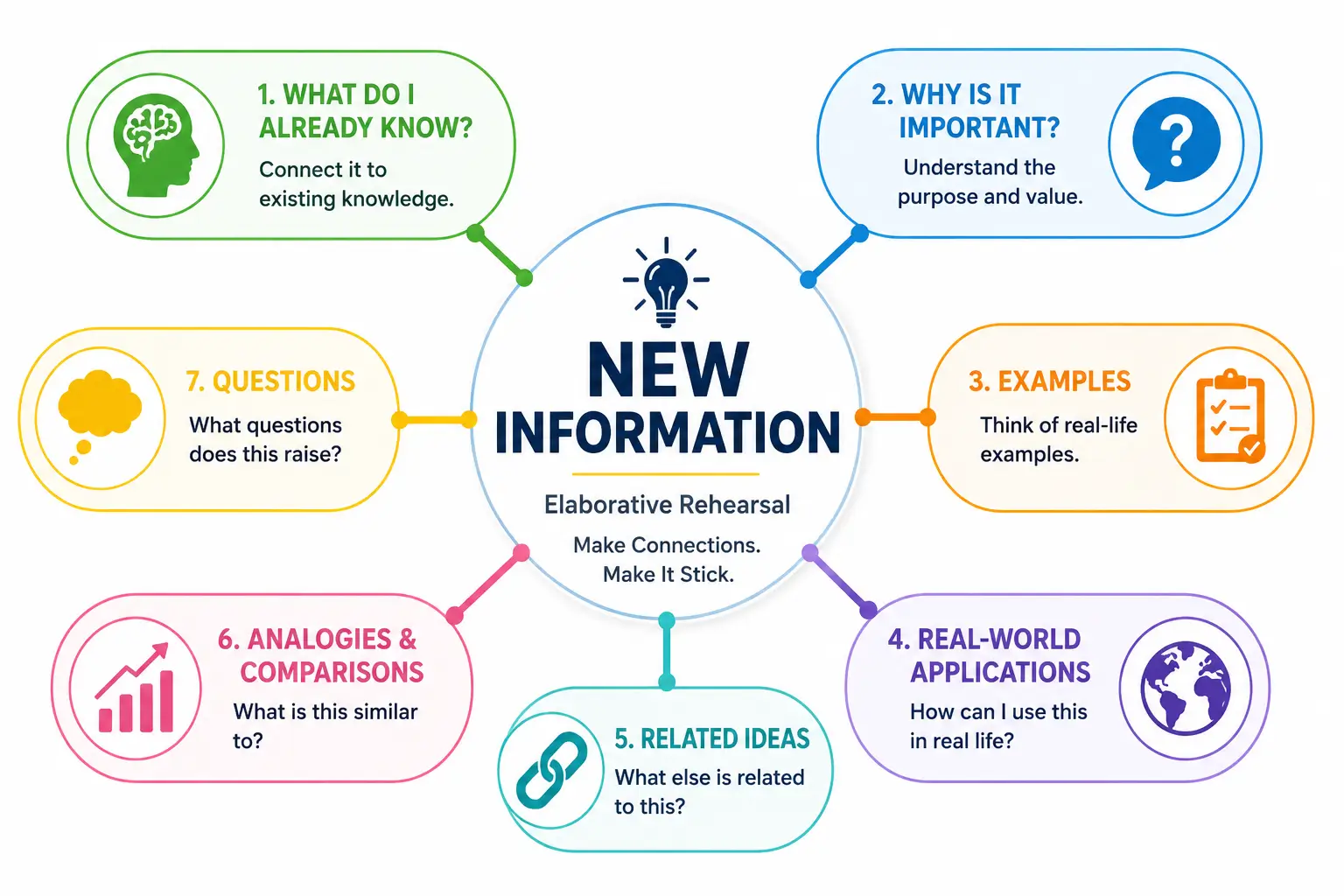
Metacognition and Elaborative Rehearsal
Metacognition works particularly well alongside Elaborative Rehearsal.
Elaborative rehearsal encourages learners to build meaningful connections between ideas.
Metacognition helps determine whether those connections truly improve understanding.
Together, they encourage deeper thinking and stronger memory formation.
Rather than simply collecting information, learners actively build knowledge structures they can use later.
Metacognition and the Feynman Technique
The Feynman Technique is one of the most practical tools for developing metacognitive awareness.
When you attempt to explain a concept in simple language, weaknesses quickly become visible.
Areas of confusion are exposed.
Knowledge gaps become obvious.
This feedback is extremely valuable.
Many learners discover that what they thought they understood is actually far less complete than they assumed.
That realization creates an opportunity for improvement.
Why Reflection Improves Learning
Reflection is one of the most powerful metacognitive habits.
After studying, many learners immediately move on to the next task.
Metacognitive learners pause and evaluate.
They ask:
- What worked well?
- What didn’t work?
- What should I change next time?
This simple practice helps learners refine their approach over time.
Small improvements accumulate and often produce significant long-term benefits.
Metacognition and Working Memory
Metacognitive awareness can also improve the use of Working Memory.
When learners recognize cognitive overload, they can adjust their study approach.
For example:
- Breaking large tasks into smaller steps
- Using visual aids
- Taking strategic breaks
- Applying chunking techniques
Awareness helps prevent inefficient learning habits and reduces unnecessary mental strain.
Common Metacognition Mistakes
Confusing Familiarity With Understanding
This is one of the most common learning mistakes.
Recognizing information is not the same as being able to retrieve or explain it.
Testing yourself provides more reliable evidence.
Never Monitoring Progress
Without feedback, learners often repeat ineffective study habits for months or even years.
Metacognition helps break that cycle.
Ignoring Weak Areas
Many people prefer studying material they already know.
Metacognitive learners deliberately identify weaknesses and spend more time improving them.
Assuming More Time Equals Better Learning
Effective learning depends on strategy, not just effort.
Ten focused minutes using evidence-based techniques may outperform an hour of passive review.
Metacognition in Everyday Life
Although metacognition is often discussed in educational settings, its benefits extend far beyond studying.
People use metacognitive skills when:
- Making decisions
- Solving problems
- Learning professional skills
- Managing projects
- Developing expertise
Understanding your own thinking helps improve performance in almost every area of life.
The ability to evaluate and adjust your approach is a valuable lifelong skill.
Supporting Better Learning and Cognitive Performance
Metacognition improves learning efficiency, but cognitive performance depends on multiple factors.
Sleep quality, stress levels, physical activity, attention management, and memory health all influence how effectively people learn and retain information.
Many learners combine evidence-based study techniques with broader strategies that support cognitive wellness.
Readers interested in memory-supportive nutritional approaches can learn more about Advanced Memory Formula.
The Skill Behind Every Great Learner
Metacognition is often described as learning how to learn.
It helps learners move beyond passive study habits and take control of their own development.
By monitoring understanding, evaluating progress, and adjusting strategies when necessary, learners become more effective and more independent.
The most successful learners are not always the ones who study the longest.
They are often the ones who understand their own learning process the best.
The better you understand how you learn, the better you can learn.