
Now Reading: Memory Consolidation Explained: How Your Brain Turns Learning Into Long-Term Memory
-
01
Memory Consolidation Explained: How Your Brain Turns Learning Into Long-Term Memory
Memory Consolidation Explained: How Your Brain Turns Learning Into Long-Term Memory

Have you ever studied something carefully, understood it perfectly, and then forgotten most of it a few days later?
Or perhaps you’ve experienced the opposite.
You learn something new, sleep on it, and suddenly it feels easier to remember the next day.
These experiences are not random.
They are closely connected to a process called memory consolidation.
Memory consolidation is the process through which newly acquired information becomes stable and long-lasting.
Without consolidation, learning would be temporary.
Experiences would fade quickly, and new knowledge would rarely survive beyond short-term memory.
Fortunately, the brain is constantly working behind the scenes to strengthen important memories and organize information for future use.
Understanding this process can help explain why some learning strategies are so effective and why sleep plays such a critical role in memory formation.
What Is Memory Consolidation?
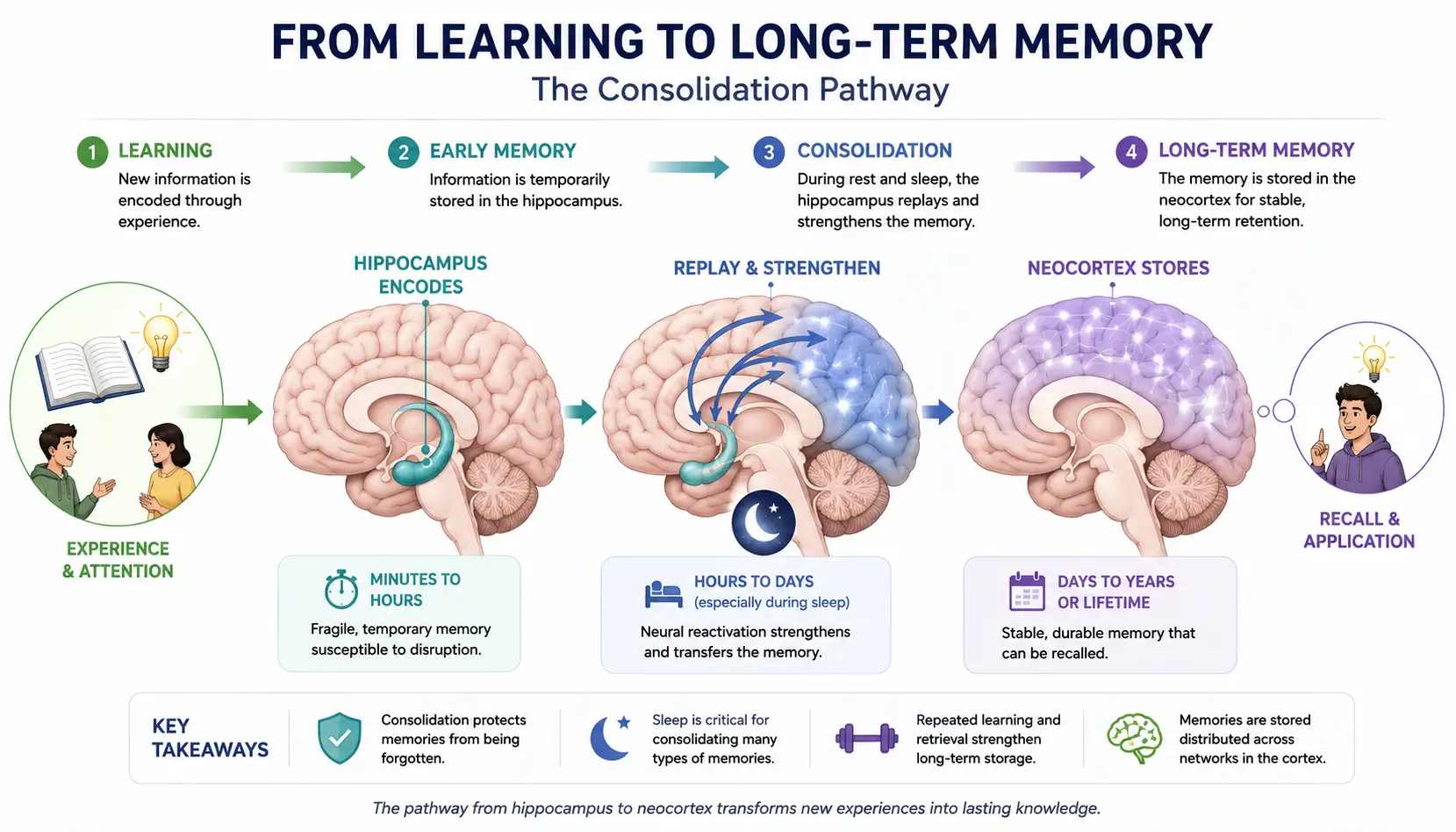
Memory consolidation is the process through which fragile new memories become stronger, more stable, and easier to retrieve.
When you first learn something, the memory is often vulnerable.
Distractions, interference, and time can weaken it.
Consolidation helps protect and strengthen that memory.
Over time, information becomes integrated into existing knowledge networks and stored more effectively for future recall.
Without consolidation, learning would be far less durable.
Why Learning Doesn’t End When Studying Stops
Many people assume learning ends when a study session finishes.
Neuroscience suggests otherwise.
Some of the most important memory processes occur after learning has already taken place.
The brain continues processing information long after active studying ends.
This ongoing activity helps explain why review sessions, retrieval practice, and sleep can have such powerful effects on memory.
Learning is not simply about acquiring information.
It is also about stabilizing it.


The Journey From Short-Term Memory to Long-Term Memory
New information often begins in a temporary state.
If that information is not reinforced, it may disappear quickly.
However, when learning is meaningful, repeated, or frequently retrieved, the chances of long-term storage increase.
Memory consolidation helps move information from temporary storage toward more durable long-term memory systems.
This process does not happen instantly.
It develops over time through biological changes within the brain.
🔬 The Science Behind Memory Consolidation
Researchers have spent decades studying how memories are formed and strengthened.
One of the most important findings is that memory formation is not a single event.
Instead, it is a dynamic process involving multiple brain regions and ongoing neural activity.
Studies suggest that newly learned information undergoes gradual stabilization before becoming a durable memory.
This process involves changes in neural connections that make future retrieval easier.
Source: https://www.ncbi.nlm.nih.gov/books/NBK547693/
The key insight is simple:
Learning creates memories. Consolidation helps preserve them.
Why Some Memories Last and Others Fade
Some memories may also change after recall, a process explored in Memory Reconsolidation and False Memory.
Not every experience receives the same level of consolidation.
The brain tends to prioritize information that appears important.
Factors that can influence memory strength include:
- Attention
- Repetition
- Emotional significance
- Meaningful connections
- Retrieval frequency
Information that receives stronger reinforcement is generally more likely to survive over time.
This helps explain why emotionally significant experiences often remain vivid for years while less meaningful details disappear quickly.
Memory Consolidation and Active Recall
One of the reasons Active Recall is so effective is that retrieval strengthens memory.
Every successful retrieval signals that information remains important.
This repeated activation can support the consolidation process.
Rather than allowing memories to weaken, retrieval helps reinforce them.
The memory becomes easier to access and more resistant to forgetting.
Memory Consolidation and Retrieval Practice
A similar relationship exists between consolidation and Retrieval Practice.
Retrieval Practice repeatedly activates memory pathways.
This activation helps strengthen connections associated with learned information.
As a result, future retrieval often becomes more successful.
Learning is not strengthened by exposure alone.
It is strengthened by successful retrieval.
The Role of Meaningful Learning
Memory consolidation is often stronger when information is meaningful.
This is one reason techniques such as Elaborative Rehearsal can be so effective.
When new information is connected to existing knowledge, the brain has more opportunities to integrate it into long-term memory networks.
The richer the connections, the stronger the potential memory trace becomes.
Meaning helps create stability.
Memory Consolidation and the Forgetting Curve
The process of consolidation also helps explain the Ebbinghaus Forgetting Curve.
Without reinforcement, memories naturally weaken over time.
Consolidation slows this process.
Every successful review session provides another opportunity to strengthen memory and reduce forgetting.
This is why strategic review often produces much better results than cramming.
Types of Memory Consolidation
Researchers generally describe memory consolidation as occurring at multiple levels.
Although the biological details can be complex, the basic idea is straightforward.
Some consolidation occurs shortly after learning, while other forms can continue for much longer periods.
Memories are gradually strengthened, reorganized, and integrated into existing knowledge structures.
This ongoing refinement helps explain why memories often become more stable over time.
Why Sleep Plays Such a Critical Role
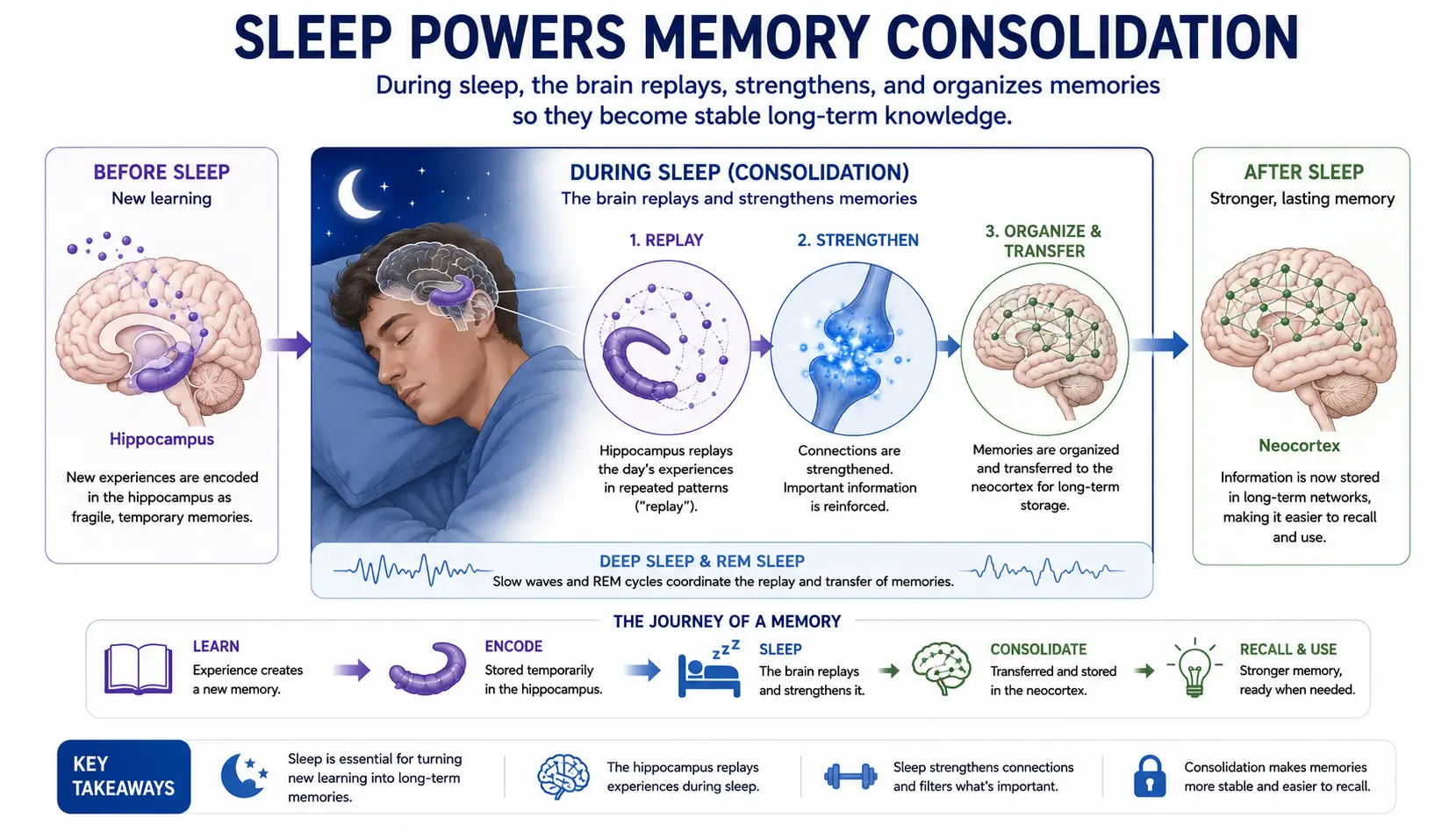
One of the most fascinating discoveries in neuroscience is the relationship between sleep and memory consolidation.
During sleep, the brain remains highly active.
Rather than shutting down, it continues processing information acquired throughout the day.
Researchers believe this activity helps strengthen newly formed memories and integrate them into long-term storage systems.
This is one reason why studying late into the night and sacrificing sleep often produces disappointing results.
The learning may occur, but the consolidation process is disrupted.
In many cases, sleep is not simply rest.
It is part of learning itself.
Memory Consolidation and Spaced Repetition
The effectiveness of Spaced Repetition is closely connected to consolidation.
Each review session reactivates a memory before it is completely forgotten.
This repeated activation strengthens the memory trace and improves long-term retention.
Rather than reviewing information continuously, spaced repetition strategically supports the consolidation process over time.
The result is stronger and more durable learning.
Why Cramming Often Fails
Many students rely on cramming before important exams.
While cramming can sometimes produce short-term recall, it rarely supports long-term retention effectively.
The problem is that consolidation requires time.
Information learned rapidly without sufficient review or sleep often remains fragile.
It may be accessible temporarily but becomes difficult to retrieve later.
This is one reason evidence-based study methods generally outperform last-minute memorization.
Memory Consolidation and Working Memory
Consolidation also helps explain the limitations of Working Memory.
Working memory temporarily holds information while it is actively being processed.
Without consolidation, much of that information may disappear.
Consolidation helps transform temporary mental activity into lasting knowledge.
It creates continuity between learning and remembering.
Signs That Consolidation Is Working
Although memory consolidation occurs largely outside conscious awareness, learners often notice its effects.
Common signs include:
- Improved recall after sleeping
- Greater fluency with familiar concepts
- Faster retrieval of information
- Reduced effort during recall
- Stronger understanding over time
Many people have experienced learning something difficult one day and finding it noticeably easier the next.
Consolidation may be one reason for this improvement.
Common Mistakes That Interfere With Consolidation
Insufficient Sleep
Sleep deprivation is one of the most significant obstacles to effective memory consolidation.
Without adequate sleep, newly learned information may not be strengthened as efficiently.
Passive Learning
Simply reading information repeatedly often produces weaker memory traces than active retrieval.
Techniques such as Active Recall and Retrieval Practice typically provide stronger reinforcement.
Massed Practice
Studying everything in a single session may create familiarity but often provides less support for long-term retention than distributed practice.
Lack of Meaningful Connections
Information connected to existing knowledge tends to be remembered more effectively.
Building relationships between ideas helps strengthen consolidation.
Can You Improve Memory Consolidation?
While memory consolidation is largely an automatic biological process, certain habits can support it.
Examples include:
- Prioritizing sleep
- Using spaced repetition
- Practicing active recall
- Reducing excessive stress
- Creating meaningful connections between ideas
- Reviewing information strategically
These habits do not guarantee perfect memory, but they can significantly improve the likelihood that important information will be retained.
Supporting Cognitive Health and Long-Term Memory
Memory consolidation depends on healthy brain function.
Alongside effective study techniques, factors such as nutrition, exercise, stress management, and sleep quality all contribute to cognitive performance.
Many learners combine evidence-based learning methods with broader approaches that support memory health and long-term cognitive function.
Readers interested in memory-supportive nutritional strategies can learn more about Advanced Memory Formula.
What Happens After Learning Matters
Memory consolidation reminds us that learning does not end when studying stops.
Some of the most important memory processes occur afterward.
Through consolidation, fragile new memories become stronger, more stable, and easier to retrieve.
This process helps transform information into knowledge and experiences into lasting memories.
Learning creates the memory. Consolidation helps it survive.
Understanding this process can help learners make better decisions about studying, reviewing, sleeping, and retaining information for the long term.