
Now Reading: Spaced Repetition: The Proven System for Remembering More in Less Time
-
01
Spaced Repetition: The Proven System for Remembering More in Less Time
Spaced Repetition: The Proven System for Remembering More in Less Time
Imagine learning a new concept today and still remembering it six months from now with only a few minutes of review.
For most people, that sounds unrealistic.
The usual pattern is familiar. You study hard, remember the information for a short period, and then gradually forget most of it.
This isn’t a sign that you’re bad at learning.
It’s how human memory naturally works.
The good news is that researchers have spent decades studying how forgetting happens and how it can be slowed down.
One of the most effective solutions ever discovered is called spaced repetition.
Instead of reviewing information over and over in a single session, spaced repetition spreads reviews across carefully chosen intervals. This simple adjustment dramatically improves long-term retention while reducing total study time.
Whether you’re studying a language, preparing for exams, learning technical skills, or simply trying to improve memory performance, spaced repetition can transform how you learn.
What Is Spaced Repetition?
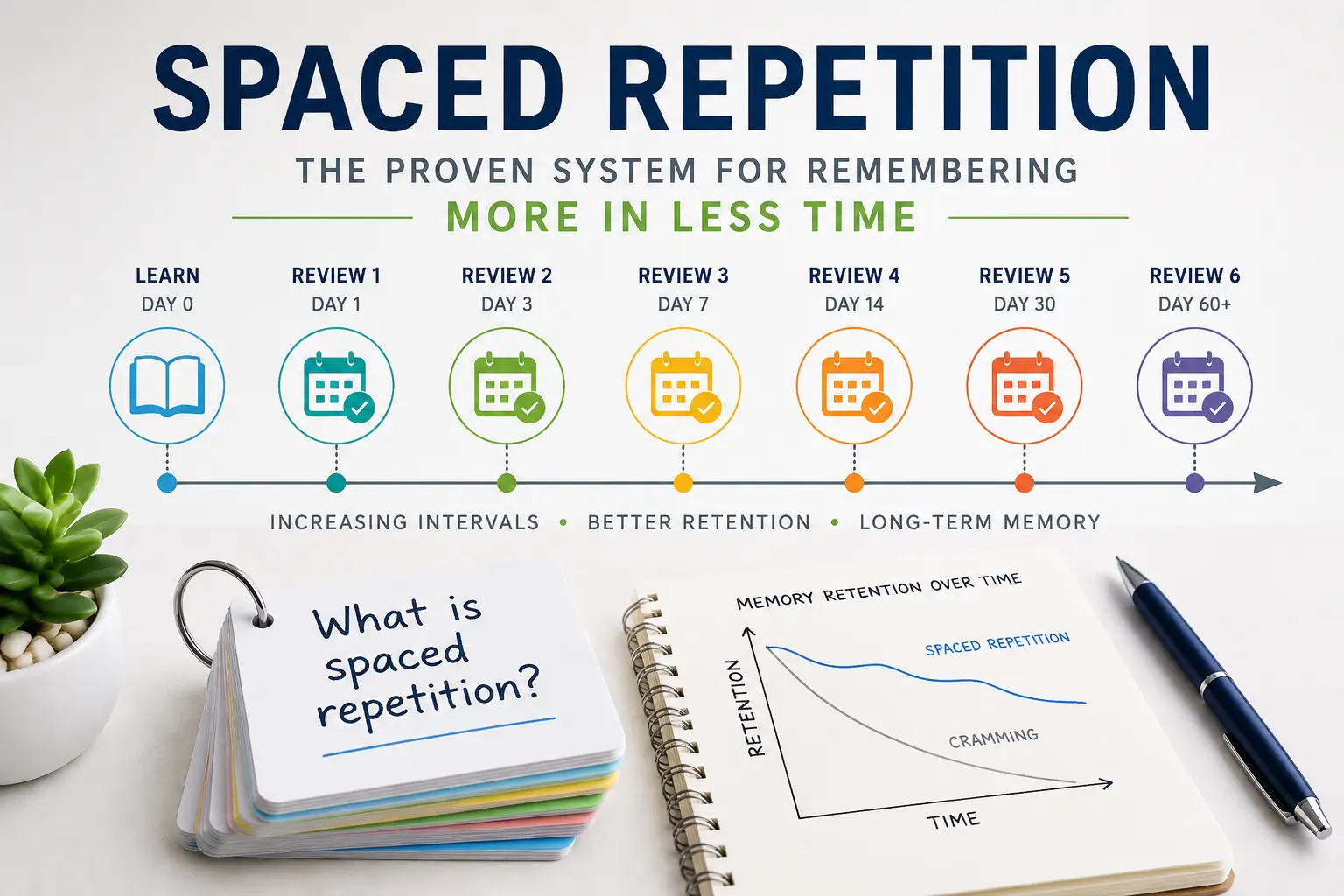
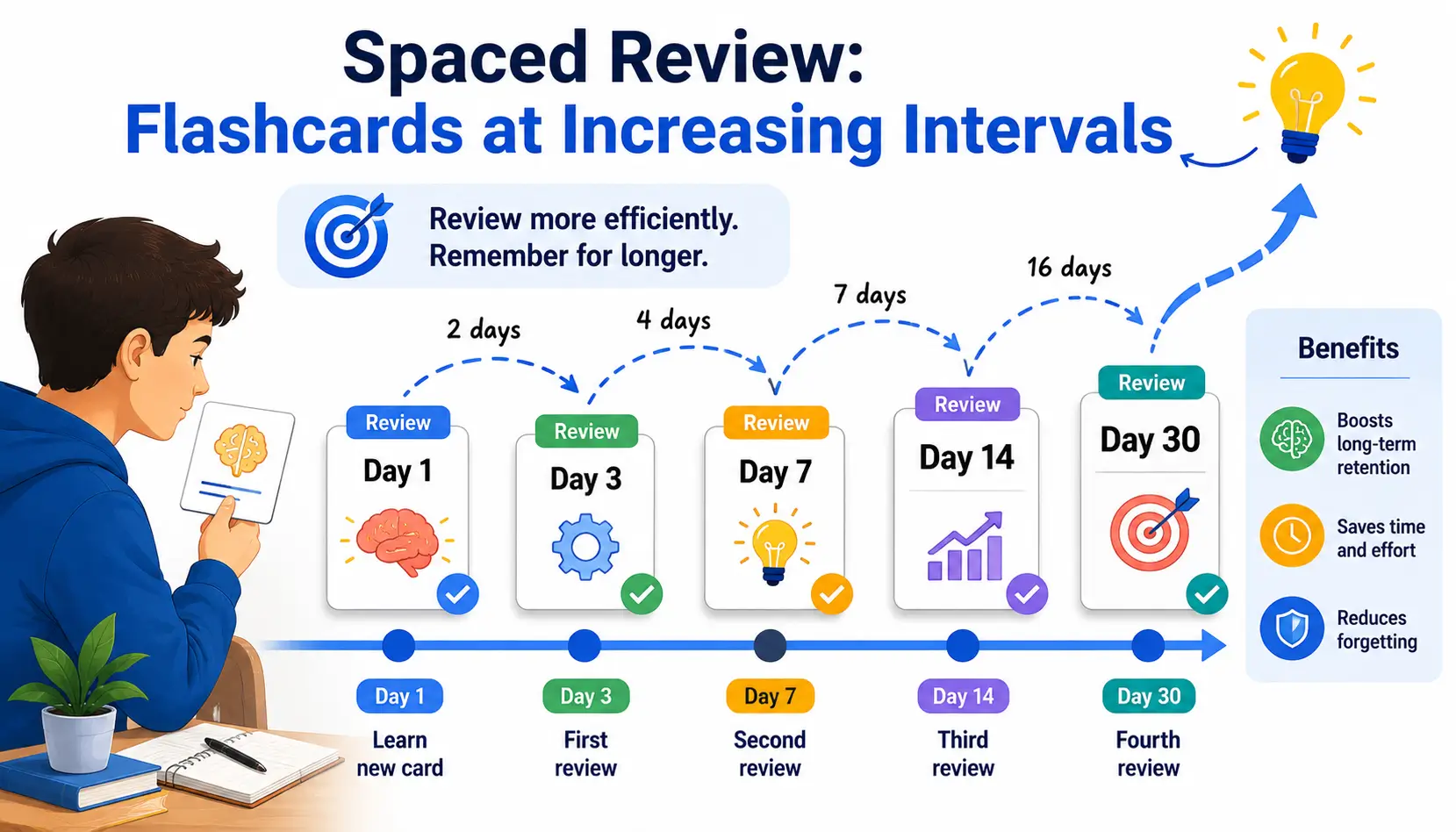
Spaced repetition is a learning technique that involves reviewing information at increasing intervals over time.
Instead of reviewing material repeatedly in a single day, you revisit it just before you’re likely to forget it.
The timing is important.
If you review too soon, you waste effort reviewing information you already remember.
If you wait too long, you may forget too much and need to relearn the material.
Spaced repetition aims for the ideal middle ground.
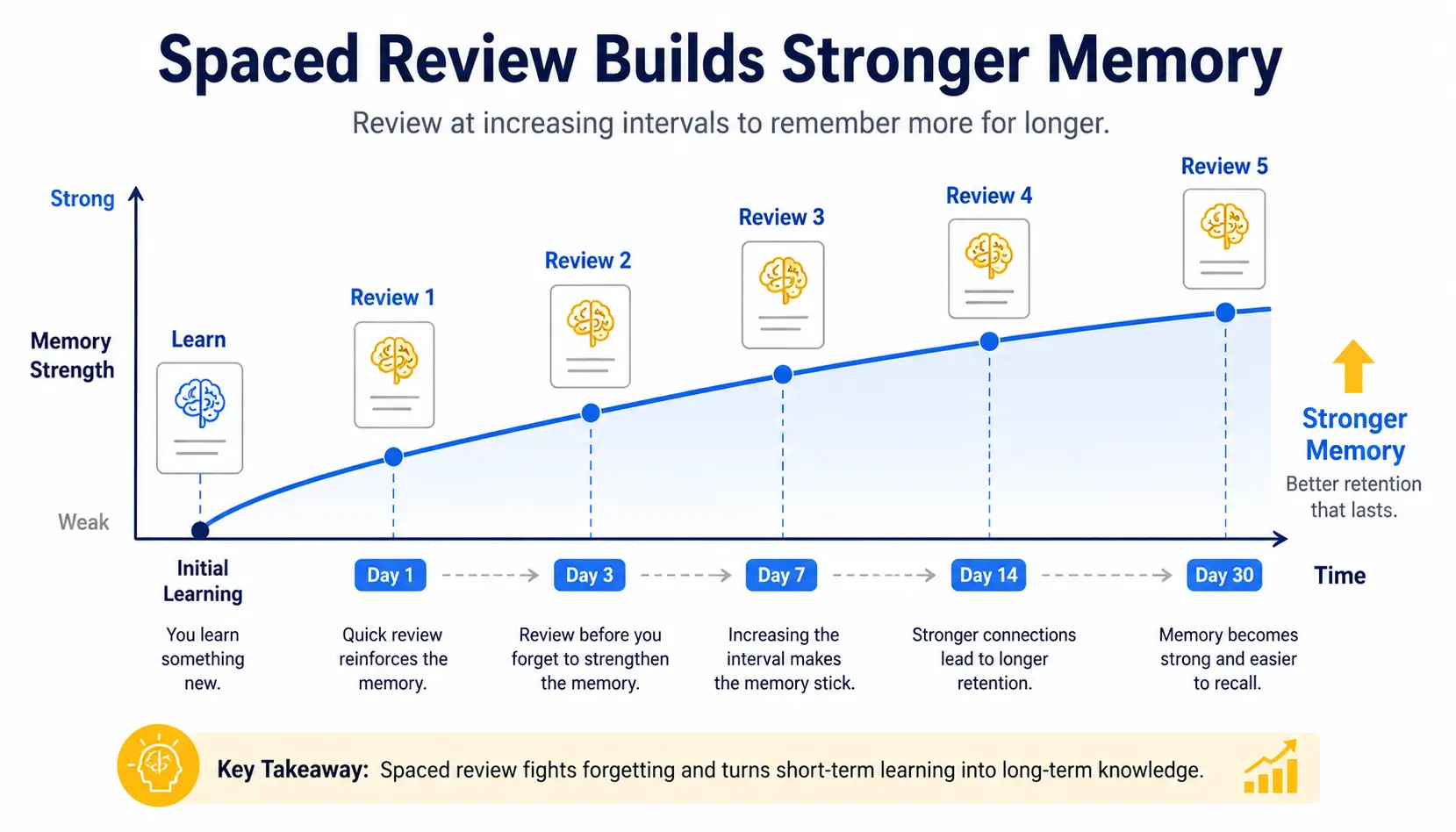
Every successful review strengthens memory and allows the next review to occur further in the future.
This is why spaced repetition is often considered one of the most efficient learning systems available.
Why We Forget Information
Forgetting can also happen when stored information becomes difficult to access because of retrieval failure or competition from similar memories through memory interference. To understand spaced repetition, we first need to understand forgetting.
Most memories weaken over time if they are not revisited.
Information that feels crystal clear today can become surprisingly difficult to recall just days or weeks later.
This process was famously studied by German psychologist Hermann Ebbinghaus.
His work led to what is now known as the Forgetting Curve.
The forgetting curve demonstrates that memory loss often happens rapidly after learning and then gradually slows over time.
Without review, much of what we learn disappears far sooner than we expect.


The Problem With Cramming
Cramming remains one of the most common study habits in the world.
Students often spend hours reviewing information immediately before an exam.
This approach can produce short-term results.
The problem is retention.
Cramming may help you remember information tomorrow.
It is far less effective at helping you remember information next month.
Spaced repetition takes the opposite approach.
Rather than concentrating review into a single session, it distributes learning across time.
This distribution strengthens long-term memory and reduces forgetting.
🔬 The Science Behind Spaced Repetition
The spacing effect has been replicated across decades of research.
Researchers consistently find that information reviewed across multiple spaced sessions is remembered better than information reviewed repeatedly in a single session.
A comprehensive review published in Psychological Science found strong evidence supporting distributed practice across a wide variety of learning environments.
Source: https://pubmed.ncbi.nlm.nih.gov/26173288/
Research has also shown that spacing improves retention across different age groups, subjects, and learning contexts.
The effect is remarkably reliable.
In simple terms:
Reviewing information at the right time helps the brain retain it for longer.
How Spaced Repetition Works
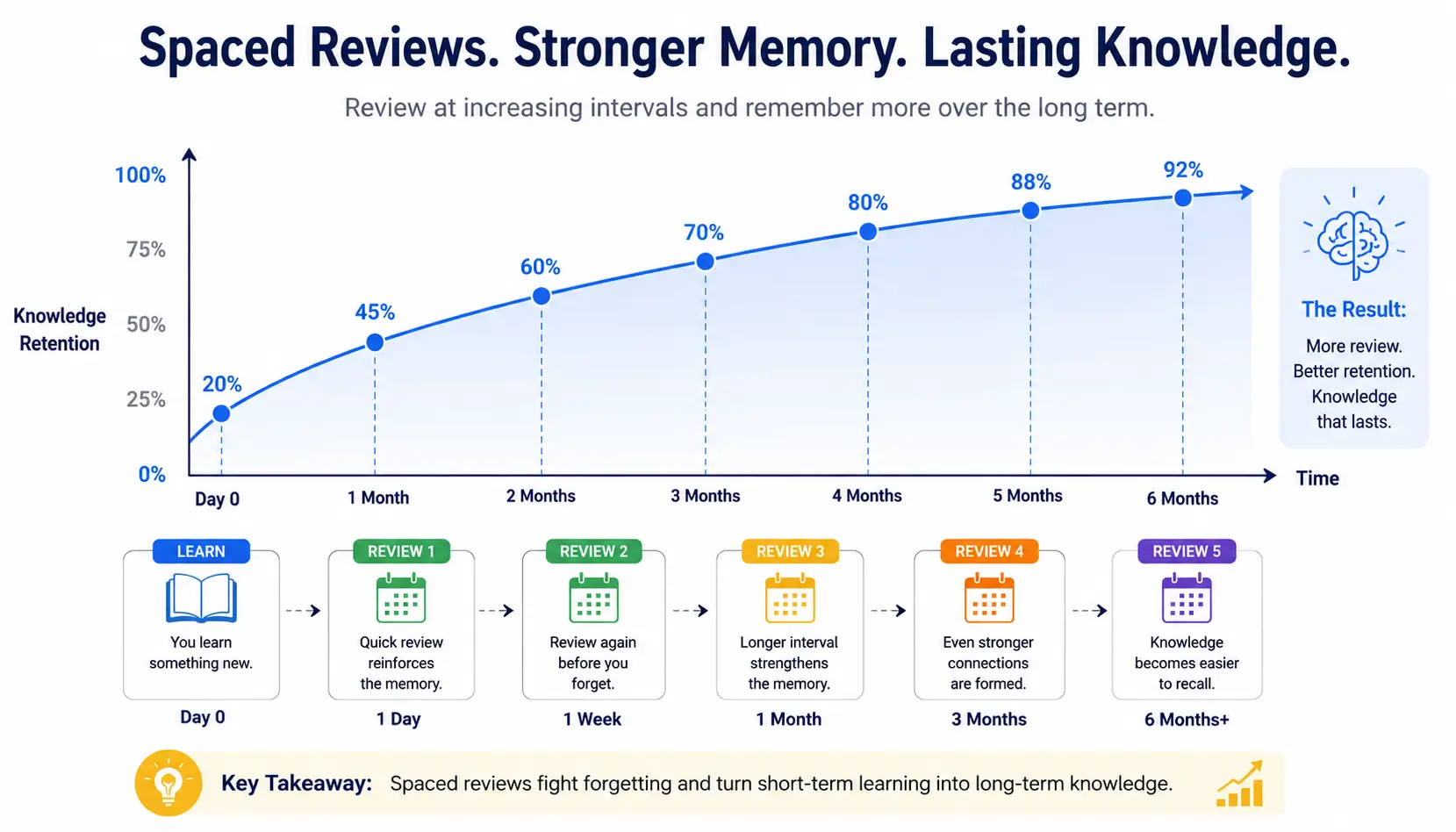
Imagine you learn a new fact today.
You review it tomorrow.
You remember it successfully.
The next review might occur three days later.
If you remember it again, the next review could occur one week later.
Then two weeks.
Then one month.
Then three months.
Each successful recall extends the interval between reviews.
This creates an efficient system where information that is easy to remember requires less attention while difficult information receives more review.
The process becomes even more powerful when combined with Active Recall.
Active recall strengthens retrieval.
Spaced repetition optimizes timing.
Together they form one of the most effective learning systems currently known.
Spaced Repetition vs Traditional Studying
Traditional studying often focuses on repetition.
Spaced repetition focuses on timing.
This distinction matters.
Repeating information ten times in one day is not the same as reviewing it five times across several weeks.
The second approach generally produces stronger retention with less total effort.
This is why many top-performing learners spend less time reviewing and more time reviewing strategically.
The Role of Retrieval in Spaced Repetition
Review alone is not enough.
The strongest results occur when spacing is combined with retrieval.
This is where Retrieval Practice and the Testing Effect become important.
Rather than simply reading information during each review session, you attempt to retrieve it from memory.
That retrieval strengthens the memory itself.
The spacing determines when the retrieval should occur.
Together, these two principles explain why spaced repetition systems consistently outperform passive review methods.
Who Benefits Most From Spaced Repetition?
The short answer is almost everyone.
Spaced repetition is especially valuable for learners who need to remember information for months or years rather than days.
- Students preparing for major exams
- Language learners
- Medical students
- Law students
- Engineers
- Professionals pursuing certifications
- Lifelong learners
Any situation that requires long-term retention can benefit from spacing.
The larger the amount of information you need to remember, the more useful spaced repetition becomes.
Using Spaced Repetition in Real Life
The beauty of spaced repetition is that it works across almost every learning domain.
The system doesn’t care whether you’re studying anatomy, learning Spanish, preparing for a certification exam, or trying to remember names and faces.
The underlying principle remains the same:
Review information shortly before you are likely to forget it.
That timing keeps memories active while minimizing unnecessary review.
Instead of spending hours repeatedly reviewing everything, you focus attention only where it’s needed.
How Anki Uses Spaced Repetition
One of the most popular spaced repetition tools is Anki Flashcards.
Anki uses an algorithm that adjusts review schedules based on your performance.
If you remember a card easily, the next review is scheduled further into the future.
If you struggle with a card, it appears again sooner.
This adaptive system allows learners to manage thousands of facts without wasting time on information they already know.
For language learners, medical students, and professionals studying large amounts of material, this can be incredibly efficient.
The real strength of Anki is that it combines spacing with Active Recall.
You are not simply reviewing information.
You are retrieving it.
The Leitner System: Spaced Repetition Without Software
Not everyone wants to use digital tools.
Fortunately, spaced repetition can also be implemented with physical flashcards.
The most famous approach is the Leitner System.
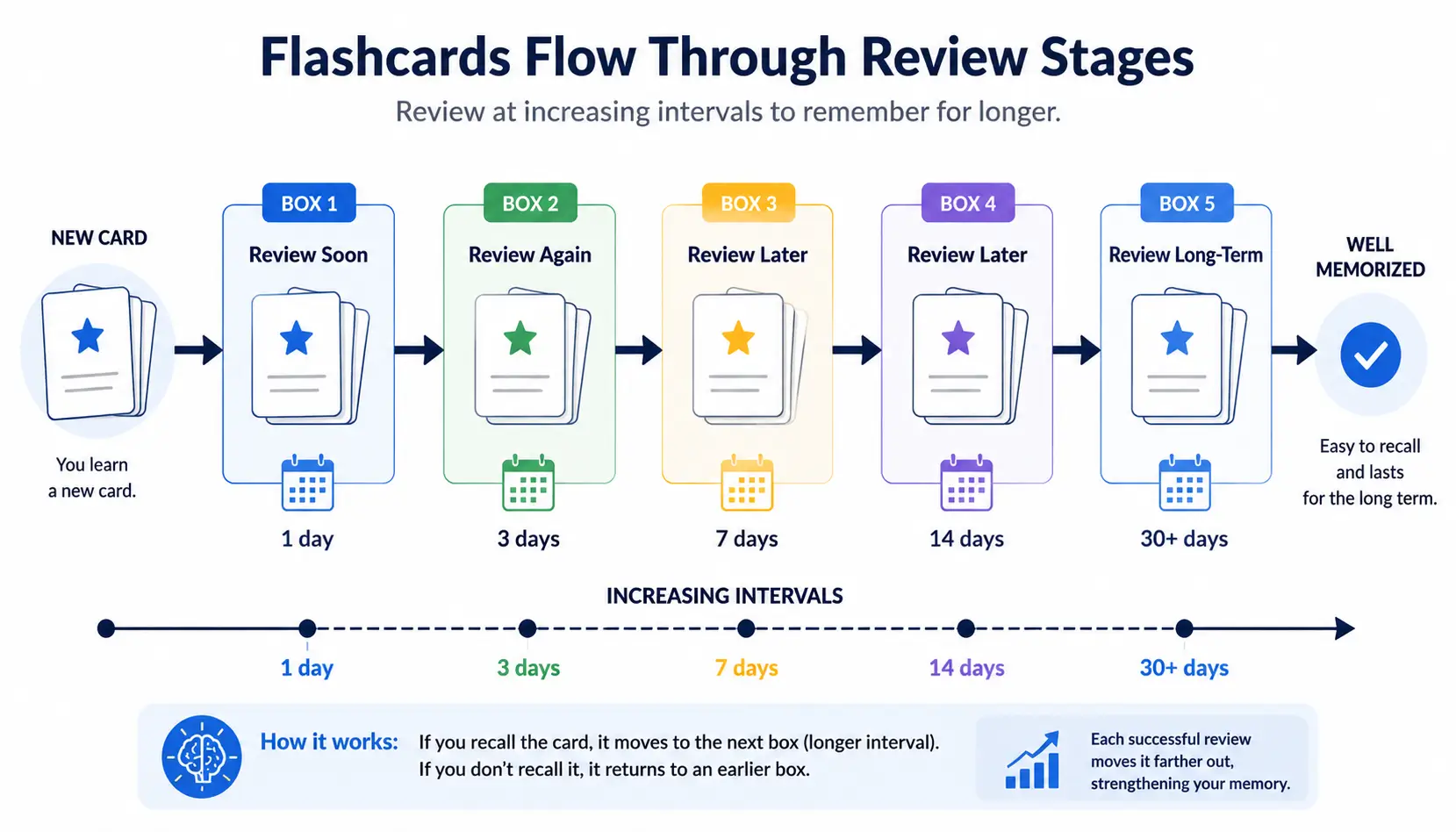
In this method, flashcards move between boxes based on how well you know them.
Cards answered correctly move to boxes reviewed less frequently.
Cards answered incorrectly return to boxes reviewed more often.
This creates a natural review schedule that prioritizes difficult material.
The result is similar to modern spaced repetition software, but without requiring an app or computer.
What Is the Best Review Schedule?
One of the most common questions learners ask is:
“Exactly how often should I review?”
There is no perfect universal schedule.
Different subjects, different learners, and different goals require different review intervals.
However, many effective systems follow a pattern similar to:
- Day 1
- Day 3
- Day 7
- Day 14
- Day 30
- Day 60
- Day 120
As memories become stronger, review sessions become less frequent.
The key is flexibility.
If you forget something, shorten the interval.
If recall feels easy, lengthen the interval.
Why Spaced Repetition Saves Time
Many people assume spaced repetition requires more work.
In reality, it often requires less.
Traditional studying repeatedly exposes you to information you already know.
Spaced repetition focuses attention where it produces the greatest benefit.
Strong memories require less review.
Weak memories receive more attention.
This targeted approach reduces wasted effort and improves efficiency.
For learners managing large amounts of information, the time savings can be substantial.
The Connection Between Spaced Repetition and Memory Consolidation
Spaced repetition works partly because it supports natural memory processes.
Each successful review helps reinforce neural pathways associated with the information.
Over time, those pathways become easier to access.
This process is closely related to Memory Consolidation, the biological mechanism through which short-term learning becomes long-term knowledge.
Every well-timed review acts as a reinforcement signal.
The brain receives another opportunity to strengthen the memory before it fades.
Common Spaced Repetition Mistakes
Reviewing Too Frequently
If you review information every day regardless of difficulty, you eliminate much of the efficiency advantage.
Spacing works because reviews become increasingly separated.
Only Reading During Reviews
Spacing is most effective when combined with retrieval.
During review sessions, challenge yourself to remember information before looking at the answer.
This is why Retrieval Practice remains such an important companion strategy.
Ignoring Difficult Material
Some learners repeatedly review information they already know because it feels rewarding.
Real improvement usually comes from addressing weak areas.
Using One Schedule for Everything
Not every topic requires the same review frequency.
Adapt intervals based on actual performance.
Spaced Repetition Beyond Academics
Many people associate spaced repetition with exam preparation.
Its applications are far broader.
You can use spacing to improve:
- Professional knowledge
- Language skills
- Public speaking
- Technical certifications
- Medical knowledge
- Historical facts
- Personal development learning
Any information that must remain accessible over time can benefit from spacing.
Supporting Long-Term Learning and Cognitive Performance
Spaced repetition is one of the most effective learning systems available, but it performs best when combined with healthy cognitive habits.
Sleep quality, physical activity, stress management, and focused attention all influence how well information is stored and retrieved.
In particular, sleep plays a major role in stabilizing memories after learning. Readers interested in this process should explore our guide to Sleep and Memory Consolidation.
Some learners also choose to support memory performance through broader wellness strategies. For those interested in nutritional support for healthy memory function, Advanced Memory Formula provides additional information about cognitive wellness and memory support.
Spaced repetition is one of several strategies that can support memory retention over time. Understanding how information is preserved and recalled can help learners combine review schedules with other effective study techniques.
A Smarter Way to Learn
Many people spend years trying to learn more by studying harder.
Spaced repetition offers a different approach.
Instead of increasing effort, it improves timing.
By reviewing information at carefully chosen intervals, you can remember more while often spending less time studying.
That combination of efficiency and effectiveness is what makes spaced repetition such a powerful learning strategy.
The goal is not endless review.
The goal is remembering what matters when you need it.