

Now Reading: Serial Position Effect Explained: Why We Remember the First and Last Items Best
-
01
Serial Position Effect Explained: Why We Remember the First and Last Items Best
Serial Position Effect Explained: Why We Remember the First and Last Items Best

Have you ever noticed that when someone reads a list of items aloud, the first few and last few items are often the easiest to remember?
This phenomenon is known as the Serial Position Effect, a well-established finding in cognitive psychology that explains why people tend to remember information presented at the beginning and end of a sequence better than information in the middle.
Researchers have studied the Serial Position Effect for decades because it reveals important insights into how memory works, how information is stored, and how students can improve learning and recall.
Whether you are studying for an exam, giving a presentation, creating educational content, or trying to remember a shopping list, understanding this effect can help you remember information more effectively.

What Is the Serial Position Effect?
The Serial Position Effect refers to the tendency to recall the first and last items in a list more easily than items presented in the middle.
This effect was first systematically studied by psychologist Hermann Ebbinghaus and later explored extensively by memory researchers seeking to understand how information moves through memory systems.
Imagine reading the following list:
- Apple
- Chair
- Mountain
- Window
- River
- Camera
- Notebook
- Guitar
- Orange
- Dog
Most people are more likely to remember “Apple” and “Dog” than items such as “Window” or “River.”
This pattern appears consistently across different ages, cultures, and learning situations.
The Two Components of the Serial Position Effect
The Serial Position Effect is typically divided into two separate phenomena:
- Primacy Effect
- Recency Effect
Together, these effects explain why information at the beginning and end of a sequence receives a memory advantage.
Primacy Effect
The Primacy Effect refers to superior memory for items presented first.
Because the first items receive more attention and rehearsal, they are more likely to enter long-term memory.
For example, when a teacher introduces a list of key concepts, students often remember the earliest concepts better because they have more opportunity to process and encode them.
This advantage becomes particularly noticeable when learners actively engage with the material.
Recency Effect
The Recency Effect refers to superior memory for items presented last.
Unlike the Primacy Effect, which relies heavily on long-term storage, the Recency Effect is largely supported by working memory and short-term memory.
The most recently presented information is still active and easily accessible when recall occurs.
This is why the last items in a list often remain easier to remember immediately after presentation.


Why Items in the Middle Are Often Forgotten
Items located in the middle of a sequence often receive neither advantage.
They do not benefit from the extensive rehearsal associated with early items, nor do they remain active in short-term memory like the final items.
As a result, middle-position information tends to be recalled less frequently.
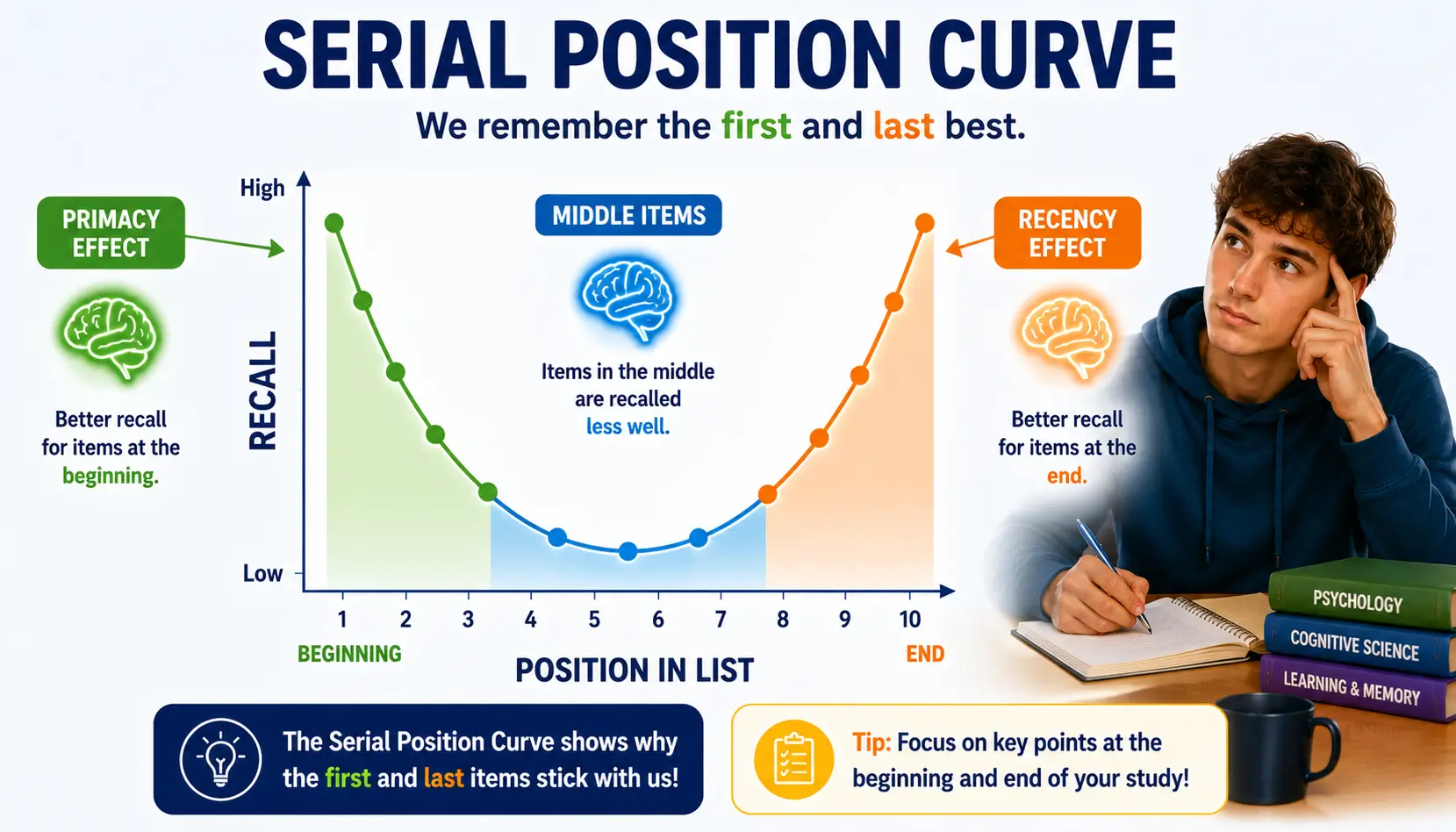
This pattern is sometimes called the serial position curve, because memory performance typically forms a U-shaped distribution when recall accuracy is plotted across list positions.
The first items are remembered well, recall drops in the middle, and then rises again near the end.
The Role of Memory Systems
The Serial Position Effect highlights the interaction between multiple memory systems.
Researchers generally believe that the Primacy Effect depends more heavily on long-term memory processes, while the Recency Effect depends more heavily on temporary storage systems.
This makes the effect particularly useful for understanding how information moves through memory.
Readers interested in these processes may also enjoy:
Real-World Examples of the Serial Position Effect
The Serial Position Effect appears in many everyday situations.
For example:
- Students often remember the first and last concepts from a lecture better than material covered in the middle.
- People frequently recall the opening and closing scenes of movies more easily than scenes in the middle.
- Consumers tend to remember the first and last products in advertisements.
- Job interviewers may remember the first and last candidates more clearly than those interviewed in the middle of the day.
These examples demonstrate that the Serial Position Effect influences much more than classroom learning.
It affects attention, decision-making, communication, and information retention in everyday life.
The Serial Position Curve
When researchers graph recall performance across a list, they often observe a distinctive U-shaped pattern known as the serial position curve.
This curve illustrates the combined effects of primacy and recency.
Items at the beginning of a sequence are recalled well because they receive more attention and rehearsal. Items at the end are recalled well because they remain active in working memory.
Meanwhile, items in the middle often receive neither advantage and are therefore more likely to be forgotten.
The serial position curve remains one of the most replicated findings in memory research.
What Research Says About the Serial Position Effect
Numerous studies have demonstrated the reliability of the Serial Position Effect.
Researchers have found similar patterns across different types of learning materials, including words, numbers, images, and even complex concepts.
One of the most important findings is that the Recency Effect often disappears when a delay is introduced before recall.
If participants are asked to perform a distracting task immediately after viewing a list, recall for the last items typically decreases.
This suggests that recent items depend heavily on short-term memory systems.
The Primacy Effect, however, tends to remain because those items have already received deeper processing and stronger encoding.
Why the Serial Position Effect Matters for Learning
This idea works especially well alongside Distributed Practice, where spreading study across time can reduce overload and improve retention across repeated sessions.
Understanding the Serial Position Effect can help students learn more efficiently.
Many learners assume that all information presented during a study session receives equal attention.
Memory research suggests otherwise.
Information encountered at the beginning and end of a learning session often receives a natural memory advantage.
As a result, students can improve retention by structuring study sessions strategically.
This principle aligns closely with evidence-based learning strategies such as Active Recall and Spaced Repetition.
How Students Can Use the Serial Position Effect
For the bigger picture of how recall, recognition, forgetting, and learning strategies connect, see the Complete Guide to Memory.
Fortunately, the Serial Position Effect can be used intentionally to improve learning outcomes.
1. Break Long Study Sessions Into Shorter Sessions
Long study sessions create fewer “beginnings” and “endings.”
Shorter sessions create more opportunities to benefit from both the Primacy Effect and the Recency Effect.
For example, three separate 30-minute sessions may produce better retention than one continuous 90-minute session.
2. Review Important Material First
If certain information is particularly important, consider placing it at the beginning of a study session.
This increases the likelihood that it will receive additional attention and rehearsal.
3. End Sessions With Key Concepts
Important information reviewed immediately before a break may benefit from the Recency Effect.
This is especially useful when preparing for exams or presentations.
4. Use Active Recall Frequently
Testing yourself throughout a study session helps move information from temporary storage into long-term memory.
Rather than simply rereading notes, try recalling information without looking at your materials.
This strengthens memory traces and improves future retrieval.
The Relationship Between the Serial Position Effect and Active Recall
The Serial Position Effect explains natural memory advantages.
Active Recall helps eliminate memory weaknesses.
When students actively retrieve information from memory, middle-position items receive additional reinforcement.
This reduces the forgetting that normally occurs between primacy and recency positions.
For this reason, many effective study systems combine multiple evidence-based strategies rather than relying on passive review.
Serial Position Effect and Spaced Repetition
The Serial Position Effect also complements spaced repetition systems.
Repeated review sessions create multiple opportunities for information to appear at the beginning and end of study periods.
Over time, repeated exposure and retrieval strengthen long-term retention.
This is one reason spaced repetition remains one of the most effective learning methods supported by cognitive science.
Limitations of the Serial Position Effect
Although the Serial Position Effect is powerful, it does not explain every aspect of memory.
Other factors also influence recall, including:
- Attention
- Motivation
- Emotional significance
- Prior knowledge
- Sleep quality
- Learning strategies
Strong interest in a topic can sometimes overcome position-related disadvantages.
Likewise, meaningful learning often produces better retention than simple repetition.
Using Memory Science to Study Smarter
The Serial Position Effect demonstrates that memory is not random.
The position of information within a sequence can significantly influence how well it is remembered.
Students who understand this principle can design more effective study sessions, prioritize important material strategically, and combine proven techniques such as Active Recall, Spaced Repetition, and retrieval practice.
Small adjustments in study structure can produce meaningful improvements in long-term learning and recall.
Readers interested in supporting memory performance through both evidence-based learning strategies and nutritional support can learn more about Advanced Memory Formula.
FAQ
What is the Serial Position Effect?
The Serial Position Effect is the tendency to remember the first and last items in a sequence better than items presented in the middle.
What is the Primacy Effect?
The Primacy Effect refers to improved recall for items presented at the beginning of a list because they receive more rehearsal and encoding.
What is the Recency Effect?
The Recency Effect refers to improved recall for recently presented information that remains active in short-term or working memory.
How can students use the Serial Position Effect?
Students can benefit by breaking study sessions into shorter blocks, reviewing important concepts first, and ending sessions with key material.
Does the Serial Position Effect improve long-term memory?
By itself, the effect reflects natural memory patterns. Combining it with Active Recall and Spaced Repetition is more effective for long-term retention.
Related Topics
- Active Recall: The Science-Backed Study Method for Long-Term Memory
- Spaced Repetition: The Proven System for Remembering More in Less Time
- The Testing Effect: Why Self-Testing Beats Re-Reading for Memory Retention
- Working Memory Explained: The Brain System Behind Learning, Focus, and Recall
Scientific Sources
https://www.simplypsychology.org/serial-position-effect.html
https://www.britannica.com/science/serial-position-effect
https://psycnet.apa.org/record/1962-06156-001