
Now Reading: Study Techniques: Evidence-Based Methods to Learn Faster and Remember More
-
01
Study Techniques: Evidence-Based Methods to Learn Faster and Remember More
Study Techniques: Evidence-Based Methods to Learn Faster and Remember More
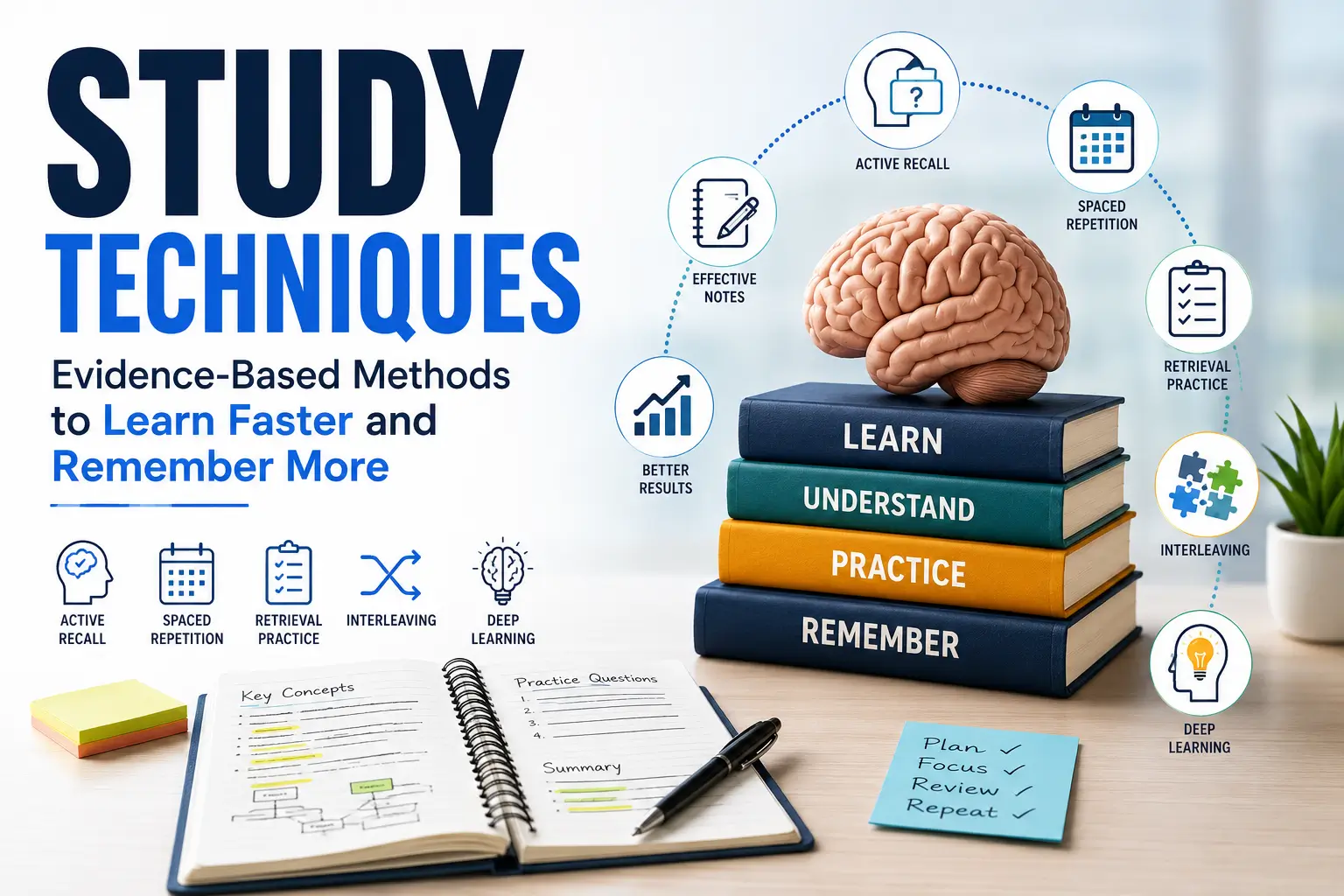
Some students spend hours studying and remember very little.
Others seem to learn faster, retain information longer, and perform better despite spending less time with their books.
The difference often has less to do with intelligence and more to do with study methods.
Modern learning science has revealed an important truth: not all study techniques are equally effective.
Some popular methods provide only the illusion of learning, while others create measurable improvements in long-term memory and understanding.
Understanding which techniques actually work can dramatically improve learning efficiency.
This guide explores the most effective study techniques supported by cognitive psychology, neuroscience, and educational research.
Why Study Techniques Matter
Learning is not simply about exposure to information.
Reading a textbook multiple times does not guarantee understanding or retention.
Instead, learning depends on how information is processed, encoded, retrieved, and reinforced.
Effective study techniques improve each of these processes.
The result is faster learning, stronger memory formation, and better long-term retention.
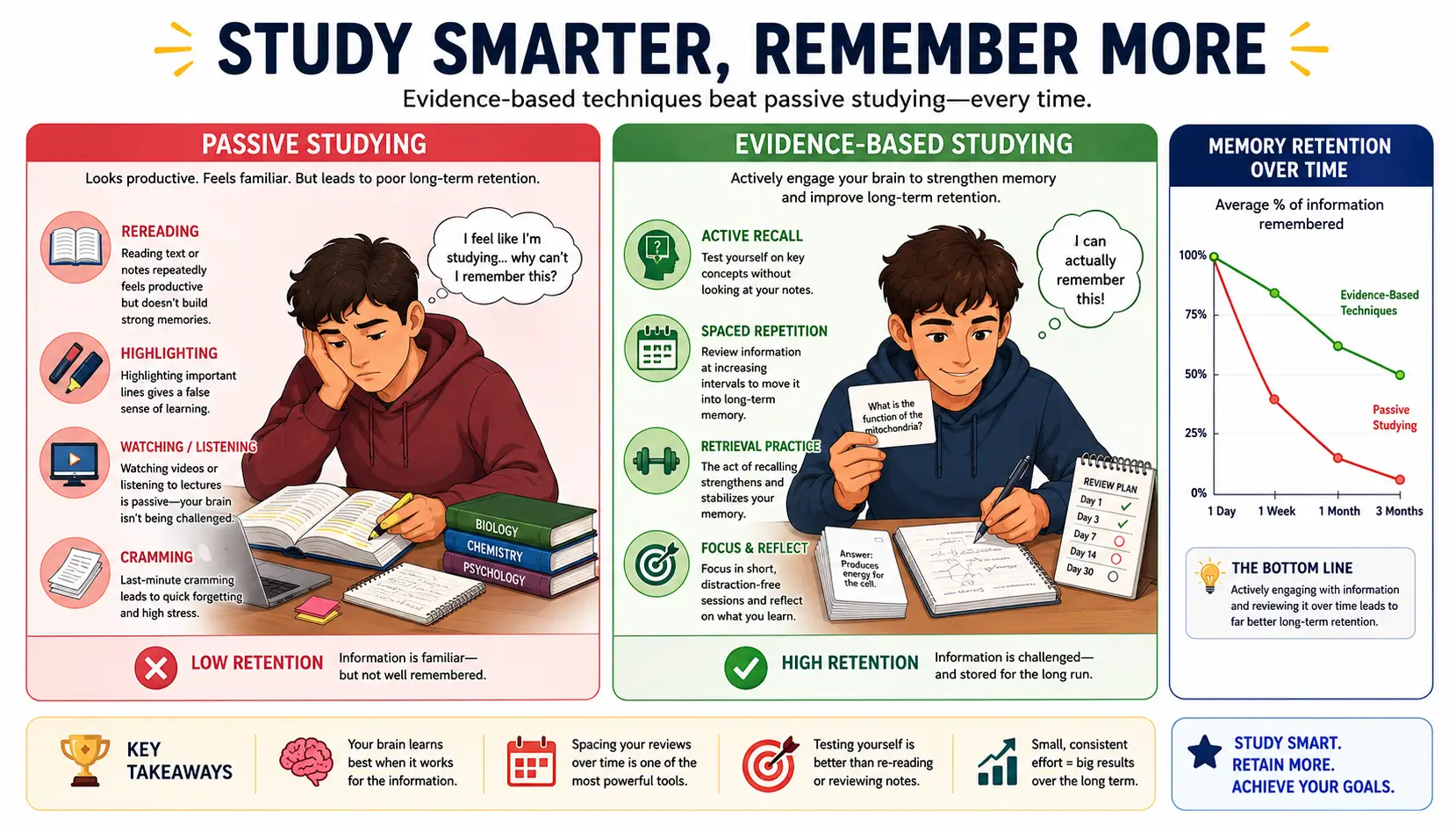
The Problem With Passive Studying
Many learners rely on passive study methods.
These include:
- Re-reading notes repeatedly
- Highlighting large sections of text
- Watching lectures without interaction
- Reviewing material without testing knowledge
While these activities feel productive, research often finds that they produce relatively weak learning outcomes.
Passive exposure creates familiarity but does not necessarily strengthen recall.
This is one reason students frequently feel prepared before an exam but struggle to retrieve information when tested.


What Makes a Study Technique Effective?
The most effective learning methods share several characteristics.
They encourage:
- Active engagement
- Memory retrieval
- Meaningful processing
- Long-term reinforcement
- Knowledge application
Techniques that incorporate these elements consistently outperform passive review strategies.
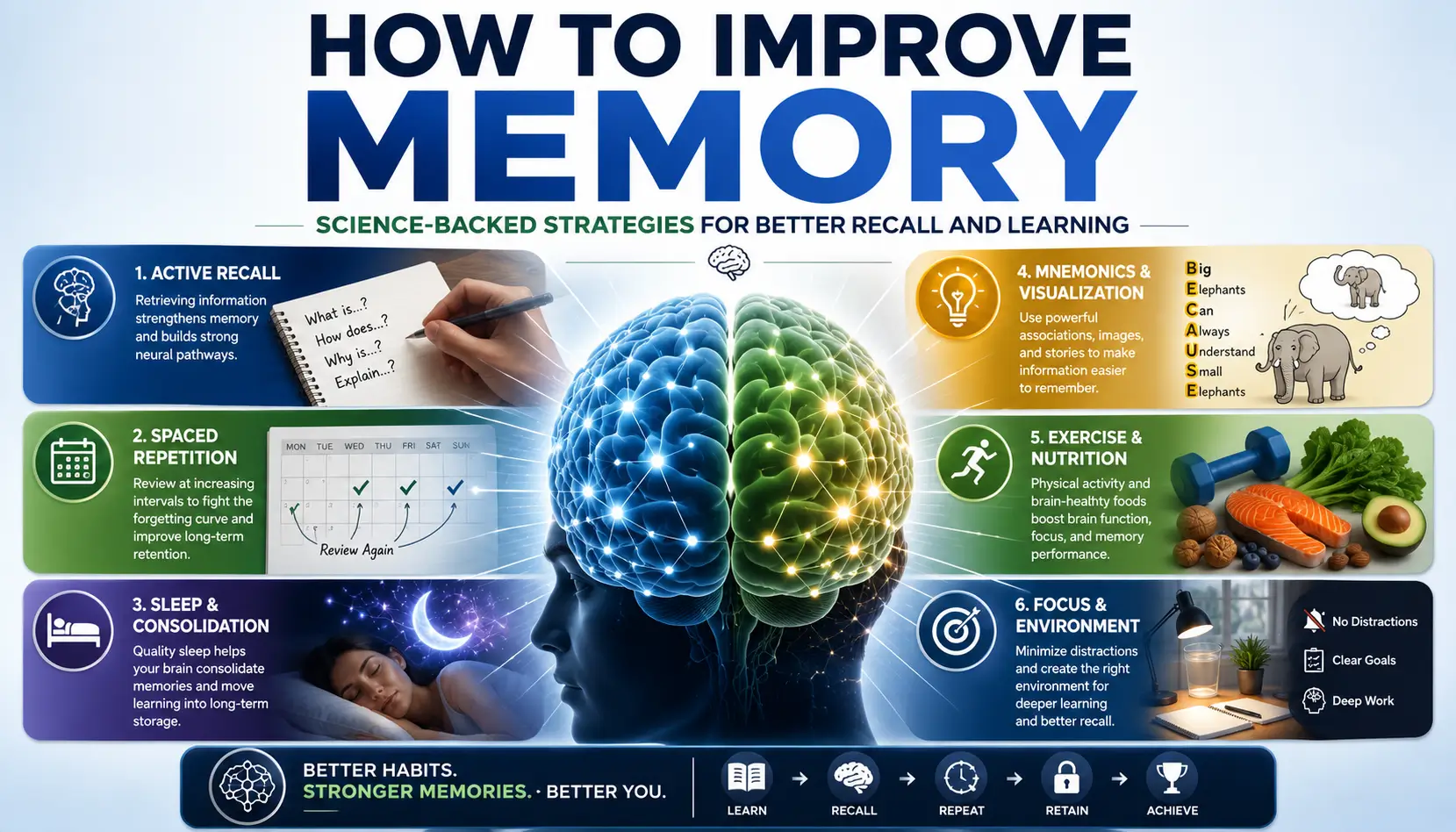
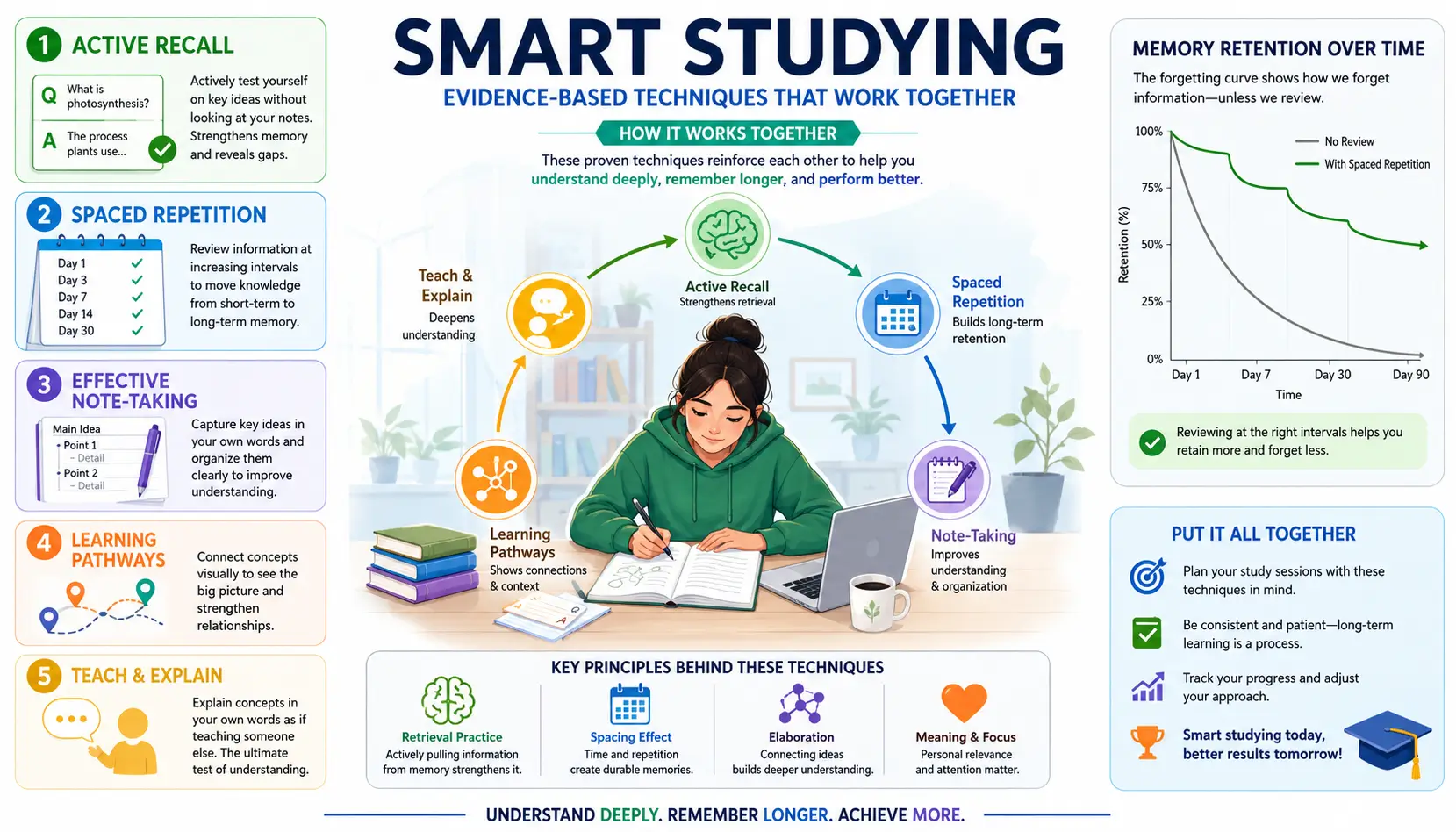
1. Active Recall
Active Recall is widely considered one of the most effective study techniques available.
Instead of reviewing information passively, learners actively retrieve it from memory.
Examples include:
- Answering questions without notes
- Self-testing
- Writing summaries from memory
- Explaining concepts without references
Every successful retrieval strengthens memory pathways and improves future recall.
Research repeatedly demonstrates that retrieval improves learning more effectively than rereading.
2. Spaced Repetition
This same idea is also explained through Distributed Practice, which focuses on why spacing study sessions improves long-term retention.
Spaced Repetition combats the natural tendency to forget information over time.
Instead of reviewing material repeatedly in one session, learners revisit information at strategically increasing intervals.
This approach aligns with the principles of the Ebbinghaus Forgetting Curve.
By reviewing information shortly before it would otherwise be forgotten, learners strengthen long-term retention while minimizing study time.
Many memory experts consider spaced repetition one of the most efficient learning systems ever developed.
3. Retrieval Practice
Retrieval Practice focuses specifically on recalling information rather than reviewing it.
Although similar to Active Recall, retrieval practice emphasizes frequent testing as a learning tool.
Examples include:
- Practice quizzes
- Flashcards
- Mock exams
- Question-and-answer sessions
The process strengthens memory retrieval pathways and improves future performance.
Retrieval practice is one of the most consistently supported findings in educational psychology.
4. The Testing Effect
The Testing Effect refers to the finding that testing improves learning.
Many students view tests solely as evaluation tools.
Research shows they can also function as powerful learning tools.
Every attempt to retrieve information strengthens memory.
Even unsuccessful retrieval attempts can improve future learning when followed by feedback.
5. Interleaving
Interleaving involves mixing related topics or problem types during study sessions.
Rather than focusing exclusively on one subject at a time, learners alternate between concepts.
This approach improves discrimination, problem-solving, and transfer of knowledge.
Although interleaving often feels more difficult than blocked practice, research suggests it produces stronger long-term learning.
6. Dual Coding
Dual Coding Theory proposes that learning improves when information is processed through both verbal and visual systems.
Combining words with diagrams, illustrations, charts, or visual models creates multiple retrieval pathways.
Visual representations often make complex information easier to understand and remember.
This technique is especially useful when studying scientific, technical, or conceptual material.
7. The Feynman Technique
The Feynman Technique is based on a simple principle: if you can teach it clearly, you understand it.
Learners explain concepts using simple language as if teaching someone with no prior knowledge.
This process exposes knowledge gaps and encourages deeper understanding.
The technique combines comprehension, retrieval, and simplification into a powerful learning strategy.
8. Chunking
Chunking improves learning by organizing information into meaningful groups.
Rather than memorizing isolated facts, learners create structured units of information.
This reduces cognitive load and makes information easier to process.
Chunking is widely used in language learning, mathematics, and memory training.
9. The Leitner System
The Leitner System is a structured flashcard method designed to improve long-term retention.
Cards answered correctly move into boxes reviewed less frequently, while difficult cards remain in boxes reviewed more often.
This approach naturally combines retrieval practice with spaced repetition.
The result is a highly efficient review system that prioritizes information based on individual learning needs.
Many modern flashcard applications use similar principles.
10. Develop Metacognitive Awareness
Metacognition refers to thinking about your own thinking.
Successful learners regularly evaluate what they know, what they do not know, and which strategies work best for them.
This self-awareness allows learners to adjust study methods and focus on weaknesses.
Metacognition is often one of the biggest differences between average and exceptional learners.
Understanding how you learn can be just as important as what you learn.
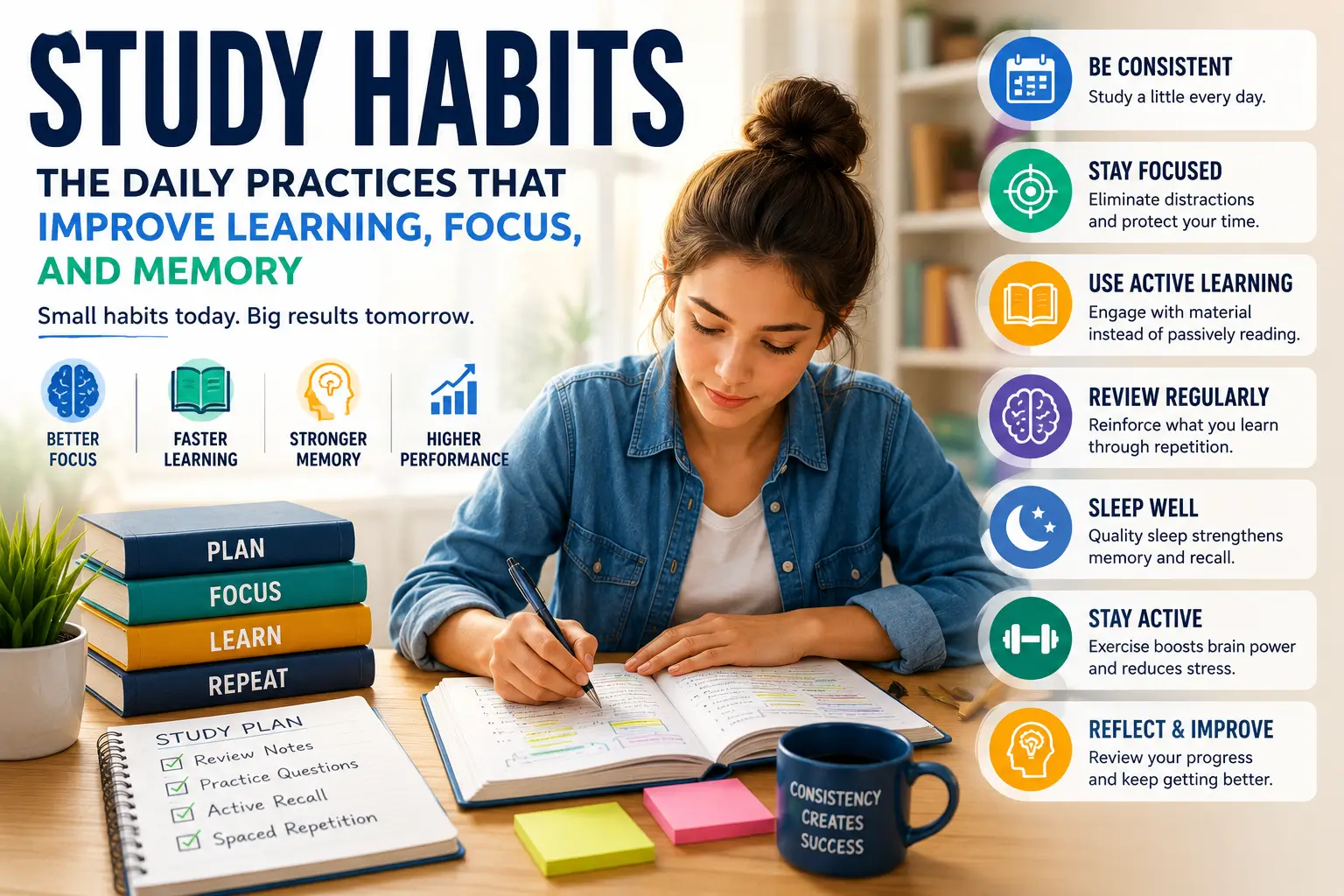
11. Create a Consistent Study Schedule
To put consistency into a practical weekly structure, see Study Schedule.
Learning improves when study sessions occur consistently over time.
Many students rely on last-minute cramming sessions.
Although cramming may produce short-term gains, it rarely supports durable memory formation.
Regular study sessions provide repeated exposure, retrieval opportunities, and reinforcement.
Consistency typically outperforms intensity when long-term retention is the goal.
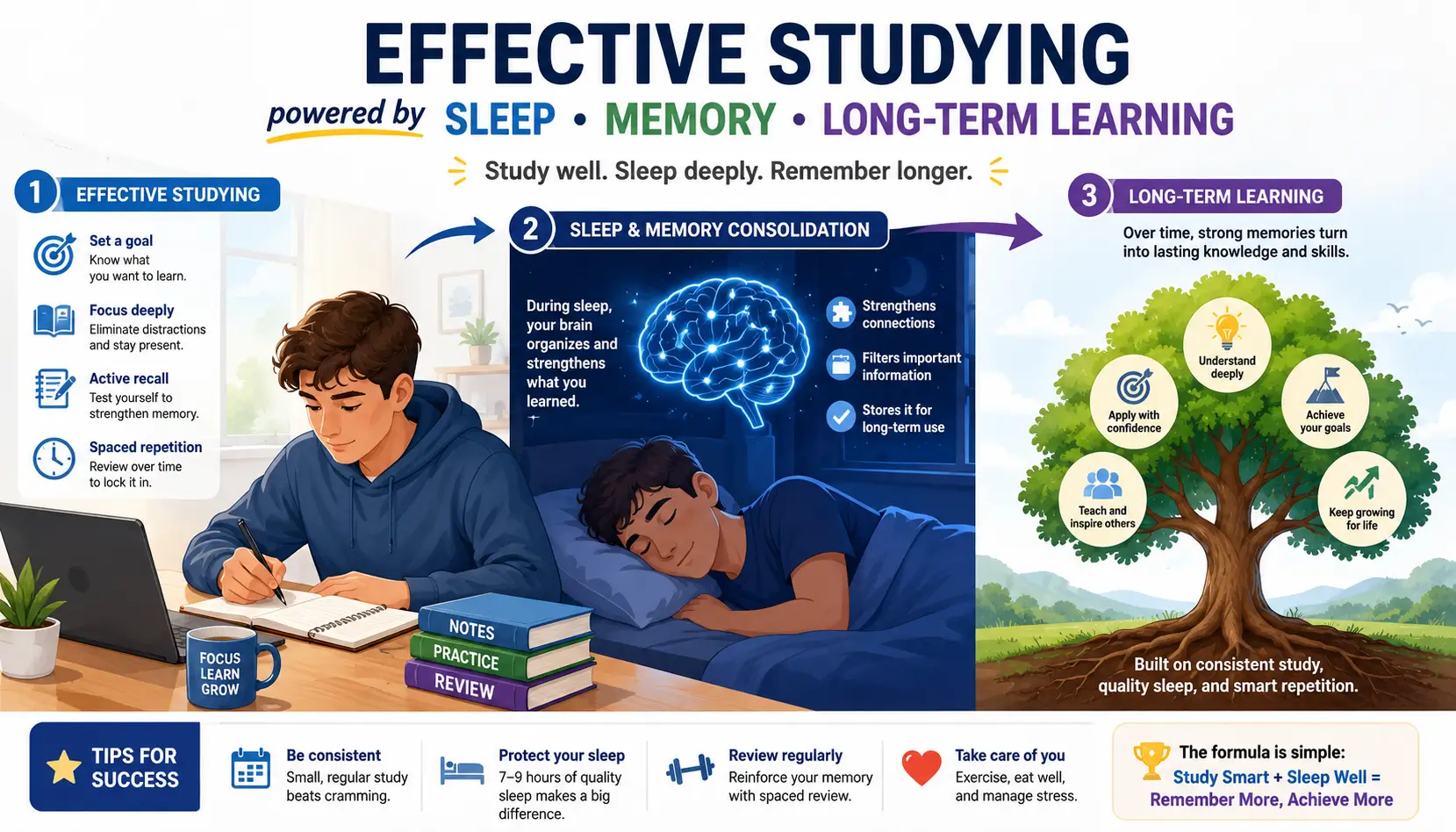
12. Protect Sleep and Recovery
Effective studying does not stop when learning ends.
Sleep plays a critical role in Memory Consolidation.
During sleep, the brain processes and stabilizes newly learned information.
Without sufficient sleep, even the best study techniques become less effective.
Many learners underestimate how important recovery is for academic performance.
Research consistently identifies sleep as one of the strongest predictors of learning success.
13. Manage Cognitive Load
Cognitive Load Theory explains that working memory has limited capacity.
When learners attempt to process too much information at once, performance often declines.
Breaking complex material into manageable sections reduces mental overload.
This allows the brain to process information more efficiently.
Effective study techniques often work because they reduce unnecessary cognitive strain.
Common Study Mistakes That Reduce Learning
Many students unknowingly use strategies that feel productive but deliver poor results.
Common mistakes include:
- Rereading without testing knowledge
- Studying for long periods without breaks
- Cramming before exams
- Ignoring sleep
- Multitasking during study sessions
- Reviewing notes passively
Replacing these habits with evidence-based techniques can dramatically improve learning efficiency.
The Most Effective Combination of Study Techniques
If you want these techniques organized into a full working system, read How to Study Effectively.
No single technique works perfectly in every situation.
However, research suggests that combining several evidence-based methods often produces the strongest results.
A highly effective learning system might include:
- Active Recall for retrieval
- Spaced Repetition for retention
- Interleaving for flexibility
- Dual Coding for understanding
- Sleep for consolidation
Together, these strategies strengthen multiple stages of the learning process.
The combination is often far more powerful than relying on a single technique alone.
How Top Learners Study Differently
The behaviors behind those results are explored further in Study Skills, which focuses on the practical abilities that improve learning performance over time.
High-performing learners rarely depend on motivation alone.
Instead, they build systems that make learning more effective.
They test themselves frequently.
They revisit information strategically.
They prioritize understanding over memorization.
Most importantly, they treat learning as an active process rather than a passive activity.
Their success often comes from better methods rather than greater effort.
The best study techniques do not simply help you learn faster—they help you remember longer.
Learning science continues to demonstrate that effective studying is not about spending more hours with information.
It is about using methods that strengthen encoding, retrieval, and long-term retention.
By applying evidence-based study techniques, learners can improve academic performance, build stronger memory systems, and make every study session more productive.
Supporting Learning Beyond Study Methods
Study techniques provide the framework for effective learning, but cognitive performance also depends on factors such as sleep, stress management, physical activity, and overall brain health.
Many learners combine proven study strategies with broader approaches that support memory and mental performance throughout life.
Readers interested in memory-supportive nutritional strategies can learn more about Advanced Memory Formula.