
Now Reading: Retrieval Practice: Why Testing Yourself Improves Memory Retention
-
01
Retrieval Practice: Why Testing Yourself Improves Memory Retention
Retrieval Practice: Why Testing Yourself Improves Memory Retention
Imagine two students preparing for the same exam.
The first student spends hours rereading notes, highlighting important passages, and reviewing textbook chapters.
The second student studies the material briefly, closes the book, and begins answering questions from memory.
Most people would assume the first student is working harder.
Research suggests the second student is often learning more.
This difference comes down to a powerful learning principle known as retrieval practice.
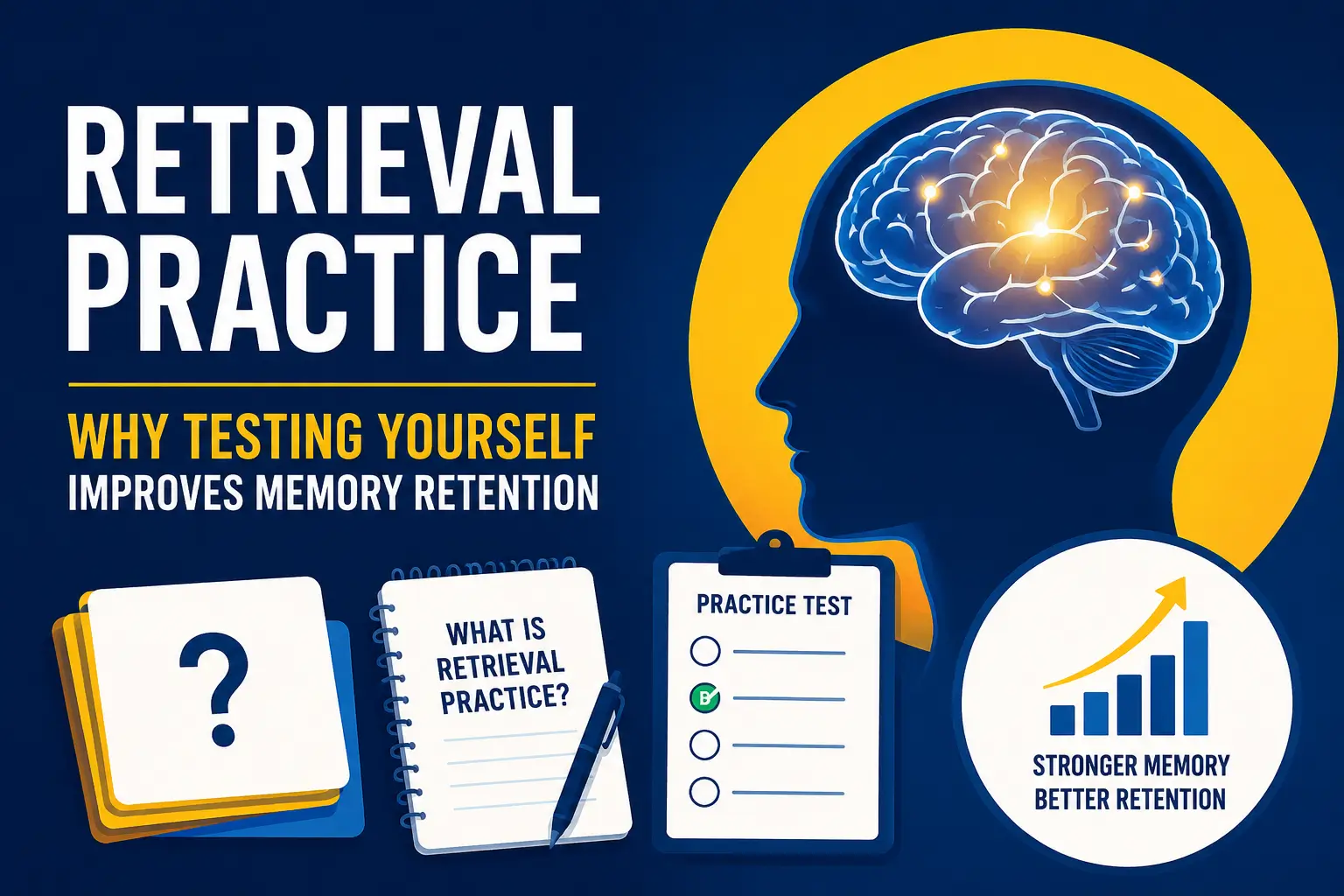
Retrieval practice is the process of recalling information from memory instead of repeatedly reviewing it. Although it feels more difficult than passive studying, it consistently produces stronger long-term retention and deeper understanding.
In fact, retrieval practice forms the scientific foundation behind many of the world’s most effective learning systems.
Whether you’re studying for exams, learning professional skills, building expertise, or simply trying to improve memory, retrieval practice deserves a central role in your learning process.

What Is Retrieval Practice?
Retrieval practice is a learning strategy that requires you to actively recall information rather than passively review it.
Instead of reading information over and over, you challenge yourself to produce the information from memory.
Examples include:
- Answering practice questions
- Using flashcards
- Taking mock exams
- Explaining concepts aloud
- Writing summaries from memory
- Teaching material to someone else
The principle sounds simple, but its effects are remarkably powerful.
Each successful retrieval strengthens the memory itself, making future recall easier and more reliable.
This is why retrieval practice is closely connected to Active Recall, one of the most effective study methods discussed on this site.
Recognition vs Retrieval: The Difference That Changes Everything
This is why understanding recall memory is so important: retrieval practice trains the brain to generate information instead of simply recognizing it. One reason retrieval practice is so effective is that it targets a skill most learners rarely train.
Recognition and retrieval are not the same thing.
Recognition occurs when information is presented to you.
You see it and think:
“Yes, I remember that.”
Retrieval is different.
Retrieval requires you to generate information without seeing the answer first.
Real-world situations almost always depend on retrieval.
Exams, presentations, conversations, interviews, and professional decision-making all require you to access information independently.
Simply recognizing information is rarely enough.
Retrieval practice trains the exact skill you actually need.


🔬 The Science Behind Retrieval Practice
Retrieval practice is one of the most heavily researched topics in cognitive psychology.
Decades of studies have demonstrated that testing yourself improves learning even when no grade is involved.
A major review of learning techniques published in Psychological Science in the Public Interest identified practice testing as one of the most effective evidence-based learning strategies available.
Source: https://journals.sagepub.com/doi/10.1177/1529100612453266
Researchers consistently find that students who retrieve information retain it longer than students who spend the same amount of time reviewing material.
Another influential study found that retrieval practice can outperform additional studying when the goal is long-term retention.
Source: https://www.pnas.org/doi/10.1073/pnas.101488998
The conclusion is surprisingly simple:
The act of remembering helps create stronger memories.
Learning doesn’t only occur when information enters your brain.
It also occurs when information is successfully retrieved.
Why Retrieval Practice Feels Difficult
If retrieval practice is so effective, why do many learners avoid it?
Because it feels harder.
Rereading notes is comfortable.
Reviewing slides feels easy.
Looking at highlighted pages creates confidence.
Retrieval practice removes those comforts.
You must confront what you truly know and what you merely recognize.
This struggle can feel frustrating.
Ironically, that challenge is one reason retrieval practice works so well.
Cognitive scientists often describe this as a desirable difficulty.
A learning task that requires effort often creates stronger retention than one that feels easy.
How Retrieval Practice Strengthens Memory
Memory is not static.
Each time you retrieve information, the memory trace becomes more accessible.
You can think of memory like a hiking trail.
The first trip requires effort.
The route may be unclear.
Every additional trip makes the path easier to follow.
Retrieval practice repeatedly travels those mental pathways.
This process supports memory consolidation, helping transform learning into stable long-term knowledge.
The result is not just better memory.
The result is faster and more reliable access to information when you need it most.
Examples of Retrieval Practice in Everyday Learning
Many people imagine retrieval practice as something only students use.
In reality, it can be applied almost anywhere.
Learning a Language
Instead of rereading vocabulary lists, cover the translations and attempt to recall them.
Professional Training
After a course or workshop, summarize key concepts without referring to your notes.
Reading Nonfiction Books
At the end of each chapter, pause and write down the most important ideas from memory.
Public Speaking
Rather than rereading a script, practice recalling key points and delivering them naturally.
The underlying principle remains the same:
Retrieve first, check later.
Retrieval Practice vs Passive Review
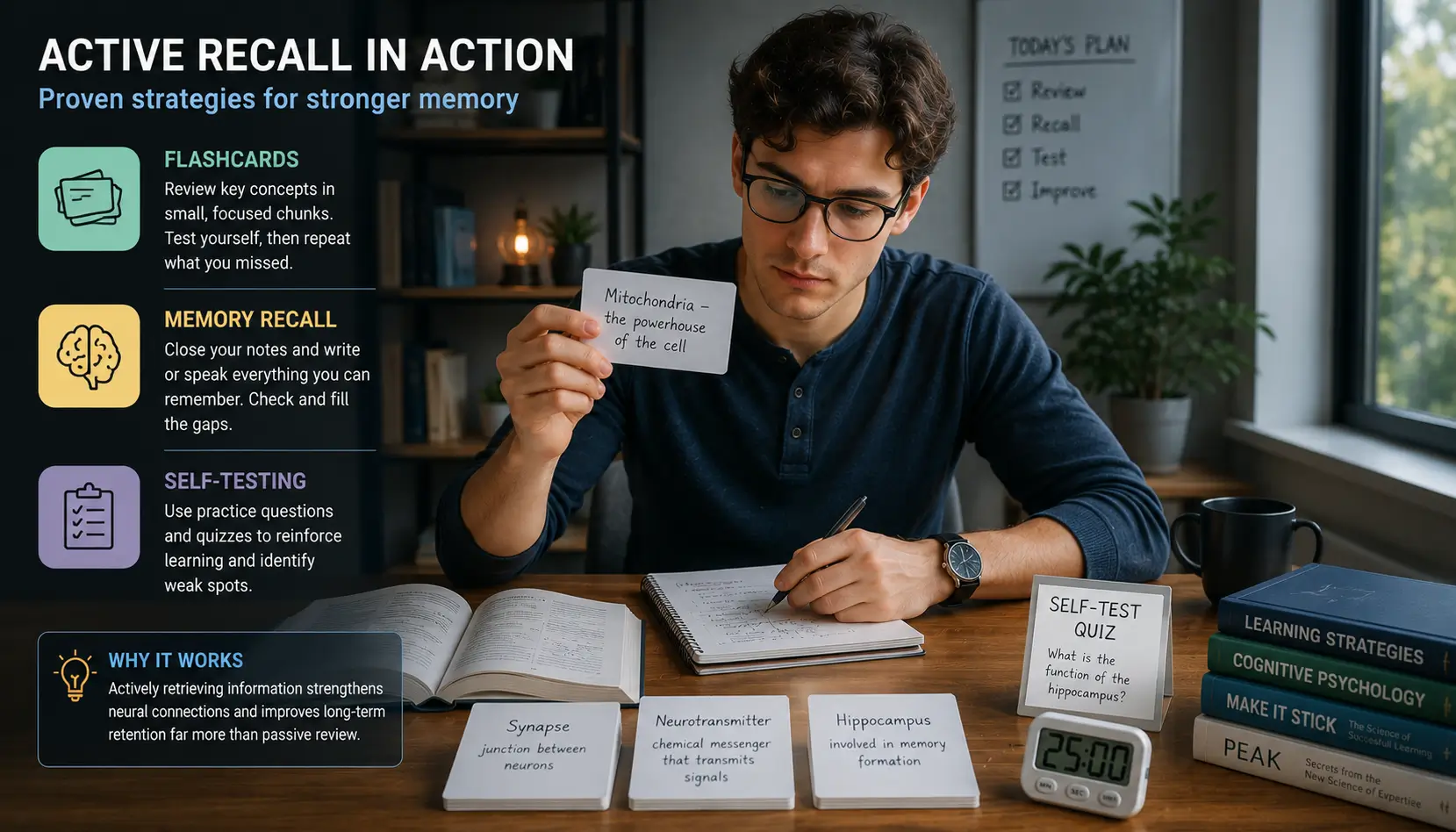
Suppose you have one hour available for studying.
You can spend the entire hour rereading notes.
Or you can spend that hour answering questions, recalling concepts, and testing yourself.
Although the second option feels more challenging, it often produces superior retention.
This is why retrieval practice is frequently combined with Spaced Repetition.
Retrieval strengthens memory.
Spacing strengthens timing.
Together they form one of the most effective learning systems available.
How to Apply Retrieval Practice Effectively
One of the biggest advantages of retrieval practice is that it can be applied almost immediately. You don’t need special software, expensive courses, or advanced study systems.
You simply need opportunities to retrieve information from memory.
The challenge is creating a habit of retrieval rather than falling back into passive review.
The following methods are among the most effective ways to incorporate retrieval practice into daily learning.
1. The Brain Dump Method
After studying a topic, close your notes and write down everything you can remember.
Don’t worry about organization.
Don’t worry about perfect wording.
The goal is retrieval.
Once finished, compare your notes to the source material and identify what you missed.
This simple exercise quickly exposes knowledge gaps while strengthening existing memories.
2. Self-Generated Questions
Turn headings and concepts into questions.
For example:
- What is retrieval practice?
- Why does testing improve memory?
- How is retrieval different from recognition?
- What role does memory consolidation play in learning?
Answer these questions without looking at your notes.
This transforms passive study materials into active learning tools.
3. Teaching What You Know
Teaching is one of the most effective forms of retrieval practice.
When you explain a concept to someone else, you must retrieve information, organize it, and communicate it clearly.
This is one reason the Feynman Technique remains so popular among high-performing learners.
If you struggle to explain an idea simply, that often indicates a gap in understanding.
The Connection Between Retrieval Practice and the Testing Effect
Many people think tests exist only to measure learning.
Research suggests something more interesting.
Tests can actually create learning.
This concept is known as the Testing Effect.
Every time you retrieve information during a quiz, flashcard session, or practice exam, the memory itself becomes stronger.
This means testing is not simply an assessment tool.
It is also a learning tool.
Understanding this principle changes the way many successful learners approach studying.
Instead of avoiding tests, they actively seek opportunities to test themselves.
Using Flashcards for Retrieval Practice
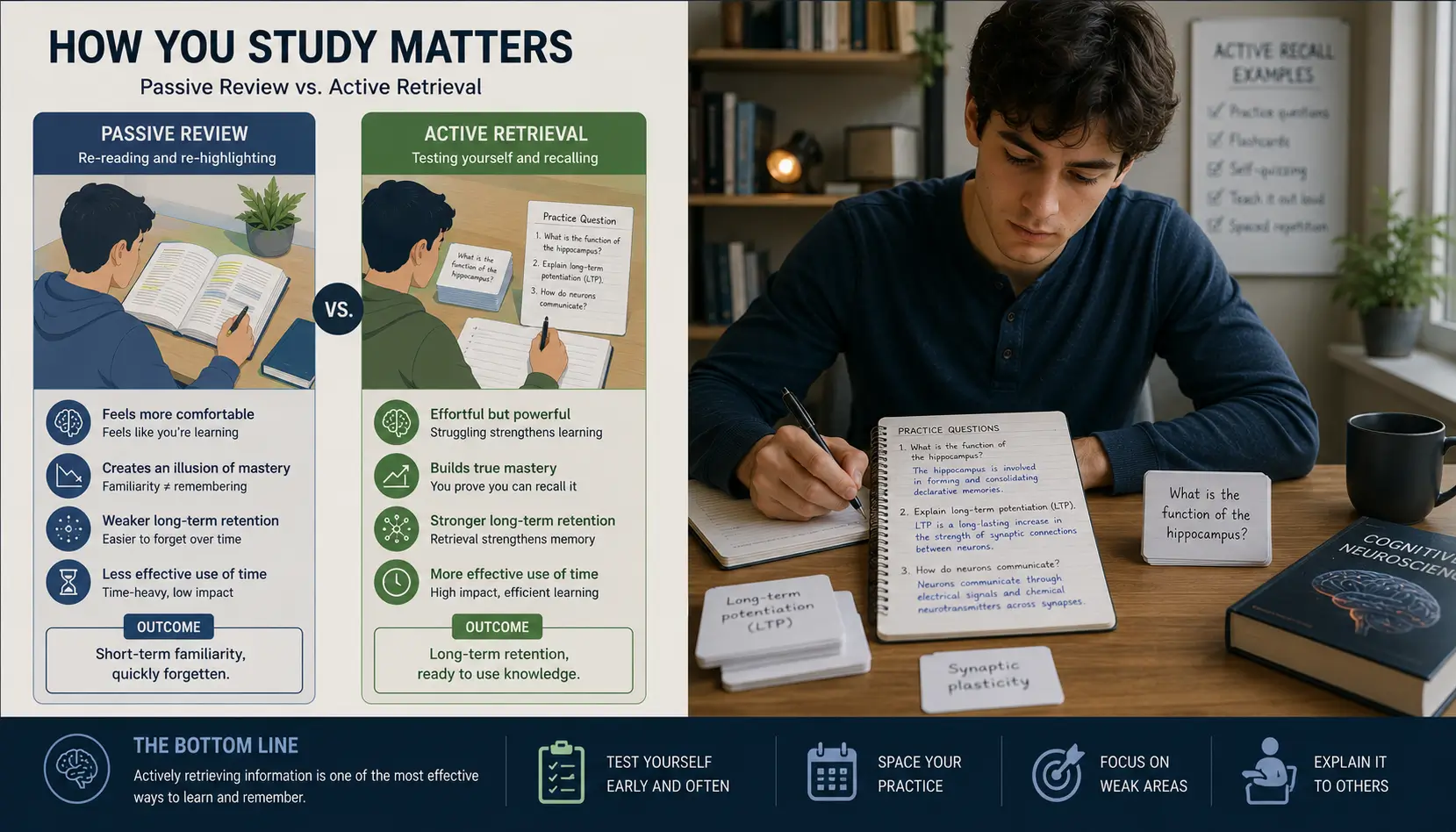
Flashcards remain one of the most effective retrieval practice tools ever developed.
However, their effectiveness depends on how they are used.
A flashcard should force you to generate an answer.
If you immediately recognize the answer without effort, the learning benefit decreases.
Strong flashcards:
- Focus on a single concept
- Require active thinking
- Avoid unnecessary complexity
- Encourage recall instead of recognition
Many learners choose digital flashcard systems because they automate scheduling and review intervals.
This is where Anki Flashcards become particularly useful.
Anki combines retrieval practice with intelligent review scheduling, making it one of the most powerful learning tools available today.
Retrieval Practice + Spaced Repetition = A Powerful Combination
If retrieval practice strengthens memory, spaced repetition determines the best time to revisit that memory.
The combination is remarkably effective.
Retrieval practice answers:
How should I study?
Spaced repetition answers:
When should I review?
Rather than reviewing information every day, spaced repetition increases the time between successful reviews.
Information that is easy to remember appears less frequently.
Information that is difficult appears more frequently.
This system reduces wasted effort while improving long-term retention.
Our guide to Spaced Repetition explains the process in greater detail.
Many learners also use the Leitner System to apply these principles using physical flashcards.
Common Retrieval Practice Mistakes
Looking at Answers Too Quickly
Retrieval requires effort.
If you immediately reveal the answer, you eliminate much of the learning benefit.
Give your brain time to search.
Only Studying What Feels Comfortable
People naturally revisit information they already know.
Unfortunately, learning growth usually occurs at the edge of your current knowledge.
Focus on weaknesses, not just strengths.
Using Retrieval Only Before Exams
Retrieval practice works best when used consistently.
Waiting until the final days before an exam reduces its effectiveness.
Ignoring Sleep and Recovery
Learning does not stop when studying ends.
During sleep, the brain continues processing and stabilizing memories.
This process plays a critical role in Sleep and Memory Consolidation.
Without adequate recovery, even the best study methods become less effective.
Why Retrieval Practice Works for More Than School
Although retrieval practice is often associated with academic learning, its applications extend far beyond the classroom.
You can use retrieval practice to improve:
- Professional knowledge
- Public speaking skills
- Foreign language learning
- Technical certifications
- Presentation preparation
- Personal development reading
Any situation that requires remembering information can benefit from retrieval.
The principle remains universal:
The more often you successfully retrieve information, the easier it becomes to retrieve again in the future.

Supporting Cognitive Performance Beyond Study Methods
Retrieval practice is one of the most powerful learning tools available, but memory performance depends on more than study techniques alone.
Sleep quality, physical activity, stress management, nutrition, and consistent mental engagement all contribute to healthy cognitive function.
Successful learners often combine evidence-based study strategies with broader brain-health habits.
For readers interested in supporting memory and cognitive wellness from multiple angles, Advanced Memory Formula provides additional information about nutritional support designed for healthy memory function.
Final Thoughts
Retrieval practice is powerful because it aligns with how memory retrieval actually works.
Rather than repeatedly exposing yourself to information, it challenges you to retrieve information from memory.
That challenge creates stronger learning, better retention, and greater confidence.
The next time you study, resist the temptation to simply reread your notes.
Close the book.
Ask yourself a question.
Try to answer from memory.
You may be surprised by how much more effective learning becomes.