

Now Reading: Study Schedule: How to Create a Science-Backed Study Plan for Better Learning and Retention
-
01
Study Schedule: How to Create a Science-Backed Study Plan for Better Learning and Retention
Study Schedule: How to Create a Science-Backed Study Plan for Better Learning and Retention

What is the best study schedule?
The best study schedule is not necessarily the one with the most hours. Instead, it is a consistent, realistic plan that balances focused learning, review sessions, breaks, and sleep.
Research in cognitive psychology shows that long-term learning depends more on how study sessions are organized than on the total amount of time spent studying.
A well-designed study schedule helps reduce procrastination, improve focus, and strengthen memory retention over time.
Whether you are preparing for exams, learning a new skill, or trying to improve academic performance, having a structured plan can dramatically increase learning efficiency.

Why Most Study Plans Fail
Many learners create ambitious schedules that look impressive on paper but are impossible to maintain.
These plans often fail because they ignore attention span limitations, energy levels, and the realities of daily life.
Successful study schedules focus on sustainability rather than perfection.
A realistic plan that can be followed consistently is usually far more effective than an aggressive schedule that lasts only a few days.
Consistency is one of the strongest predictors of long-term learning success.
The Science Behind Effective Study Scheduling
For the wider memory framework behind review timing, retrieval, and durable retention, see How to Improve Memory.
Memory formation depends on repeated exposure, retrieval practice, and consolidation.
This means that learning should be distributed across multiple sessions rather than concentrated into a single marathon study period.
Research on Distributed Practice and Spaced Repetition consistently shows that spreading learning across time improves retention and recall.
Instead of studying one topic for six consecutive hours, students often benefit more from several shorter sessions spread across multiple days.


Step 1: Identify Your Available Study Time
The first step in creating an effective study schedule is understanding how much time is actually available.
Many learners overestimate their free time and underestimate daily responsibilities.
Start by identifying:
- Work or school commitments
- Exercise and personal activities
- Family responsibilities
- Sleep requirements
- Available study blocks
This process helps create a schedule that is realistic and sustainable.
Step 2: Prioritize High-Value Subjects
Not all subjects require the same amount of attention.
Difficult topics, weak areas, and high-priority goals should generally receive more study time than material you already understand well.
This approach allows you to allocate mental energy where it produces the greatest learning benefit.
Many successful learners place their most demanding study sessions during periods of peak concentration.
This idea is closely related to the research discussed in Best Time to Study.
Step 3: Use Short Focused Study Sessions
If maintaining attention is the main challenge, How to Focus on Studying goes deeper into concentration, distraction control, and cognitive stamina.
Long study marathons often create mental fatigue and diminishing returns.
Instead, many learners benefit from focused study blocks lasting between 25 and 60 minutes.
These sessions can then be separated by short recovery breaks.
This structure helps maintain attention while reducing cognitive overload.
Research related to Cognitive Load Theory helps explain why shorter focused sessions are often more productive than extended periods of uninterrupted studying.

Step 4: Schedule Regular Review Sessions
One of the biggest mistakes learners make is focusing exclusively on new material while neglecting review.
Memory naturally weakens over time unless information is revisited.
Adding review sessions to your study schedule helps strengthen retention and prevents forgetting.
A simple approach is to review material:
- One day after learning
- Three days later
- One week later
- Two weeks later
This strategy takes advantage of the spacing effect and supports long-term memory formation.
Research related to the Ebbinghaus Forgetting Curve explains why scheduled reviews are so effective.
Step 5: Include Active Recall in Every Study Session
Studying does not automatically produce learning.
To strengthen memory, information must be actively retrieved.
This means that every study block should include some form of Active Recall.
Examples include:
- Answering practice questions
- Using flashcards
- Writing summaries from memory
- Teaching concepts aloud
- Explaining topics without notes
These activities strengthen retrieval pathways and improve future recall.
Learn more in Active Recall and Retrieval Practice.
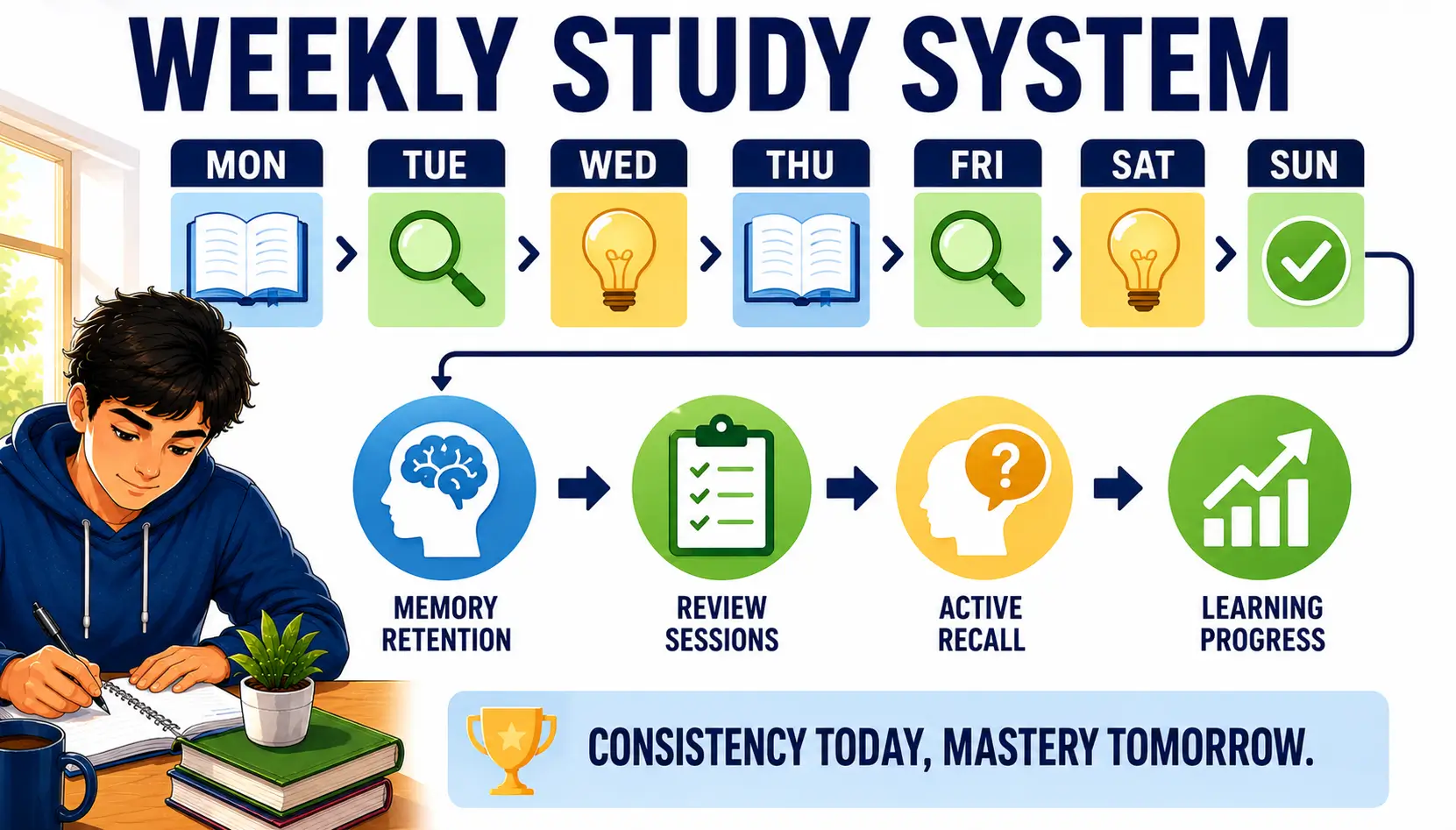
A Sample Science-Backed Weekly Study Schedule
While every learner’s schedule will look different, an effective framework might include:
- Monday: New learning + Active Recall
- Tuesday: New learning + Review previous material
- Wednesday: Practice questions + Active Recall
- Thursday: New learning + Spaced Review
- Friday: Consolidation and self-testing
- Saturday: Weak area review
- Sunday: Light review and planning
This approach balances learning, review, and memory reinforcement throughout the week.
Frequently Asked Questions
How many hours should I study each day?
The ideal amount varies by individual goals and responsibilities. Consistent, focused study sessions are generally more effective than extremely long study marathons.
Should I study every day?
Regular study sessions typically produce better results than irregular intensive sessions. However, recovery time and sleep remain important for learning.
How often should I review old material?
Reviewing information periodically through spaced repetition helps maintain long-term retention and reduces forgetting.
What is the biggest mistake when creating a study schedule?
The most common mistake is creating a schedule that is too ambitious to maintain consistently over time.
Building a Study Schedule That Actually Works
The most effective study schedule is not the most complicated one.
It is the schedule that you can realistically follow week after week.
By combining focused study sessions, Active Recall, Spaced Repetition, and regular review periods, learners can improve retention, reduce forgetting, and make study time significantly more productive.
Over time, these small improvements compound into stronger learning outcomes and better academic performance.
Some learners also explore evidence-based nutritional approaches that support memory and cognitive performance. Learn more here: Advanced Memory Formula.