
Now Reading: Elaborative Rehearsal: The Memory Technique That Makes Information Stick
-
01
Elaborative Rehearsal: The Memory Technique That Makes Information Stick
Elaborative Rehearsal: The Memory Technique That Makes Information Stick
Imagine meeting two students who are trying to learn the same concept.
The first student reads the information several times and repeats it silently.
The second student asks questions.
They connect the idea to things they already know, create examples, explain it in their own words, and look for real-world applications.
A week later, which student is more likely to remember the information?
In many cases, the second student.
The difference is not intelligence.
The difference is how the information was processed.
This is where Elaborative Rehearsal becomes important.
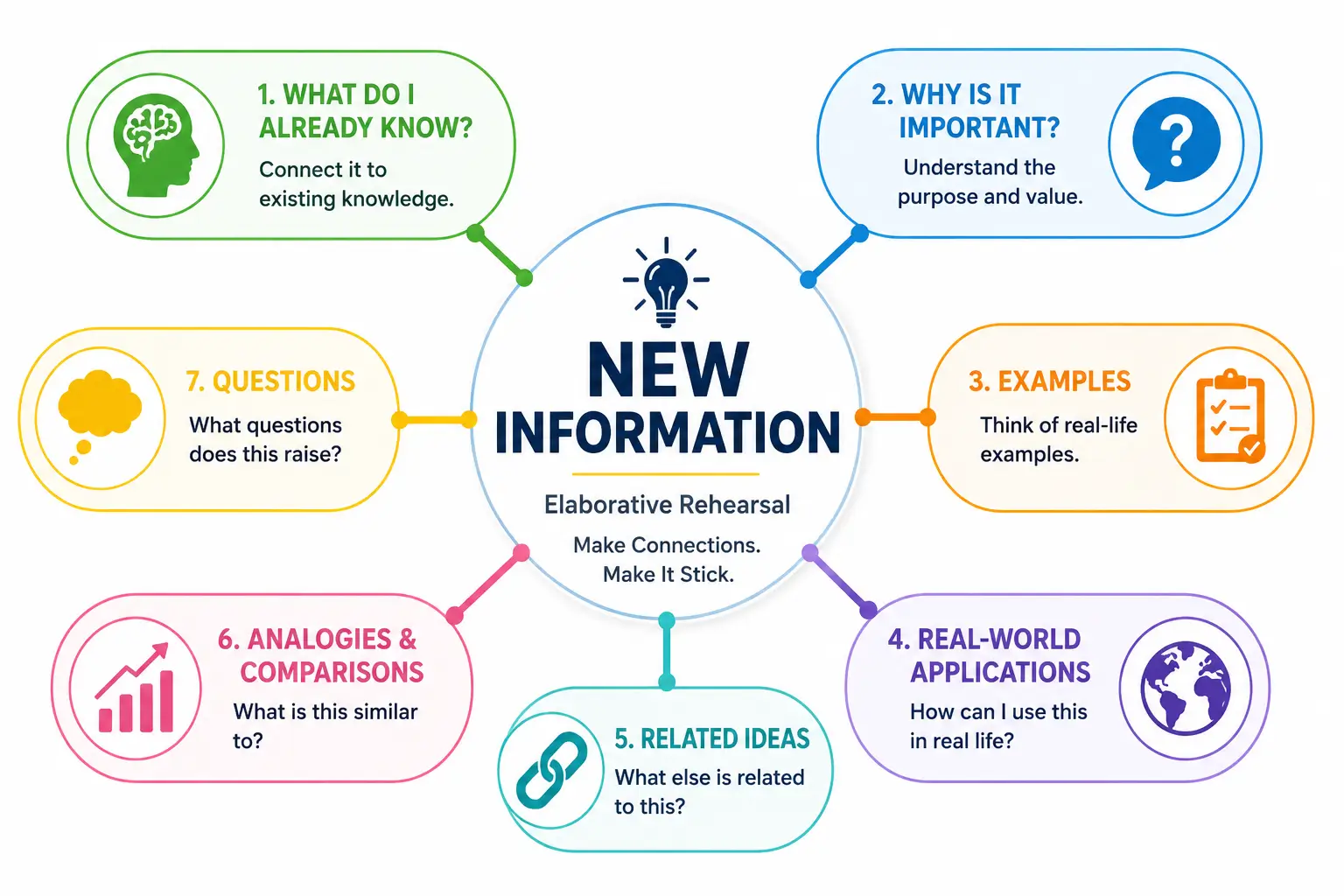
Elaborative Rehearsal is a learning strategy that strengthens memory by connecting new information to existing knowledge. Rather than simply repeating information, learners actively build meaning around it.
The more meaningful the information becomes, the easier it often is to remember.
This principle sits at the heart of many effective learning methods and helps explain why some memories last for years while others disappear within days.
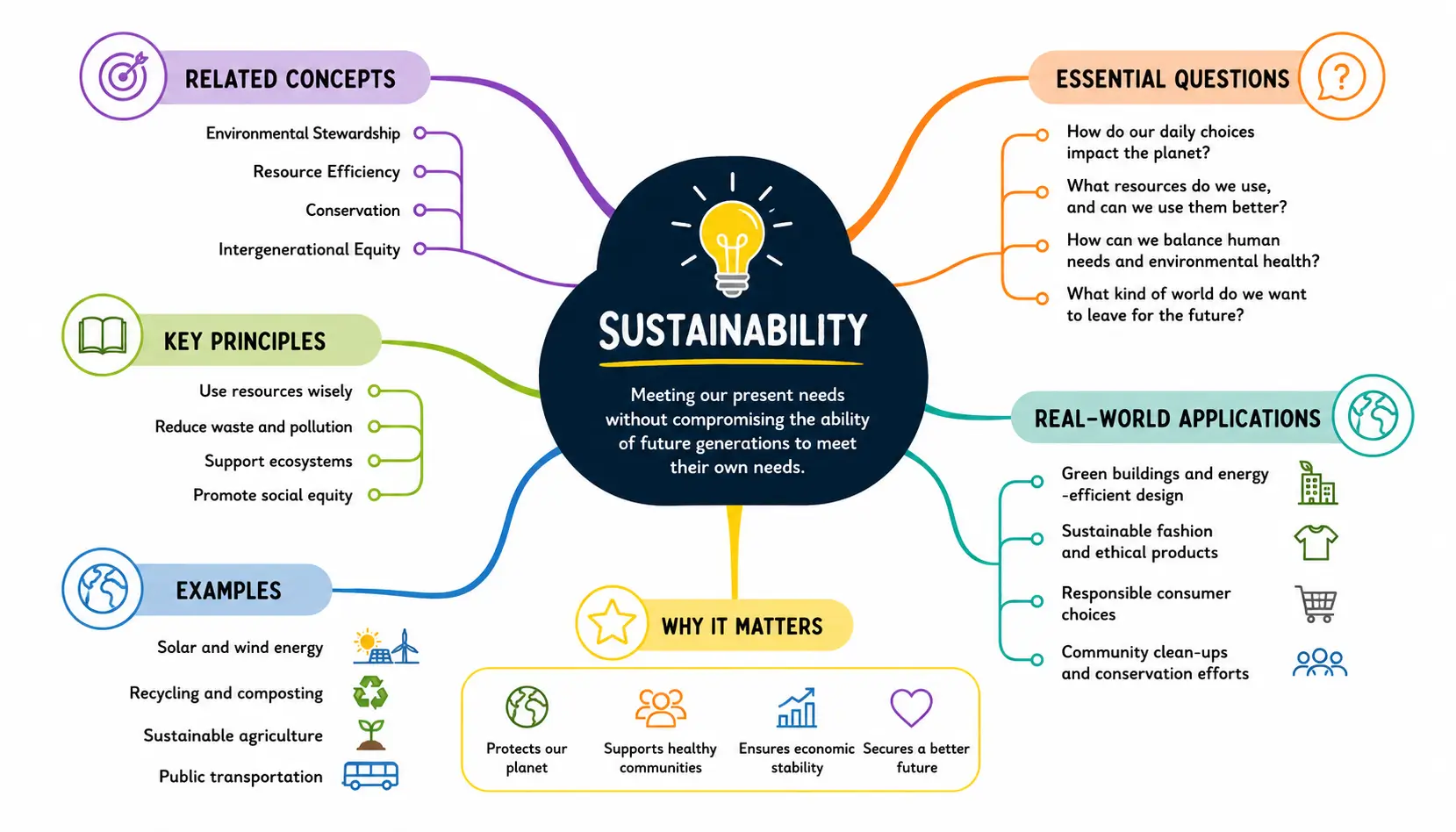
What Is Elaborative Rehearsal?
Elaborative Rehearsal is a memory strategy that involves actively expanding and enriching information during learning.
Instead of simply repeating information, learners create additional connections.
These connections can include:
- Personal experiences
- Examples
- Comparisons
- Questions
- Analogies
- Existing knowledge
The goal is not repetition.
The goal is meaning.
The brain tends to remember information that has multiple connections more effectively than information that exists in isolation.
Maintenance Rehearsal vs Elaborative Rehearsal
To understand why elaborative rehearsal is powerful, it helps to compare it with another learning strategy known as maintenance rehearsal.
Maintenance rehearsal focuses on repetition.
For example:
“Paris is the capital of France. Paris is the capital of France. Paris is the capital of France.”
The information is repeated but not expanded.
Elaborative rehearsal takes a different approach.
The learner might ask:
- Why is Paris important?
- What landmarks are located there?
- What historical events happened there?
- How does Paris compare to other European capitals?
Each new connection creates additional retrieval pathways.
This often improves long-term retention.


Why Meaning Improves Memory
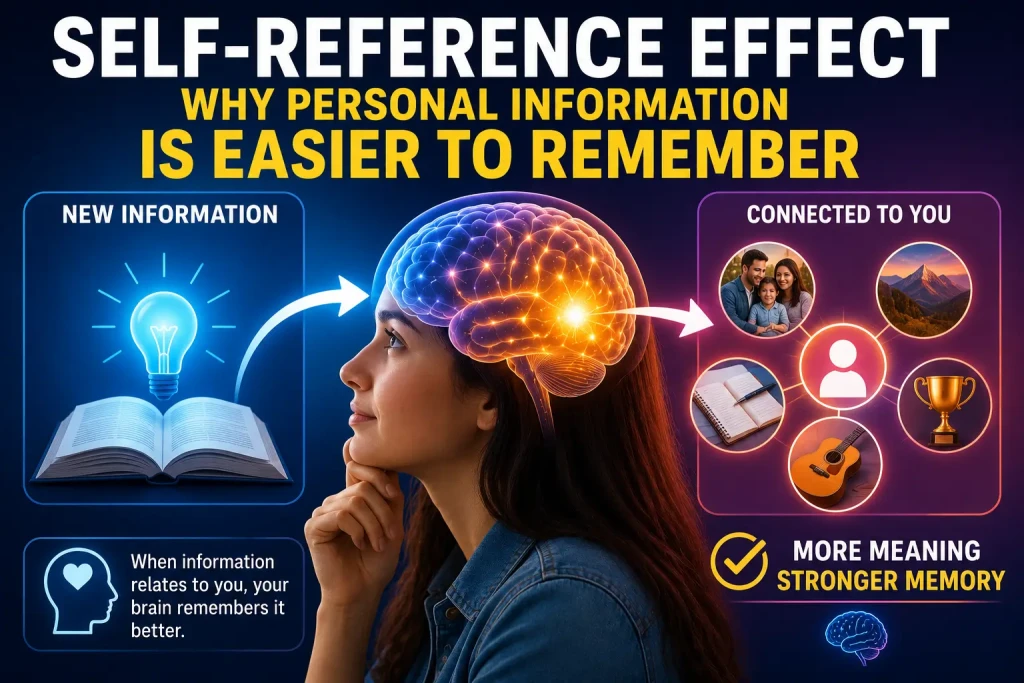
This also explains why the self-reference effect can improve memory: information connected to personal experience becomes more meaningful and easier to retrieve. The human brain is exceptionally good at storing connected information.
When new information links to existing knowledge, it becomes easier to retrieve later.
Think of memory as a network.
A single isolated fact has only one connection.
A fact linked to experiences, examples, and existing knowledge may have dozens.
If one retrieval route fails, another may still succeed.
This is one reason elaborative rehearsal is frequently more effective than simple repetition.
🔬 The Science Behind Elaborative Rehearsal
Research in cognitive psychology has consistently demonstrated that deeper processing improves memory retention.
Information processed at a meaningful level tends to be remembered better than information processed only at a surface level.
This idea became particularly influential through the Levels of Processing framework developed by Craik and Lockhart.
Source: https://www.simplypsychology.org/levels-of-processing.html
The core insight remains highly relevant:
The depth of processing often matters more than the amount of repetition.
In other words, understanding tends to outperform memorization.
How Elaborative Rehearsal Works in Practice
Suppose you’re learning about memory consolidation.
You could memorize a definition.
Or you could ask:
- How does memory consolidation affect my daily learning?
- What role does sleep play?
- Why do I remember some experiences more clearly than others?
- How does this connect to studying for exams?
These questions force the brain to build relationships between ideas.
The information becomes part of a larger knowledge structure.
This often makes recall easier and more reliable.
Elaborative Rehearsal and Long-Term Memory
One reason elaborative rehearsal is so valuable is that it supports long-term memory formation.
Information that receives meaningful processing is often more likely to survive beyond short-term memory.
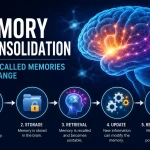
This relationship connects closely to Memory Consolidation.
Memories that are richly connected and frequently revisited tend to become more stable over time.
The more meaningful the information becomes, the more opportunities the brain has to retrieve it later.
Why Questions Are Powerful Learning Tools
Many effective learners naturally use elaborative rehearsal by asking questions.
Questions force the brain to think beyond simple facts.
For example:
- Why does this happen?
- How does this work?
- What does this remind me of?
- How could I explain this to someone else?
These questions transform passive learning into active learning.
The learner becomes involved in constructing knowledge rather than simply receiving it.
Elaborative Rehearsal and Active Recall
Elaborative rehearsal works particularly well alongside Active Recall.
Elaborative rehearsal strengthens encoding.
Active Recall strengthens retrieval.
Together, they create a highly effective learning system.
One technique helps build memory.
The other helps access it.
When combined, the result is often stronger long-term retention.
Real-World Examples of Elaborative Rehearsal
People use elaborative rehearsal in many situations without realizing it.
Examples include:
- Relating new vocabulary to familiar words
- Connecting historical events to modern situations
- Comparing scientific concepts to everyday experiences
- Explaining ideas in your own words
- Creating analogies and examples
All of these activities increase the number of connections attached to information.
More connections generally create stronger memory networks.
How to Practice Elaborative Rehearsal Effectively
One of the best things about elaborative rehearsal is that it requires no special equipment.
You do not need flashcards, software, or advanced memory training.
You simply need to interact with information more deeply.
Whenever you learn something new, ask yourself:
- Why is this important?
- How does this relate to what I already know?
- Can I think of a real-world example?
- How would I explain this to someone else?
These questions encourage deeper processing and help transform information into meaningful knowledge.
Elaborative Rehearsal and the Feynman Technique
Elaborative rehearsal works exceptionally well alongside the Feynman Technique.
The Feynman Technique encourages learners to explain concepts in simple language.
Doing so forces the brain to organize information, identify gaps in understanding, and build meaningful connections.
When you explain an idea clearly, you naturally engage in elaborative processing.
This is one reason teaching often becomes one of the most powerful forms of learning.
The act of explanation strengthens understanding.
Elaborative Rehearsal and Metacognition
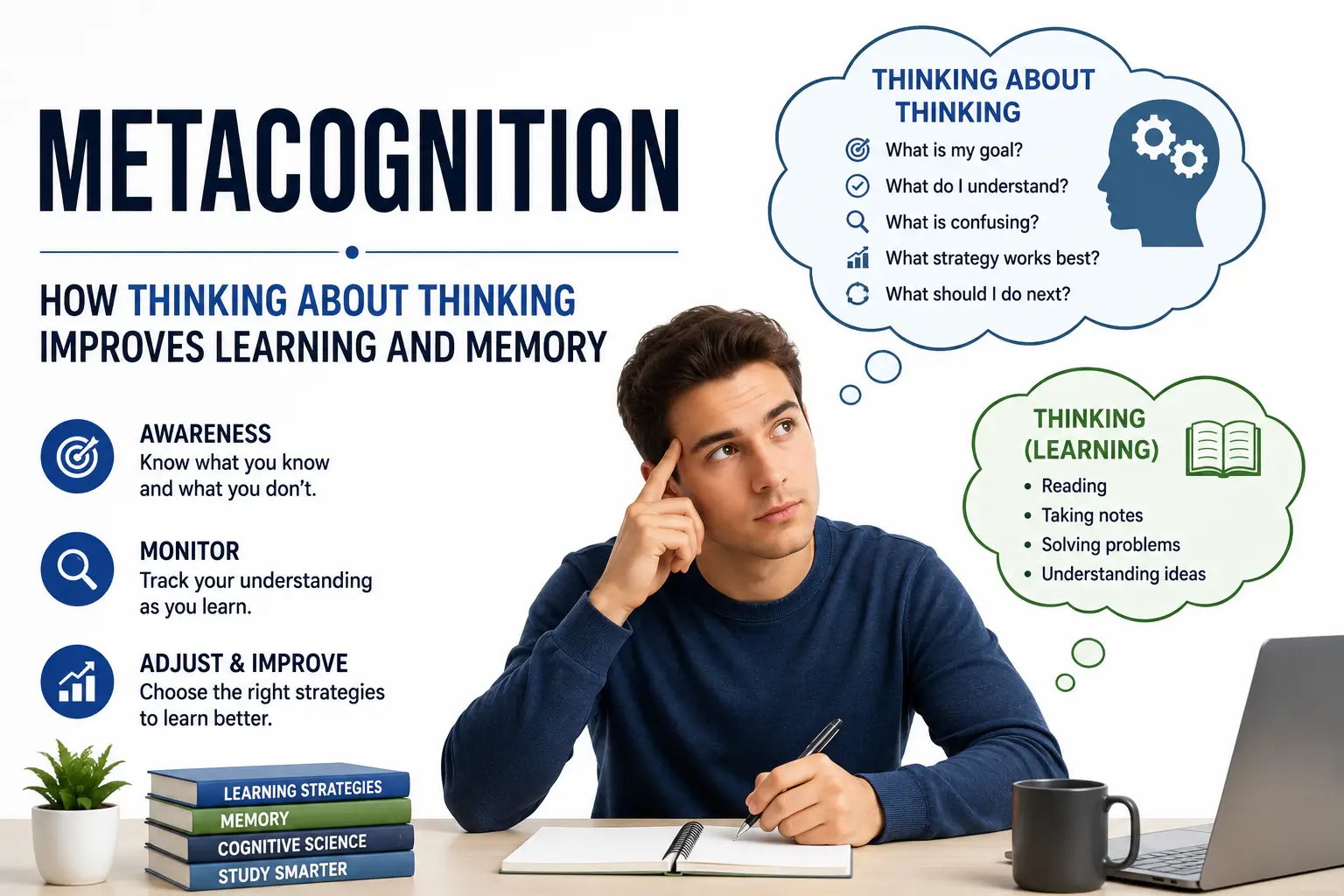
Another powerful connection exists between elaborative rehearsal and Metacognition.
Metacognition refers to thinking about your own thinking.
When learners ask questions, create examples, and evaluate their understanding, they become more aware of what they truly know.
This awareness improves study efficiency.
Instead of passively reviewing information, learners actively monitor comprehension and identify weak areas.
The result is often more focused and effective learning.
Using Dual Coding to Strengthen Elaboration
Elaborative rehearsal can also be enhanced through Dual Coding Theory.
Rather than relying entirely on verbal explanations, learners can combine words with visuals.
Examples include:
- Mind maps
- Concept diagrams
- Visual summaries
- Flowcharts
- Sketch notes
These visual representations create additional retrieval pathways and make complex information easier to understand.
Combining elaboration and visualization often produces stronger learning outcomes than using either strategy alone.
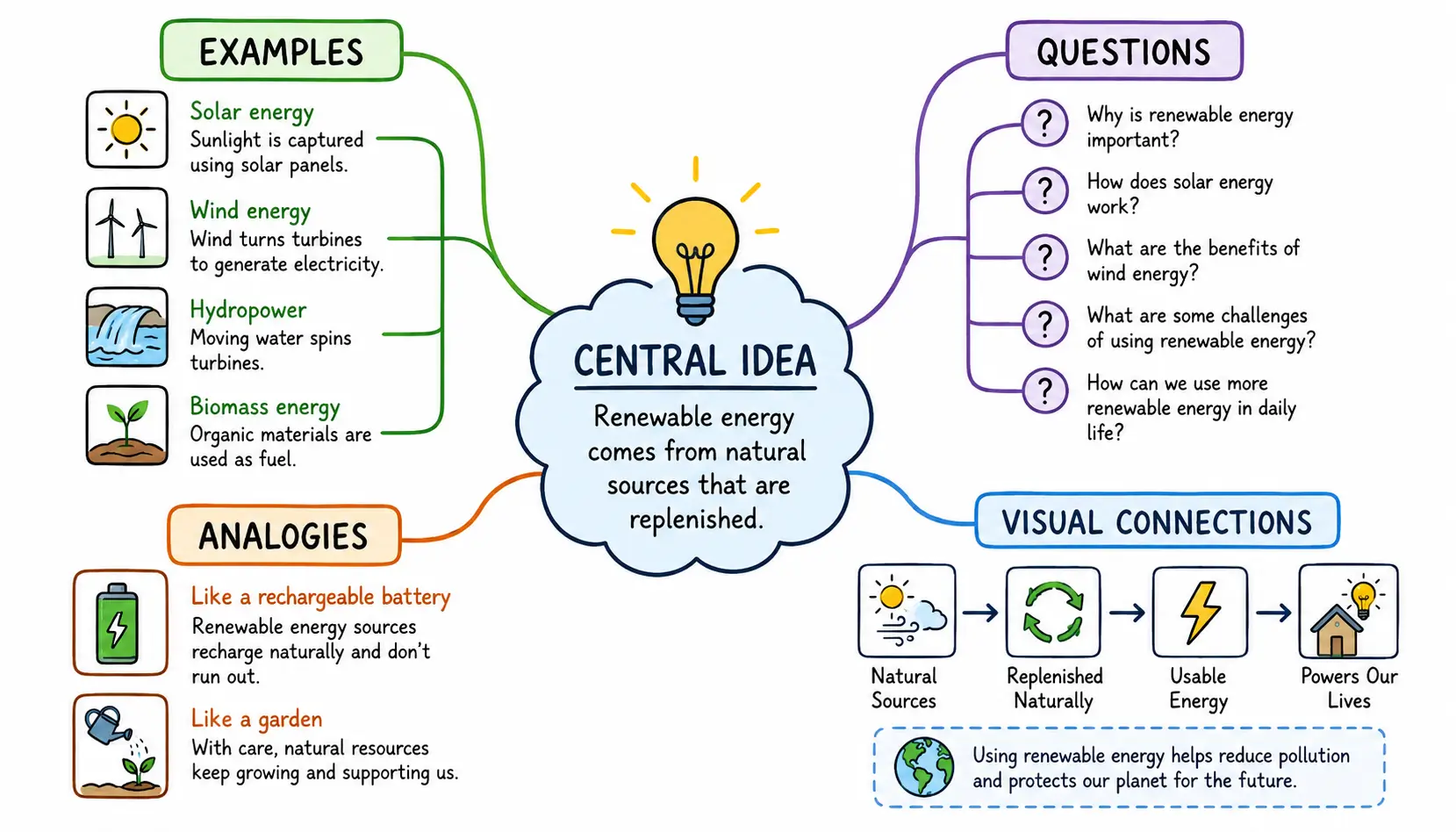
Why Elaborative Rehearsal Improves Understanding
Many study techniques focus on memorization.
Elaborative rehearsal focuses on meaning.
This distinction is important.
Memorized information may be recalled temporarily.
Understood information is often easier to apply, explain, and retain.
When learners create connections between concepts, they develop richer mental models.
These mental models support deeper understanding and more flexible thinking.
This is particularly valuable in subjects where problem-solving matters more than simple fact recall.
Common Elaborative Rehearsal Mistakes
Focusing Only on Repetition
Many learners assume that more repetition automatically leads to better memory.
Without meaningful processing, repetition often produces weaker results than expected.
Creating Shallow Connections
Not all connections are equally useful.
The strongest elaborations are meaningful, relevant, and personally understandable.
Never Testing Understanding
Building connections is valuable, but retrieval remains essential.
Combining elaborative rehearsal with Retrieval Practice and Active Recall often produces the best results.
Ignoring Prior Knowledge
One of the biggest advantages of elaborative rehearsal is the ability to connect new information to existing knowledge.
Failing to make those connections limits the technique’s effectiveness.
Who Benefits Most From Elaborative Rehearsal?
Almost anyone who learns complex information can benefit.
This includes:
- Students
- Language learners
- Professionals
- Teachers
- Researchers
- Lifelong learners
The technique is particularly valuable when understanding matters more than memorizing isolated facts.
The deeper the learning objective, the more useful elaborative rehearsal often becomes.
Supporting Long-Term Learning and Cognitive Performance
Elaborative rehearsal strengthens learning by improving encoding and understanding.
However, memory performance is influenced by many additional factors.
Sleep quality, stress management, attention, physical activity, and cognitive health all play important roles in long-term retention.
Many learners combine evidence-based study techniques with broader strategies that support healthy cognitive function.
Readers interested in memory-supportive nutritional approaches can learn more about Advanced Memory Formula.
Learning That Actually Lasts
Elaborative rehearsal teaches a simple but powerful lesson:
The brain remembers meaning better than repetition.
By connecting new information to existing knowledge, creating examples, asking questions, and building deeper understanding, learners make memories easier to store and retrieve.
Whether you’re preparing for exams, learning professional skills, or exploring a new subject, elaborative rehearsal offers a practical way to turn information into lasting knowledge.
Sometimes the key to remembering more is not reviewing information again.
It’s understanding it more deeply.