
Now Reading: Memory Retrieval Explained: How the Brain Accesses Stored Information
-
01
Memory Retrieval Explained: How the Brain Accesses Stored Information
Memory Retrieval Explained: How the Brain Accesses Stored Information
Have you ever struggled to remember a name that felt just out of reach?
Or suddenly recalled a forgotten memory after hearing a familiar song?
These experiences involve a process known as memory retrieval.
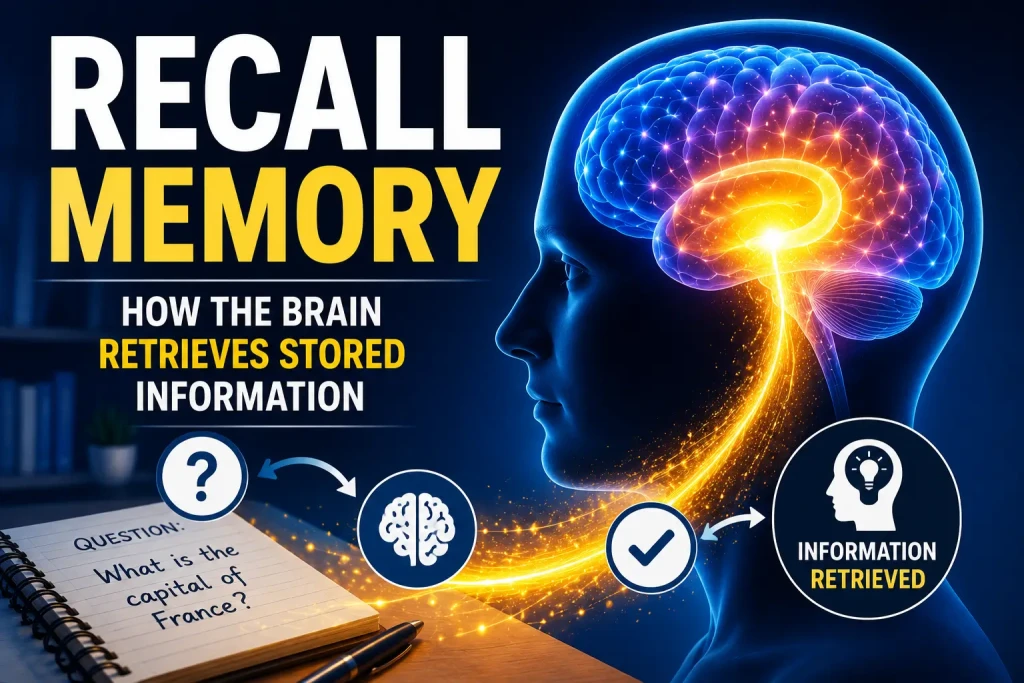
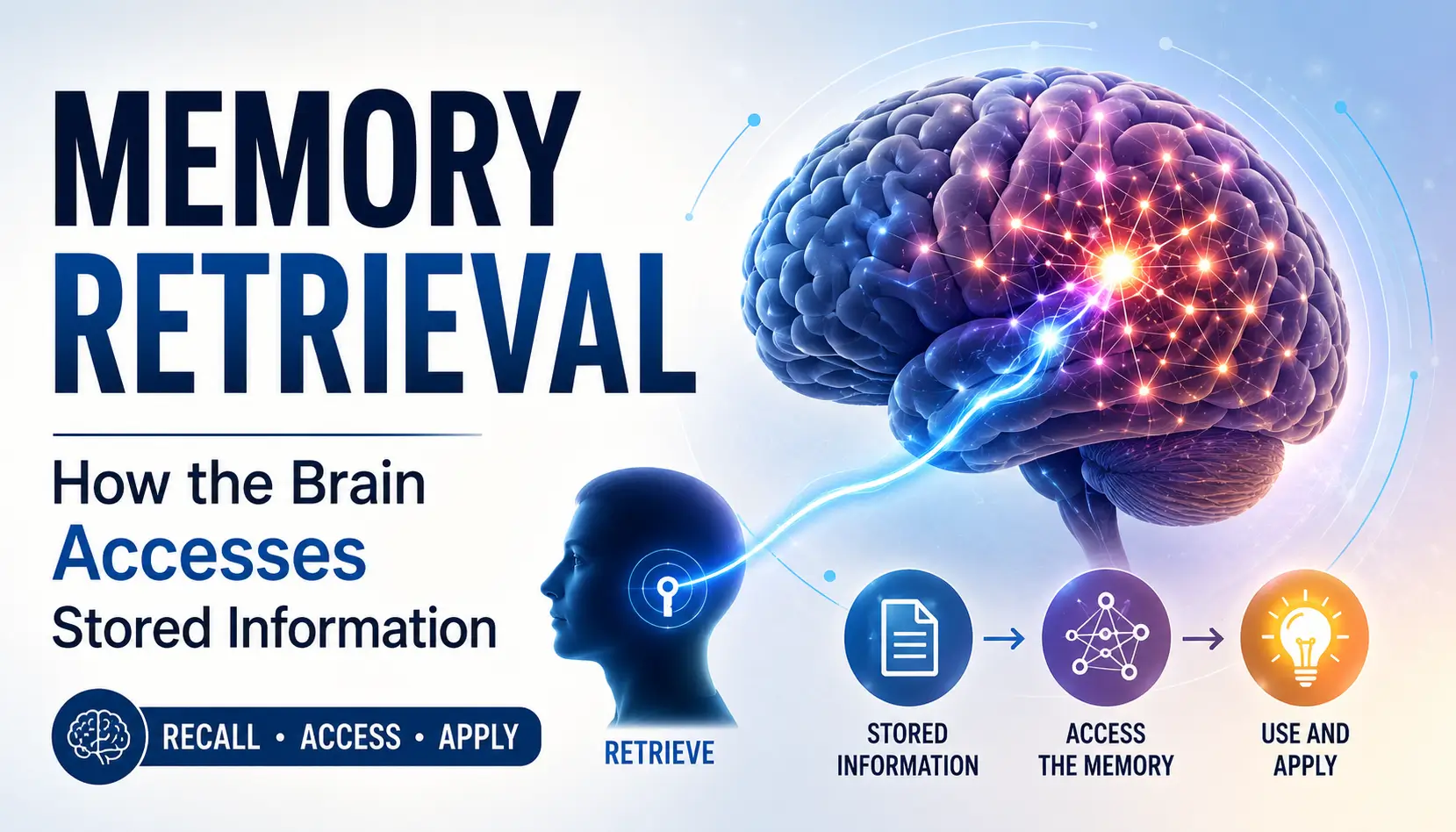
Memory retrieval is the ability to access information that has already been stored in memory.
Without retrieval, learning would have little practical value.
Information might exist somewhere in the brain, but it would remain inaccessible when needed.
Retrieval allows people to recall knowledge, experiences, skills, and facts that support everyday thinking and decision-making.
It is one of the most important functions of human memory.
What Is Memory Retrieval?
Memory retrieval is the process of accessing information that has previously been encoded and stored.
Whenever you remember a fact, recognize a face, recall an experience, or solve a familiar problem, retrieval is taking place.
Retrieval represents the final stage of the memory process.
Most memory researchers describe memory as involving three major stages:
- Memory Encoding
- Memory Consolidation
- Memory Retrieval
Without retrieval, stored information cannot be used effectively.
Why Memory Retrieval Matters
Learning is only useful if information can be recalled when needed.
Students retrieve information during exams.
Professionals retrieve knowledge while performing their jobs.
People retrieve memories during conversations and daily decision-making.
The ability to access stored information is often more important than simply storing it.


🔬 The Science Behind Memory Retrieval
Cognitive psychologists view retrieval as an active reconstruction process.
Rather than playing back a perfect recording, the brain rebuilds memories using stored information and retrieval cues.
The quality of retrieval often depends on how information was originally encoded and consolidated.
Strong encoding and repeated retrieval generally improve future accessibility.
Source: https://www.ncbi.nlm.nih.gov/books/NBK559316/
A memory is only useful when it can be successfully retrieved.
The Memory Process: Encoding, Storage, and Retrieval
Memory retrieval cannot occur in isolation.
It depends on earlier stages of memory formation.
First, information must be encoded.
Next, it must be stabilized through consolidation.
Finally, retrieval allows access to the stored information.
This sequence forms the foundation of learning and memory.
Types of Memory Retrieval
In practice, retrieval is often divided into recall memory and recognition memory, which place different demands on the learner.
Researchers often distinguish between different forms of retrieval.
Recall
Recall involves retrieving information without being given the answer.
For example, answering an essay question requires recall.
This type of retrieval is often more difficult but can strengthen memory significantly.
Recognition
Recognition involves identifying information when it is presented.
Multiple-choice questions frequently rely on recognition.
Recognition is generally easier than recall because retrieval cues are already available.
Relearning
Relearning occurs when previously learned information is acquired again more quickly than during the original learning process.
This suggests that memory traces remain even when retrieval is difficult.
Retrieval and Long-Term Memory
Most retrieval processes involve information stored within Long-Term Memory.
Facts, experiences, concepts, and skills can remain accessible for years when retrieval pathways remain strong.
Successful retrieval demonstrates that information has been preserved within memory systems.
The easier information becomes to retrieve, the more useful it often becomes.
Retrieval Cues: The Keys to Memory
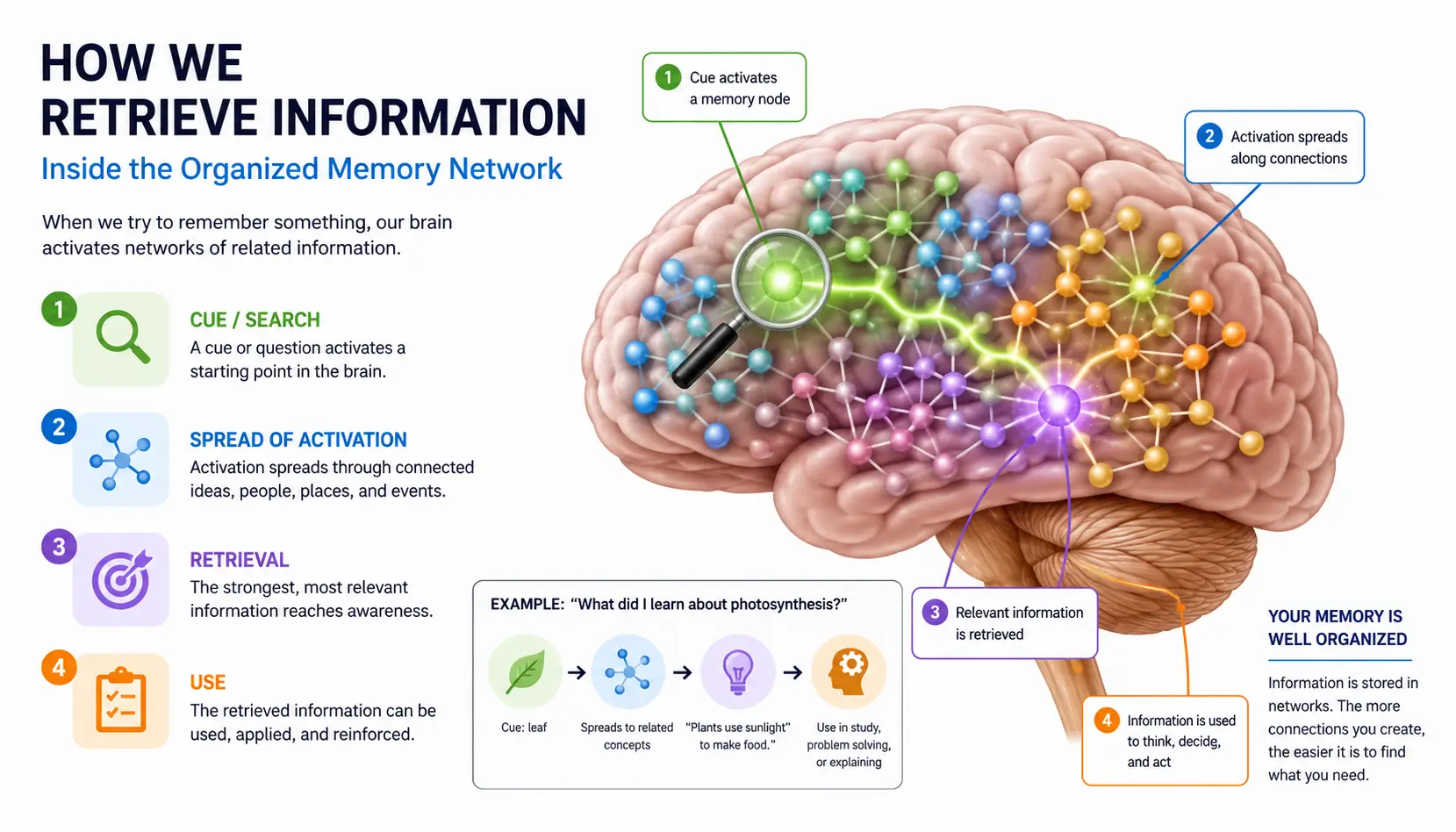
These cues are most effective when they resemble the conditions present during learning, which is the core idea behind the encoding specificity principle and the broader role of retrieval cues.
Retrieval cues are pieces of information that help trigger access to stored memories.
Examples include:
- Photographs
- Locations
- Sounds
- Smells
- Words
- Emotions
These cues can activate networks of associated memories.
A related process is priming, in which previous exposure to information can make associated concepts easier to recognize or process. Unlike deliberate memory retrieval, priming can influence responses without conscious recall.
This is why a familiar song may suddenly bring back memories from years earlier.
Why Some Memories Are Easy to Retrieve
Some information is easier to retrieve because it was encoded deeply and reinforced frequently.
Meaningful information tends to create stronger memory pathways.
Information connected to existing knowledge structures is also easier to access.
Frequent retrieval further strengthens accessibility over time.
This principle plays a central role in many evidence-based learning strategies.
Memory Retrieval and Active Recall
Active Recall is built directly upon retrieval.
Rather than reviewing information passively, learners attempt to retrieve it from memory.
This effort strengthens retrieval pathways and improves future recall.
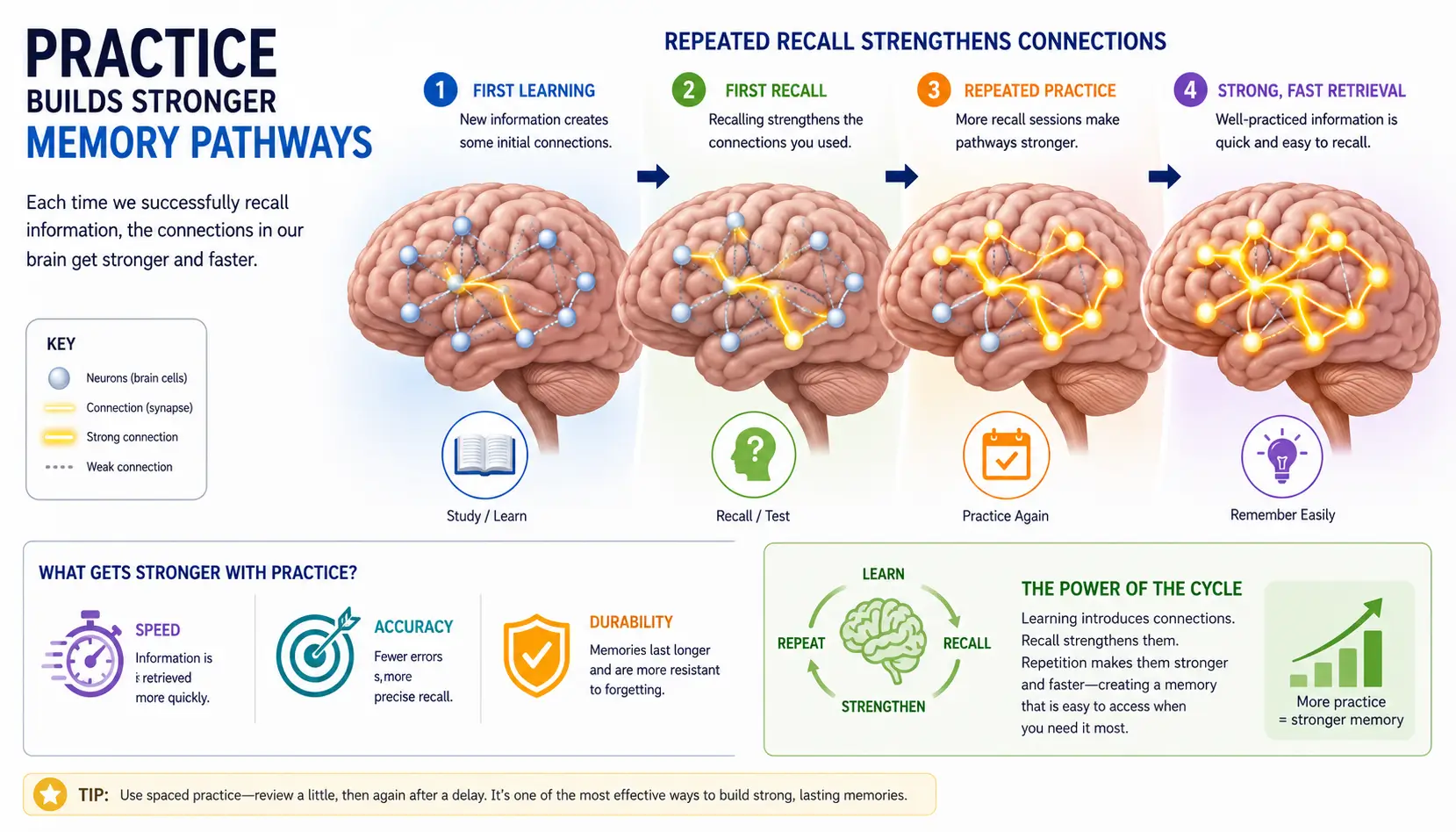
Each successful retrieval makes future retrieval slightly easier.
This is one reason active recall is considered one of the most effective study techniques available.
The Testing Effect and Retrieval Strength
One of the most important discoveries in learning science is the Testing Effect.
Research consistently shows that retrieving information strengthens memory more effectively than simply reviewing it.
Every retrieval attempt acts as a form of practice for the brain.
The more frequently information is successfully retrieved, the stronger retrieval pathways often become.
This process improves both retention and future recall.
Retrieval Practice: Training Memory Through Recall
Retrieval Practice applies this principle directly.
Instead of repeatedly rereading notes, learners actively test themselves.
Examples include:
- Answering practice questions
- Using flashcards
- Self-quizzing
- Explaining concepts from memory
- Writing summaries without notes
These activities strengthen retrieval pathways and improve long-term learning outcomes.
Why We Sometimes Forget Information
Forgetting does not always mean information has disappeared.
In many cases, retrieval simply becomes more difficult.
The memory may still exist but lack sufficient retrieval cues.
This concept helps explain why forgotten information sometimes suddenly returns when the right cue appears.
Memory accessibility can fluctuate even when storage remains intact.
The Forgetting Curve and Retrieval
The Ebbinghaus Forgetting Curve demonstrates how information becomes less accessible over time when retrieval does not occur.
Without review or retrieval, memory traces gradually weaken.
Retrieval interrupts this decline.
Each successful recall strengthens the memory and helps preserve it for longer periods.
This is why spaced review schedules can be highly effective.
Memory Retrieval in Episodic Memory
Retrieval plays a major role in Episodic Memory.
When people remember personal experiences, they retrieve details about events, locations, emotions, and people associated with those experiences.
Retrieval often reconstructs these memories rather than replaying them exactly.
This reconstruction process helps explain why memories can sometimes change over time.
Memory Retrieval in Semantic Memory
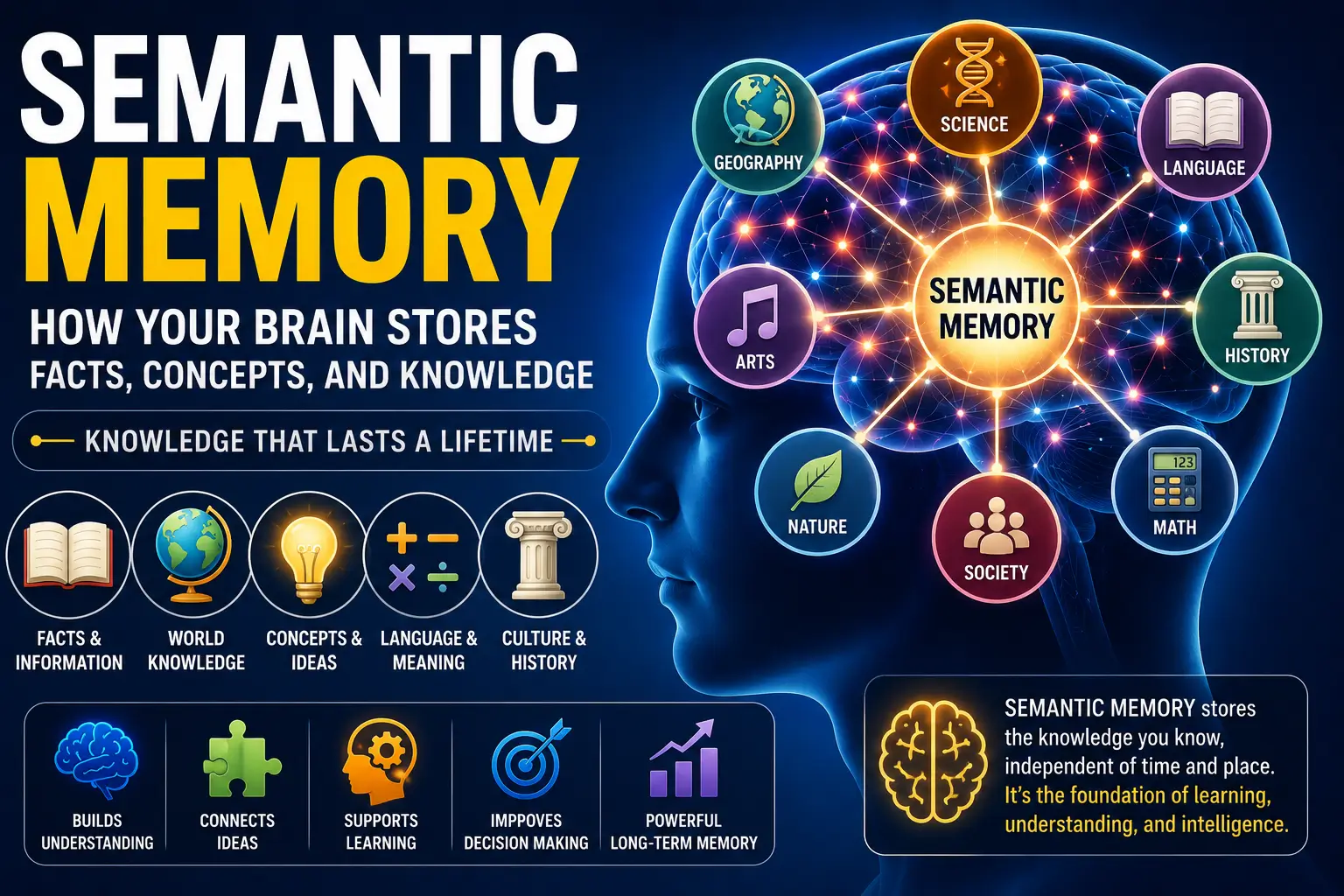
Semantic Memory also depends heavily on retrieval.
Whenever people recall facts, vocabulary, concepts, or general knowledge, semantic retrieval is occurring.
Students rely on semantic retrieval constantly during learning.
Strong semantic memory often reflects strong retrieval pathways.
Retrieval Failure: When Information Feels Out of Reach
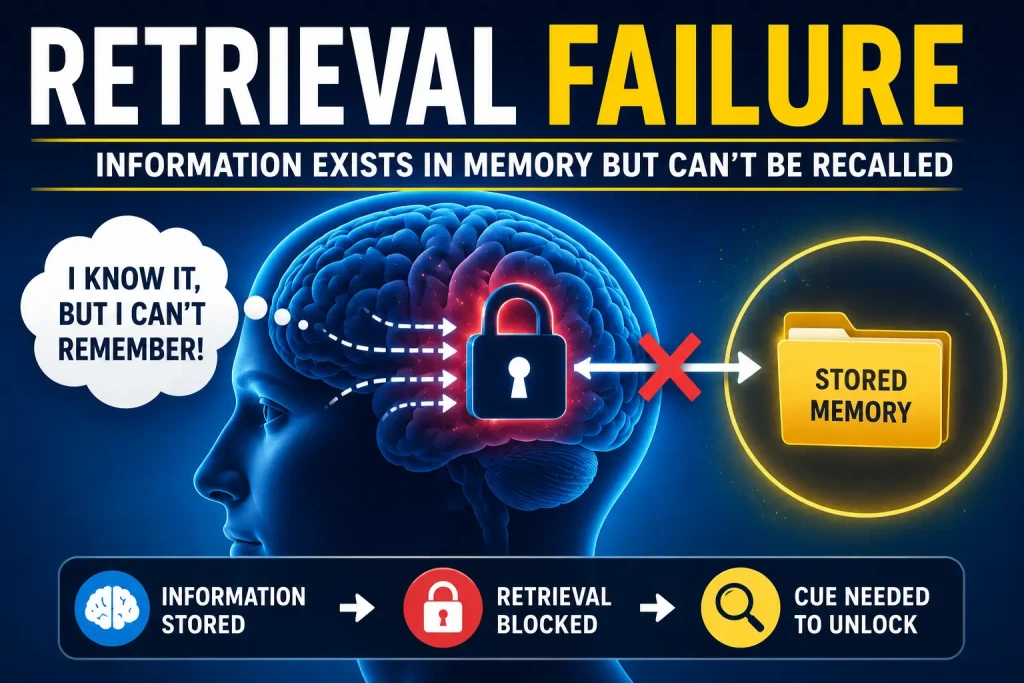
When stored information exists but still cannot be accessed, the problem is often best understood as retrieval failure rather than permanent forgetting.
Most people have experienced the “tip-of-the-tongue” phenomenon.
This occurs when information feels familiar but cannot be retrieved immediately.
Retrieval failures often result from insufficient cues rather than complete memory loss.
Given enough time or the right trigger, the memory may become accessible again.
This illustrates the difference between storage problems and retrieval problems.
How to Improve Memory Retrieval
Several evidence-based techniques can strengthen retrieval ability.
- Practice Active Recall
- Use Spaced Repetition
- Create meaningful associations
- Apply Retrieval Practice regularly
- Teach concepts to others
- Use multiple retrieval cues
- Review information strategically over time
These methods help strengthen neural pathways associated with recall.
Consistent retrieval practice improves long-term accessibility.
Memory Retrieval and Academic Success
Many students focus heavily on reviewing information but spend little time practicing retrieval.
Research suggests this approach is often less effective than active testing.
The ability to retrieve information under real conditions is what ultimately determines performance during exams and practical situations.
Learning should focus on accessibility, not simply exposure.
The Final Stage of Memory
For a full overview of how retrieval connects with encoding, forgetting, and memory improvement, see the complete guide to memory.
Memory retrieval completes the learning process.
Information is first encoded, then consolidated, and finally retrieved when needed.
Without retrieval, stored knowledge cannot influence behavior, decisions, or performance.
Retrieval transforms stored information into usable knowledge.
The strength of a memory is often measured by how easily it can be retrieved when needed.
Understanding memory retrieval helps explain why some information remains available for years while other information seems to disappear quickly.
The key is not simply storing information, but repeatedly practicing access to it.
Supporting Memory Beyond Retrieval Practice
Strong retrieval depends on effective encoding, consolidation, sleep quality, focused attention, and overall cognitive health.
Many learners combine evidence-based study strategies with broader approaches that support long-term brain performance.
Readers interested in memory-supportive nutritional strategies can learn more about Advanced Memory Formula.