
Now Reading: Study Habits: The Daily Practices That Improve Learning, Focus, and Memory
-
01
Study Habits: The Daily Practices That Improve Learning, Focus, and Memory
Study Habits: The Daily Practices That Improve Learning, Focus, and Memory
Why do some people consistently learn faster, remember more, and perform better academically?
While intelligence certainly plays a role, research suggests that daily habits often have a greater impact on long-term success than natural ability alone.
The most effective learners rarely rely on motivation, inspiration, or last-minute effort.
Instead, they build routines that make learning easier, more consistent, and more sustainable.
These routines are known as study habits.
Study habits influence how often you learn, how effectively you retain information, and how efficiently you use your mental resources.
Over time, small daily behaviors can produce remarkable improvements in knowledge, memory, and academic performance.
This guide explores the study habits most strongly associated with successful learning and long-term memory development.
What Are Study Habits?
Study habits are the regular behaviors and routines that influence learning outcomes.
They include how learners organize study sessions, manage distractions, review information, schedule learning activities, and maintain focus.
Unlike individual study techniques, habits operate automatically over time.
A learner may occasionally use a powerful study method, but lasting improvement typically occurs when effective behaviors become consistent routines.
In many cases, study habits determine whether knowledge is retained or forgotten.
Why Study Habits Matter More Than Motivation
Many students believe success depends on staying motivated.
However, motivation naturally rises and falls.
Habits provide stability when motivation disappears.
A learner with strong study habits continues making progress even on days when energy or enthusiasm is low.
This consistency creates a significant advantage over time.
Successful learning is often the result of repeated actions rather than occasional bursts of effort.


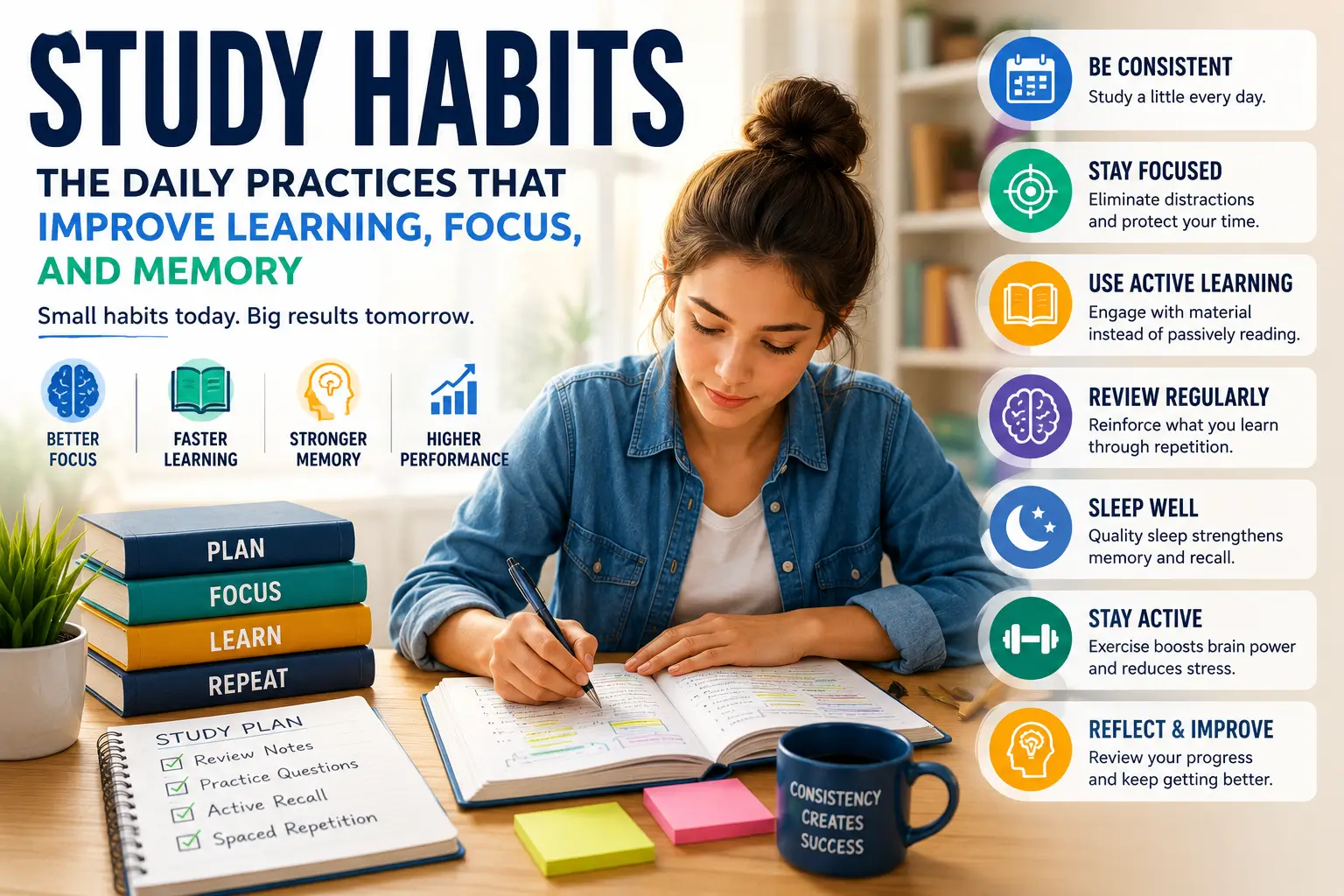
Habit #1: Study Consistently Instead of Cramming
If you want to turn consistency into a realistic plan, see Study Schedule.
One of the most effective study habits is maintaining a regular study schedule.
Many learners wait until deadlines approach before opening their books.
This approach often leads to stress, fatigue, and poor retention.
Short, consistent study sessions typically outperform long cramming sessions.
Regular exposure creates multiple opportunities for encoding and reinforcement.
It also works naturally with strategies such as Spaced Repetition.
Habit #2: Use Active Learning Methods
Successful learners rarely spend hours passively reviewing material.
Instead, they actively engage with information.
Examples include:
- Self-testing
- Practice questions
- Teaching concepts to others
- Writing summaries from memory
- Solving problems without notes
Research in cognitive psychology consistently shows that active engagement produces stronger learning outcomes than passive review.
Techniques such as Active Recall and Retrieval Practice are powerful examples.
Habit #3: Eliminate Distractions During Study Sessions
For a deeper look at attention control and concentration during learning, read How to Focus on Studying.
Attention is one of the brain’s most valuable resources.
Every interruption forces the brain to switch contexts.
This process consumes mental energy and reduces learning efficiency.
High-performing learners often create environments designed to minimize distractions.
Common strategies include:
- Silencing notifications
- Using dedicated study spaces
- Closing unnecessary browser tabs
- Scheduling focused work periods
Protecting attention allows working memory to process information more effectively.
Habit #4: Plan Study Sessions in Advance
Effective learners rarely decide what to study at the last minute.
They establish clear objectives before each session begins.
A simple study plan might include:
- Topics to review
- Practice exercises to complete
- Questions to answer
- Specific learning goals
Planning reduces decision fatigue and increases productivity.
It also makes it easier to track progress over time.
Habit #5: Prioritize Understanding Over Memorization
Memorization has its place, but understanding creates stronger and more flexible knowledge.
When learners focus solely on memorizing facts, information often disappears quickly.
Understanding allows knowledge to be applied in new situations.
This deeper processing strengthens memory formation and improves recall.
Methods such as the Feynman Technique help learners develop genuine comprehension rather than superficial familiarity.
Habit #6: Review Mistakes Regularly
Many learners focus exclusively on correct answers.
However, mistakes often provide the greatest learning opportunities.
Reviewing errors helps identify misunderstandings and knowledge gaps.
Over time, this process improves accuracy and strengthens understanding.
Top-performing students often maintain error logs that allow them to revisit difficult concepts repeatedly.
Habit #7: Build a Learning-Friendly Environment
Your surroundings influence attention, focus, and memory.
A consistent study environment can become associated with learning activities.
This relationship is closely related to Context-Dependent Memory.
When studying occurs in a predictable environment, the brain often retrieves information more efficiently.
Simple adjustments such as proper lighting, comfortable seating, and reduced noise can improve concentration significantly.
Habit #8: Take Strategic Breaks
Many people assume longer study sessions produce better results.
In reality, mental performance often declines when concentration is sustained for extended periods.
Strategic breaks help restore attention and reduce mental fatigue.
Short recovery periods allow the brain to process information and maintain productivity.
Techniques such as the Pomodoro Method are popular because they balance focused work with structured recovery.
Habit #9: Protect Your Sleep
Sleep is one of the most overlooked study habits.
Many learners sacrifice sleep in an attempt to create more study time.
Unfortunately, this often produces the opposite effect.
Research shows that sleep plays a critical role in Memory Consolidation, the process through which newly learned information becomes more stable and accessible.
Without adequate sleep, attention declines, learning efficiency decreases, and recall becomes more difficult.
Strong study habits extend beyond the study desk and into nightly recovery routines.
A consistent sleep schedule may improve learning more than an extra hour of late-night studying.
Habit #10: Stay Physically Active
Physical activity benefits far more than physical health.
Regular exercise supports blood flow, brain function, mood regulation, and cognitive performance.
Numerous studies have linked exercise with improvements in memory, attention, and executive function.
Even moderate activities such as walking can contribute to better mental performance.
For learners seeking long-term cognitive improvement, movement should be considered part of the learning process.

Habit #11: Read Regularly
Reading remains one of the most powerful habits for cognitive development.
Regular reading strengthens comprehension, vocabulary, attention span, and knowledge acquisition.
It also exposes the brain to new concepts and ideas, creating opportunities for deeper learning.
Learners who read consistently often develop stronger critical thinking skills and greater mental flexibility.
Even short daily reading sessions can produce significant long-term benefits.
Habit #12: Reflect on What You Learn
Learning does not end when a study session finishes.
Successful learners often spend time reflecting on what they have learned.
This process helps organize information, identify gaps in understanding, and strengthen memory connections.
Reflection is closely related to Metacognition, the ability to evaluate and monitor your own thinking.
Questions such as “What did I learn today?” and “What remains confusing?” can improve future learning outcomes.
Habit #13: Use Technology Intentionally
Technology can either improve learning or become a major distraction.
Successful learners use digital tools strategically.
Examples include:
- Flashcard applications
- Spaced repetition software
- Digital note-taking systems
- Practice testing platforms
- Learning management tools
At the same time, they minimize unnecessary notifications, social media interruptions, and multitasking.
The goal is to use technology as a learning aid rather than an attention drain.
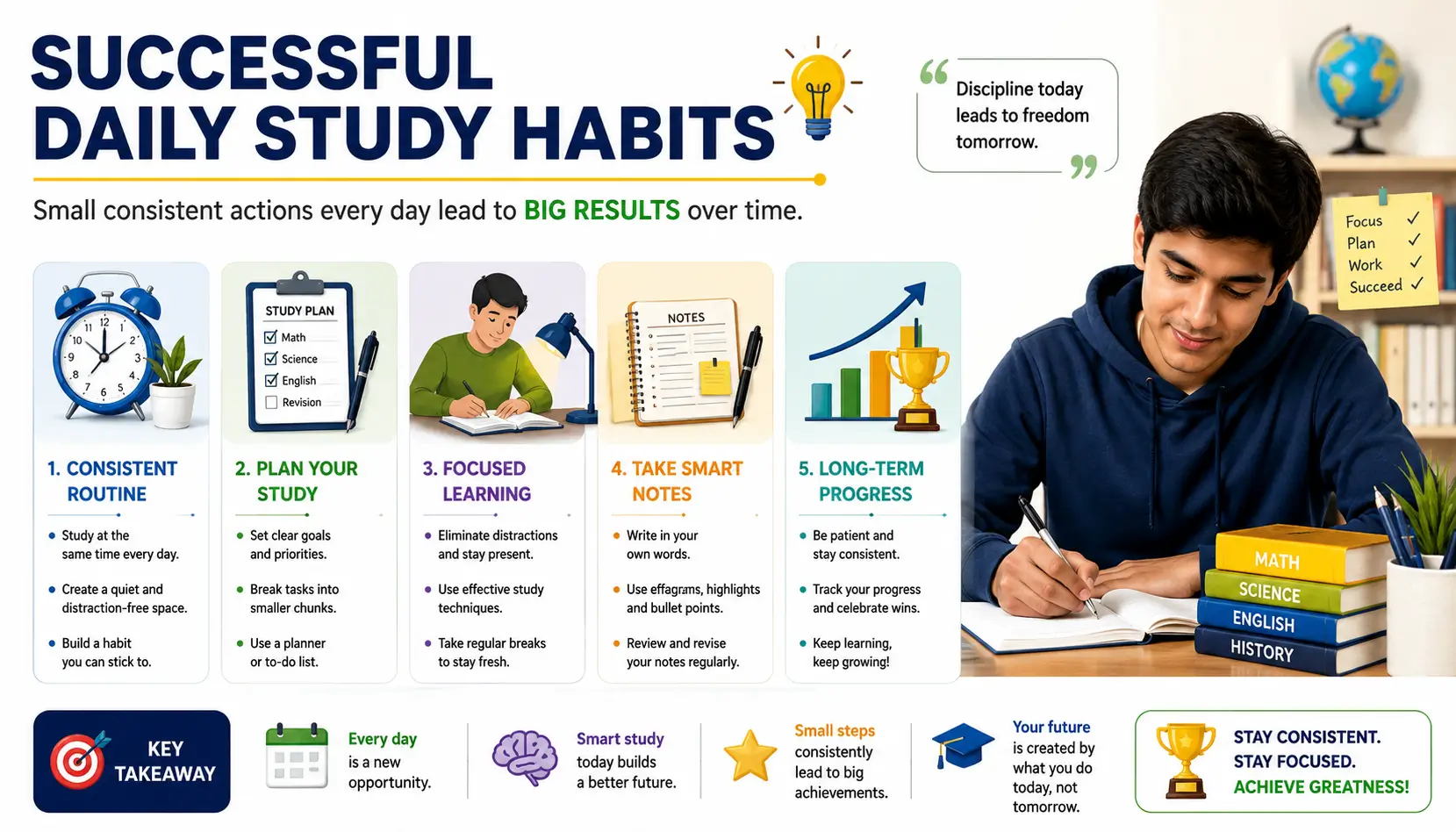
What High-Performing Students Have in Common
Although every learner is different, successful students often share several common habits.
- They study consistently.
- They test themselves frequently.
- They prioritize understanding over memorization.
- They protect their sleep.
- They review mistakes.
- They minimize distractions.
- They maintain long-term learning systems.
None of these habits are particularly complex.
The difference comes from applying them consistently over time.
Small improvements repeated daily often create extraordinary long-term results.
Building Better Study Habits Gradually
Once strong habits are in place, the next step is applying them through a full system like How to Study Effectively.
Many learners attempt to change everything at once.
This approach often leads to frustration and inconsistency.
A more effective strategy is to focus on one habit at a time.
For example:
- Establish a regular study schedule.
- Add Active Recall to study sessions.
- Improve sleep consistency.
- Reduce distractions to protect your attention span.
- Introduce spaced repetition reviews.
As these behaviors become automatic, additional habits can be added gradually.
Sustainable progress typically comes from small improvements repeated consistently.
Successful learning is rarely the result of a single breakthrough. It is usually the result of effective habits practiced repeatedly over time.
Study habits shape how information is learned, stored, and recalled.
While study techniques provide powerful tools, habits determine whether those tools are used consistently.
By building routines that support focus, memory, and long-term learning, learners can improve performance while making studying less stressful and more effective.
Over time, these daily practices become the foundation of academic success and lifelong learning.
Learners interested in supporting memory and cognitive performance beyond study strategies can learn more about Advanced Memory Formula.