
Now Reading: Ebbinghaus Forgetting Curve: Why We Forget and How to Remember More
-
01
Ebbinghaus Forgetting Curve: Why We Forget and How to Remember More
Ebbinghaus Forgetting Curve: Why We Forget and How to Remember More
Have you ever studied something carefully, felt confident that you understood it, and then discovered days later that most of it had vanished from memory?
You’re not alone.
In fact, this experience is so common that it became the focus of one of the most influential memory experiments ever conducted.
More than a century ago, German psychologist Hermann Ebbinghaus set out to answer a simple but important question:
How quickly do people forget information after learning it?
The answer changed how scientists think about memory.
Ebbinghaus discovered that forgetting is not random. Instead, memory tends to decline in a predictable pattern.
This pattern became known as the Forgetting Curve.
Understanding the forgetting curve helps explain why so many traditional study methods fail and why techniques such as Spaced Repetition and Active Recall are so effective.
If you’ve ever wondered why information disappears so quickly after learning, the forgetting curve provides the answer.
Who Was Hermann Ebbinghaus?
Before we explore the forgetting curve itself, it helps to understand the person behind the research.
Hermann Ebbinghaus was a German psychologist who became one of the pioneers of memory research.
During the late nineteenth century, many aspects of memory were still poorly understood.
Ebbinghaus wanted to measure memory scientifically.
Rather than relying on theories alone, he conducted carefully controlled experiments on himself.
To eliminate the influence of prior knowledge, he memorized thousands of nonsense syllables—combinations of letters that had no meaning.
Examples included items such as:
- WID
- ZOF
- BAK
- YAT
Because these syllables carried no existing associations, they allowed Ebbinghaus to observe memory more objectively.
The results led to one of the most famous concepts in cognitive psychology.
What Is the Forgetting Curve?
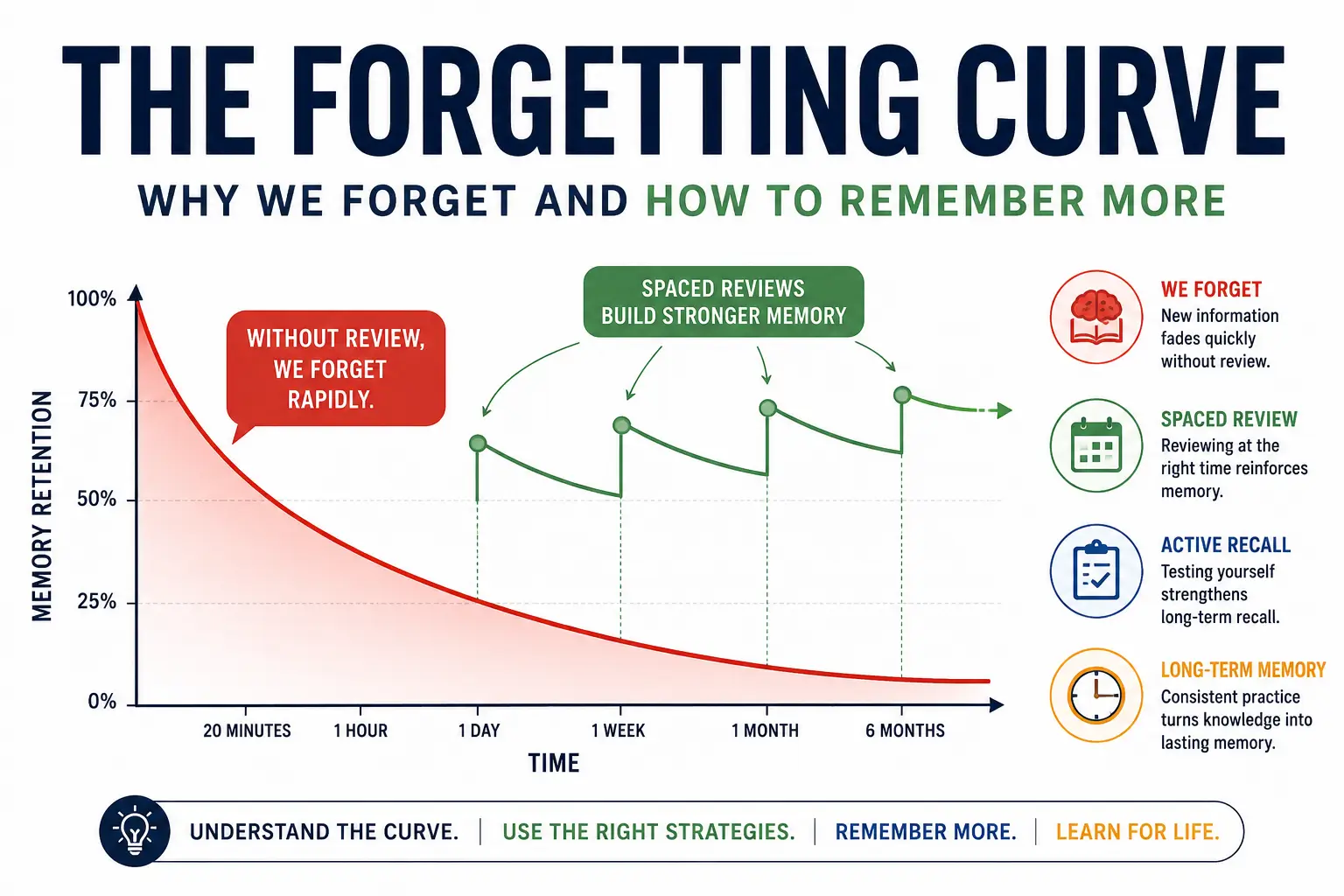
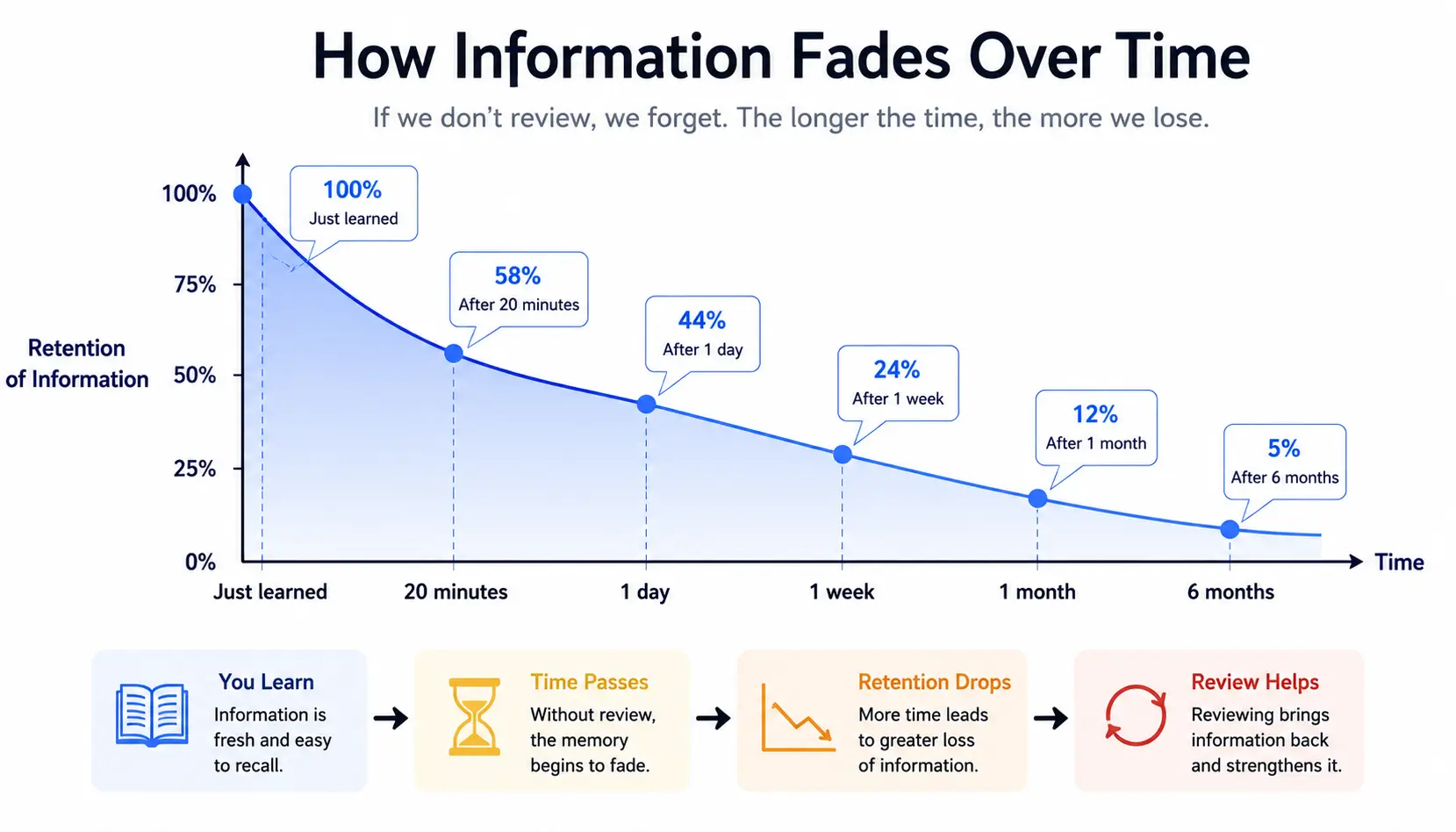
The forgetting curve describes how memory retention decreases over time after learning.
Immediately after studying, recall is typically high.
However, without review or retrieval, memory often begins to decline surprisingly quickly.
The most dramatic forgetting usually occurs shortly after learning.
As time passes, the rate of forgetting slows.
In simple terms:
- Information is forgotten rapidly at first.
- Memory loss slows over time.
- Without reinforcement, retention continues to decline.
This pattern appears across many different learning situations.
Whether you’re studying biology, learning a language, preparing for a certification exam, or trying to remember names, the forgetting curve can influence retention.


Why Forgetting Is Actually Normal
Many people view forgetting as a personal failure.
They assume that if information disappears, they must have studied incorrectly.
In reality, forgetting is a normal part of how memory works.
Your brain constantly receives enormous amounts of information.
If every detail were stored permanently, memory would become overwhelmed.
Forgetting acts as a filtering mechanism.
The brain gradually removes information that appears unimportant while strengthening information that continues to be used.
The challenge for learners is convincing the brain that certain information deserves to be retained.
This is where strategic review becomes important.
Why We Forget So Quickly After Learning
One of the most surprising findings from Ebbinghaus’s research was how quickly forgetting begins.
Many learners assume that once information is understood, it has been learned.
Unfortunately, understanding and retention are not identical.
You can fully understand a concept today and still struggle to recall it a week later.
This happens because newly formed memories are often fragile.
Without reinforcement, they become increasingly difficult to access.
The solution is not necessarily more studying.
The solution is often better review timing.
🔬 Scientific Support for the Forgetting Curve
Although Ebbinghaus conducted his experiments more than a century ago, modern research continues to support the idea that memory declines when information is not revisited.
His findings helped establish the foundation for many modern learning strategies.
Source: https://www.britannica.com/biography/Hermann-Ebbinghaus
Contemporary research in cognitive psychology has further demonstrated that retrieval and spaced review can dramatically improve long-term retention.
Source: https://pubmed.ncbi.nlm.nih.gov/26173288/
The forgetting curve remains one of the most important frameworks for understanding why learning fades over time.
The Problem With One-Time Learning
Many people treat learning as a one-time event.
They read a chapter, watch a lesson, attend a seminar, or complete a training session and assume the information will remain available indefinitely.
The forgetting curve suggests otherwise.
Without reinforcement, much of what is learned may become difficult to retrieve.
This explains why students often feel prepared immediately after studying but struggle later when the material is needed.
The issue is not necessarily a lack of intelligence.
It is often a lack of reinforcement.
How the Forgetting Curve Affects Everyday Life
The forgetting curve extends far beyond classrooms.
It influences:
- Language learning
- Professional training
- Public speaking
- Medical education
- Technical certifications
- Workplace knowledge
- Personal development learning
Any information that is not revisited is vulnerable to forgetting.
This is why lifelong learning requires more than exposure.
It requires reinforcement.
Forgetting vs Memory Failure
This is why forgetting should also be understood alongside retrieval failure, memory interference, and false memory. Another common misconception is that forgetting means a memory is completely gone.
Often, information is not erased.
It simply becomes harder to retrieve.
This distinction is important.
Many memories can be strengthened again through review and retrieval.
The information may still exist somewhere in memory even if access has become difficult.
This idea helps explain why retrieval-based techniques are so effective.
Methods such as Retrieval Practice and the Testing Effect help reactivate and strengthen memories before they fade further.
The Key Insight Most Learners Miss
The most important lesson of the forgetting curve is not that forgetting happens.
Everyone forgets.
The important lesson is that forgetting can be slowed dramatically.
By understanding when forgetting occurs, learners can intervene before memories weaken too much.
This insight eventually led to the development of some of the most effective learning systems ever created.
How to Beat the Forgetting Curve
The good news is that the forgetting curve is not a life sentence.
While forgetting is natural, it can be slowed dramatically through the right learning strategies.
The key is reinforcement.
Every time you successfully revisit information, you strengthen the memory and make it more resistant to future forgetting.
Think of memory as a path through a forest.
The first time you walk the path, it is difficult to see.
Each additional visit makes the route clearer and easier to follow.
Memory works in a surprisingly similar way.
The more often information is successfully revisited, the stronger the memory becomes.
Why Spaced Repetition Works So Well
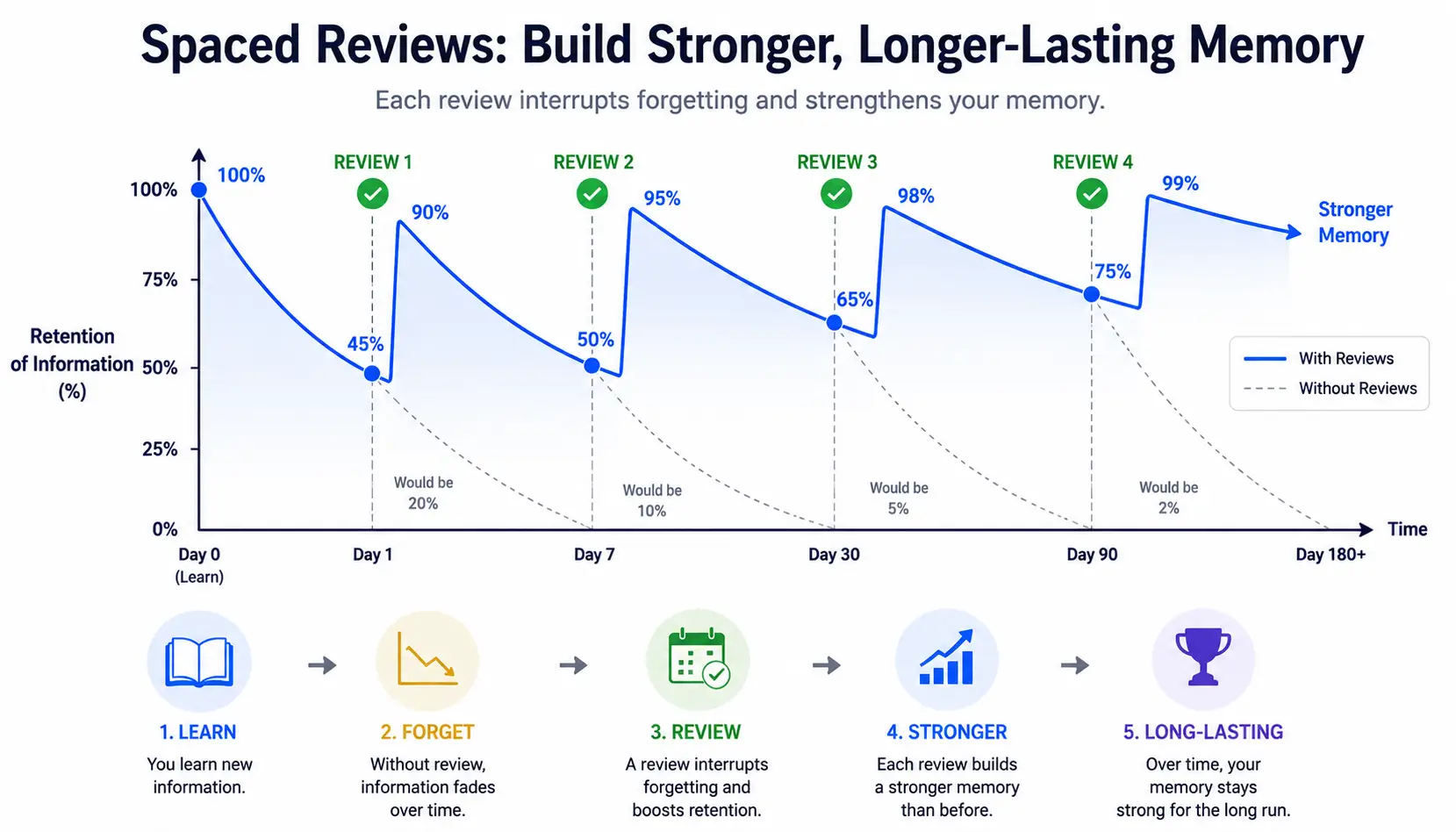
One of the most powerful solutions to the forgetting curve is Spaced Repetition.
Rather than reviewing information constantly, spaced repetition schedules reviews at carefully chosen intervals.
The timing matters.
You review information shortly before it is likely to be forgotten.
This strengthens the memory and resets the forgetting curve.
Each successful review makes the next review less urgent.
Over time, the intervals become longer:
- 1 day
- 3 days
- 1 week
- 2 weeks
- 1 month
- 3 months
The exact schedule varies, but the principle remains the same.
Review before forgetting becomes severe.
This simple strategy can dramatically improve long-term retention while reducing total study time.
That is why spaced repetition remains one of the most evidence-based learning systems available.
For a broader understanding of how information remains accessible over time, explore our guide to memory retention, including the factors that influence how well learned information is preserved and recalled.
Why Active Recall Matters
Timing alone is not enough.
What you do during a review session also matters.
Many learners revisit information by rereading notes.
Unfortunately, passive review often creates familiarity without creating strong retrieval ability.
This is where Active Recall becomes important.
Instead of simply looking at information again, active recall requires you to retrieve information from memory.
You test yourself.
You answer questions.
You explain concepts without looking.
This retrieval process strengthens memory much more effectively than passive review.
When active recall and spaced repetition are combined, the forgetting curve becomes significantly less steep.
The Role of Retrieval Practice
Another effective strategy is Retrieval Practice.
Retrieval practice focuses on recalling information rather than reviewing it.
Each successful retrieval acts as reinforcement.
The brain receives a signal that the information remains important.
This repeated reinforcement helps keep memories accessible over longer periods.
The process may feel more difficult than rereading, but that difficulty is often what makes it effective.
Learning scientists sometimes describe this as a desirable difficulty.
The effort involved in retrieval helps create stronger retention.
How Anki Was Built Around the Forgetting Curve
Modern learning tools often use the forgetting curve as their foundation.
One of the most well-known examples is Anki Flashcards.
Anki uses spaced repetition algorithms to determine when information should be reviewed.
If you remember a card easily, the next review occurs further into the future.
If you struggle, the card returns sooner.
This dynamic scheduling helps learners review information at highly efficient intervals.
The result is less wasted effort and stronger long-term retention.
For students managing thousands of facts, this can be transformative.
The Connection Between Forgetting and Memory Consolidation
The forgetting curve also highlights the importance of Memory Consolidation.
When information is first learned, the memory is relatively fragile.
Over time, biological processes help stabilize and strengthen those memories.
Sleep plays a particularly important role in this process.
During sleep, the brain continues organizing and reinforcing newly acquired information.
This is one reason why late-night cramming often produces disappointing long-term results.
Learning requires not only study but also recovery.
Common Mistakes That Accelerate Forgetting
Studying Only Once
Many learners treat study sessions as one-time events.
Without reinforcement, forgetting is likely to occur.
Relying Entirely on Re-Reading
Rereading creates familiarity, but familiarity does not guarantee recall.
Retrieval-based techniques are usually more effective.
Cramming Before Exams
Cramming may produce short-term performance improvements.
However, information often disappears quickly afterward.
The forgetting curve explains why.
Ignoring Sleep
Sleep is not wasted time.
It is an essential part of the learning process.
Poor sleep quality can significantly reduce memory performance.
What the Forgetting Curve Teaches Us About Learning
Perhaps the most important lesson from Ebbinghaus’s work is that memory is not fixed.
Forgetting is not a sign of failure.
It is part of the normal learning process.
The goal is not to eliminate forgetting entirely.
The goal is to manage it.
By understanding how memory changes over time, learners can make better decisions about when and how to review information.
This shift in approach often produces far better results than simply studying harder.
Supporting Long-Term Memory Performance
Learning techniques are important, but memory performance is influenced by many factors.
Sleep quality, stress management, physical activity, nutrition, and cognitive engagement all contribute to how effectively memories are formed and maintained.
Many people combine evidence-based learning strategies with broader wellness practices designed to support healthy cognitive function.
For readers interested in nutritional support for memory and cognitive wellness, Advanced Memory Formula provides additional information about ingredients formulated to support healthy memory function.
A Century-Old Discovery That Still Matters
More than one hundred years after Hermann Ebbinghaus conducted his experiments, the forgetting curve remains one of the most influential ideas in learning science.
Its message is surprisingly simple:
What you learn today will gradually fade unless you actively reinforce it.
Fortunately, modern learning strategies provide effective ways to fight back.
Through active recall, retrieval practice, spaced repetition, and strategic review, it is possible to remember far more than most people think.
The forgetting curve explains why memories fade.
The rest of learning science teaches us how to keep them alive.