
Now Reading: How to Improve Memory: Science-Backed Strategies for Better Recall and Learning
-
01
How to Improve Memory: Science-Backed Strategies for Better Recall and Learning
How to Improve Memory: Science-Backed Strategies for Better Recall and Learning
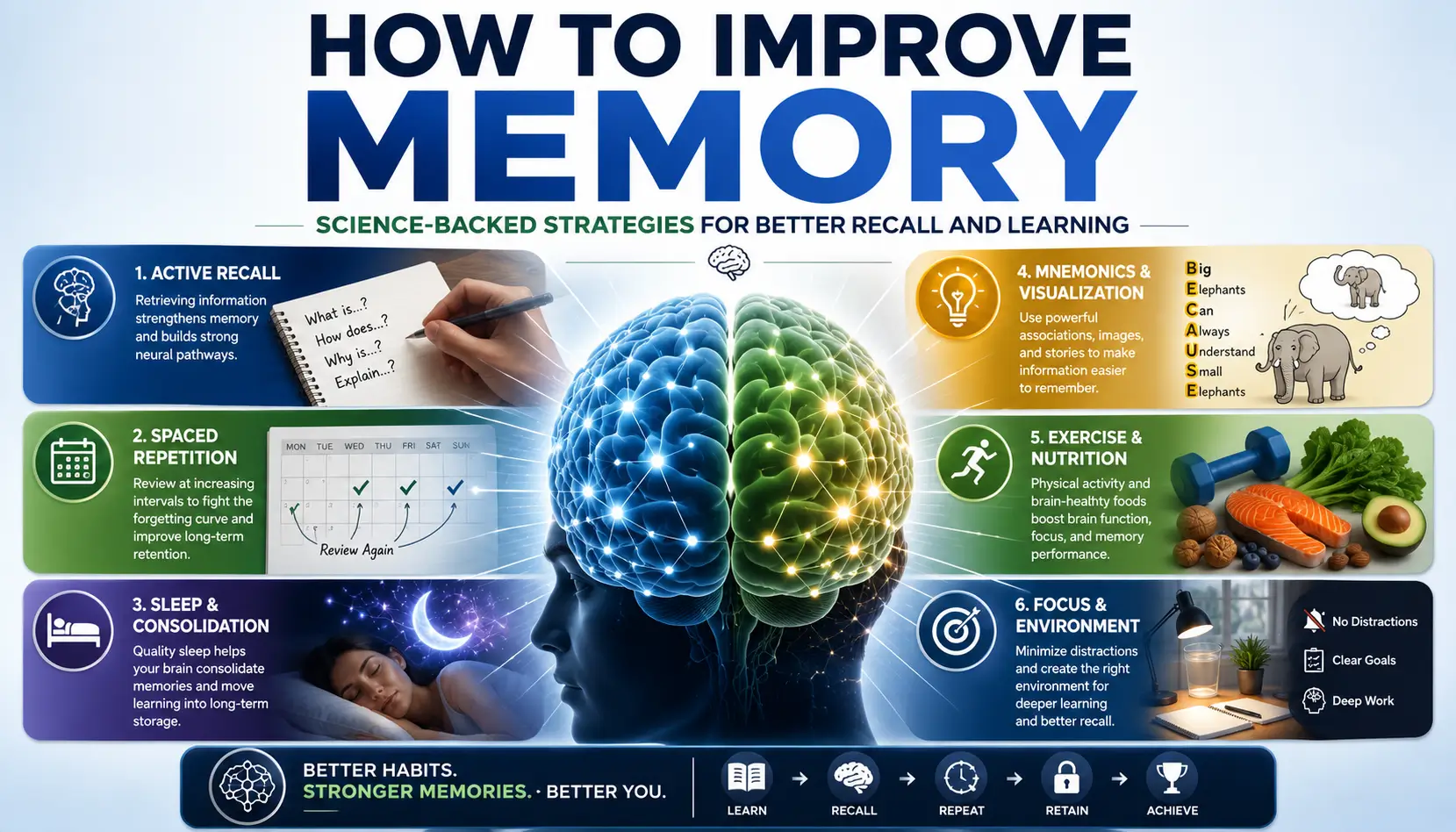
Why can some people remember names, facts, and conversations effortlessly while others struggle to recall information learned just days earlier?
The answer is not usually intelligence.
In most cases, memory performance depends on how information is encoded, stored, retrieved, and reinforced over time.
Memory is not a fixed trait that some people possess and others lack.
Modern neuroscience shows that memory can be strengthened through specific habits, learning techniques, and lifestyle choices.
Just as muscles adapt to training, memory systems respond to repeated use and effective practice.
Understanding how memory works provides the foundation for improving it.
This guide explores the most effective science-backed strategies for improving memory, learning faster, and retaining information longer.
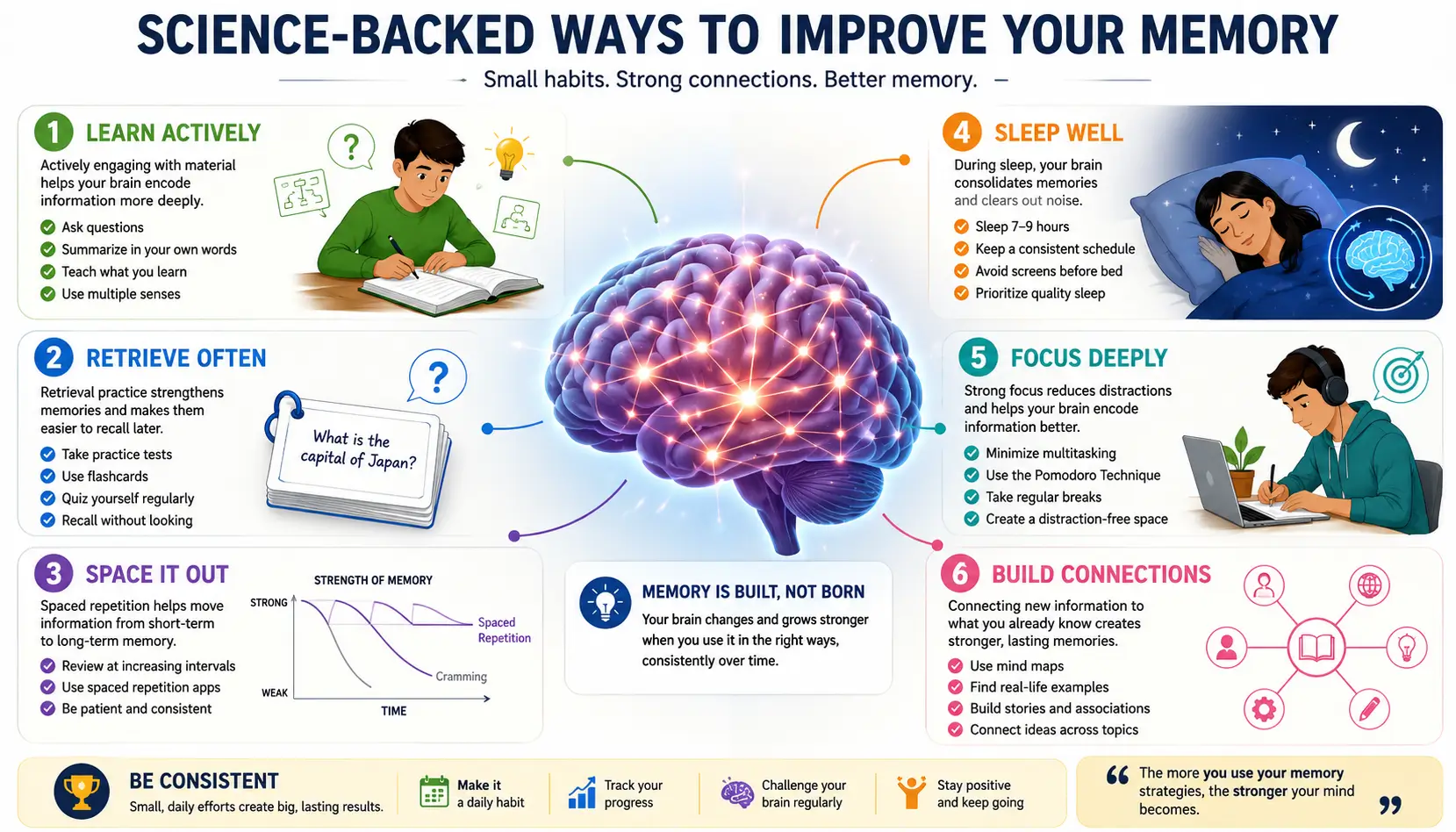
What Does It Mean to Improve Memory?
Memory improvement refers to increasing your ability to encode, retain, retrieve, and use information effectively.
Many people think memory simply means remembering facts.
However, memory actually involves several interconnected systems.
These systems help us learn new information, remember experiences, perform skills, and make decisions.
Improving memory therefore means strengthening the processes that support learning and recall.
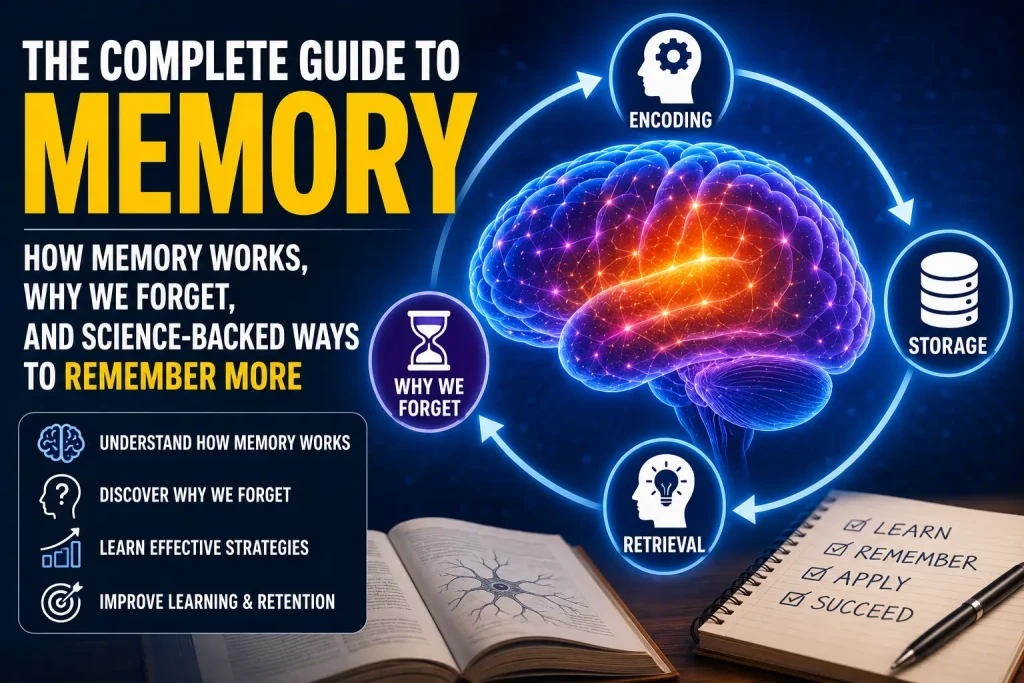
How Human Memory Works
Memory formation generally involves three major stages:
Information must first be encoded.
Next, it must be stabilized and stored.
Finally, it must be retrieved when needed.
Weakness in any stage can reduce memory performance.
Understanding these stages helps explain why some memory strategies work better than others.


1. Use Active Recall Instead of Passive Review
One of the most effective ways to improve memory is through Active Recall.
Rather than repeatedly reading information, Active Recall requires retrieving it from memory.
This process strengthens neural pathways associated with recall.
Examples include:
- Answering questions without notes
- Self-testing
- Explaining concepts from memory
- Writing summaries without looking at source material
Research consistently shows that retrieval strengthens memory more effectively than rereading.
2. Apply Spaced Repetition
Memory naturally weakens over time.
The Ebbinghaus Forgetting Curve demonstrates how information becomes less accessible when it is not reviewed.
Spaced Repetition combats this process.
Instead of reviewing information repeatedly in a single session, learners revisit material at gradually increasing intervals.
This timing strengthens long-term retention while reducing total study time.
Many experts consider spaced repetition one of the most efficient learning systems ever developed.
3. Prioritize Quality Sleep
Sleep plays a critical role in memory formation.
During sleep, the brain consolidates newly learned information.
Without adequate sleep, learning becomes less effective and retrieval becomes more difficult.
Research shows that sleep supports both memory consolidation and cognitive performance.
Consistently poor sleep can significantly impair memory function.
Source: https://www.ncbi.nlm.nih.gov/books/NBK526132/
4. Strengthen Working Memory
Working Memory acts as the brain’s temporary workspace.
It helps people hold and manipulate information during learning, problem-solving, and decision-making.
Strong working memory often improves comprehension and learning efficiency.
Strategies that reduce distractions and improve focus can indirectly support working memory performance.
5. Learn Through Meaning, Not Memorization
One of the most important discoveries in cognitive psychology comes from Levels of Processing Theory.
The theory suggests that meaningful learning creates stronger memories than superficial repetition.
When learners connect information to existing knowledge, retention improves dramatically.
Instead of memorizing isolated facts, focus on understanding concepts and relationships.
Deep processing creates stronger and more durable memory traces.
Why Meaningful Learning Improves Memory
Information becomes easier to remember when it connects to knowledge that already exists.
The brain stores information within networks of associations.
The more associations a memory has, the more retrieval pathways become available.
This increases the likelihood of successful recall in the future.
Meaning creates memory strength.
6. Use Retrieval Practice Regularly
Retrieval Practice builds directly on the science of memory retrieval.
Every time information is successfully recalled, retrieval pathways become stronger.
Examples include:
- Practice exams
- Flashcards
- Self-quizzing
- Teaching concepts from memory
Retrieval practice improves both retention and future accessibility.
7. Organize Information Using Chunking
The brain processes information more efficiently when it is grouped into meaningful units.
This strategy is known as Chunking.
Instead of memorizing long sequences of unrelated information, learners create structured groups.
Chunking reduces cognitive load and improves recall.
It is widely used in education, language learning, and skill acquisition.
8. Build Memory Associations
Strong memories rarely exist in isolation.
They connect to existing knowledge, experiences, and concepts.
Creating associations increases retrieval opportunities.
This principle forms the foundation of many memory techniques, including mnemonics and memory palaces.
The more connections a memory has, the easier it becomes to access later.
9. Use Mnemonics to Improve Recall
If you want a broader toolbox beyond mnemonics alone, explore Memorization Techniques for additional methods that improve encoding, retention, and retrieval.
Mnemonics are memory tools that make information easier to retrieve.
Rather than memorizing information directly, learners create memorable associations.
Popular mnemonic techniques include:
- Acronyms
- Rhymes
- Visualization
- Story-based memory systems
- Association chains
These techniques improve encoding and increase retrieval cues.
Research shows that meaningful associations often improve recall dramatically.
Learn more about Mnemonics.
10. Build a Memory Palace
One of the most powerful memory techniques ever developed is the Memory Palace Technique.
Also known as the Method of Loci, this strategy involves placing information within imagined physical locations.
Because humans naturally remember locations well, these mental maps create highly effective retrieval pathways.
Memory champions frequently use this technique to remember enormous amounts of information.
It remains one of the most powerful memory systems supported by both history and modern research.
11. Exercise Regularly
For a more specific look at mental and physical activities that support recall, see Brain Exercises for Memory.
Physical activity benefits the brain as well as the body.
Exercise increases blood flow, supports brain health, and promotes the growth of new neural connections.
Research suggests that regular aerobic exercise may improve cognitive performance and support memory function.
Even moderate physical activity can contribute to better learning and mental performance over time.
Memory improvement is not limited to study techniques alone.
12. Manage Stress Effectively
Chronic stress can interfere with memory formation and retrieval.
High stress levels may reduce concentration, impair learning, and disrupt sleep.
Because memory depends on attention and consolidation, prolonged stress can negatively affect performance.
Managing stress through healthy habits often improves both focus and recall.
Reducing unnecessary cognitive strain creates a better environment for learning.
13. Improve Focus During Learning
Memory begins with attention.
If information never receives sufficient attention, it cannot be encoded effectively.
Many memory failures actually begin as attention failures.
Reducing distractions, maintaining focus, and engaging actively with information can significantly improve memory outcomes.
Focused learning creates stronger initial encoding.
14. Understand the Forgetting Curve
The Forgetting Curve demonstrates that memory naturally declines when information is not revisited.
This process is normal.
However, forgetting can be slowed dramatically through retrieval practice and spaced repetition.
Understanding how forgetting works allows learners to intervene before memories fade.
The goal is not to eliminate forgetting but to strategically reinforce important information.
15. Teach What You Learn
One of the fastest ways to identify knowledge gaps is to explain information to someone else.
The Feynman Technique uses this principle directly.
Teaching requires learners to organize knowledge, simplify concepts, and retrieve information actively.
This combination strengthens memory and deepens understanding.
If you cannot explain a concept clearly, you probably do not understand it as well as you think.
16. Support Long-Term Memory Formation
Many memory strategies focus on immediate recall.
However, the ultimate goal is usually Long-Term Memory.
Long-term memory allows knowledge to remain accessible for months, years, or even decades.
Building long-term memory requires consistent reinforcement, meaningful learning, and effective retrieval.
The strongest memories are rarely created in a single study session.
17. Develop Better Memory Retention Habits
Memory Retention depends on what happens after learning.
Review schedules, sleep quality, retrieval practice, and ongoing use all influence whether information remains accessible.
Retention is often the result of repeated reinforcement rather than one-time exposure.
Small improvements in daily habits can produce substantial improvements over time.
Common Myths About Improving Memory
Several myths continue to circulate regarding memory improvement.
- Memory is fixed and cannot improve
- Intelligence determines memory ability
- Rereading is the best study strategy
- People remember everything accurately
- Memory declines inevitably with age
Research has challenged each of these assumptions.
Memory remains highly adaptable throughout life.
Effective strategies often matter more than natural ability.
What Is the Best Memory Improvement Strategy?
For a wider map of how memory works before you choose a strategy, read The Complete Guide to Memory.
There is no single technique that works for everyone.
However, research consistently highlights several approaches that outperform passive study methods.
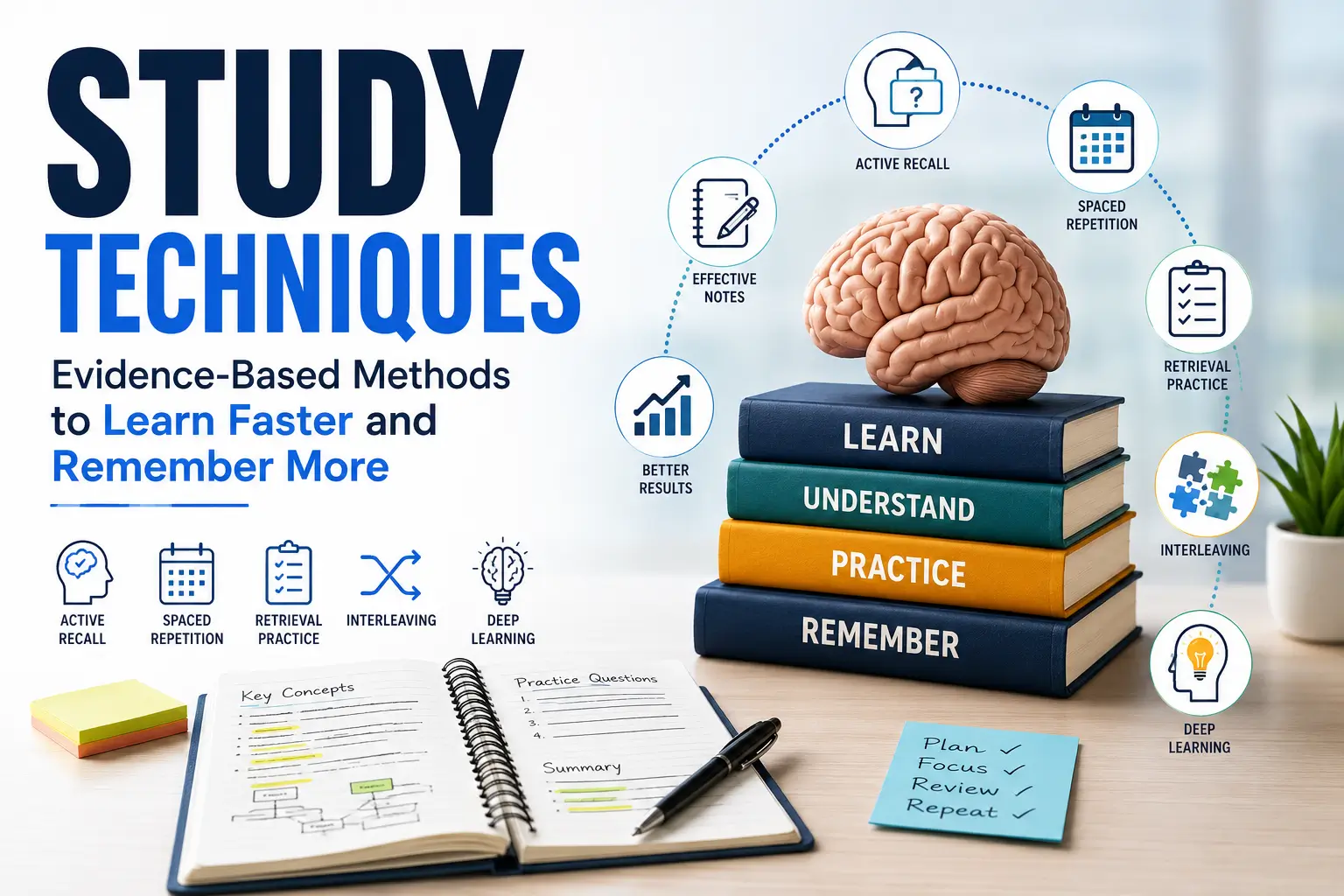
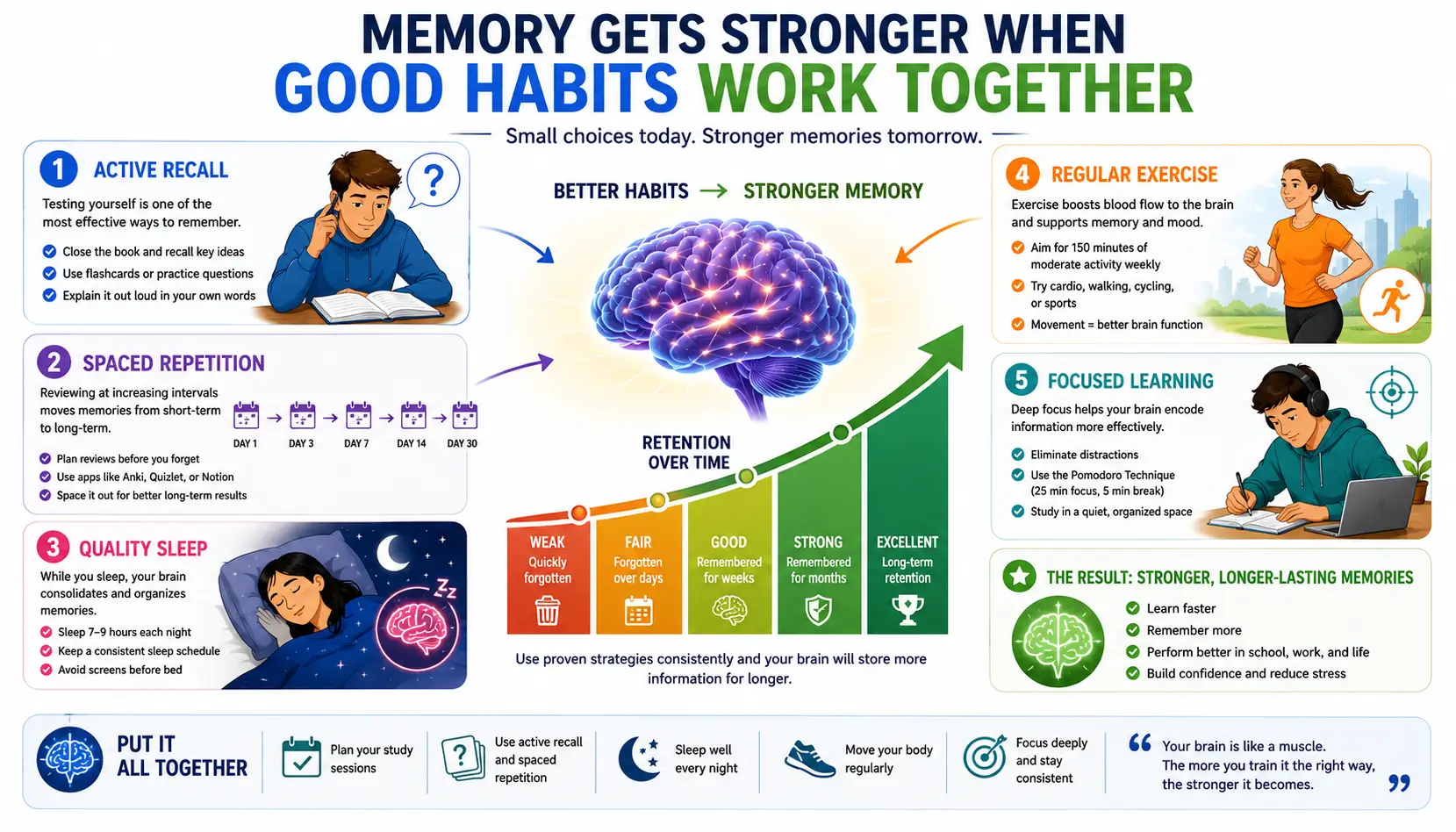
The strongest combination typically includes:
- Active Recall
- Spaced Repetition
- Retrieval Practice
- Meaningful Learning
- Adequate Sleep
- Consistent Review
- Focused Attention
When combined, these strategies create a powerful system for long-term learning and recall.
Memory improves most when information is repeatedly retrieved, meaningfully understood, and reinforced over time.
The good news is that memory is not a fixed talent.
It is a skill that can be strengthened through evidence-based habits and consistent practice.
By understanding how memory works and applying proven learning strategies, most people can dramatically improve their ability to learn, retain, and recall information.
Supporting Memory Beyond Learning Techniques
Effective study habits form the foundation of memory improvement, but many people also focus on broader factors that support long-term cognitive performance.
Sleep quality, nutrition, exercise, stress management, and brain health all contribute to how well memory systems function.
Readers interested in memory-supportive nutritional strategies can learn more about Advanced Memory Formula.