
Now Reading: Method of Loci: The Ancient Memory Technique Backed by Modern Science
-
01
Method of Loci: The Ancient Memory Technique Backed by Modern Science
Method of Loci: The Ancient Memory Technique Backed by Modern Science
More than two thousand years ago, long before smartphones, notebooks, and search engines existed, people still needed to remember enormous amounts of information.
Orators delivered speeches from memory.
Scholars memorized lengthy texts.
Politicians recalled complex arguments without written notes.
How did they do it?
One of their most powerful tools was a memory strategy known as the Method of Loci.
The technique has survived for centuries because it works with one of the brain’s greatest strengths: remembering places.
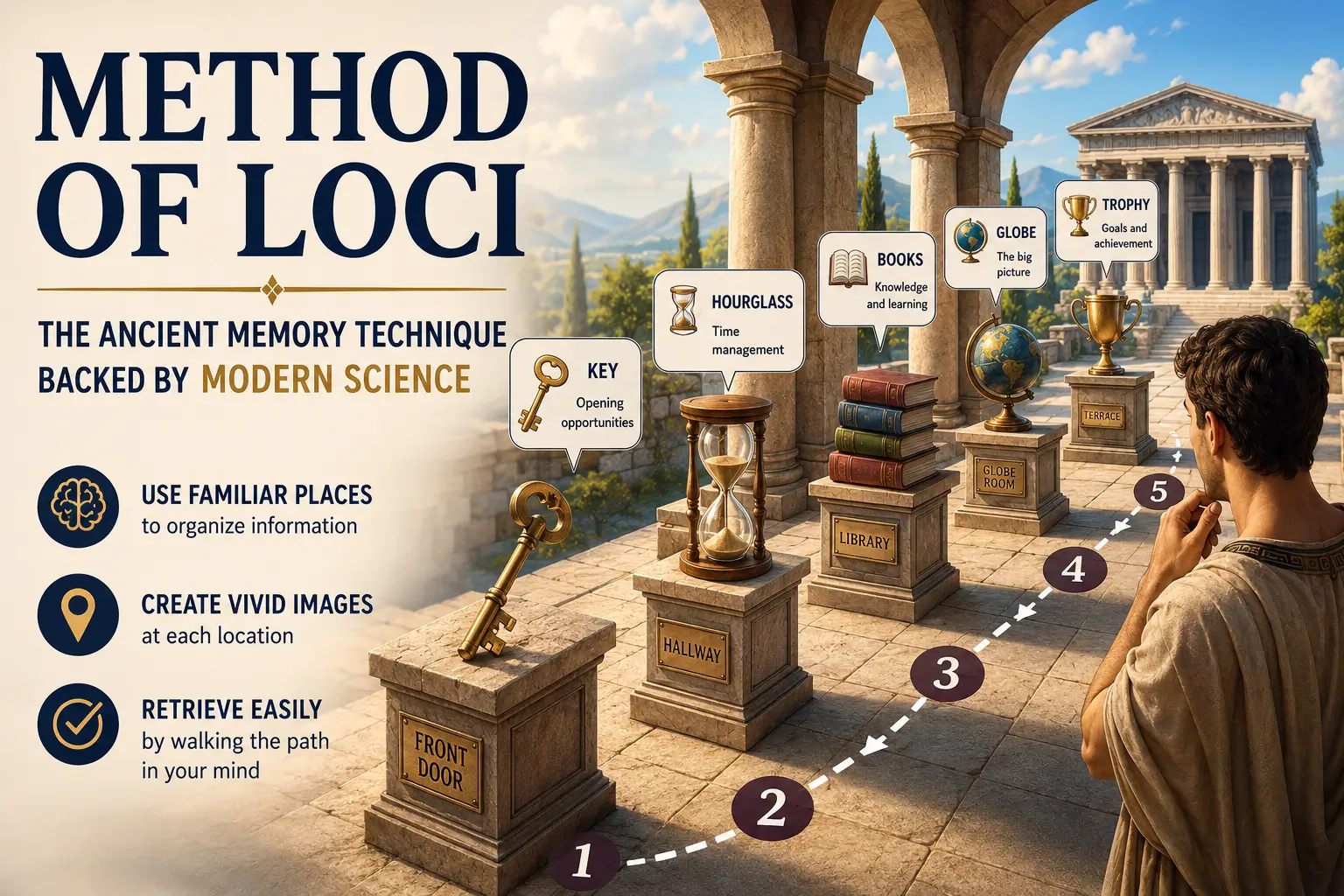
Rather than memorizing information directly, learners attach information to familiar locations and mentally walk through those locations when they need to retrieve it.
Today, the Method of Loci remains one of the most effective memory techniques ever developed.
It is used by students, professionals, memory athletes, and anyone interested in improving recall.
Despite its ancient origins, modern cognitive science continues to support many of the principles behind it.
What Is the Method of Loci?
The Method of Loci is a memory technique that involves placing information inside familiar locations in your mind.
The word loci is the plural form of the Latin word locus, meaning “place” or “location.”
The technique works by creating a mental journey through a familiar environment.
This environment could be:
- Your home
- Your school
- Your workplace
- A favorite walking route
- A familiar building
Information is attached to specific locations along the route.
When recall is needed, you mentally travel through the environment and retrieve the information stored at each point.
This simple concept forms the foundation of one of the most powerful memory systems ever created.
The Origins of the Method of Loci
The Method of Loci is often traced back to ancient Greece.
According to historical accounts, the poet Simonides of Ceos discovered that people could remember information more effectively when it was associated with physical locations.
Over time, this observation evolved into a structured memory system.
Greek and Roman speakers later used the technique extensively to memorize speeches.
In a world without digital storage, memory was an essential skill.
The Method of Loci became one of the most respected tools for preserving and organizing information.


Why Locations Are So Easy to Remember
The effectiveness of the Method of Loci comes from the brain’s natural ability to remember places.
Humans evolved in environments where spatial awareness was critical for survival.
Our ancestors needed to remember:
- Food sources
- Travel routes
- Dangerous areas
- Shelter locations
- Important landmarks
As a result, the human brain developed remarkably strong spatial memory abilities.
Even decades later, many people can still visualize the layout of childhood homes, schools, or neighborhoods.
The Method of Loci simply leverages this natural strength.
How the Method of Loci Works
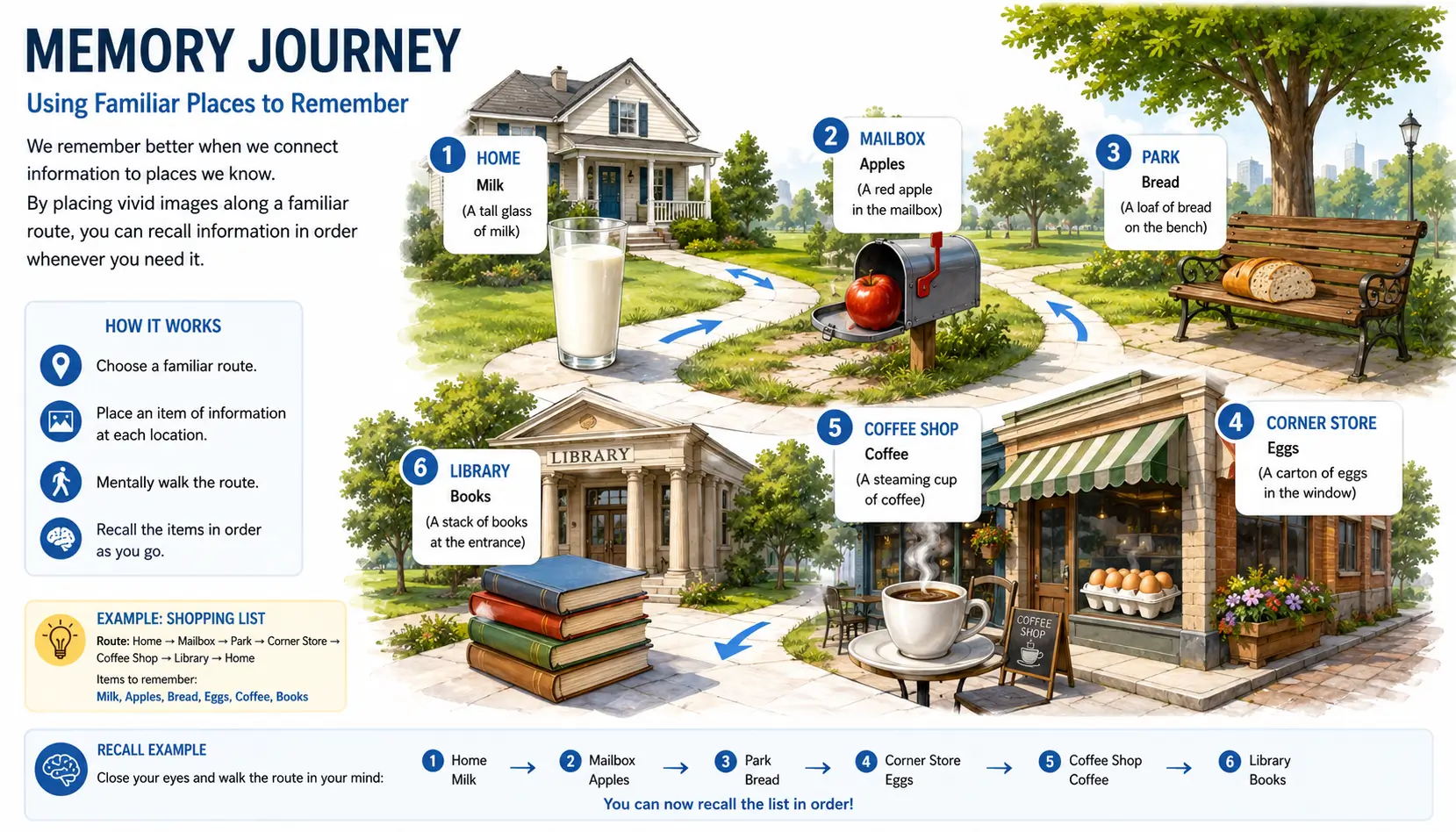
Imagine that you need to remember the following shopping list:
- Milk
- Bread
- Coffee
- Apples
- Eggs
Rather than repeating the list over and over, you place each item at a location in your home.
For example:
- Milk exploding at the front door
- Bread hanging from the hallway ceiling
- Coffee flowing through the living room
- Apples bouncing on the kitchen table
- Eggs stacked on the bed
The images are deliberately unusual.
The more vivid and memorable the image becomes, the easier retrieval often is.
When you mentally walk through your home later, the information naturally appears.
Why Strange Images Improve Recall
One of the secrets of the Method of Loci is that ordinary images are often forgettable.
Extraordinary images stand out.
The brain tends to remember things that are:
- Unexpected
- Emotional
- Funny
- Exaggerated
- Visually striking
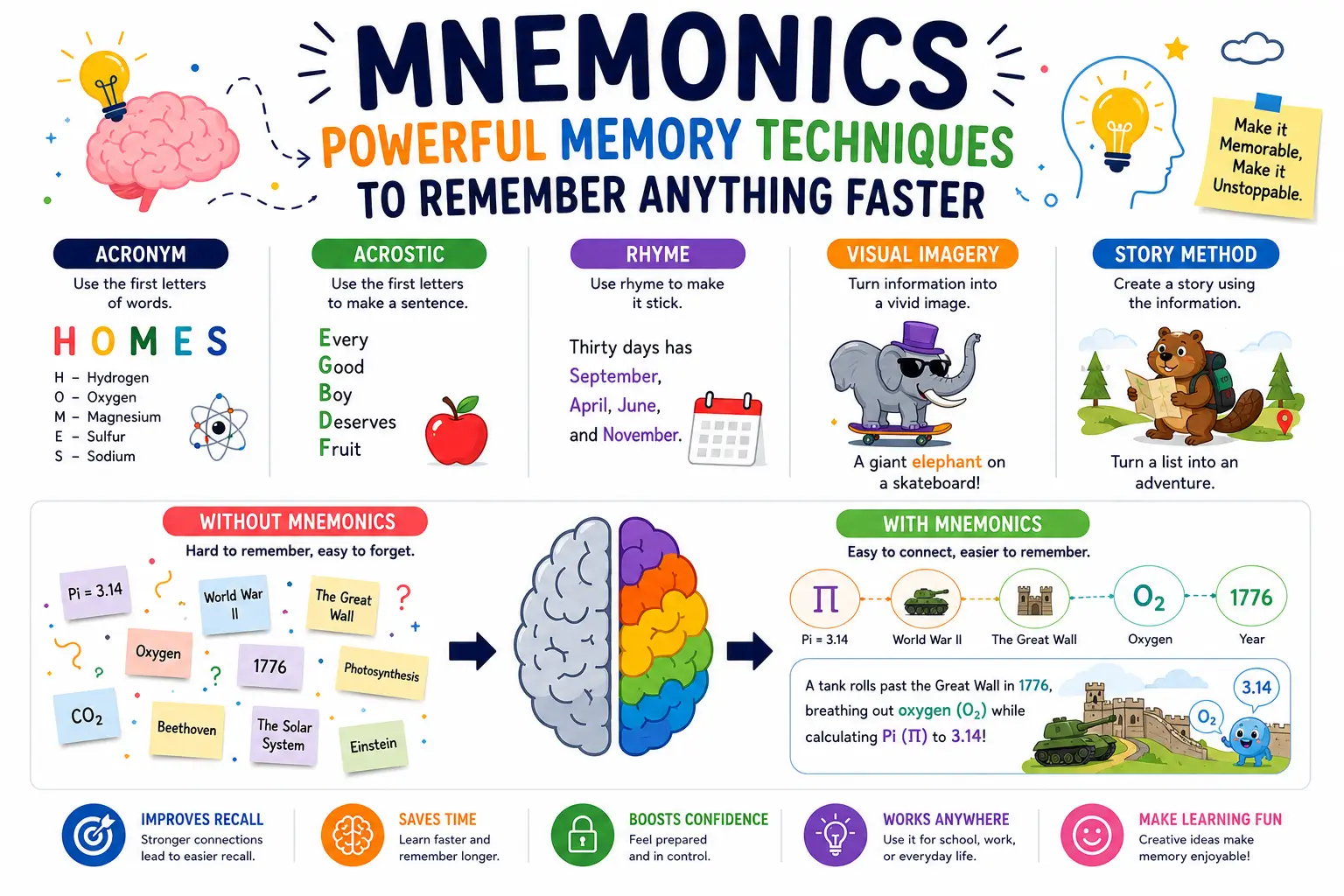
This is one reason the Method of Loci works so well alongside Mnemonic Techniques.
Both strategies rely on creating memorable associations.
The Method of Loci adds structure through locations.
Mnemonics add memorability through imagery and association.
🔬 Scientific Support for the Method of Loci
Modern neuroscience and cognitive psychology continue to explore why location-based memory techniques are so effective.
Research suggests that spatial memory systems and episodic memory systems are closely connected.
This may help explain why placing information into familiar environments can significantly improve recall.
Studies involving memory champions have also shown that many elite memorizers rely heavily on location-based techniques.
Source: https://www.ncbi.nlm.nih.gov/pmc/articles/PMC4171803/
The findings suggest that extraordinary memory performance is often linked more to strategy than natural talent.
Method of Loci vs Memory Palace
Many people wonder whether the Method of Loci and the Memory Palace Technique are different.
In practice, they are extremely similar.
The Memory Palace Technique is essentially a modern interpretation of the Method of Loci.
Both techniques use familiar locations as memory storage systems.
The terminology differs more than the underlying principles.
Understanding one usually means understanding the other.
Method of Loci and Working Memory
The Method of Loci can also reduce pressure on Working Memory.
Rather than attempting to hold large amounts of information mentally at the same time, learners distribute information throughout a structured environment.
This organization makes retrieval more manageable.
Instead of remembering a random list, the brain follows a familiar route.
The route itself becomes a retrieval aid.
Who Can Benefit From the Method of Loci?
The technique is useful for almost anyone who needs to remember information.
Common applications include:
- Exam preparation
- Language learning
- Presentations
- Public speaking
- Professional certifications
- Names and faces
- Historical facts
The larger the amount of information, the more valuable an organized memory system becomes.
How to Build Your First Method of Loci System
One reason the Method of Loci has survived for centuries is its simplicity.
You do not need special equipment, advanced memory skills, or years of training to begin.
Start by choosing a location you know extremely well.
Your current home is often the best option.
Next, create a fixed route through that environment.
For example:
- Front Door
- Hallway
- Living Room
- Kitchen
- Dining Table
- Bedroom
- Bathroom
These locations become memory anchors.
When new information needs to be remembered, place vivid mental images at each location.
The route should always remain consistent.
A stable path makes retrieval significantly easier.
Why Order Matters
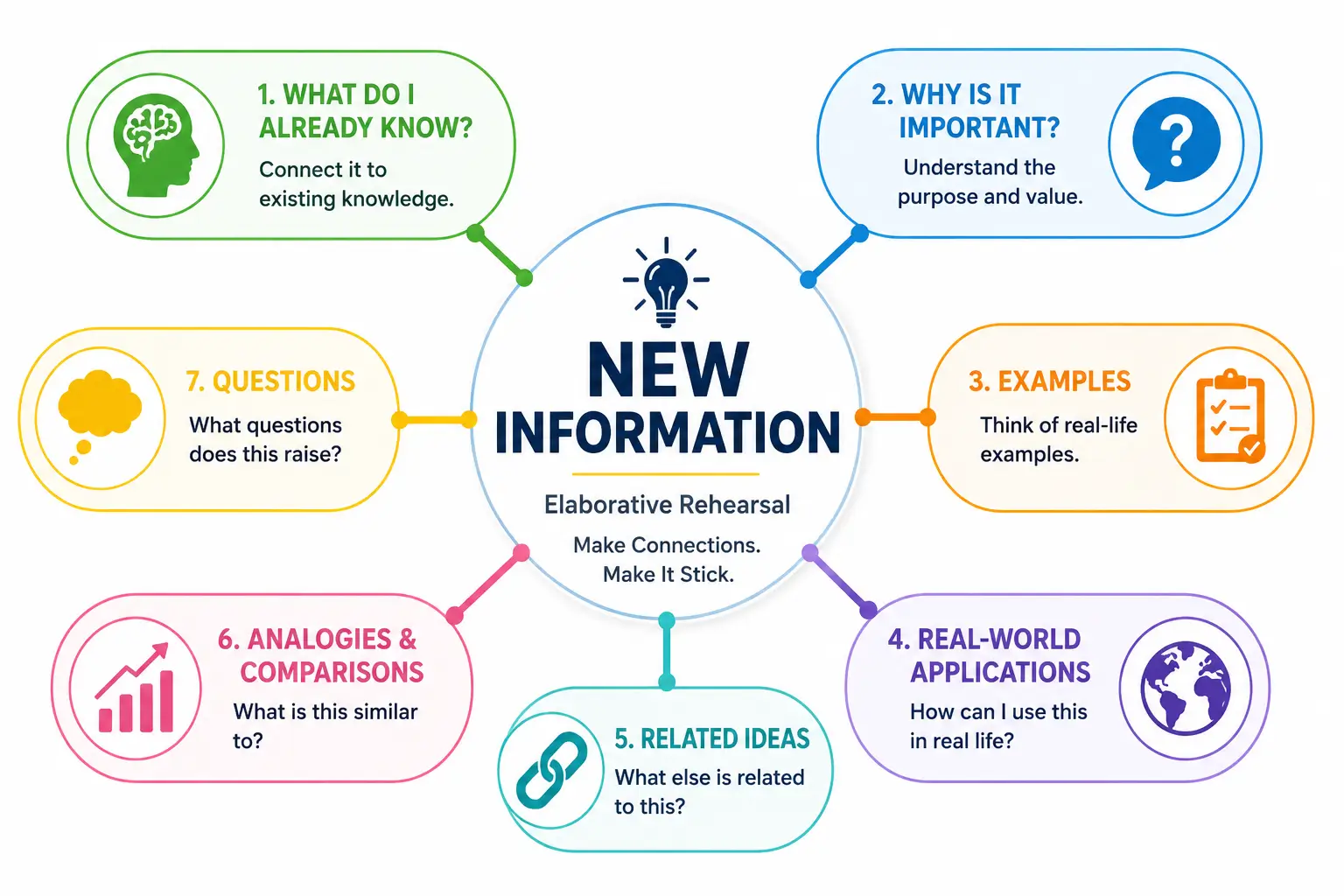
This ordered route works because each location becomes a retrieval cue. Readers interested in how cues improve recall can explore Retrieval Cues and the Encoding Specificity Principle.
The Method of Loci is particularly effective when information must be remembered in sequence.
Each location acts as a cue for the next piece of information.
This creates a natural chain of recall.
Rather than searching randomly through memory, the brain follows a familiar journey.
This structure is one reason the technique became popular among ancient speakers who needed to remember long speeches without notes.
The route itself becomes part of the memory.
Combining the Method of Loci With Memory Palaces
As discussed earlier, the Memory Palace Technique is essentially a modern version of the Method of Loci.
The two concepts overlap extensively.
Many learners begin with a simple route through their home and eventually expand into larger memory palaces containing dozens or even hundreds of locations.
Over time, entire knowledge systems can be organized within these mental environments.
The larger the palace becomes, the more information it can potentially store.
The key is maintaining clear organization.

Method of Loci and Chunking
The Method of Loci becomes even more effective when paired with Chunking Memory.
Instead of storing dozens of unrelated facts individually, learners can group information into meaningful categories.
For example:
- One room for historical events
- One room for vocabulary
- One room for scientific concepts
- One room for formulas
This structure reduces mental clutter and improves retrieval efficiency.
Chunking provides organization.
The Method of Loci provides location-based retrieval cues.
Together, they form a powerful memory system.
Using Active Recall With the Method of Loci
Creating a memory route is only the first step.
To strengthen long-term retention, information must be retrieved repeatedly.
This is where Active Recall becomes important.
Rather than simply reviewing the locations, challenge yourself to mentally walk through the route and retrieve information before checking your answers.
The retrieval process strengthens memory pathways and improves long-term retention.
The Method of Loci helps organize information.
Active Recall helps reinforce it.
Common Method of Loci Mistakes
Choosing Unfamiliar Locations
The technique depends on familiarity.
If you struggle to visualize the environment, recall becomes more difficult.
Using Weak Mental Images
Ordinary images are easy to forget.
Exaggerated, unusual, and emotionally engaging images are typically more memorable.
Changing the Route Frequently
Consistency is important.
Changing locations regularly can create confusion and weaken retrieval cues.
Trying to Store Too Much Too Quickly
Beginners often attempt to build enormous memory systems immediately.
Start with a small route and expand gradually.
Why Memory Athletes Love the Method of Loci
Many world-class memory competitors rely heavily on location-based memory systems.
Using the Method of Loci, they can memorize:
- Long number sequences
- Decks of playing cards
- Word lists
- Names and faces
- Historical information
What appears to be extraordinary natural memory is often the result of highly refined memory techniques.
The Method of Loci remains one of the most important tools in competitive memory training.
Can the Method of Loci Improve Everyday Memory?
Absolutely.
Although the technique is famous in memory competitions, its practical uses are often overlooked.
People frequently use location-based memory systems to remember:
- Shopping lists
- Presentation points
- Meeting agendas
- Names
- Travel plans
- Study material
Even simple applications can improve confidence and reduce reliance on written reminders.
The more often the technique is used, the more natural it tends to become.
Supporting Memory Beyond Memory Techniques
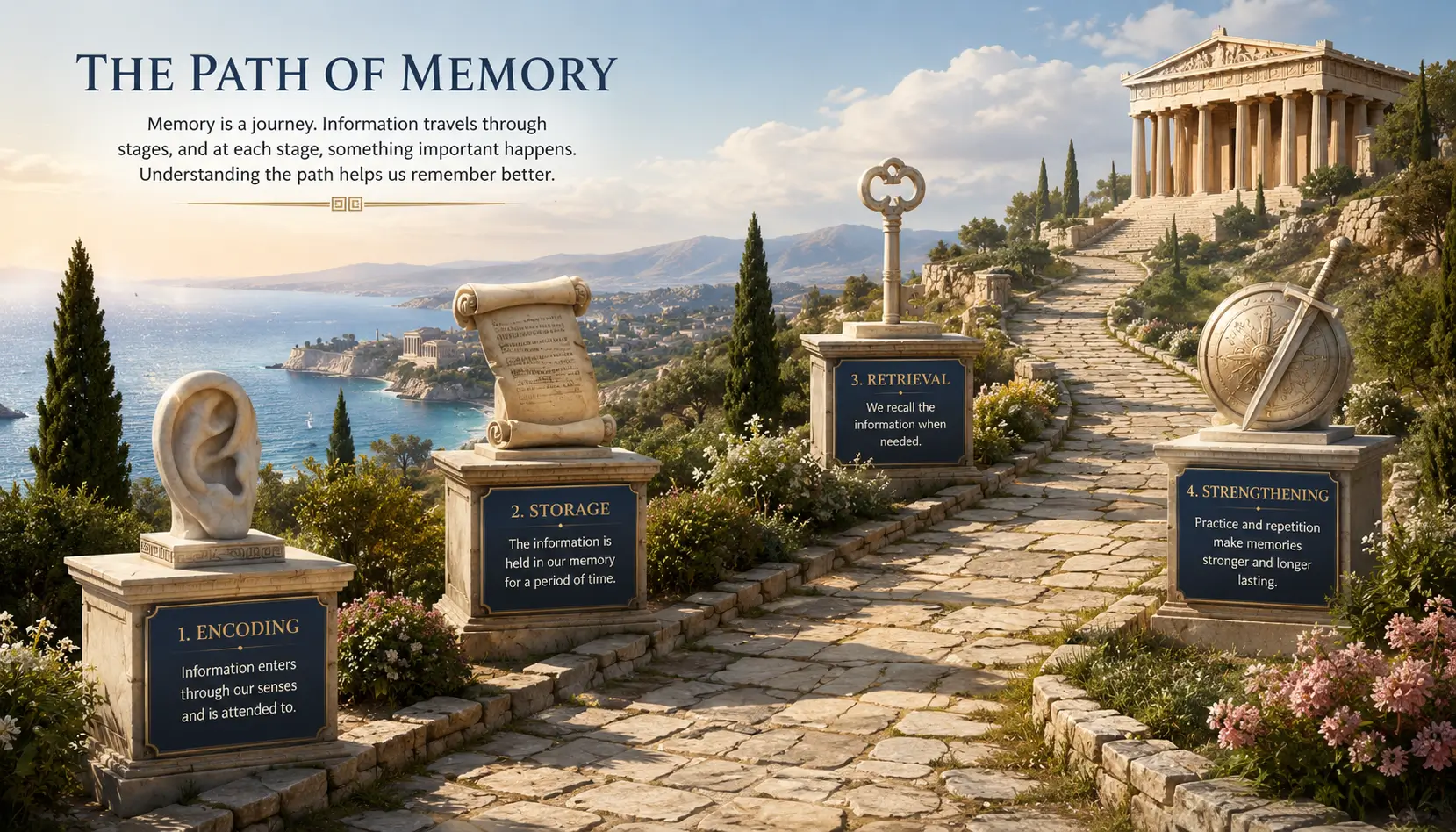
Memory strategies such as the Method of Loci can dramatically improve recall, but memory performance is influenced by many factors.
Sleep quality, stress management, attention, physical activity, and overall cognitive health all contribute to how effectively information is stored and retrieved.
For example, the process of Memory Consolidation plays a critical role in turning newly learned information into long-term memories.
Many learners also explore broader approaches to supporting cognitive wellness.
Readers interested in nutritional support for healthy memory function can learn more about Advanced Memory Formula.
An Ancient Technique That Still Works Today
The Method of Loci has survived for thousands of years for a simple reason:
It aligns with how the brain naturally remembers places and experiences.
By attaching information to familiar locations, learners create powerful retrieval cues that make recall easier and more reliable.
Whether you’re preparing for an exam, learning a language, delivering a presentation, or simply trying to improve memory, the Method of Loci remains one of the most effective techniques available.
Sometimes the best memory innovations are the ones that have already stood the test of time.