
Now Reading: Mnemonics: Powerful Memory Techniques to Remember Anything Faster
-
01
Mnemonics: Powerful Memory Techniques to Remember Anything Faster
Mnemonics: Powerful Memory Techniques to Remember Anything Faster
Imagine trying to remember a long list of information with no structure, no associations, and no context.
For most people, that task would be difficult.
Now imagine transforming the same information into a funny phrase, a vivid image, or a memorable story.
Suddenly, remembering becomes much easier.
This is the basic idea behind mnemonics.
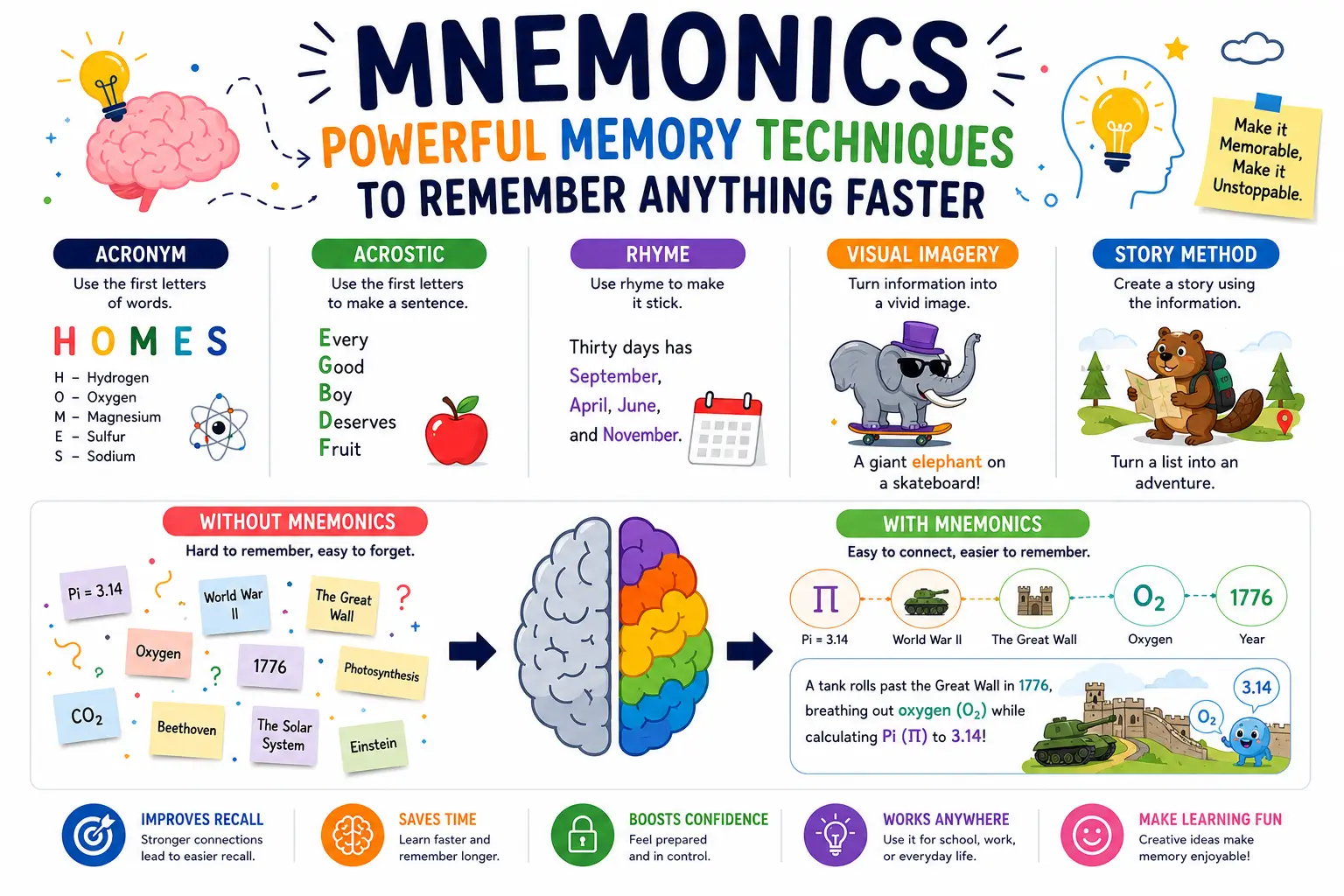
Mnemonics are memory techniques designed to make information easier to encode, store, and retrieve.
They work by creating meaningful associations between new information and things your brain already finds memorable.
Rather than relying solely on repetition, mnemonics use creativity, imagery, patterns, and organization to strengthen memory.
For centuries, students, scholars, speakers, and memory champions have used mnemonic systems to remember everything from speeches to vocabulary lists.
The remarkable part is that these techniques are available to anyone.
You don’t need a photographic memory.
You simply need better memory tools.
What Are Mnemonics?
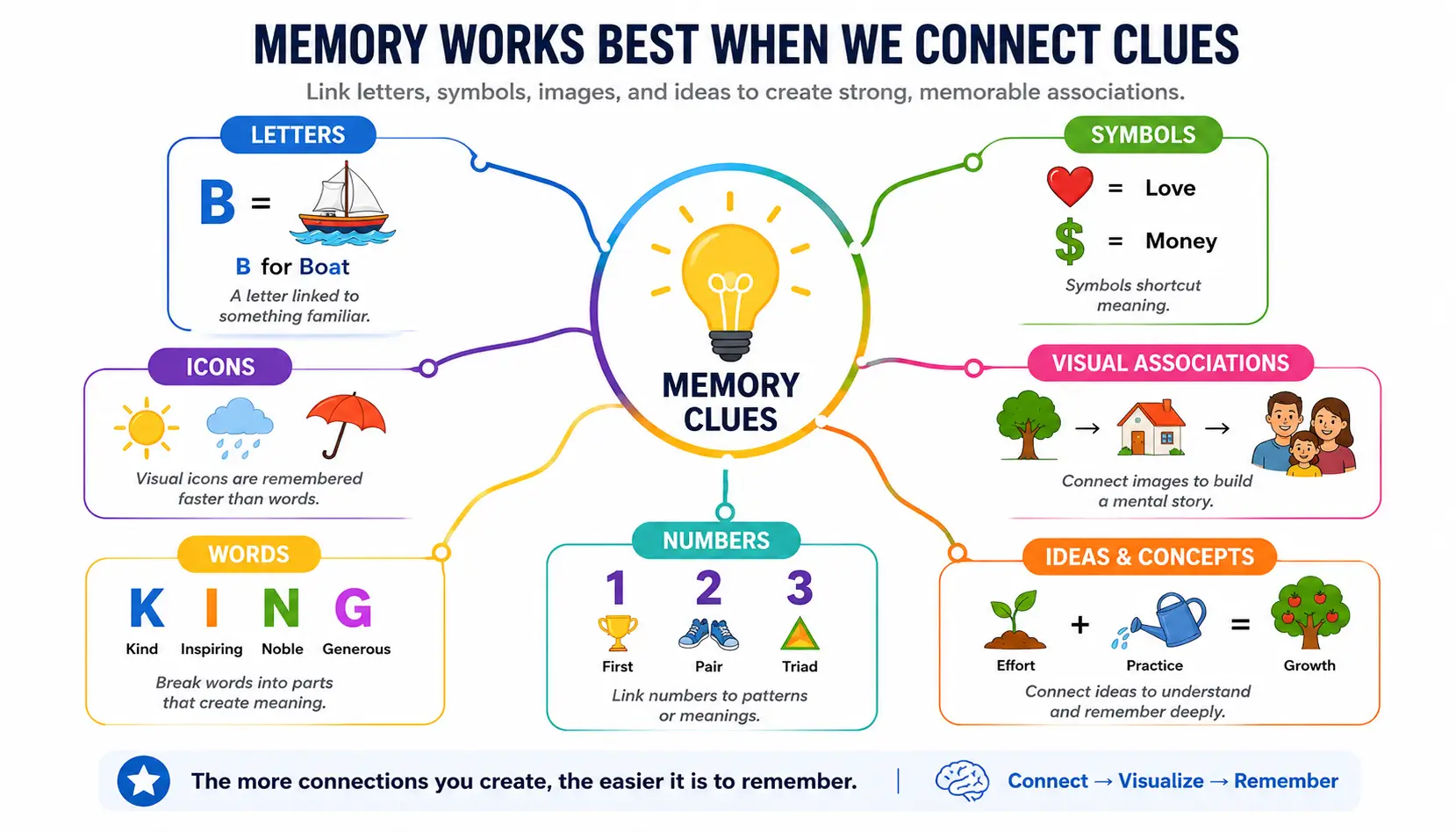
A mnemonic is any technique that helps information become easier to remember.
Instead of memorizing information exactly as it appears, you transform it into a format that is more memorable.
This transformation creates stronger retrieval cues.
When the brain encounters those cues later, recall becomes easier.
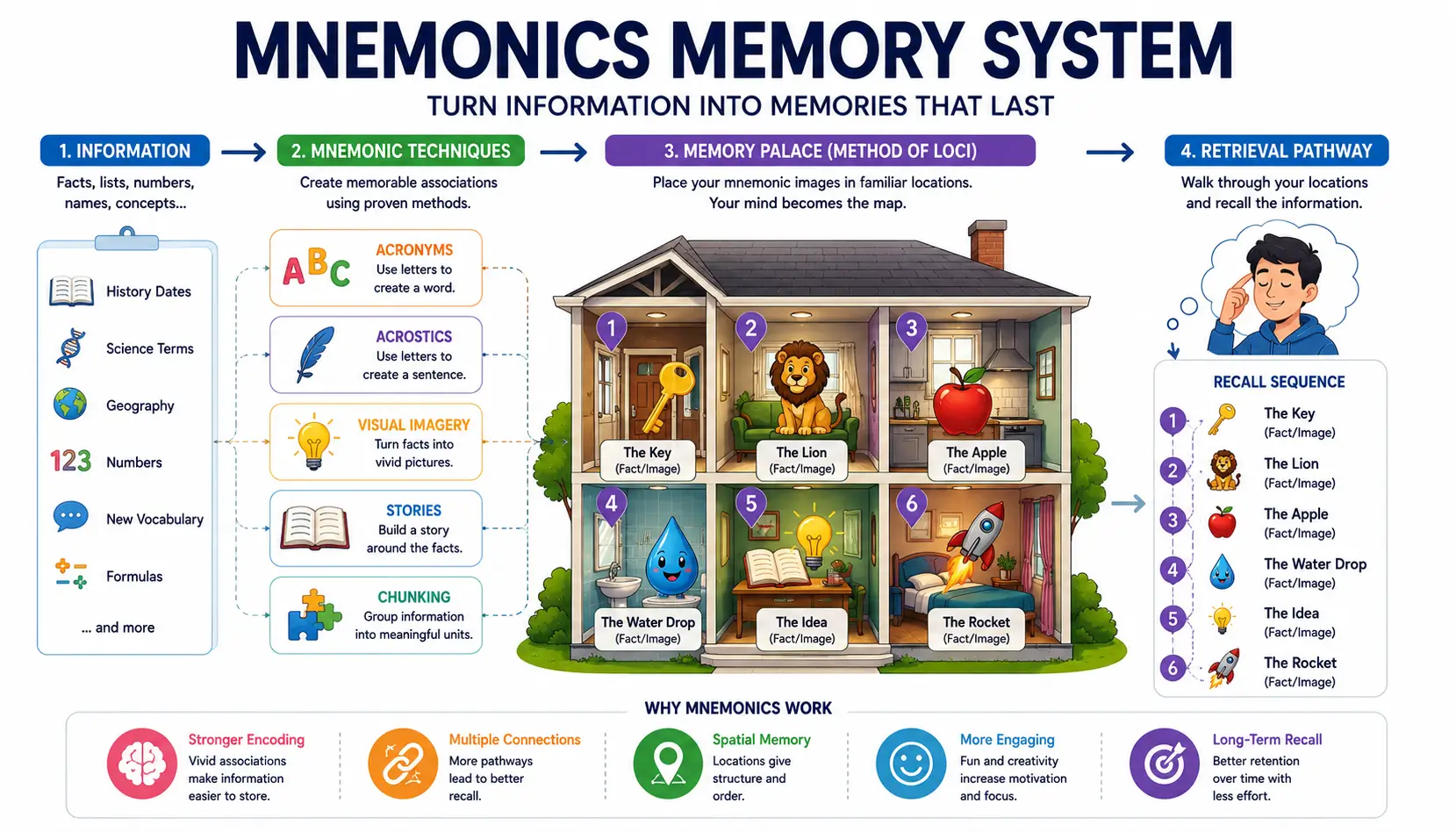
Some of the most common mnemonic techniques include:
- Acronyms
- Acrostics
- Rhymes
- Visual imagery
- Stories
- Location-based systems
- Chunking methods
Although the techniques vary, they all share a common goal:
Make information easier for the brain to retrieve.
Why Mnemonics Work
The human brain is not particularly good at remembering isolated facts.
However, it is remarkably good at remembering:
- Stories
- Images
- Patterns
- Locations
- Emotions
- Relationships
Mnemonics take advantage of these natural strengths.
Instead of presenting information in a dry format, they create connections that make memories more distinctive.
The more meaningful or unusual the connection becomes, the easier it often is to remember.
This is why ridiculous mental images frequently outperform ordinary ones.


A Simple Mnemonic Example
Many people learn the colors of the rainbow using the acronym:
ROYGBIV
- Red
- Orange
- Yellow
- Green
- Blue
- Indigo
- Violet
Instead of remembering seven separate color names individually, learners remember a single memorable pattern.
The acronym becomes a retrieval shortcut.
This principle appears throughout education, language learning, science, medicine, and professional training.
🔬 The Science Behind Mnemonics
Research in cognitive psychology consistently shows that meaningful associations improve memory performance.
Mnemonics create additional retrieval pathways, making information easier to access later.
Rather than storing isolated facts, learners create networks of connected information.
Source: https://www.ncbi.nlm.nih.gov/books/NBK55914/
Many mnemonic strategies also benefit from principles related to imagery, elaboration, and associative learning.
The more connections attached to a memory, the easier retrieval often becomes.
Types of Mnemonics
Acronyms
Acronyms combine the first letters of multiple items into a single word or abbreviation.
Examples are often short, simple, and easy to recall.
Acrostics
Acrostics create memorable sentences where each word represents something you need to remember.
For example, music students often learn:
Every Good Boy Deserves Fruit
to remember notes on the treble clef staff.
Rhymes
Rhythm and rhyme help information become more memorable.
This is one reason children frequently learn through songs.
Visual Mnemonics
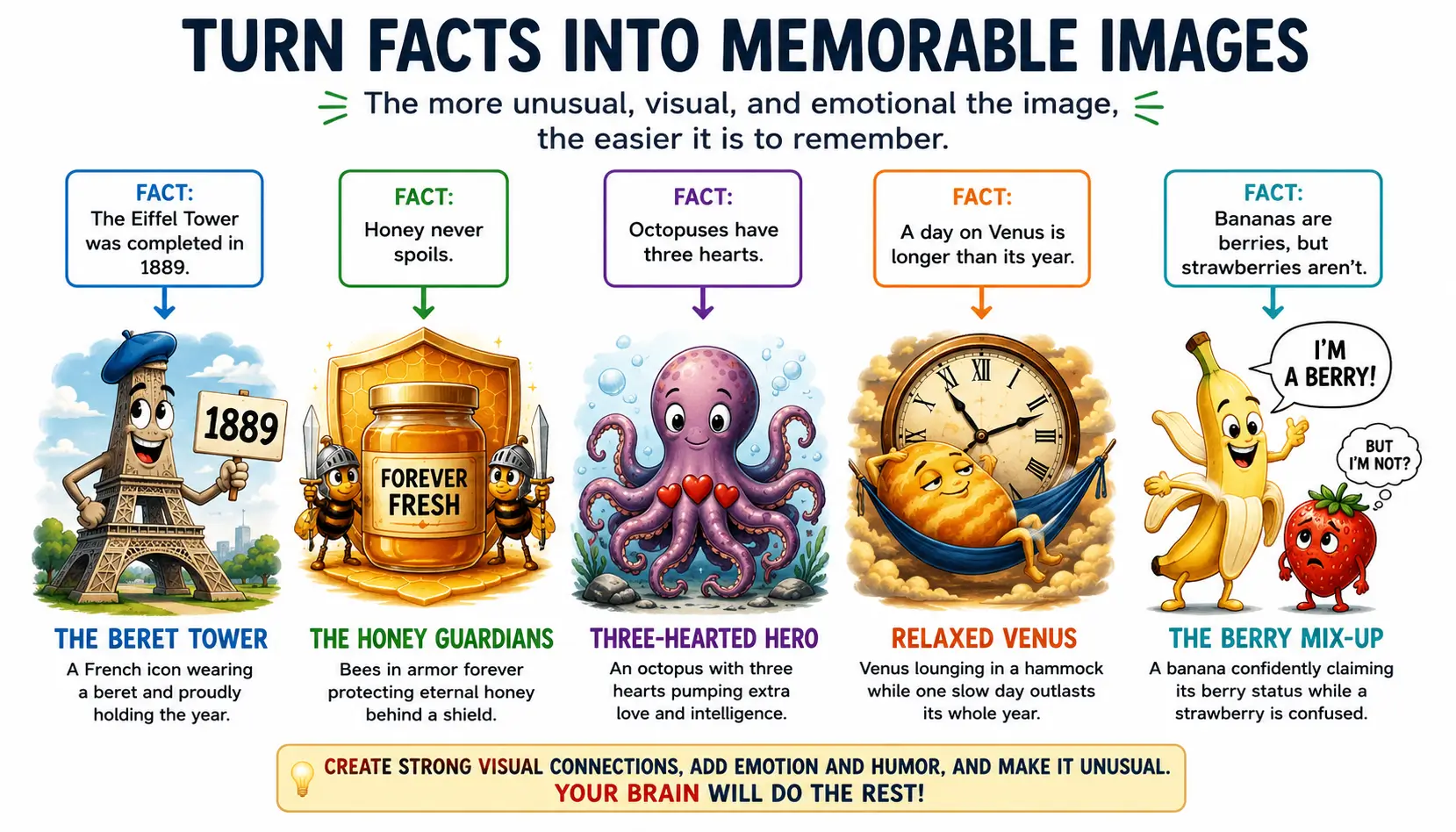
Visual mnemonics transform information into memorable mental images.
The more unusual the image, the better.
This approach aligns closely with Dual Coding Theory, where visual and verbal information work together.
Visual Mnemonics in Action
Suppose you need to remember the word “apple.”
You could simply repeat the word several times.
Or you could imagine a giant apple rolling through your living room while wearing sunglasses and singing opera.
The second option sounds ridiculous.
That is exactly why it works.
The brain tends to remember unusual experiences more easily than ordinary ones.
Visual mnemonics deliberately exploit this tendency.
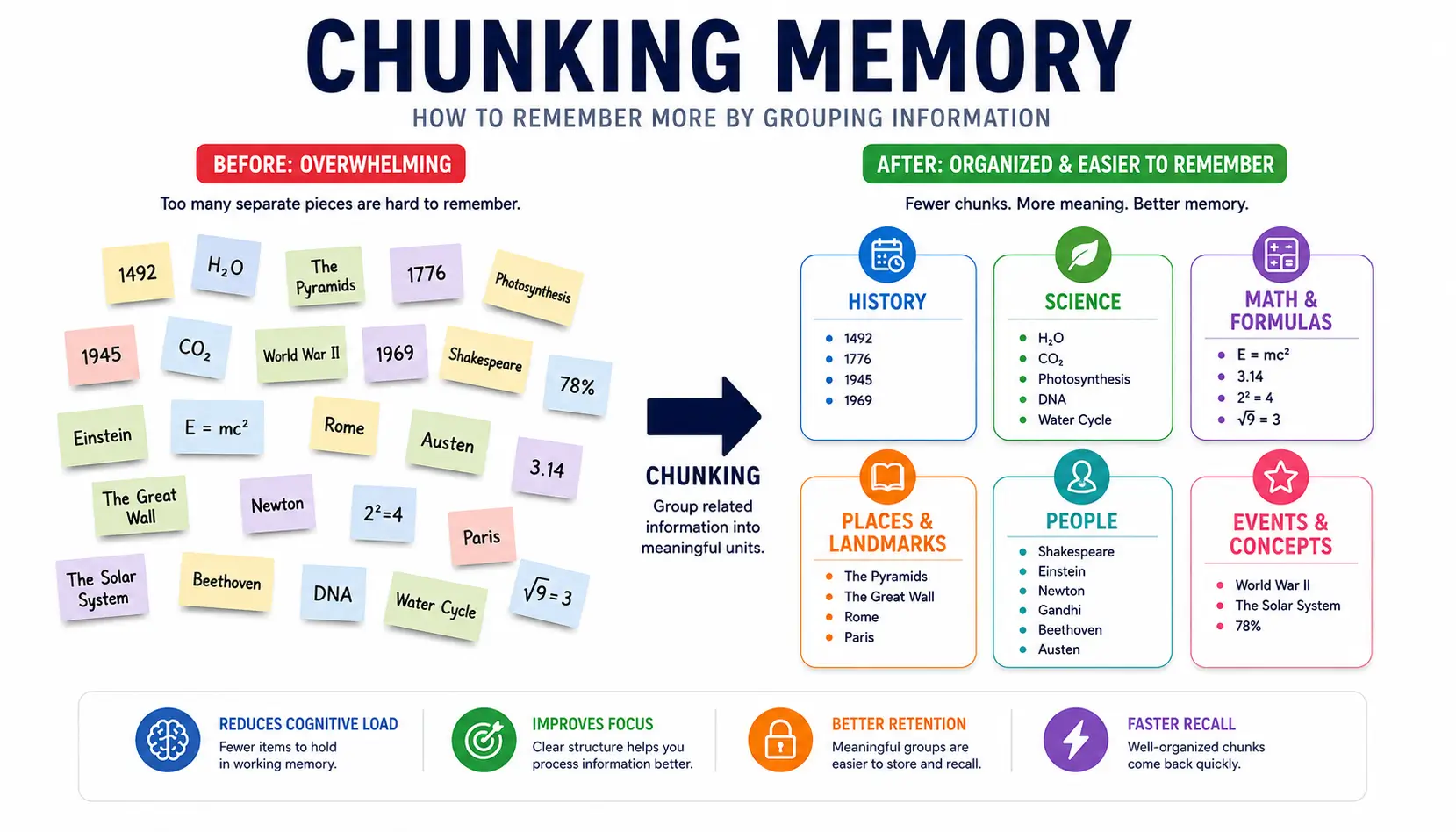
Mnemonics and Chunking
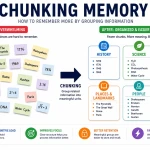
Many mnemonic systems work even better when combined with Chunking Memory.
Chunking organizes information into manageable groups.
Mnemonics make those groups easier to remember.
Together, they reduce mental overload while improving recall.
This combination is particularly useful when learning large amounts of information.
Mnemonics and Memory Palaces
One of the most powerful memory systems ever developed combines mnemonics with the Memory Palace Technique.
Instead of placing ordinary facts inside a Memory Palace, learners place vivid mnemonic images.
The result is often dramatically stronger recall.
This is one reason memory competitors frequently combine multiple memory techniques rather than relying on a single strategy.
The techniques reinforce each other.
Why Mnemonics Are Popular With Memory Champions
If you’ve ever watched a memory competition, you’ve probably seen participants memorize extraordinary amounts of information.
Many of them are not relying on natural memory alone.
They are using highly refined mnemonic systems.
Numbers become images.
Words become stories.
Facts become visual experiences.
The information becomes easier for the brain to organize and retrieve.
Their results may seem superhuman, but the underlying principles are surprisingly accessible.
How to Use Mnemonics in Everyday Learning
One of the biggest advantages of mnemonics is their flexibility.
You don’t need to be preparing for a memory competition to benefit from them.
Mnemonics can be used for:
- Exam preparation
- Language learning
- Professional certifications
- Presentations
- Historical dates
- Scientific terminology
- Names and faces
Any situation that requires recall can potentially benefit from mnemonic strategies.
The challenge is not finding information to memorize.
The challenge is creating memorable associations.
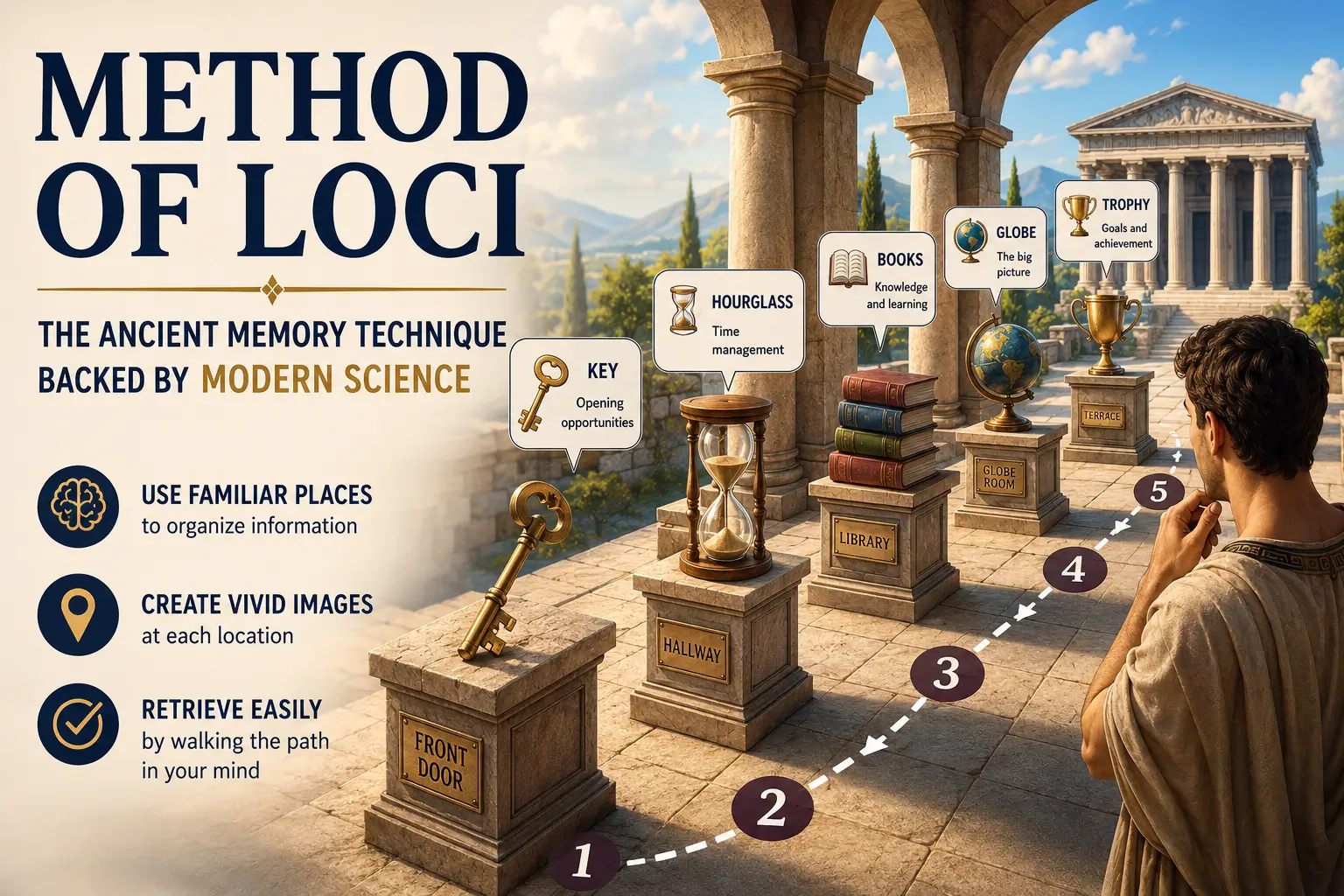
Mnemonics and the Method of Loci
One of the most powerful combinations in memory training involves pairing mnemonics with the Method of Loci.
The Method of Loci uses familiar locations as memory storage points.
Mnemonics provide the memorable images placed inside those locations.
For example, instead of storing the word “planet” inside a location, you might imagine a giant spinning Earth bouncing around your kitchen.
The vivid image becomes easier to retrieve later.
This combination is so effective that many memory athletes rely on it extensively during competitions.
The location provides structure.
The mnemonic image provides memorability.
Mnemonics and Active Recall
Mnemonics help encode information.
However, encoding is only part of the learning process.
To strengthen long-term retention, learners must also retrieve information.
This is where Active Recall becomes valuable.
Rather than repeatedly reviewing mnemonic associations, challenge yourself to retrieve them without looking.
The retrieval process strengthens memory and helps prevent forgetting.
When mnemonics and active recall work together, learning often becomes both faster and more durable.
In many ways, mnemonics help create the memory, while active recall helps maintain it.
Mnemonics for Students
Students often use mnemonic techniques without realizing it.
For example:
- Acronyms for scientific classifications
- Rhymes for historical facts
- Stories for language vocabulary
- Visual imagery for anatomy
- Memory phrases for mathematics
The key is personalization.
A mnemonic that feels memorable to one learner may not work as well for another.
The best mnemonic is usually the one that feels meaningful, funny, unusual, or emotionally engaging to you.
Why Weird Works Better
One of the most common questions learners ask is:
“Why do memory experts create such strange images?”
The answer is simple.
Ordinary information blends together.
Unusual information stands out.
The brain naturally pays more attention to things that are surprising, emotional, exaggerated, or unexpected.
This is why many mnemonic systems intentionally use bizarre imagery.
A giant dancing elephant is usually easier to remember than an ordinary elephant.
The same principle applies to memory.
Common Mnemonic Mistakes
Creating Weak Associations
If the connection feels boring or forgettable, it probably won’t help much.
Make associations vivid and distinctive.
Using Too Much Complexity
Some learners create mnemonic systems so complicated that they become harder to remember than the original information.
Keep things simple.
Never Practicing Retrieval
Mnemonics help with encoding, but retrieval still matters.
Combine mnemonic systems with Retrieval Practice whenever possible.
Ignoring Review
Even the best mnemonic benefits from reinforcement.
Using Spaced Repetition can significantly improve long-term retention.
Can Mnemonics Improve Long-Term Memory?
Yes, especially when combined with other evidence-based learning strategies.
Mnemonics make information easier to encode.
Active recall strengthens retrieval.
Spaced repetition improves timing.
Memory Palaces provide structure.
Together, these methods create a comprehensive memory system.
This is why effective learners rarely depend on a single technique.
They build systems where multiple strategies reinforce each other.
Mnemonics and Everyday Life
You don’t need to be a student to benefit from mnemonic techniques.
People use mnemonics to remember:
- Passwords and security phrases
- Shopping lists
- Names
- Phone numbers
- Presentation points
- Important tasks
The ability to create memorable associations is useful in almost every area of life.
The more often you practice, the more naturally the skill develops.
Supporting Memory Beyond Memory Tricks
Mnemonic techniques can dramatically improve memory performance, but memory is influenced by many factors.
Sleep quality, stress management, physical activity, attention, and overall cognitive health all play important roles.
For example, the process of Memory Consolidation helps stabilize memories after learning.
Many learners combine memory techniques with broader cognitive wellness habits.
Readers interested in nutritional support for healthy memory function can learn more about Advanced Memory Formula.
The Power of Meaningful Associations
At its core, every mnemonic technique is built on a simple principle:
The brain remembers meaningful information better than isolated information.
By transforming facts into images, stories, patterns, and memorable associations, learners make information easier to retrieve when it matters. One practical example is the Memory Palace Technique, which uses familiar locations to organize memorable associations.
Whether you’re preparing for an exam, learning a language, remembering names, or simply trying to improve memory, mnemonics offer one of the most practical and effective tools available.
Sometimes the fastest way to remember more is not to work harder.
It’s to make information more memorable.