
Now Reading: How to Memorize Faster: Science-Backed Techniques to Learn and Recall Information Quickly
-
01
How to Memorize Faster: Science-Backed Techniques to Learn and Recall Information Quickly
How to Memorize Faster: Science-Backed Techniques to Learn and Recall Information Quickly

How can you memorize information faster?
The most effective way is not to spend more hours rereading notes. Research shows that memory improves when information is actively processed, meaningfully connected to existing knowledge, and repeatedly retrieved over time.
In other words, successful memorization depends less on effort alone and more on using the right learning strategies.
Whether you are preparing for exams, learning a new skill, studying a language, or trying to remember important information for work, understanding how memory works can dramatically accelerate learning.
The brain is remarkably efficient when information is encoded properly. The challenge is knowing how to help that process happen.

Why Some Information Is Remembered Faster Than Other Information
For a broader toolkit of evidence-based methods beyond speed alone, see Memorization Techniques.
The brain does not treat all information equally.
Meaningful, emotional, surprising, or personally relevant information is often remembered more easily than random facts.
This happens because attention influences memory formation. Understanding how attention span affects concentration can help explain why some information is easier to encode and remember.
Information that captures attention receives deeper processing, which increases the likelihood of successful storage.
Research related to Levels of Processing Theory shows that deeper processing creates stronger and more durable memories.
This means that understanding information generally produces better retention than simple repetition.
Focus on Understanding Before Memorizing
Many learners immediately begin trying to memorize information without first understanding it.
This approach often creates frustration because disconnected facts are difficult for the brain to organize.
Instead, begin by asking:
- What does this concept mean?
- Why is it important?
- How does it connect to something I already know?
- Can I explain it in my own words?
The stronger these connections become, the easier memorization becomes.
This principle is closely related to Elaborative Rehearsal, one of the most effective memory-building techniques identified by cognitive psychology research.

Use Active Recall Instead of Passive Review
If there is one technique consistently supported by memory research, it is Active Recall.
Rather than repeatedly reading information, Active Recall requires you to retrieve it from memory without looking at your notes.
For example:
- Cover your notes and explain the concept.
- Answer practice questions.
- Create flashcards.
- Teach the material to someone else.
Every successful retrieval strengthens memory pathways.
This process helps information become easier to access in the future.
Research discussed in Active Recall and The Testing Effect consistently demonstrates substantial improvements in long-term retention.
Break Large Amounts of Information Into Smaller Chunks
The brain can only process a limited amount of information at one time.
This is why large blocks of information often feel overwhelming.
Chunking helps solve this problem.
Instead of memorizing ten separate pieces of information, group them into meaningful units.
Phone numbers, vocabulary lists, formulas, and historical dates become easier to remember when organized into chunks.
This strategy is explained in greater detail in Chunking Memory.

Use Spaced Repetition to Memorize Faster Over Time
Many students assume that memorizing faster means studying more intensely.
In reality, memory often improves when learning is distributed across multiple sessions.
Spaced Repetition works by reviewing information at carefully timed intervals before forgetting occurs.
Each successful review strengthens the memory and slows the forgetting process.
This approach is far more effective than cramming because it aligns with how long-term memory develops.
Research related to Spaced Repetition and the Ebbinghaus Forgetting Curve consistently supports this strategy.
Create Multiple Memory Associations
The more retrieval paths a memory has, the easier it becomes to access.
One effective way to strengthen memory is to connect new information to multiple existing ideas.
For example, when learning a new concept, you can:
- Associate it with a personal experience.
- Connect it to a visual image.
- Relate it to something you already understand.
- Create a memorable story around it.
These additional connections create more retrieval cues, making future recall easier.
This process is closely related to research discussed in Retrieval Cues and Encoding Specificity Principle.
Use Memory Palaces and Mnemonics for Difficult Information
When information is particularly difficult to remember, mnemonic systems can provide a significant advantage.
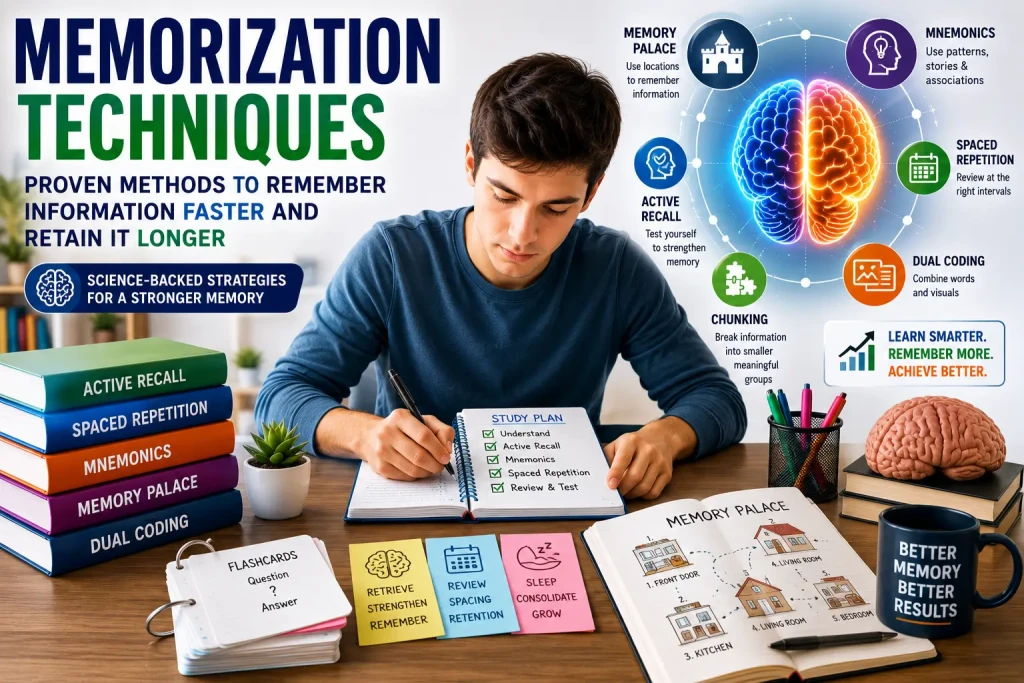
Techniques such as memory palaces, acronyms, visualization methods, and association systems help transform abstract information into memorable mental structures.
Competitive memory athletes frequently rely on these approaches to memorize enormous amounts of information quickly.
While most learners do not need extreme memorization skills, these techniques can dramatically improve everyday learning.
Learn more in Memory Palace Technique and Mnemonics.

Frequently Asked Questions
What is the fastest way to memorize something?
Active Recall is one of the fastest and most effective memorization methods because it forces the brain to retrieve information rather than passively review it.
Is rereading an effective memorization strategy?
Rereading can help with familiarity, but it is generally less effective than Active Recall, Retrieval Practice, and Spaced Repetition.
How long does it take information to move into long-term memory?
The process varies depending on attention, repetition, sleep quality, and learning methods. Strong encoding and repeated retrieval typically accelerate long-term retention.
Can anyone improve memorization ability?
Yes. Memory performance can often be improved through evidence-based learning techniques, consistent practice, and healthy lifestyle habits.
Learning Faster by Working With Your Brain
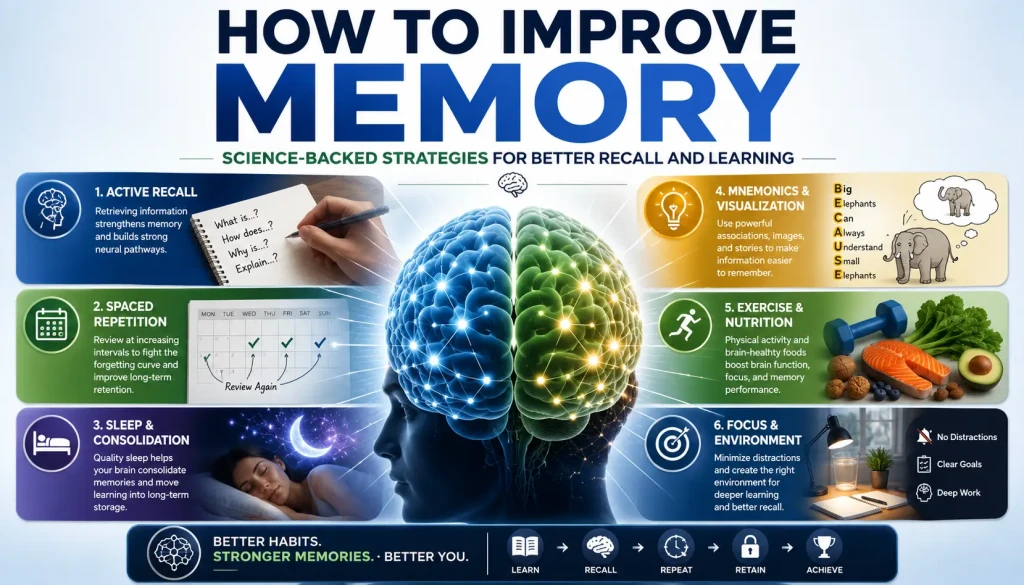
To connect faster memorization with long-term retention, sleep, retrieval, and spacing, read How to Improve Memory.
Memorizing faster is not about finding shortcuts.
It is about understanding how memory actually works and using techniques that support the brain’s natural learning processes.
Active Recall, Spaced Repetition, Chunking, meaningful associations, and mnemonic techniques all strengthen memory formation and retrieval.
When these methods are combined consistently, learning becomes more efficient and information becomes easier to retain for the long term.
Many learners also choose to support memory performance through evidence-based nutritional approaches. Learn more here: Advanced Memory Formula.