
Now Reading: Sensory Memory Explained: How the Brain Briefly Stores Incoming Information
-
01
Sensory Memory Explained: How the Brain Briefly Stores Incoming Information
Sensory Memory Explained: How the Brain Briefly Stores Incoming Information
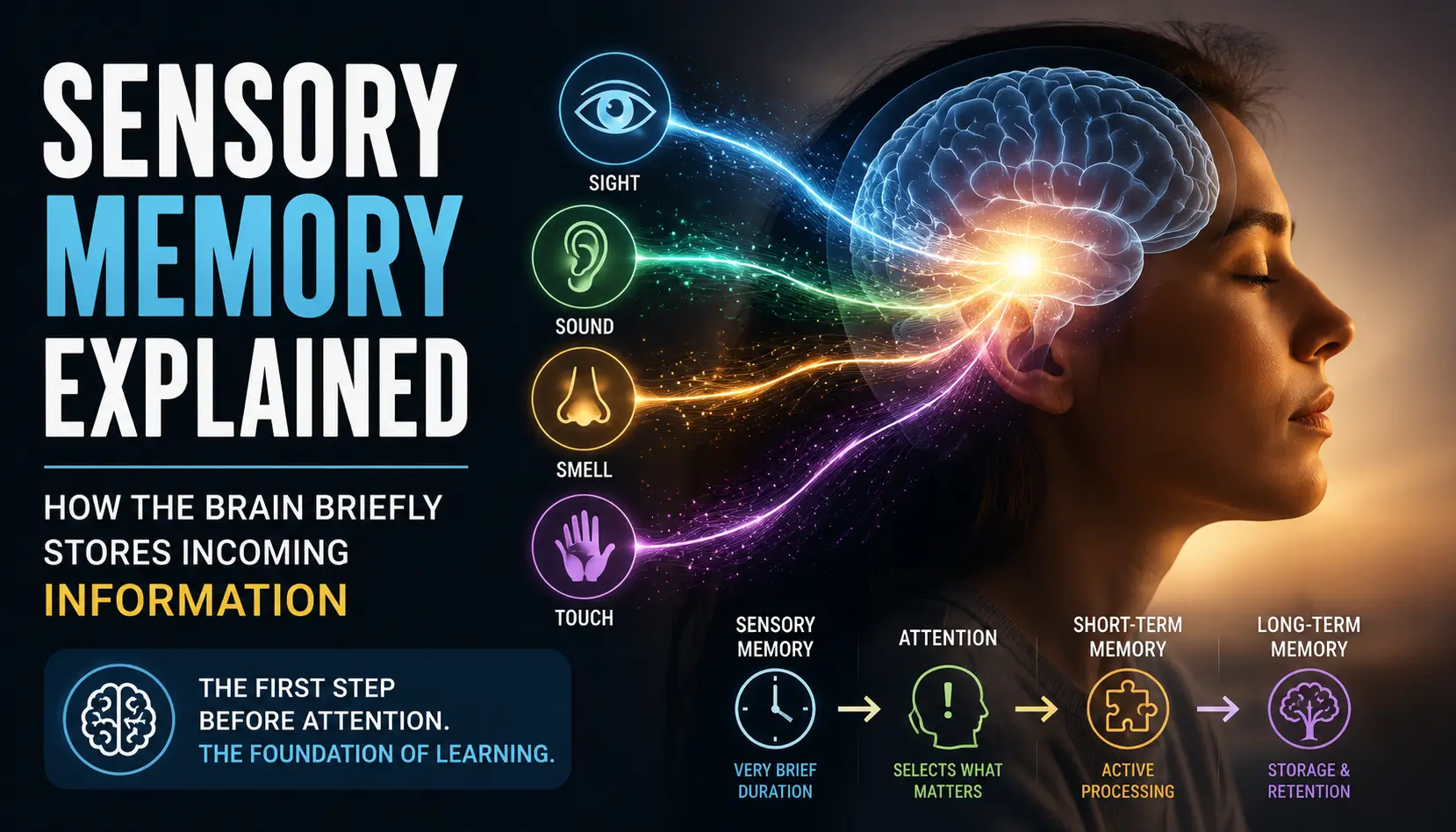
Every second, your brain receives an astonishing amount of information.
Colors, sounds, movements, smells, textures, and countless other sensory signals constantly compete for attention.
If the brain attempted to process all of this information at once, cognitive overload would occur almost immediately.
Instead, the mind relies on a remarkably efficient filtering system.
The first stage of that system is known as sensory memory.
Sensory memory serves as the brain’s initial holding area for incoming information.
Although it lasts only a fraction of a second in many cases, it plays a critical role in perception, learning, attention, and memory formation.
Without sensory memory, the world would appear fragmented and chaotic rather than smooth and continuous.
Understanding how sensory memory works helps explain how information enters the broader memory system and eventually becomes part of long-term knowledge.
A Brief Moment That Shapes Everything
Imagine watching a bird fly across the sky.
The movement appears continuous and seamless.
In reality, your eyes and brain are processing a rapid stream of separate visual inputs.
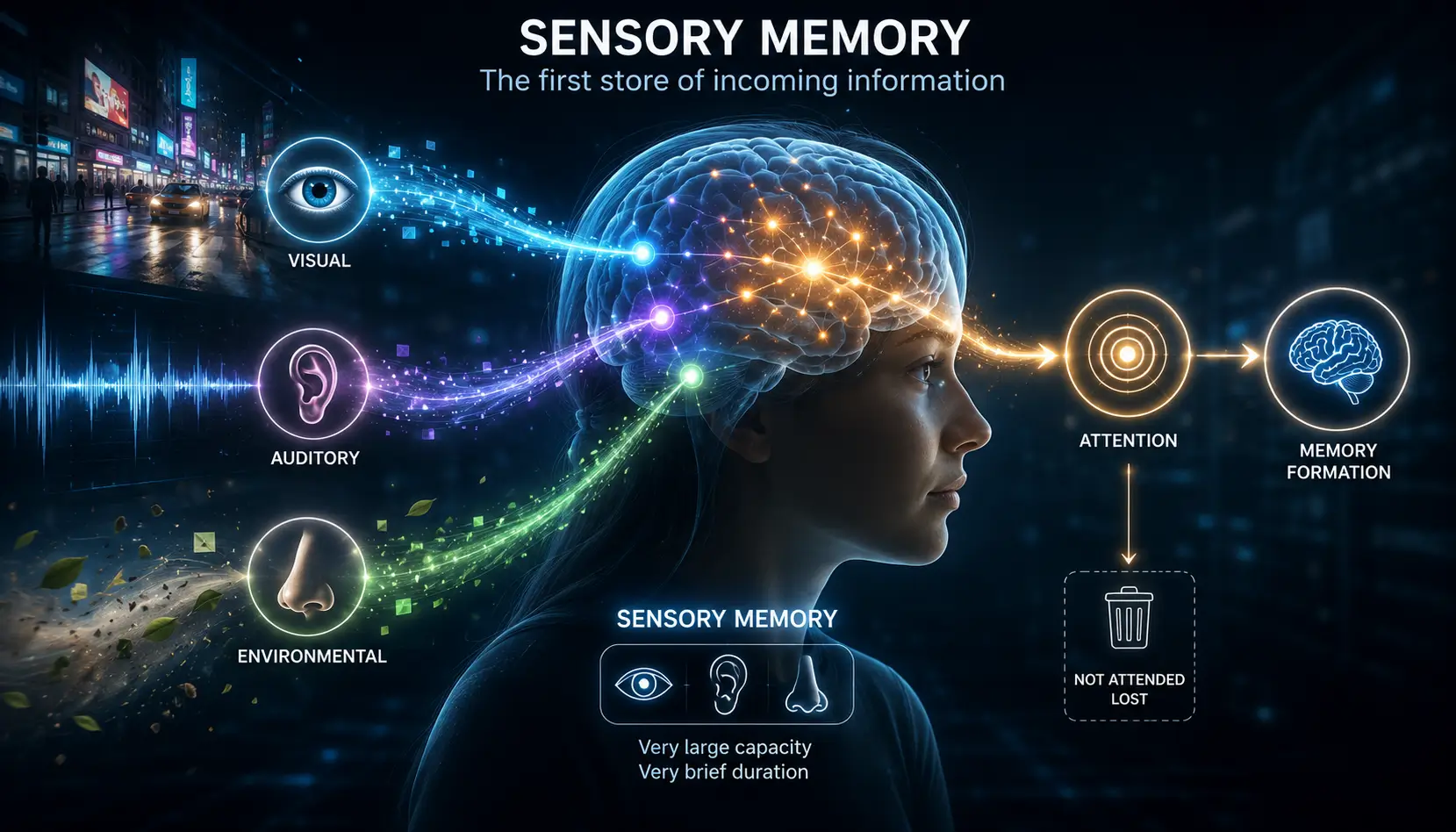
Sensory memory briefly preserves these inputs long enough for the brain to interpret them as a coherent experience.
The same process occurs when listening to speech.
Individual sounds arrive one after another, yet sensory memory allows them to be combined into meaningful words and sentences.
Although people rarely notice it, sensory memory operates continuously throughout everyday life.
What Is Sensory Memory?
Sensory memory is the earliest stage of memory processing.
It temporarily stores raw sensory information received from the environment.
This storage occurs before conscious attention and before information enters short-term memory.
Psychologists often describe sensory memory as an automatic buffer that briefly holds sensory experiences while the brain decides what deserves further processing.
Information that receives attention may move into Short-Term Memory.
Information that is ignored typically disappears almost immediately.
This filtering process helps prevent cognitive systems from becoming overwhelmed by unnecessary details.


The Three Main Types of Sensory Memory
Researchers generally divide sensory memory into several categories based on the sensory system involved.
Iconic Memory
Iconic memory refers to visual sensory memory.
It briefly stores visual information after a stimulus disappears.
Classic experiments conducted by psychologist George Sperling demonstrated that people can retain visual impressions for a very short period even after an image is no longer visible.
Most iconic memories last only a few hundred milliseconds.
Echoic Memory
Echoic memory involves auditory information.
It generally lasts longer than iconic memory.
This allows people to process speech, music, and environmental sounds over time.
Echoic memory helps explain why you can still understand a sentence even if your attention briefly drifts during a conversation.
Haptic Memory
Haptic memory stores information related to touch.
Textures, pressure, temperature, and physical sensations may briefly remain available even after contact ends.
Although less frequently discussed than iconic or echoic memory, haptic memory contributes to many everyday experiences.
Why Sensory Memory Matters
Sensory memory may be brief, but its influence is enormous.
It provides the foundation upon which more complex memory systems operate.
Without sensory memory:
- Visual perception would appear disconnected
- Speech comprehension would become difficult
- Attention would function less efficiently
- Learning new information would be significantly harder
The brain depends on sensory memory to organize incoming information before conscious processing begins.
This stage serves as the gateway between perception and memory.
Information that survives this initial stage may eventually become part of Memory Encoding, where experiences begin transforming into lasting memories.
From Sensory Memory to Attention
Because attention determines what moves beyond this early memory stage, How to Focus on Studying is a useful practical follow-up for learners who want better concentration during study sessions.
Most sensory information disappears quickly.
Only a small portion receives sufficient attention to continue through the memory system.
Attention acts as a selection mechanism.
It determines which information moves beyond sensory memory and enters conscious awareness.
This relationship between sensory memory and attention has been extensively studied within cognitive psychology.
Research published by the American Psychological Association has shown that attention plays a crucial role in determining which sensory inputs receive deeper processing.
In other words, sensory memory provides the information, but attention decides what happens next.
The Relationship Between Sensory Memory and Learning
To place sensory memory inside the larger system of encoding, storage, and retrieval, read the Complete Guide to Memory.
Although sensory memory itself does not store information for long periods, it plays a critical role in learning.
Every lesson, conversation, book, lecture, or educational video begins as sensory input.
The quality of attention applied during this early stage often determines whether information progresses further through the learning process.
Students who actively focus on relevant information increase the likelihood that sensory information will enter working memory and eventually become long-term knowledge.
This connection explains why distractions can significantly reduce learning efficiency.
When attention is divided, valuable information may disappear before meaningful processing occurs.
Sensory Memory and Working Memory
Sensory memory and working memory are closely connected but serve different purposes.
Sensory memory briefly captures raw information from the environment.
Working memory actively manipulates and processes selected information.
For example, when reading a sentence:
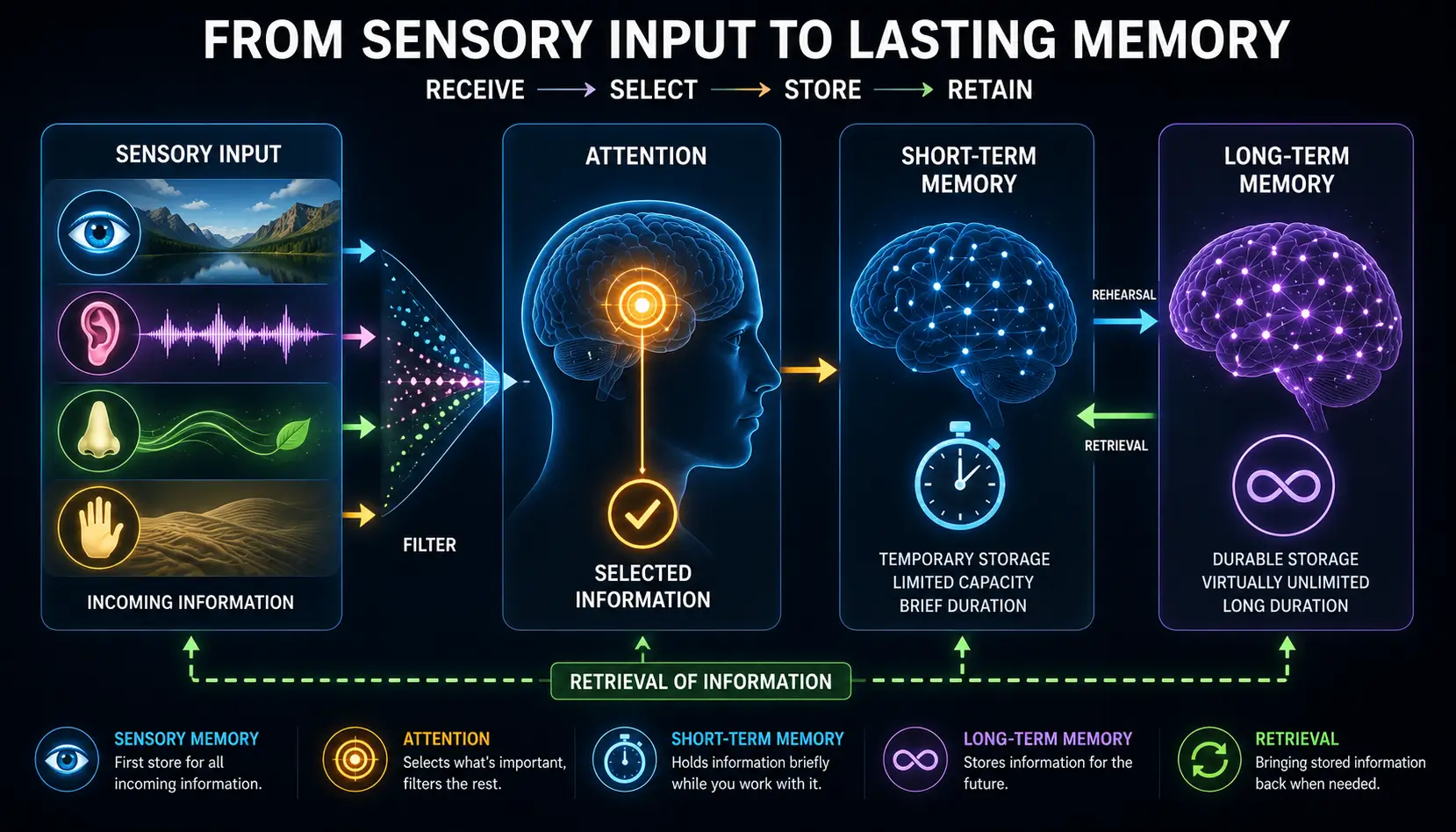
- Sensory memory captures the visual appearance of words.
- Attention selects relevant information.
- Working memory processes meaning.
- Long-term memory stores important concepts for future use.
This sequence occurs rapidly and continuously during learning activities.
Readers interested in the next stage of information processing can explore Working Memory Explained: The Brain System Behind Learning, Focus, and Recall.
Can Sensory Memory Be Improved?
Sensory memory itself is largely automatic and influenced by biological factors.
However, individuals can improve how effectively information moves beyond sensory memory by strengthening attention and learning habits.
Helpful strategies include:
- Reducing environmental distractions
- Practicing focused attention
- Using active learning methods
- Getting sufficient sleep
- Managing cognitive load during study sessions
- Reviewing information through retrieval practice
These approaches do not necessarily extend sensory memory itself, but they improve the likelihood that important information will continue through the memory system.
Sensory Memory in Everyday Life
Sensory memory influences far more than classroom learning.
It supports nearly every interaction with the environment.
Examples include:
- Understanding spoken language
- Recognizing moving objects
- Following conversations
- Reading text smoothly
- Reacting to visual changes while driving
- Interpreting music and rhythm
- Navigating complex environments
Because sensory memory operates automatically, most people never notice its contribution.
Yet nearly every cognitive activity depends on its ability to preserve information for a brief moment before it disappears.
Scientific Research on Sensory Memory
Research on sensory memory began with pioneering experiments conducted by George Sperling during the 1960s.
His studies provided some of the strongest evidence that visual information remains available briefly after a stimulus disappears.
Subsequent cognitive neuroscience research has expanded understanding of sensory memory across multiple sensory systems.
Modern brain imaging studies suggest that sensory memory involves temporary neural activity within sensory processing regions before information receives further attention and interpretation.
These findings continue to support the idea that sensory memory serves as the foundation of human perception and learning.
Why Understanding Sensory Memory Matters
People often focus on memory techniques designed to improve recall or long-term retention.
However, every memory begins with sensory input.
Without sensory memory, information would never reach the later stages of processing that support learning and knowledge acquisition.
Understanding this early stage provides valuable insight into how the brain transforms fleeting experiences into meaningful memories.
It also highlights the importance of attention, focus, and effective learning environments during study and education.
Sensory memory may last only milliseconds, but its impact extends far beyond that brief moment. It forms the first link in the chain of memory formation, allowing the brain to capture information, select what matters, and prepare it for deeper processing. Every lesson learned, conversation remembered, and skill acquired begins with this remarkably efficient memory system.