
Now Reading: Declarative Memory Explained: How the Brain Stores Facts, Knowledge, and Personal Experiences
-
01
Declarative Memory Explained: How the Brain Stores Facts, Knowledge, and Personal Experiences
Declarative Memory Explained: How the Brain Stores Facts, Knowledge, and Personal Experiences
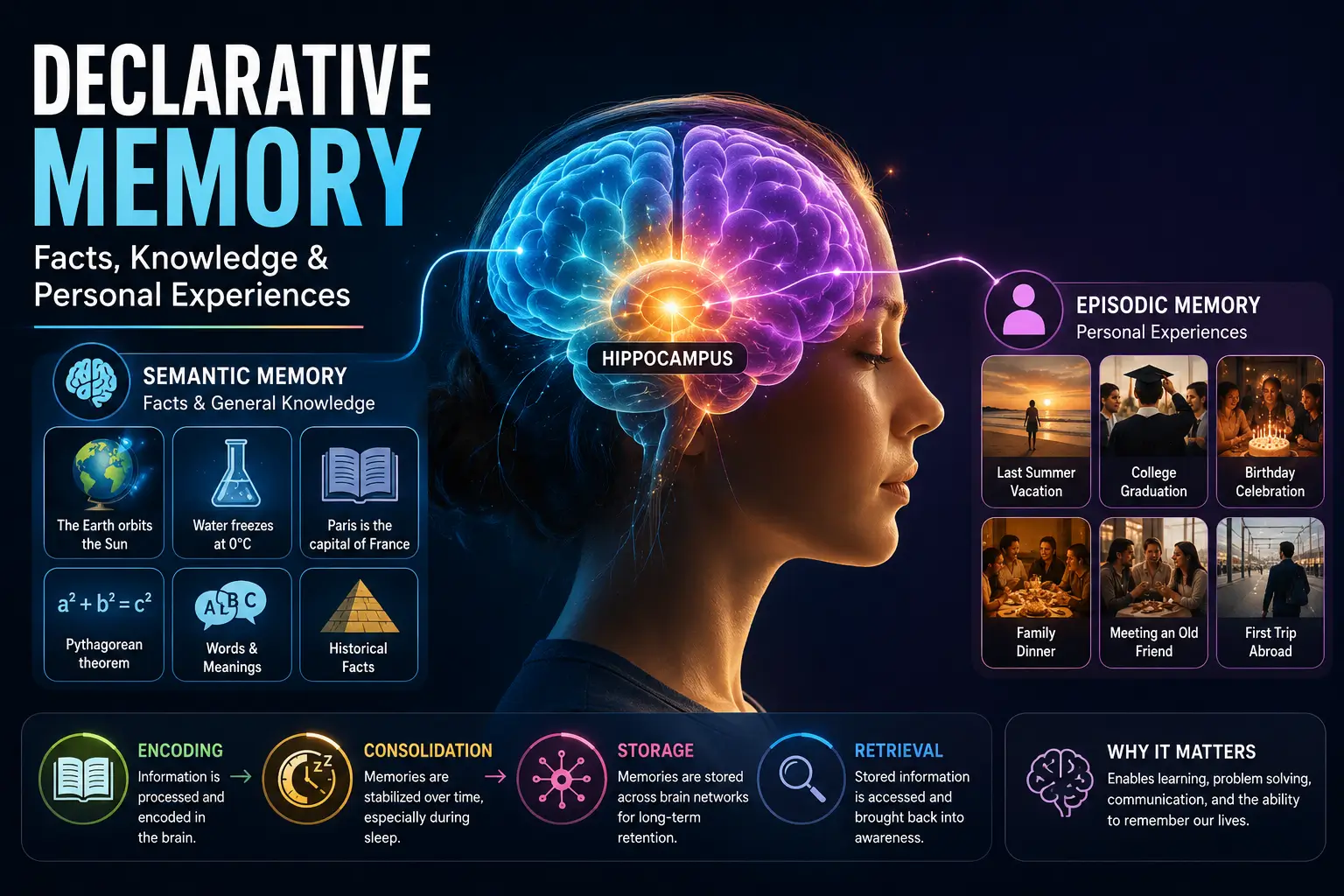
Declarative memory is the memory system responsible for storing facts, knowledge, and personal experiences that can be consciously recalled. Whether you’re remembering a historical event, recalling a conversation from yesterday, or recognizing the capital of a country, you’re using declarative memory. It forms the foundation of learning, education, and much of what we consider personal knowledge.
Unlike automatic skills such as typing or riding a bicycle, declarative memories can be intentionally accessed and verbally described. This makes declarative memory one of the most important cognitive systems for students, professionals, and lifelong learners.
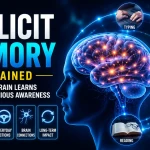
In cognitive psychology, declarative memory is often referred to as explicit memory because it involves conscious awareness. It works closely with processes such as memory encoding, memory consolidation, and memory retrieval to create and maintain long-term memories.
What Is Declarative Memory?
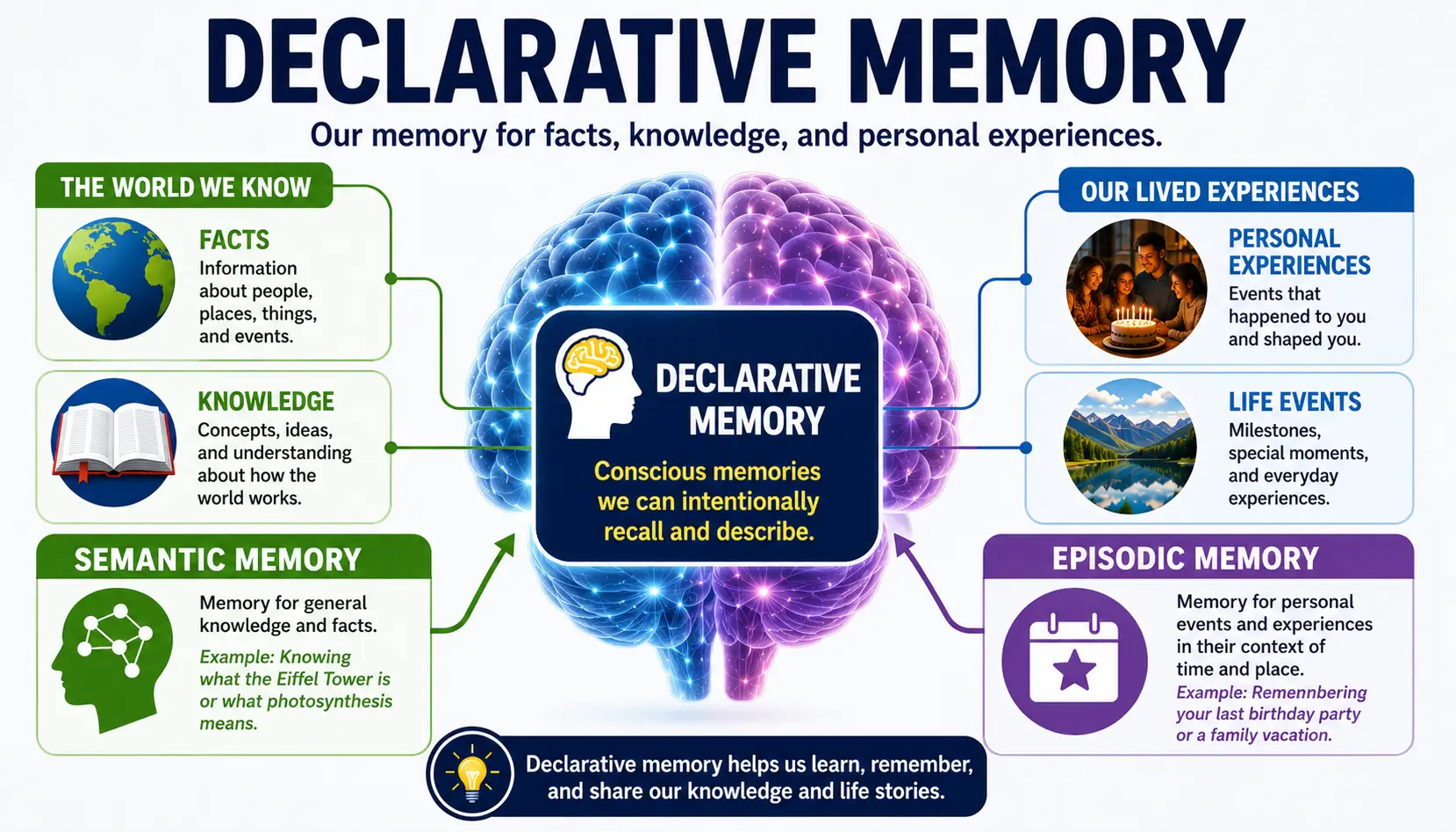
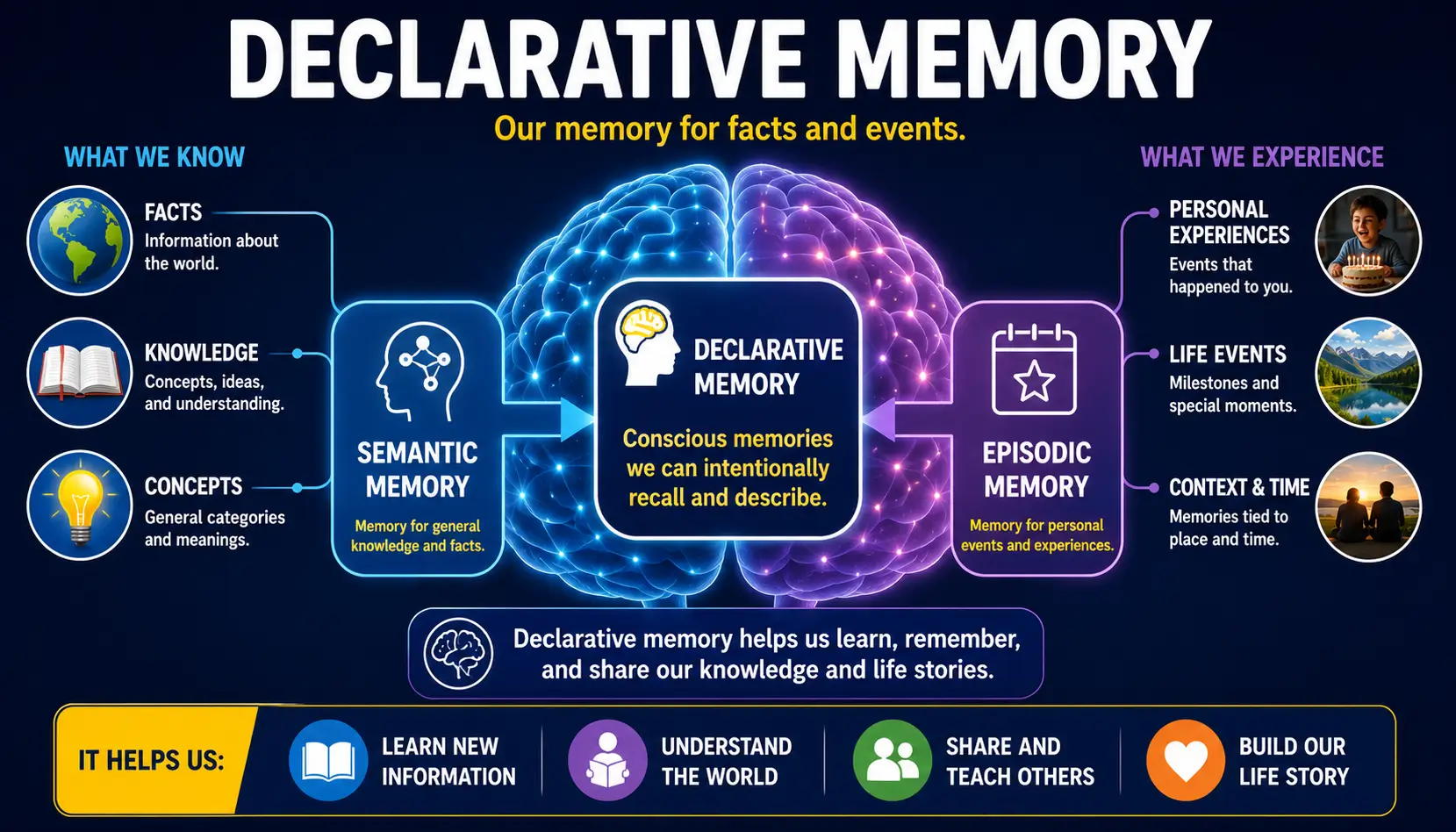
Declarative memory is the part of long-term memory that stores information we can consciously remember and describe. Researchers generally divide it into two major categories:
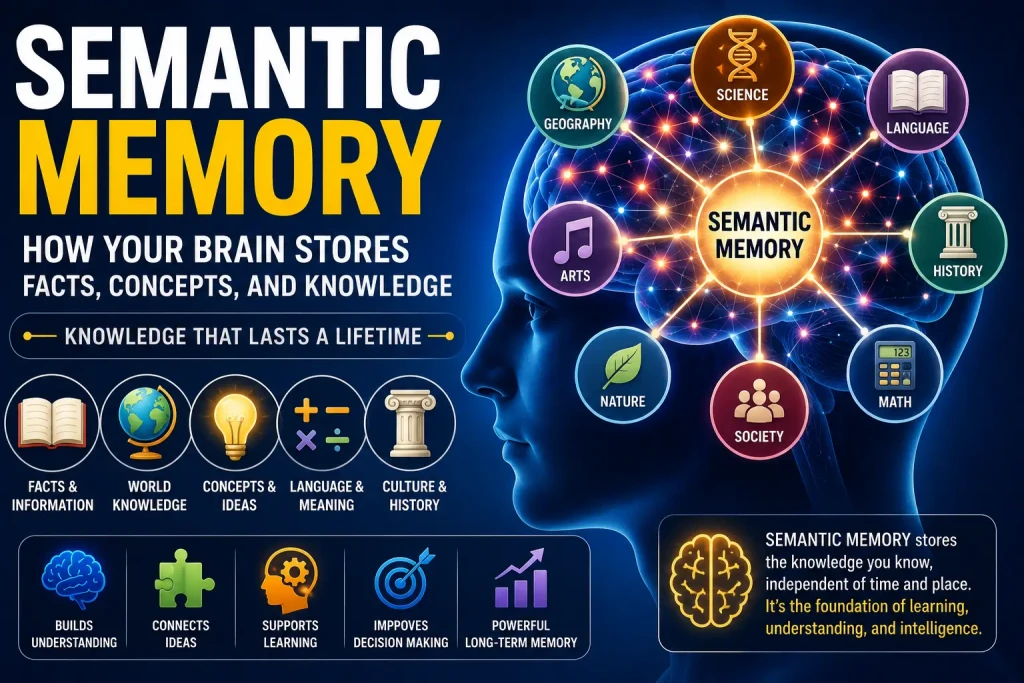
- Semantic Memory — knowledge, facts, concepts, and meanings.
- Episodic Memory — personal experiences and life events.
For example, knowing that Earth orbits the Sun is a semantic memory. Remembering your graduation day is an episodic memory. Both belong to the broader declarative memory system.
These memory types work together to help people understand the world and maintain a sense of personal identity.
The Two Components of Declarative Memory
Semantic Memory
Semantic memory contains general knowledge that is independent of personal experience. It includes facts, vocabulary, concepts, and information accumulated throughout life.
Examples include:
- The meaning of words
- Scientific concepts
- Historical events
- Mathematical formulas
- Geographic information
When someone asks who wrote Hamlet or what the largest ocean is, semantic memory provides the answer.
Episodic Memory
Episodic memory stores personally experienced events. These memories often include emotional details, locations, sensory information, and a sense of time.
Examples include:
- Your first day at school
- A recent vacation
- A memorable birthday celebration
- A conversation from last week
- An important professional achievement
Episodic memories allow individuals to mentally travel back in time and relive past experiences.

How Declarative Memories Are Created
For a broader explanation of how memories are encoded, stored, and later retrieved, see the Complete Guide to Memory.
Declarative memories develop through a series of interconnected stages rather than appearing instantly.
1. Attention
Before information can be remembered, it must first receive attention. Information that is ignored rarely becomes a lasting memory.
2. Encoding
During encoding, the brain transforms incoming information into a format suitable for storage. Stronger encoding generally leads to stronger memory formation.
Techniques such as elaborative rehearsal, dual coding, and active recall can significantly improve encoding quality.
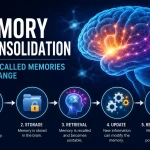
3. Consolidation
Once encoded, information must be stabilized and integrated into long-term memory networks. This process is known as consolidation.
Research consistently shows that sleep plays a critical role in strengthening newly acquired declarative memories.
4. Retrieval
Stored memories become useful only when they can be successfully retrieved. Retrieval strengthens memory traces and often improves future recall.
The Brain Regions Involved in Declarative Memory
Several brain structures work together to support declarative memory formation and retrieval.
Hippocampus
The hippocampus is perhaps the most famous structure associated with declarative memory. It helps convert newly learned information into long-term memories.
Studies of patients with hippocampal damage have shown that people may lose the ability to form new declarative memories while retaining older memories and learned skills.
Medial Temporal Lobe
The medial temporal lobe helps organize and process information before long-term storage occurs.
Neocortex
Over time, many declarative memories become distributed across cortical networks throughout the brain, making them more stable and resistant to forgetting.
Declarative Memory vs Procedural Memory
One of the most important distinctions in memory science is the difference between declarative memory and procedural memory.
Declarative memory stores information that can be consciously recalled and explained. Procedural memory stores skills and habits that are performed automatically.
This distinction also highlights the difference between explicit and implicit memory. Declarative memory is generally associated with conscious recall, while implicit memory influences learned skills, habits, and other processes without requiring conscious recollection.
For example:
- Knowing the rules of driving involves declarative memory.
- Actually driving a car relies heavily on procedural memory.
Although these systems operate differently, they frequently work together during learning and everyday performance.
Why Declarative Memory Matters
Declarative memory supports many of the activities people perform every day.
- Academic learning
- Professional knowledge
- Communication
- Problem-solving
- Decision-making
- Personal identity
- Social relationships
Without declarative memory, accumulating knowledge and recalling meaningful experiences would become extremely difficult.
How Sleep Strengthens Declarative Memory
Sleep is one of the most important factors supporting declarative memory.
During sleep, the brain continues processing recently acquired information. Researchers believe this process helps stabilize memory traces and strengthen connections between neural networks.
This is one reason why students who sacrifice sleep to study often perform worse than expected. Learning does not end when studying stops. Memory consolidation continues long after information is first encountered.
Research on sleep and memory consolidation consistently shows that quality sleep improves the retention of newly learned facts and experiences.
Why Some Declarative Memories Last for Years
Not all memories are equally durable.
Some facts and experiences are forgotten quickly, while others remain accessible for decades.
Several factors influence whether a declarative memory survives long term.
- Depth of processing
- Emotional significance
- Frequency of retrieval
- Sleep quality
- Prior knowledge
- Attention during learning
Information that is meaningful and repeatedly retrieved tends to become more stable over time.
This idea is closely related to the Levels of Processing Theory, which suggests that deeper learning produces stronger memories.
Can Declarative Memories Change?
Many people assume memories function like recordings stored inside the brain.
Modern research suggests otherwise.
Declarative memories are dynamic rather than fixed.
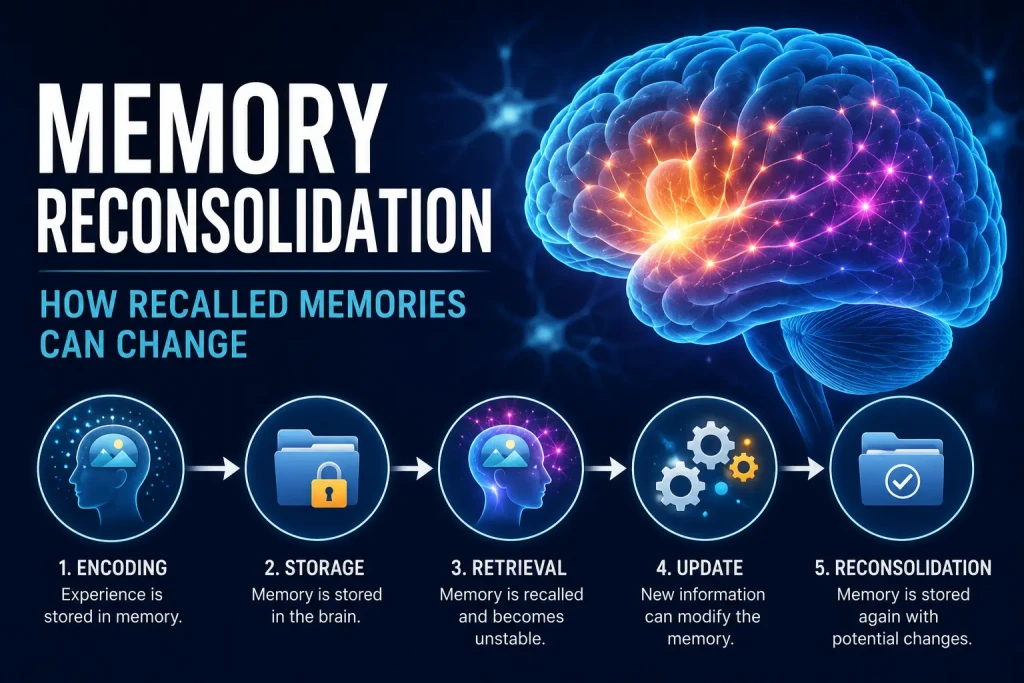
Each time a memory is recalled, it may undergo a process known as reconsolidation. During this period, memories can be updated, strengthened, weakened, or modified.
This process helps explain why memories sometimes change over time and why different people may remember the same event differently.
Readers interested in this topic can explore Memory Reconsolidation Explained: How Recalled Memories Can Change.
How to Improve Declarative Memory
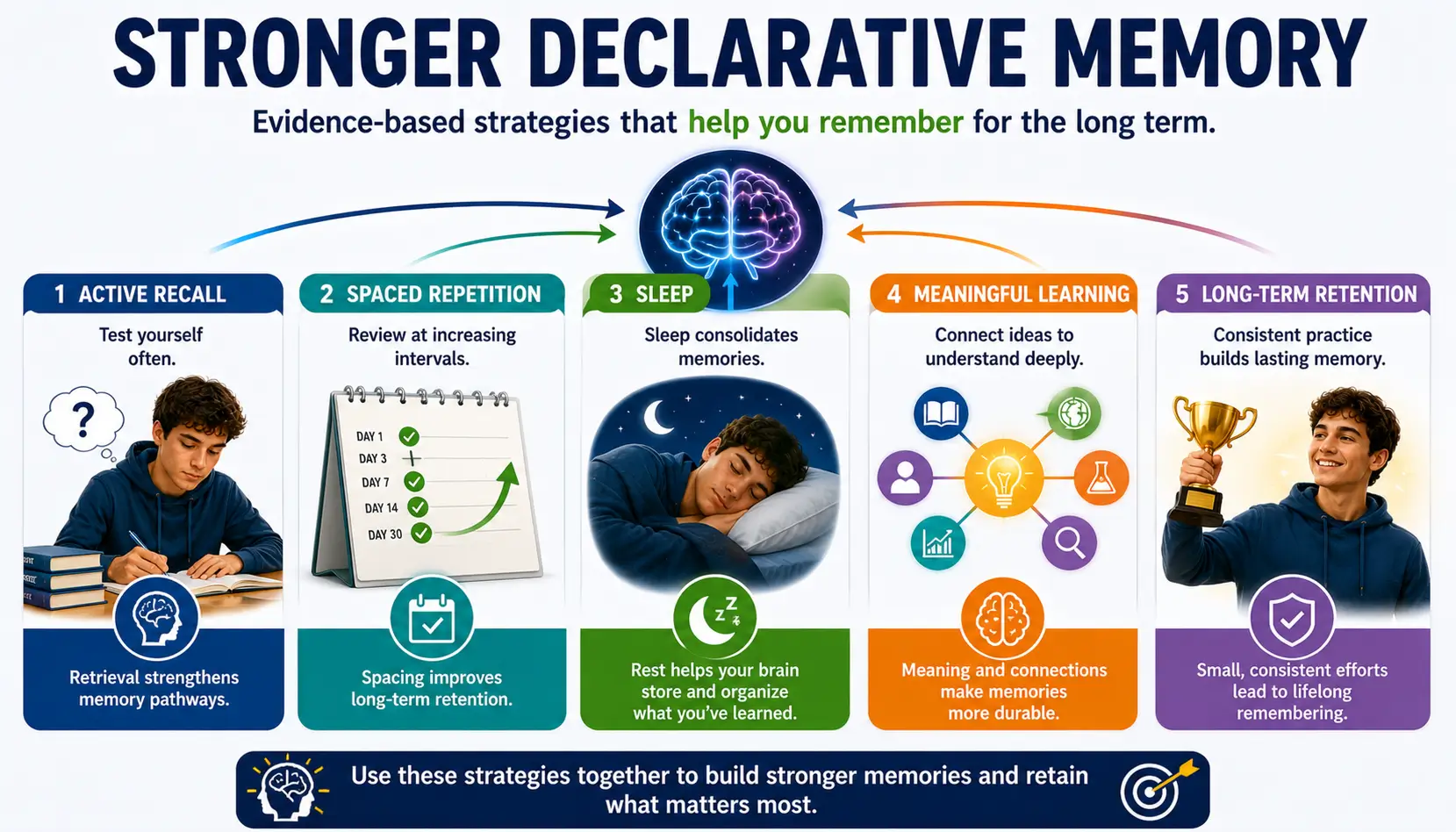
Fortunately, several evidence-based strategies can strengthen declarative memory performance.
Practice Active Recall
Active Recall forces the brain to retrieve information rather than simply review it.
Repeated retrieval strengthens memory pathways and improves long-term retention.
Use Spaced Repetition
Spaced Repetition helps reinforce information before forgetting occurs.
Reviewing material at strategic intervals strengthens memory consolidation and retention.
Connect New Information to Existing Knowledge
Meaningful associations make information easier to encode and retrieve later.
The brain often remembers connected information more effectively than isolated facts.
Prioritize Sleep
Sleep remains one of the most effective tools for supporting declarative memory formation.
Reduce Cognitive Overload
When too much information is presented at once, memory performance can suffer.
Applying ideas from Cognitive Load Theory can improve learning efficiency and retention.
Declarative Memory and Education
Nearly every educational system relies heavily on declarative memory.
Students use it to learn vocabulary, historical events, scientific concepts, mathematical principles, and countless other forms of knowledge.
Understanding how declarative memory works allows learners to study more efficiently and make better use of evidence-based learning strategies.
Rather than relying solely on rereading, successful learners often combine retrieval practice, spaced repetition, elaborative rehearsal, and quality sleep to support long-term retention.
Scientific Research on Declarative Memory
Research on declarative memory has significantly expanded our understanding of learning and cognition.
Studies involving hippocampal damage demonstrated that the brain contains specialized systems for forming and storing explicit memories.
Modern neuroscience continues to investigate how declarative memories are encoded, consolidated, retrieved, and modified throughout life.
These discoveries have influenced education, psychology, neuroscience, and cognitive performance research.
FAQ
What is declarative memory?
Declarative memory is the memory system responsible for storing facts, knowledge, and personal experiences that can be consciously recalled.
What are the two types of declarative memory?
The two primary types are semantic memory, which stores facts and knowledge, and episodic memory, which stores personal experiences.
Why is declarative memory important?
It supports learning, communication, decision-making, personal identity, and the ability to remember information about the world.
Which brain structure is most important for declarative memory?
The hippocampus plays a critical role in forming new declarative memories.
Can declarative memory be improved?
Readers looking for practical ways to strengthen everyday recall can also explore How to Improve Memory for science-backed techniques that support stronger long-term retention.
Yes. Active recall, spaced repetition, quality sleep, meaningful learning, and effective study habits can all strengthen declarative memory performance.
Related Topics
- Semantic Memory Explained: How Your Brain Stores Facts, Concepts, and Knowledge
- Episodic Memory Explained: How Your Brain Stores Personal Experiences
- Memory Encoding: How Information Becomes a Lasting Memory
- Memory Consolidation Explained: How Your Brain Turns Learning Into Long-Term Memory
- Memory Retrieval Explained: How the Brain Accesses Stored Information
Scientific Sources
https://www.ncbi.nlm.nih.gov/books/NBK547704/
https://www.ncbi.nlm.nih.gov/books/NBK537319/
https://www.apa.org/topics/memory