
Now Reading: Flashbulb Memory: Why Emotional Events Feel So Vivid and Unforgettable
-
01
Flashbulb Memory: Why Emotional Events Feel So Vivid and Unforgettable
Flashbulb Memory: Why Emotional Events Feel So Vivid and Unforgettable

Most people can remember exactly where they were when they heard about a major world event.
Some recall the room they were standing in.
Others remember who delivered the news, what they were wearing, or even the emotions they felt at that precise moment.
These memories often seem unusually vivid, detailed, and permanent.
Psychologists refer to this phenomenon as flashbulb memory.
A flashbulb memory is a highly detailed recollection of the circumstances surrounding a surprising, emotionally significant event.
Unlike ordinary memories, these experiences often feel frozen in time.
People frequently report extraordinary confidence in their accuracy.
Understanding flashbulb memory helps explain how emotion influences memory formation and why certain moments become unforgettable.
What Is Flashbulb Memory?
Flashbulb memory refers to a person’s vivid recollection of the circumstances in which they learned about an emotionally significant event.
The term was introduced by psychologists Roger Brown and James Kulik in 1977.
They proposed that surprising and emotionally powerful experiences trigger a special type of memory formation.
These memories often include details unrelated to the event itself.
For example, people may remember:
- Where they were
- Who they were with
- What they were doing
- How they felt
- What happened immediately afterward
These surrounding details become part of the memory package.
The Origin of the Term
Brown and Kulik compared these memories to a camera flashbulb.
Just as a camera captures a scene instantly, emotionally important events appear to capture a detailed snapshot of personal circumstances.
The metaphor became one of the most influential concepts in memory research.
Although later studies challenged some aspects of the theory, the term remains widely used today.
Source: https://psycnet.apa.org/record/1978-00248-001
Emotionally significant events often create memories that feel unusually vivid and unforgettable.


Why Do Flashbulb Memories Feel So Strong?
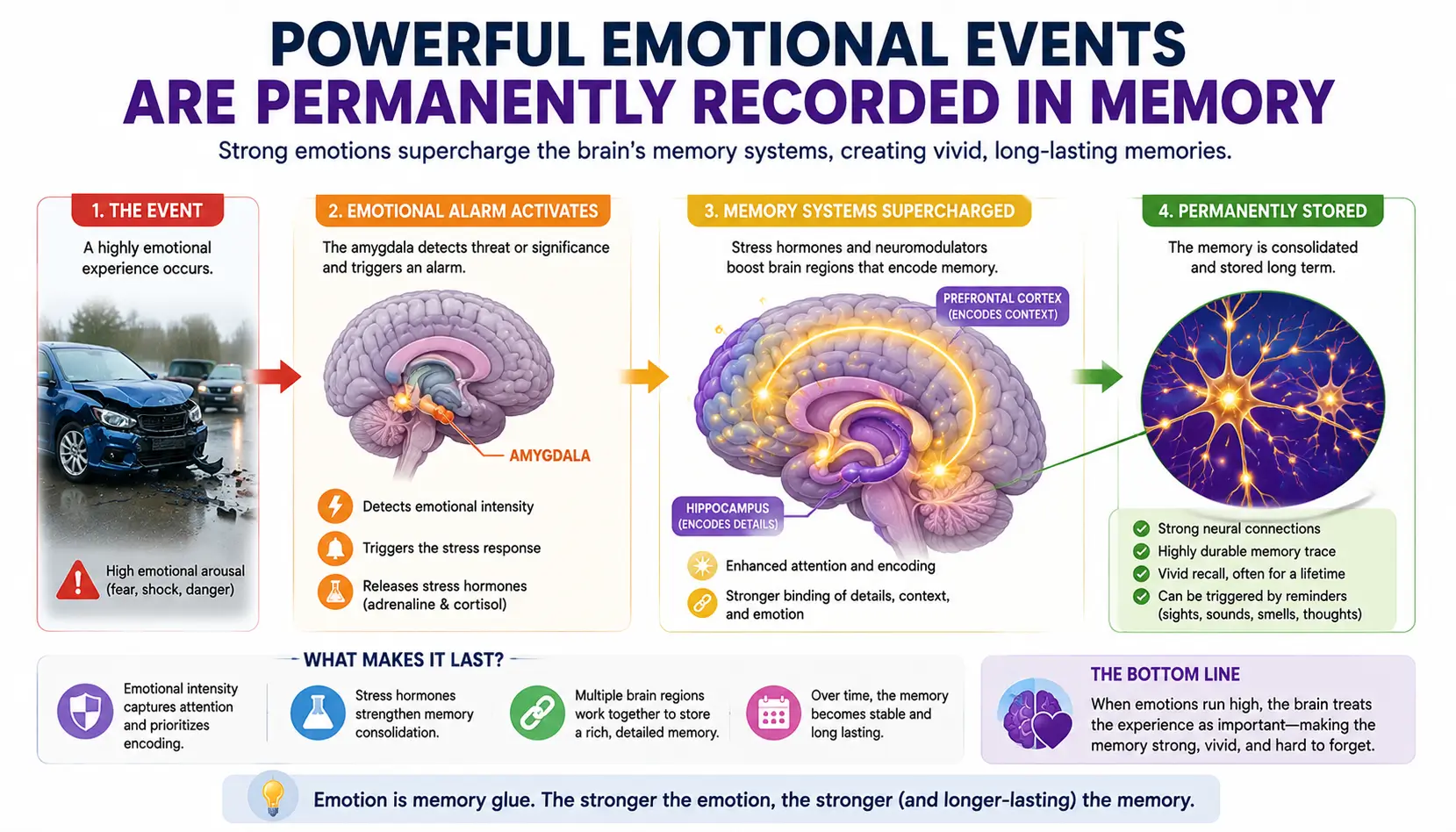
Strong emotions activate brain systems involved in memory formation.
When an event generates surprise, fear, excitement, shock, or joy, the brain allocates additional attention and processing resources.
This increased processing strengthens encoding.
The result is often a memory that feels exceptionally clear.
Emotional arousal also influences activity within the amygdala, a brain structure heavily involved in emotional learning.
The amygdala interacts closely with memory systems, helping prioritize significant experiences.
Examples of Flashbulb Memories
Researchers have studied flashbulb memories surrounding many major events.
Examples include:
- The September 11 attacks
- The Challenger disaster
- The fall of the Berlin Wall
- Major election outcomes
- Historic sports victories
- Personal life-changing experiences
Flashbulb memories are not limited to public events.
Many people develop them after weddings, births, graduations, major achievements, or unexpected personal news.
Flashbulb Memory and Episodic Memory
Because these memories are tied to personally experienced moments, they also relate closely to Autobiographical Memory, which focuses on how life events are stored and revisited over time.
Flashbulb memory is often considered a special form of Episodic Memory.
Episodic memory stores personal experiences and the context surrounding them.
Flashbulb memories fit this definition because they involve recollections of specific moments in time.
However, their emotional intensity makes them stand out from everyday experiences.
The combination of emotion and personal context contributes to their remarkable vividness.
The Role of Emotion in Memory Formation
Emotion plays a central role in memory formation.
Events that trigger strong emotional responses receive more attention during encoding.
This attention helps create stronger memory traces.
Emotion also increases the likelihood that an experience will be discussed, revisited, and mentally rehearsed over time.
Each recollection can strengthen accessibility and confidence.
Flashbulb Memory and Memory Encoding
The concept is closely related to Memory Encoding.
Encoding determines how information is initially processed and stored.
Emotionally significant events often receive exceptionally deep encoding.
Because attention is highly focused during these moments, memory formation can become unusually powerful.
This helps explain why flashbulb memories often remain accessible for years.
The Brain Systems Involved
Several brain regions contribute to flashbulb memory formation.
Researchers frequently focus on:
- The amygdala
- The hippocampus
- The prefrontal cortex
The amygdala helps process emotional significance.
The hippocampus supports memory formation and consolidation.
Together, these systems help create durable recollections of emotionally important events.
Confidence Versus Accuracy
That gap between vividness and accuracy also connects with False Memory, which explains why confident recollections can still contain distortions.
One of the most fascinating findings in flashbulb memory research involves confidence.
People often express extremely high confidence in these memories.
However, confidence does not always guarantee accuracy.
Researchers have discovered that flashbulb memories can change over time just like ordinary memories.
Despite feeling highly accurate, some details may gradually become distorted.
Research Findings on Flashbulb Memory
Some of the most influential flashbulb memory studies examined people’s memories of major public events.
Researchers found that individuals often retained vivid recollections years after the event occurred.
However, when their memories were compared with earlier reports, inconsistencies frequently emerged.
This suggested that flashbulb memories may feel highly accurate without necessarily being perfectly accurate.
The emotional intensity remained strong even when certain details changed over time.
Why Flashbulb Memories Can Change
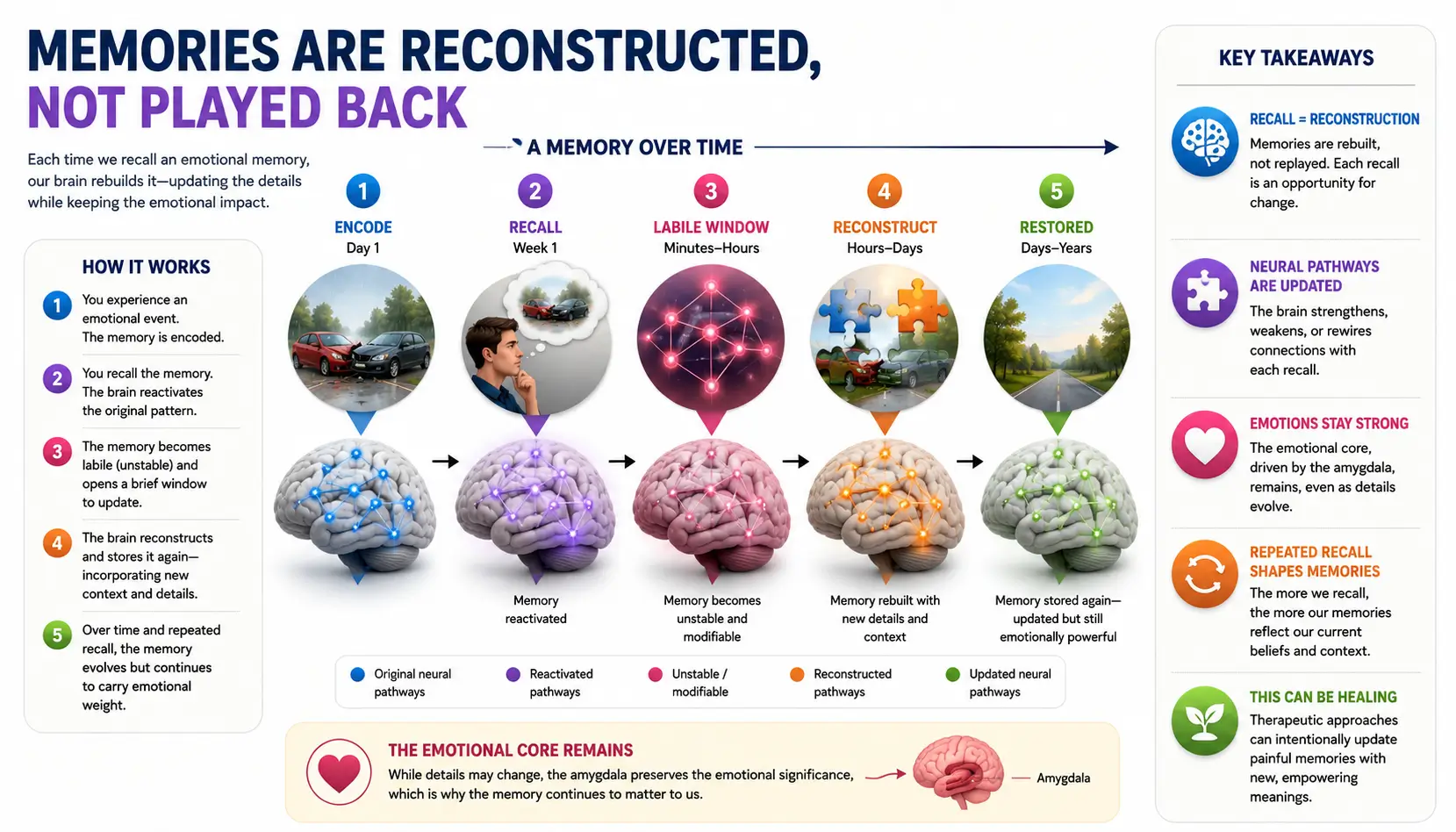
Memory is not a recording device.
Modern memory research suggests that remembering involves reconstruction rather than replay.
Each time a memory is recalled, it becomes vulnerable to modification.
New information, later experiences, and repeated discussion can influence the remembered event.
This process helps explain why vivid memories can still contain errors.
The feeling of certainty often remains even when factual details shift.
Flashbulb Memory and Memory Reconsolidation
This phenomenon is closely connected to Memory Reconsolidation.
Reconsolidation occurs when a retrieved memory becomes temporarily flexible before being stored again.
During this period, memories can be updated or altered.
Flashbulb memories appear to undergo this same process.
As a result, emotionally significant memories may evolve over time while still feeling authentic.
Why Emotion Strengthens Recall
Emotion increases attention.
Attention influences encoding.
Encoding influences retrieval.
This chain of events helps explain why emotionally significant experiences are easier to remember.
Events that trigger strong emotional responses often receive more mental resources during memory formation.
The brain treats these experiences as important information worth preserving.
Flashbulb Memory and Retrieval Cues
For a broader look at how prompts, associations, and situational details trigger recall, see What Are Retrieval Cues?.
Flashbulb memories often contain numerous retrieval cues.
People may associate a memory with:
- A particular location
- A specific sound
- A television broadcast
- A conversation
- An emotional reaction
- A meaningful object
These cues can later trigger recollection of the entire experience.
The greater the number of associations, the easier retrieval may become.
The Relationship Between Flashbulb Memory and State-Dependent Memory
Emotional state often contributes to memory retrieval.
This creates a connection between flashbulb memory and State-Dependent Memory.
When people experience emotions similar to those present during the original event, retrieval may become easier.
Emotional states can therefore function as powerful memory cues.
This relationship highlights the close connection between emotion and recall.
Flashbulb Memory and Context-Dependent Memory
Environmental context may also influence recollection.
This links flashbulb memory to Context-Dependent Memory.
Returning to a familiar location or encountering similar surroundings can sometimes trigger vivid recollections.
The brain often stores contextual information alongside significant events.
These contextual cues become part of the retrieval process.
Are Flashbulb Memories Unique?
Researchers continue debating whether flashbulb memories represent a special memory system.
Some argue they are fundamentally different from ordinary memories.
Others believe they reflect the normal memory process operating under unusually emotional conditions.
Regardless of the explanation, most researchers agree that emotion strongly influences memory strength and accessibility.
This influence remains one of the most reliable findings in cognitive psychology.
Can Positive Events Create Flashbulb Memories?
Yes.
Flashbulb memories are not limited to tragic or shocking experiences.
Positive life events can produce equally vivid memories.
Examples may include:
- Marriage proposals
- Wedding days
- The birth of a child
- Graduations
- Major achievements
- Unexpected good news
The key factor is emotional significance rather than whether the experience is positive or negative.
Flashbulb Memory in Everyday Life
Although researchers often study major public events, flashbulb memories occur regularly in everyday life.
People frequently develop vivid memories surrounding personal milestones and emotionally meaningful moments.
These experiences help shape identity, relationships, and life narratives.
Some become reference points that individuals revisit repeatedly throughout their lives.
The emotional meaning attached to these events often remains powerful for decades.
What Flashbulb Memory Teaches Us About Human Memory
If you want a broader overview of how emotion, retrieval, forgetting, and memory change fit together, read The Complete Guide to Memory.
Flashbulb memory reveals both the strengths and limitations of human memory.
It demonstrates how emotion can dramatically enhance memory formation.
At the same time, it reminds us that vivid memories are not always perfectly accurate. This is closely related to memory distortion, which explains how remembered events can change over time. This is closely related to memory distortion, which explains how remembered events can change over time.
The brain prioritizes meaning and significance rather than creating flawless recordings of reality.
This balance between vividness and reconstruction lies at the heart of memory science.
A memory can feel crystal clear while still changing over time.
Understanding flashbulb memory helps explain why some moments remain unforgettable and why emotionally important experiences often shape our personal stories for years to come.
Supporting Memory Beyond Emotional Experiences
While emotion can strengthen memory formation, long-term cognitive performance also depends on sleep, attention, learning habits, and overall brain health.
Many people combine evidence-based memory strategies with broader approaches that support healthy cognitive function throughout life.
Readers interested in memory-supportive nutritional strategies can learn more about Advanced Memory Formula.