
Now Reading: Long-Term Memory: How Information Is Stored, Retained, and Retrieved
-
01
Long-Term Memory: How Information Is Stored, Retained, and Retrieved
Long-Term Memory: How Information Is Stored, Retained, and Retrieved
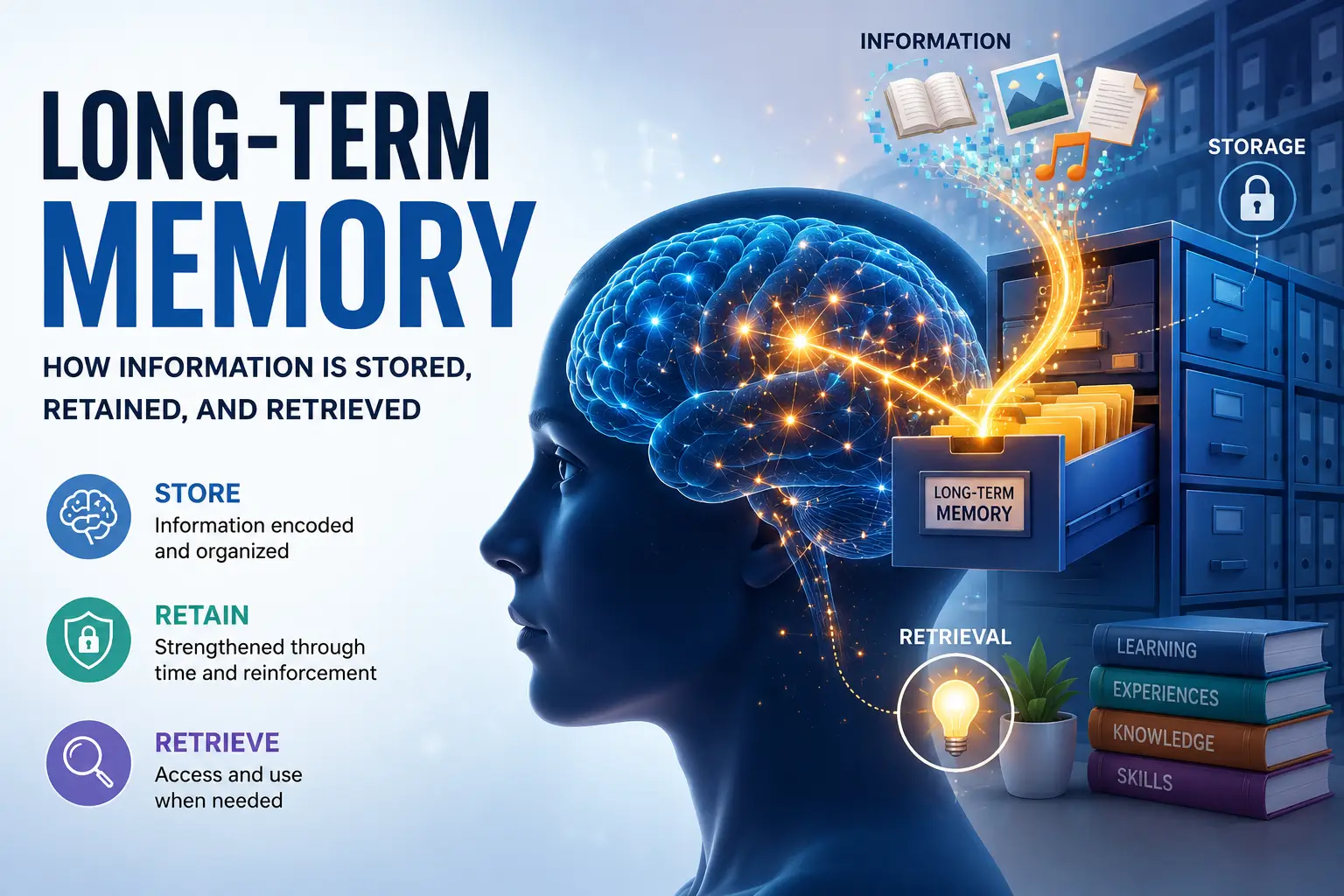
Why can you remember your childhood home years later but forget where you placed your keys this morning?
Why do some facts stay with us for decades while others disappear within hours?
The answer lies in one of the most remarkable systems in the human brain:
Long-term memory.
Long-term memory allows people to store information for extended periods ranging from days to entire lifetimes.
It contains personal experiences, learned skills, knowledge, language, habits, and countless memories accumulated throughout life.
Without long-term memory, learning would be impossible.
Every new experience would feel like the first time.
Understanding how long-term memory works can help explain why some learning strategies are highly effective while others fail to produce lasting results.
What Is Long-Term Memory?
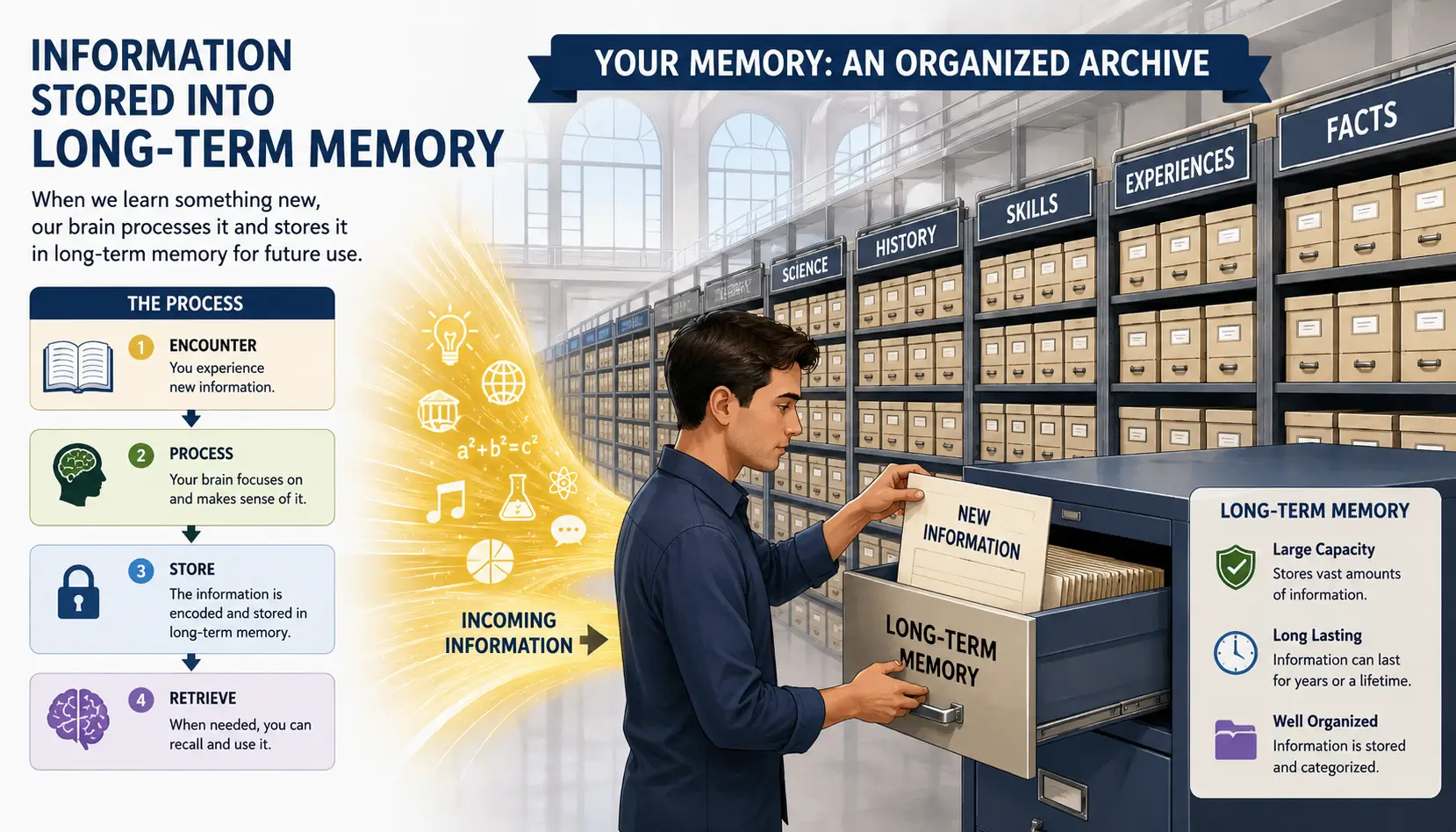
Long-term memory is the brain’s system for storing information over extended periods of time.
Unlike Short-Term Memory, which holds information briefly, long-term memory can retain information for months, years, or even a lifetime.
It serves as the foundation of knowledge, skills, experiences, and personal identity.
Everything from riding a bicycle to remembering historical facts relies on long-term memory.
When information is successfully stored in long-term memory, it becomes available for future retrieval.
Why Long-Term Memory Matters
Long-term memory is essential for almost every aspect of daily life.
It enables people to:
- Remember personal experiences
- Learn new skills
- Recognize people and places
- Use language effectively
- Solve problems using past knowledge
- Build expertise over time
Without long-term memory, learning would constantly reset.
Knowledge accumulation would be nearly impossible.
This is why long-term memory is often viewed as the ultimate goal of learning.


🔬 The Science Behind Long-Term Memory
Researchers believe long-term memories are created through changes in neural connections within the brain.
As information is learned and reinforced, networks of neurons become strengthened.
Repeated activation increases the likelihood that information can be successfully retrieved later.
Although scientists continue studying the precise mechanisms involved, long-term memory formation remains one of the central topics in cognitive neuroscience.
Source: https://www.ncbi.nlm.nih.gov/books/NBK470173/
Learning creates information. Long-term memory preserves it.
How Information Reaches Long-Term Memory
Information does not automatically enter long-term memory.
Instead, it typically moves through several stages.
Information is first processed through attention and temporary memory systems.
It may then pass through Working Memory, where active processing occurs.
Finally, through processes such as Memory Consolidation, information can become part of long-term memory.
This journey helps explain why understanding and review are so important for retention.
Long-Term Memory vs Short-Term Memory
Long-term memory and short-term memory serve different purposes.
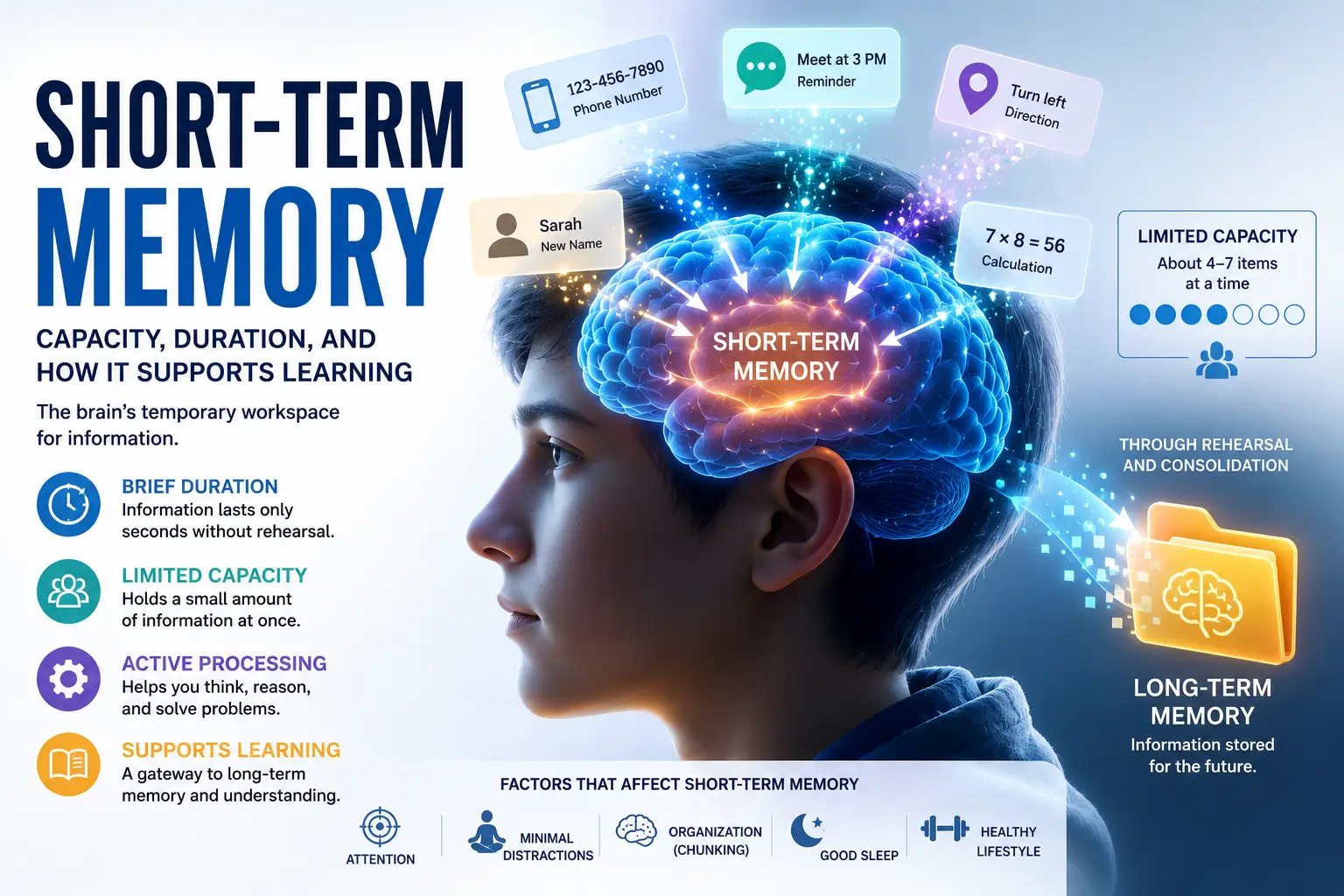
Short-term memory temporarily holds information for immediate use.
Long-term memory focuses on durable storage.
For example:
- Remembering a phone number briefly uses short-term memory.
- Remembering your childhood address relies on long-term memory.
The two systems work together constantly.
New information often begins in temporary memory before becoming permanently stored.
Long-Term Memory vs Working Memory
Long-term memory is also different from Working Memory.
Working memory functions as a temporary mental workspace.
Long-term memory functions as a storage system.
Working memory helps process information.
Long-term memory helps preserve it.
Together, these systems form the foundation of learning and cognitive performance.
Types of Long-Term Memory
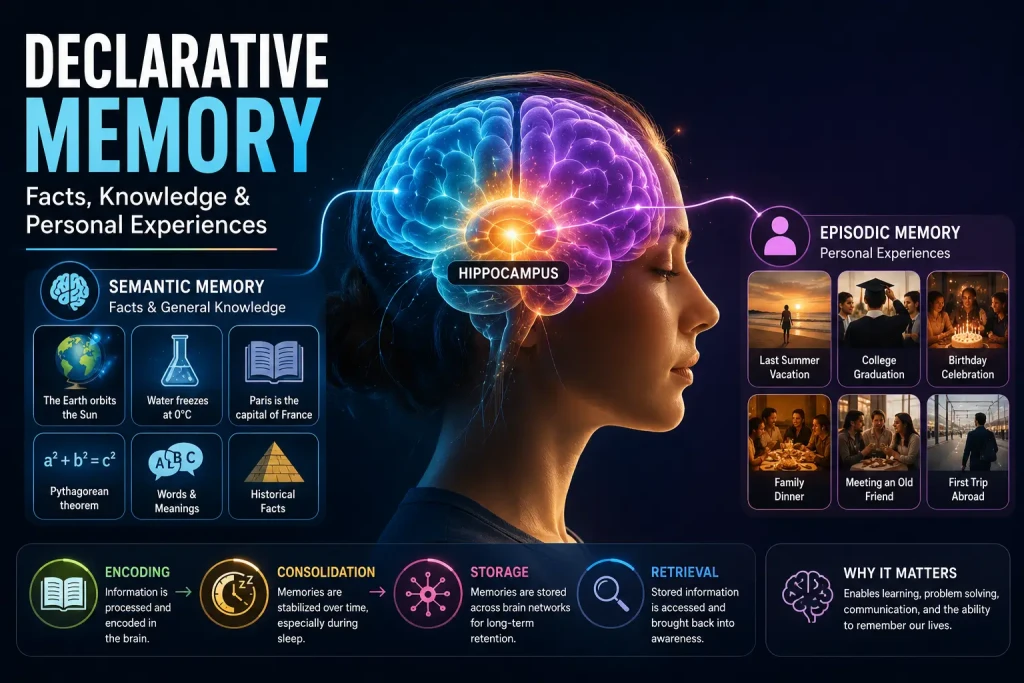
Within this broader system, declarative memory covers consciously recalled facts and experiences, while procedural memory supports learned skills and habits.
Researchers often divide long-term memory into multiple categories.
Explicit Memory
Explicit memories are memories that can be consciously recalled.
Examples include:
- Historical facts
- Vocabulary words
- Personal experiences
- Academic knowledge
Implicit Memory
Implicit memories influence behavior without conscious awareness.
Examples include:
- Riding a bicycle
- Typing on a keyboard
- Driving a car
- Playing a musical instrument
Both forms of memory play important roles in everyday life.
Memory Consolidation and Long-Term Storage
One of the most important concepts in long-term memory research is Memory Consolidation.
Consolidation helps stabilize memories after learning.
Without consolidation, newly acquired information may remain fragile and vulnerable to forgetting.
This process explains why review, practice, and sleep can improve retention.
Long-term memory depends on more than learning.
It depends on successful consolidation after learning.
Why Some Memories Last and Others Fade
These same factors help explain overall memory retention, including why some information stays accessible while other material rapidly becomes harder to recall.
Not all memories receive equal treatment.
Some experiences are repeated frequently and become deeply ingrained.
Others are encountered once and quickly forgotten.
Factors that influence long-term retention include:
- Attention
- Meaningfulness
- Repetition
- Emotional significance
- Sleep quality
- Retrieval frequency
The stronger these factors are, the more likely information is to remain accessible in the future.
How Retrieval Strengthens Long-Term Memory
One of the biggest misconceptions about memory is that retrieval simply reveals what is already stored.
In reality, retrieval often strengthens memory.
Every successful recall can reinforce neural pathways associated with that information.
This is one reason techniques such as Active Recall and Retrieval Practice are so effective.
Retrieval is not just a test of memory.
It is part of the learning process itself.
Long-Term Memory and the Forgetting Curve
Long-term memory is powerful, but it is not perfect.
Without reinforcement, memories can weaken over time.
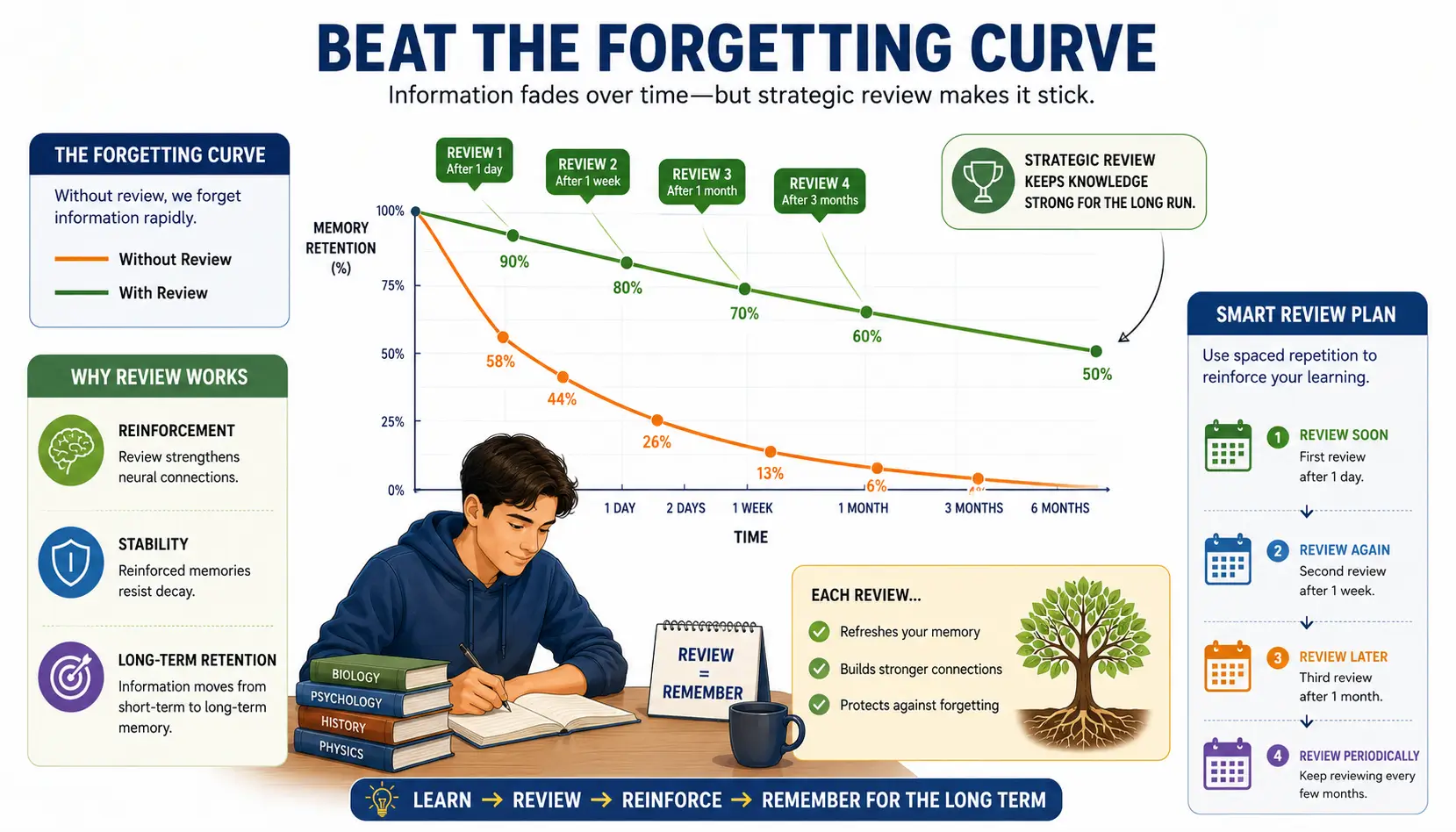
This phenomenon was famously described by the Ebbinghaus Forgetting Curve.
The forgetting curve demonstrates that information is often lost rapidly unless it is reviewed.
Fortunately, strategic review can dramatically improve retention.
Long-term memory becomes stronger when information is revisited at appropriate intervals.
How Spaced Repetition Supports Long-Term Memory
This same principle is also described more broadly as distributed practice, where review is spread across time instead of massed into a single session.
Spaced Repetition was designed specifically to improve long-term retention.
Rather than reviewing information continuously, learners revisit material at carefully timed intervals.
Each review strengthens memory before forgetting becomes complete.
This approach allows information to remain accessible with far less study time than constant repetition.
Many evidence-based learning systems rely heavily on spaced repetition because it aligns closely with how long-term memory works.
The Role of Sleep in Long-Term Memory
Research consistently shows that sleep plays a critical role in long-term memory formation.
During sleep, the brain continues processing recently learned information.
This activity supports Sleep and Memory Consolidation.
Many learners notice that information feels clearer and easier to recall after a good night’s sleep.
Sleep does not create memory by itself.
However, it often helps strengthen what has already been learned.
Common Reasons Long-Term Memory Fails
Lack of Attention
Information that never receives focused attention is unlikely to reach long-term memory effectively.
Insufficient Retrieval
Memories that are never revisited often become harder to access over time.
Poor Sleep
Sleep deprivation can interfere with consolidation and retention.
Passive Review
Simply rereading information may create familiarity without creating durable memory.
Active learning methods often produce stronger results.
Can Long-Term Memory Be Improved?
While memory capacity is influenced by many factors, people can often improve retention by adopting more effective learning strategies.
Examples include:
- Using Active Recall
- Practicing Retrieval Practice
- Applying Spaced Repetition
- Improving sleep quality
- Creating meaningful associations
- Reducing distractions during learning
These habits support the processes that help information remain accessible over time.
Long-Term Memory and Memory Techniques
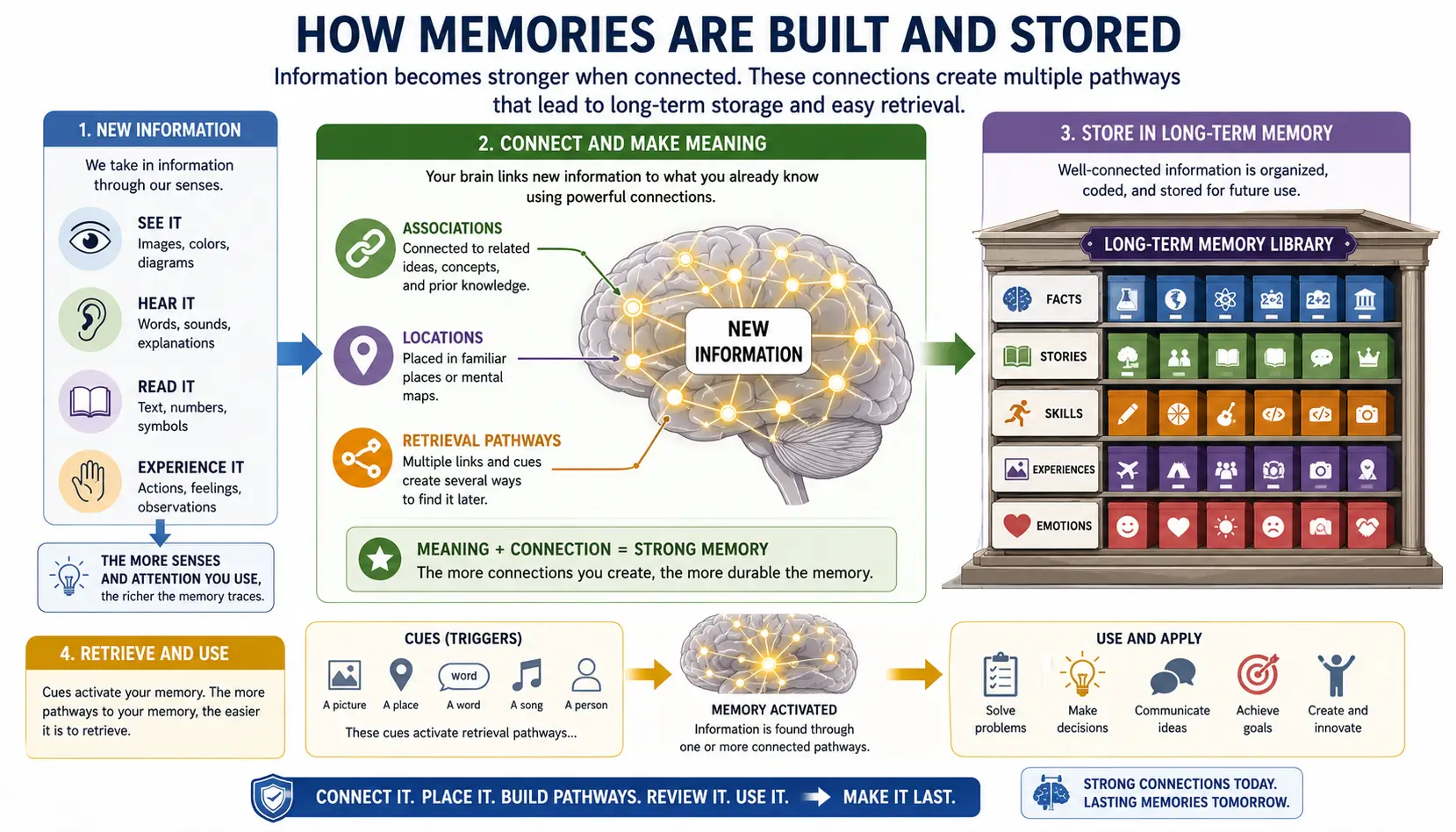
Many classic memory methods are designed specifically to improve long-term retention.
Examples include:
These techniques help create stronger connections between ideas, making retrieval easier in the future.
The stronger the connections, the more resilient the memory often becomes.
Supporting Long-Term Memory and Cognitive Health
Long-term memory depends on more than study techniques alone.
Nutrition, sleep, stress management, physical activity, and cognitive engagement all influence memory performance.
Many learners combine evidence-based learning strategies with broader approaches that support long-term brain health.
Readers interested in memory-supportive nutritional strategies can learn more about Advanced Memory Formula.
The Foundation of Lifelong Learning
For a broader map of how storage, forgetting, retrieval, and improvement strategies fit together, see the complete guide to memory.
Long-term memory is one of the most valuable cognitive systems humans possess.
It allows people to accumulate knowledge, develop expertise, preserve experiences, and build skills over a lifetime.
Every effective learning strategy ultimately aims to support this system.
Whether through retrieval practice, spaced repetition, memory techniques, or quality sleep, the goal remains the same:
Transform temporary information into lasting knowledge.
Understanding how long-term memory works can help learners study more effectively, retain information longer, and continue growing throughout life.
Related Topics
- Memory Consolidation Explained: How Your Brain Turns Learning Into Long-Term Memory
- Working Memory Explained: The Brain System Behind Learning, Focus, and Recall
- Spaced Repetition: The Proven System for Remembering More in Less Time
- Active Recall: The Science-Backed Study Method for Long-Term Memory