
Now Reading: Levels of Processing Theory: Why Deep Learning Creates Stronger Memories
-
01
Levels of Processing Theory: Why Deep Learning Creates Stronger Memories
Levels of Processing Theory: Why Deep Learning Creates Stronger Memories
Why do some pieces of information stay with us for years while others disappear within hours?
Most people assume memory depends mainly on repetition.
However, cognitive psychologists have discovered that the way information is processed often matters more than how many times it is reviewed.
This idea forms the foundation of Levels of Processing Theory.
Developed by psychologists Fergus Craik and Robert Lockhart in 1972, the theory proposes that memories become stronger when information is processed at deeper, more meaningful levels.
Rather than viewing memory as a simple storage system, the theory suggests that learning quality depends heavily on how information is interpreted and understood.
Understanding Levels of Processing Theory helps explain why some study methods produce long-term learning while others lead to rapid forgetting.
What Is Levels of Processing Theory?
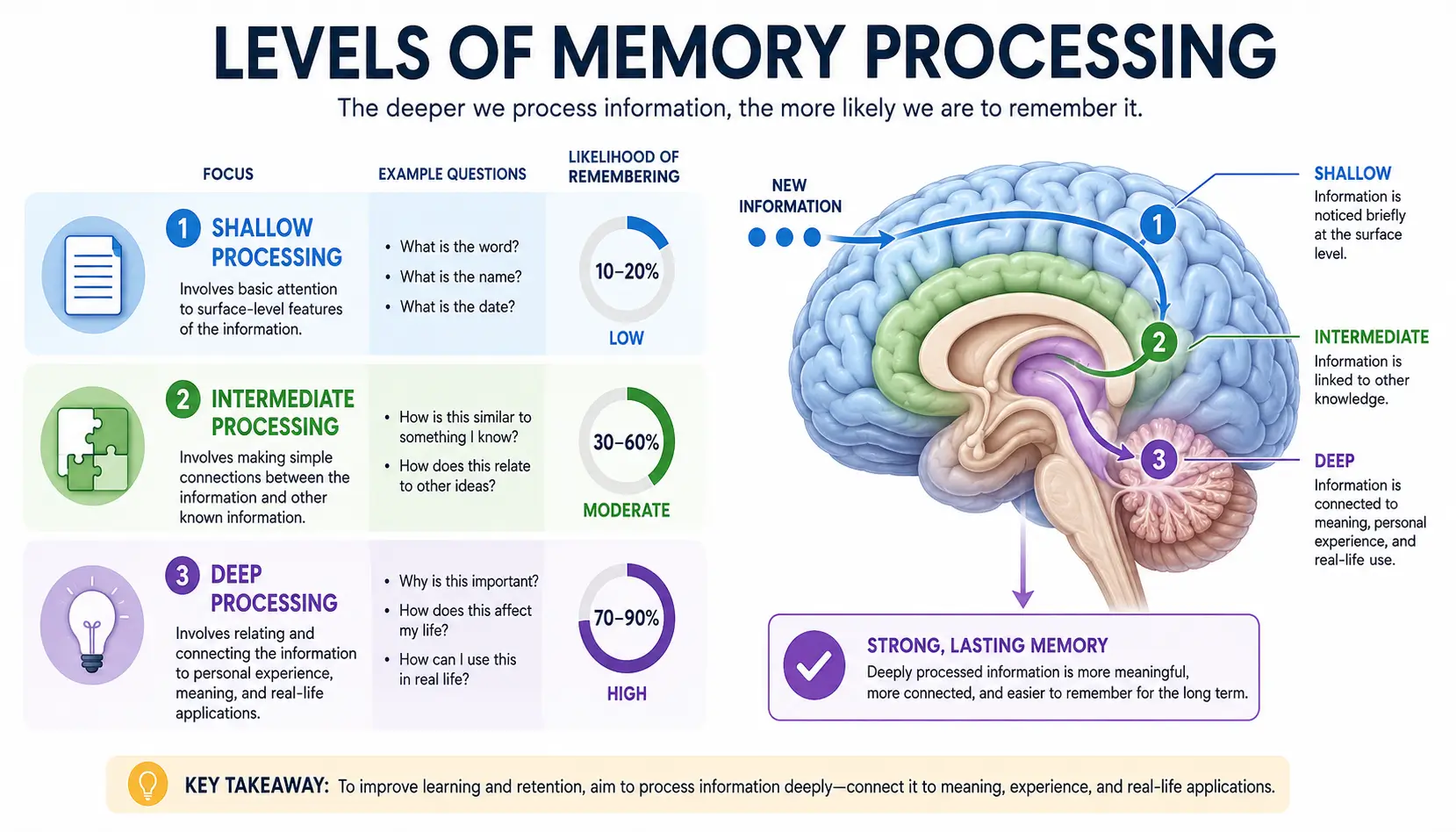
Levels of Processing Theory argues that memory retention depends on the depth at which information is processed.
According to the theory, information can be processed at different levels ranging from superficial characteristics to meaningful understanding.
The deeper the processing, the stronger and more durable the resulting memory.
This theory challenged earlier memory models that focused primarily on short-term and long-term storage systems.
Instead, Craik and Lockhart proposed that memory strength depends largely on cognitive processing itself.
The Origins of the Theory
Before the 1970s, many researchers viewed memory as a sequence of storage stages.
Information entered short-term memory and, through rehearsal, eventually moved into long-term memory.
Craik and Lockhart questioned whether storage location alone could explain memory performance.
They argued that meaningful processing creates stronger memory traces than simple repetition.
Their work became one of the most influential developments in cognitive psychology.
Source: https://psycnet.apa.org/record/1972-22016-001
Memory durability depends more on how information is processed than where it is stored.


Three Main Levels of Processing
The theory describes a continuum of processing depth rather than strictly separate categories.
However, researchers often discuss three major levels.
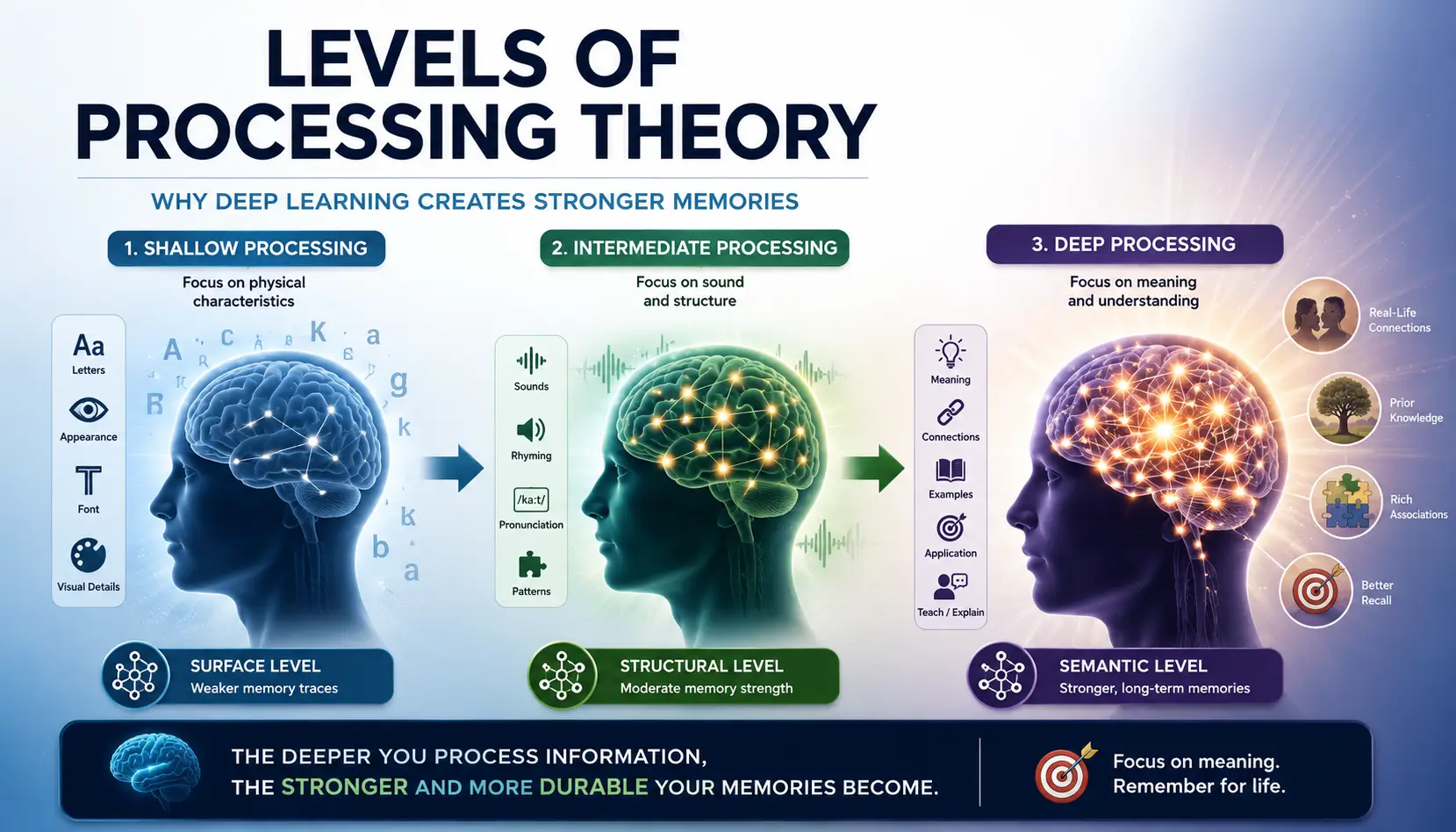
1. Shallow Processing
Shallow processing focuses on surface-level features.
This may include:
- Letter shapes
- Font styles
- Word appearance
- Physical characteristics
For example, noticing whether a word is written in capital letters represents shallow processing.
This type of processing generally produces weak memory retention.
2. Intermediate Processing
Intermediate processing involves analyzing sound and structure.
Examples include:
- Rhyming words
- Pronunciation
- Phonetic patterns
- Sound recognition
These processes create stronger memories than purely visual analysis but often remain less effective than semantic processing.
3. Deep Processing
Deep processing focuses on meaning, helping learners connect new information with existing knowledge stored in semantic memory.
Rather than examining how information looks or sounds, learners think about what it means.
This may involve:
- Making associations
- Connecting new knowledge to prior knowledge
- Creating examples
- Applying concepts
- Explaining ideas in your own words
Deep processing consistently produces stronger long-term memory formation.
Why Deep Processing Creates Better Memory
One reason meaningful processing works so well is that personally relevant information is easier to retain, a pattern explored further in Self-Reference Effect.
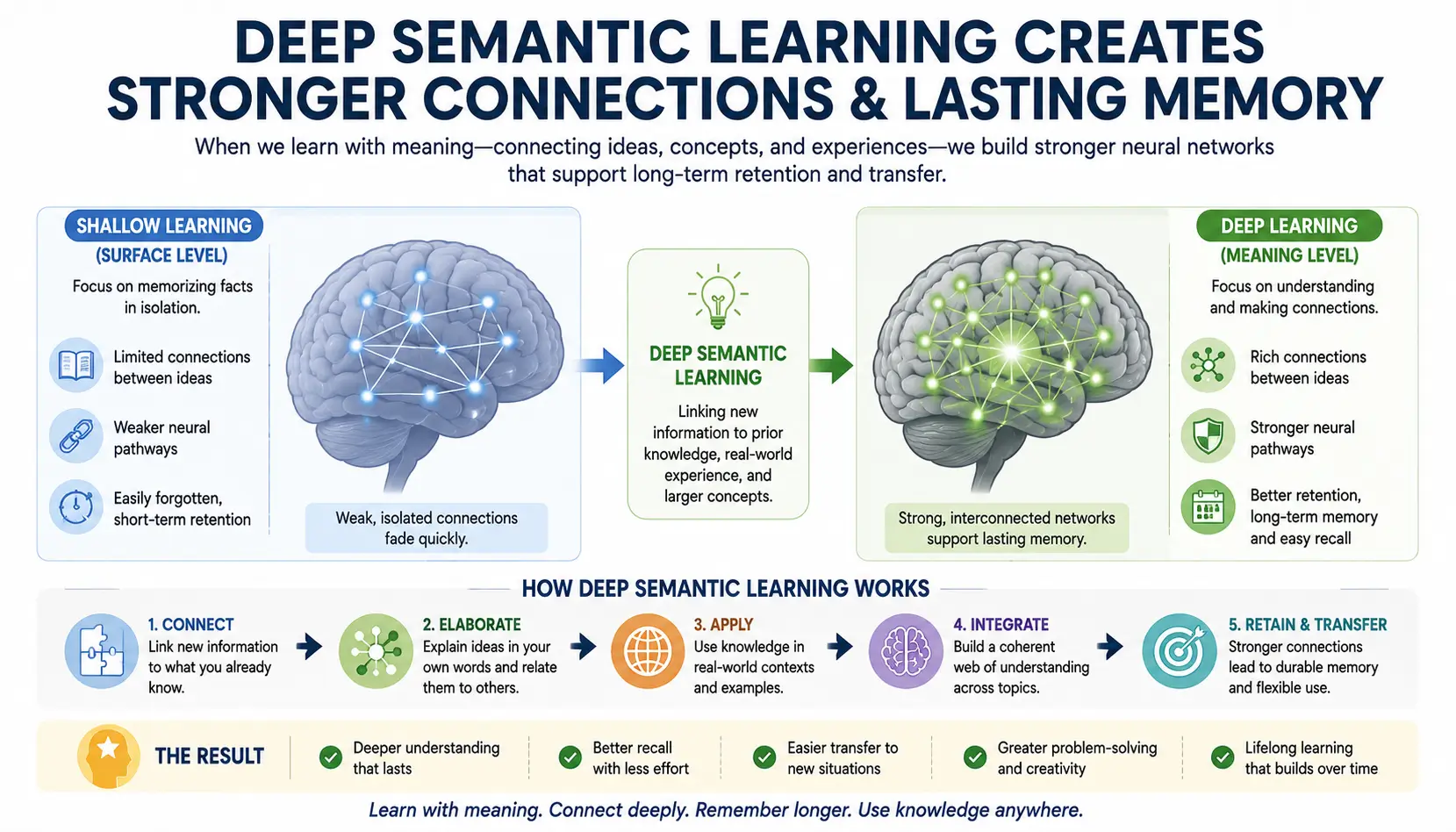
Deep processing activates broader networks of knowledge within the brain.
When information becomes linked to existing memories, multiple retrieval pathways are created.
This makes future recall easier.
Meaningful learning also encourages elaboration, which strengthens encoding.
The more connections a memory has, the more likely it is to remain accessible over time.
Levels of Processing and Memory Encoding
The theory is closely connected to Memory Encoding.
Encoding refers to the process of transforming information into a memory representation.
Levels of Processing Theory explains why some forms of encoding are more effective than others.
Information encoded semantically tends to be remembered far better than information encoded superficially.
This insight remains one of the most important principles in learning science.
Research Supporting Levels of Processing Theory
Decades of research have supported the central prediction of the theory.
Participants consistently remember information better when tasks require semantic analysis.
For example, people are more likely to remember a word when asked whether it fits into a sentence than when asked whether it contains a particular letter.
The difference results from deeper cognitive engagement.
Numerous experiments have replicated this finding across different populations and learning environments.
Levels of Processing and Long-Term Memory
Deep processing contributes directly to Long-Term Memory.
When information is processed meaningfully, it becomes more resistant to forgetting.
This does not guarantee permanent retention, but it significantly improves memory durability.
Long-term learning often depends more on processing depth than on study duration alone.
Levels of Processing and Retrieval
The benefits of deep processing extend beyond encoding.
Memories that are encoded semantically are often easier to retrieve later.
This relationship helps explain why meaningful learning improves recall performance.
Information that is connected to existing knowledge networks tends to have more retrieval cues available.
This improves accessibility during exams, conversations, and real-world problem-solving situations.
The connection between processing depth and retrieval is one reason why meaningful learning produces lasting results.
Real-World Example of Processing Depth
Imagine three students studying the same vocabulary word.
The first student focuses only on the word’s spelling.
The second student repeats the word aloud several times.
The third student creates an example sentence, connects the word to prior knowledge, and explains its meaning.
According to Levels of Processing Theory, the third student is most likely to remember the word later.
The difference is not study time but processing depth.
How Levels of Processing Explains Effective Study Methods
Many of the methods discussed in Study Techniques work precisely because they force deeper, more meaningful processing instead of passive review.
Many evidence-based learning strategies work because they encourage deep processing.
Examples include:
Each of these techniques requires learners to interact with information at a meaningful level.
Rather than simply reviewing material, learners actively transform and apply knowledge.
This creates stronger memory traces.
Levels of Processing and Active Recall
Active Recall naturally promotes deep processing.
When learners attempt to retrieve information from memory, they engage with concepts rather than merely viewing them.
This effort encourages semantic processing and strengthens retrieval pathways.
Each successful recall reinforces meaningful memory connections.
This is one reason Active Recall consistently outperforms passive review methods.
The Relationship Between Levels of Processing and Elaborative Rehearsal
Levels of Processing Theory strongly influenced later research on elaboration.
Elaborative rehearsal involves connecting new information to existing knowledge.
Instead of repeating facts mechanically, learners focus on meaning and relationships.
This approach creates richer memory networks and deeper encoding.
Researchers generally consider elaborative rehearsal one of the most effective applications of deep processing.
Common Study Habits That Create Shallow Processing
Many popular study habits encourage only superficial learning.
- Repeated rereading
- Passive highlighting
- Copying notes without reflection
- Memorizing isolated facts
- Reviewing material without testing understanding
While these methods may create a feeling of familiarity, they often fail to produce durable memory formation.
Learners may recognize information but struggle to retrieve it independently.
How to Apply Levels of Processing Theory in Daily Learning
For a more practical, step-by-step version of these ideas, see How to Study Effectively, where deep processing is translated into usable study methods.
Students, professionals, and lifelong learners can use the theory immediately.
Practical strategies include:
- Ask why concepts are important
- Create personal examples
- Connect new information to existing knowledge
- Teach ideas to someone else
- Use Active Recall rather than passive review
- Summarize information in your own words
- Look for relationships between concepts
These approaches increase semantic engagement and strengthen memory formation.
Levels of Processing and Educational Psychology
The theory remains highly influential in modern educational psychology.
Many contemporary teaching practices encourage learners to analyze, interpret, apply, and explain information.
These activities naturally promote deeper processing.
Educational research consistently demonstrates that meaningful engagement produces stronger learning outcomes than passive exposure.
The principle continues to guide classroom instruction, curriculum design, and study recommendations worldwide.
Criticisms of Levels of Processing Theory
Although highly influential, the theory is not without criticism.
Some researchers argue that “depth” can be difficult to define objectively.
Others suggest that retrieval processes and learning context also play major roles in memory performance.
Despite these debates, the theory remains one of the most successful explanations for why meaningful learning improves retention.
Its core findings have been replicated repeatedly across decades of research.
Why Deep Learning Creates Stronger Memories
For a wider framework on turning stronger encoding and retrieval into better everyday recall, see How to Improve Memory.
The central message of Levels of Processing Theory is surprisingly simple.
Memories become stronger when information is processed meaningfully.
Rather than focusing solely on repetition, effective learners focus on understanding, connecting, and applying knowledge.
These activities strengthen encoding, improve retrieval, and increase long-term retention.
Learning becomes more durable when information becomes personally meaningful.
The deeper you think about information, the more likely you are to remember it later.
Levels of Processing Theory continues to provide one of the clearest explanations for why some learning experiences last a lifetime while others disappear within days.
Supporting Memory Beyond Study Techniques
Deep processing improves memory formation, but long-term cognitive performance also depends on sleep quality, attention, brain health, and effective learning habits.
Many learners combine evidence-based study strategies with broader approaches that support healthy cognitive function.
Readers interested in memory-supportive nutritional strategies can learn more about Advanced Memory Formula.