
Now Reading: How to Study Effectively: Science-Backed Methods to Learn Faster and Remember More
-
01
How to Study Effectively: Science-Backed Methods to Learn Faster and Remember More
How to Study Effectively: Science-Backed Methods to Learn Faster and Remember More
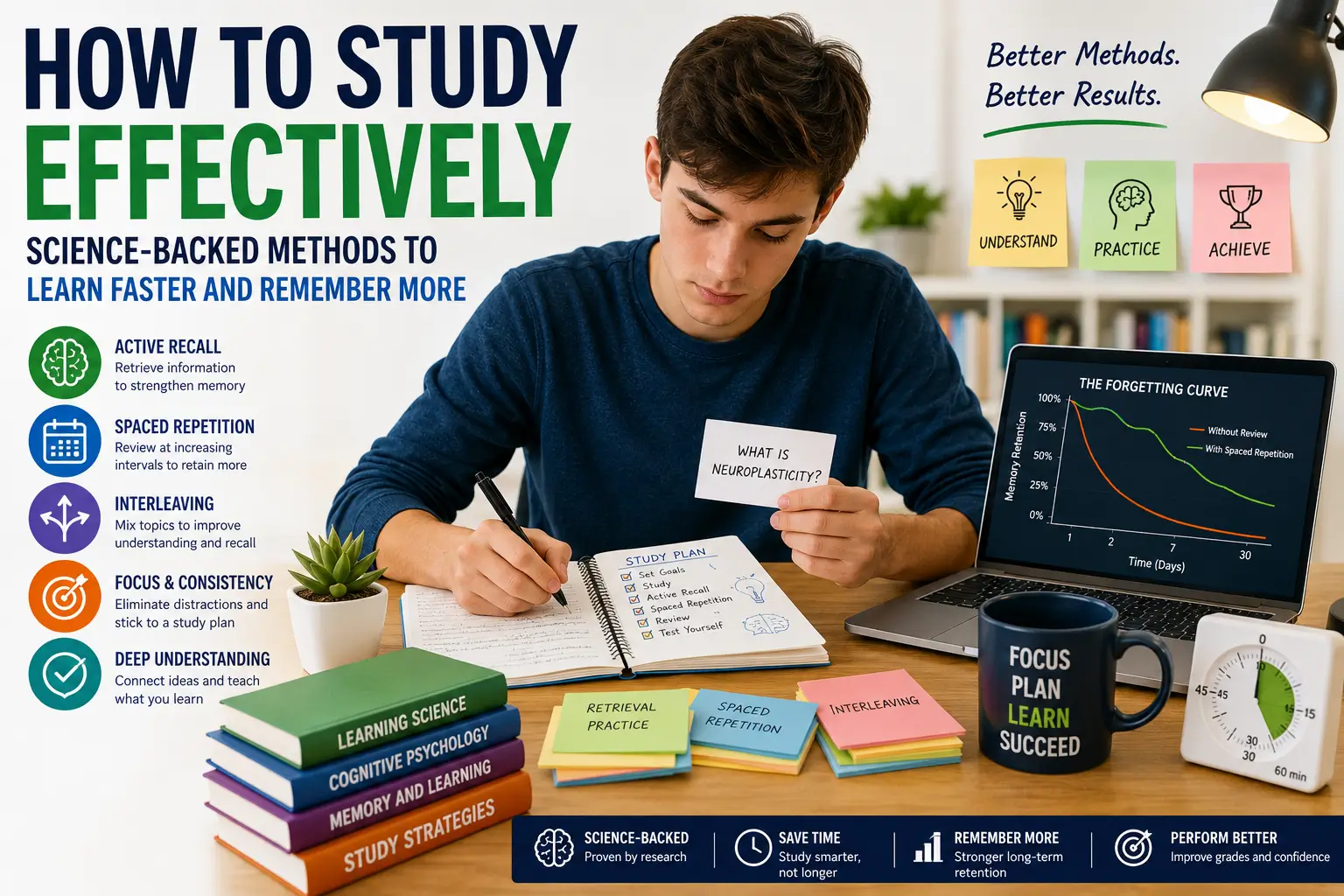
Many students spend hours studying yet remember surprisingly little a few days later.
The problem is rarely a lack of effort.
More often, the issue is using ineffective study methods that create the illusion of learning without producing lasting memory.
Research in cognitive psychology has repeatedly shown that some study strategies produce dramatically better long-term results than others.
Understanding how memory works allows learners to spend less time studying while retaining more information.
If your goal is to improve grades, master complex subjects, or simply remember what you learn, adopting evidence-based study methods can significantly improve results.
In this guide, we’ll explore how to study effectively using techniques supported by decades of learning science research.
Why Most Study Methods Fail
Many learners rely on familiar habits such as rereading textbooks, highlighting large sections of text, or reviewing notes repeatedly.
While these activities feel productive, they often produce only short-term familiarity.
Psychologists call this the illusion of competence.
You recognize information when you see it, but struggle to recall it independently later.
Studies from learning researchers have consistently found that retrieval-based learning strategies outperform passive review methods.
The brain strengthens memory not by repeatedly seeing information, but by repeatedly retrieving it.
This principle forms the foundation of effective studying.
The Core Principles of Effective Studying
For a broader overview of the evidence-based methods built on these principles, see Study Techniques.
Before looking at specific techniques, it’s helpful to understand the core principles behind successful learning.
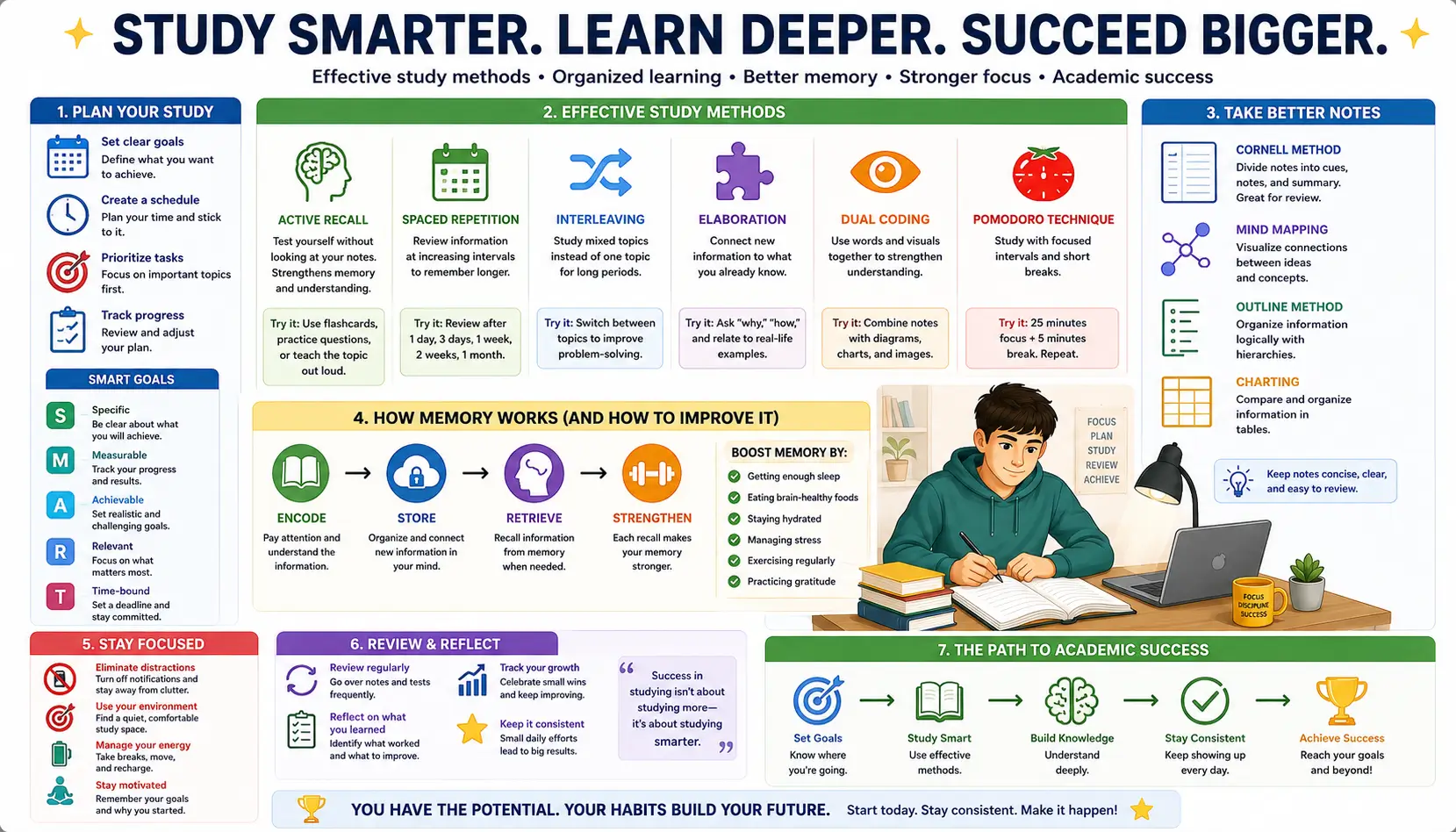
- Active retrieval strengthens memory pathways.
- Spacing reduces forgetting.
- Deep processing improves retention.
- Interleaving improves flexible thinking.
- Organization reduces cognitive overload.
- Sleep supports memory consolidation.
Most evidence-based study techniques are built around one or more of these principles.
Research from cognitive scientists including Henry Roediger, Jeffrey Karpicke, and other learning researchers has consistently demonstrated the effectiveness of retrieval practice and spaced learning for long-term retention.

Method #1: Use Active Recall Instead of Passive Review
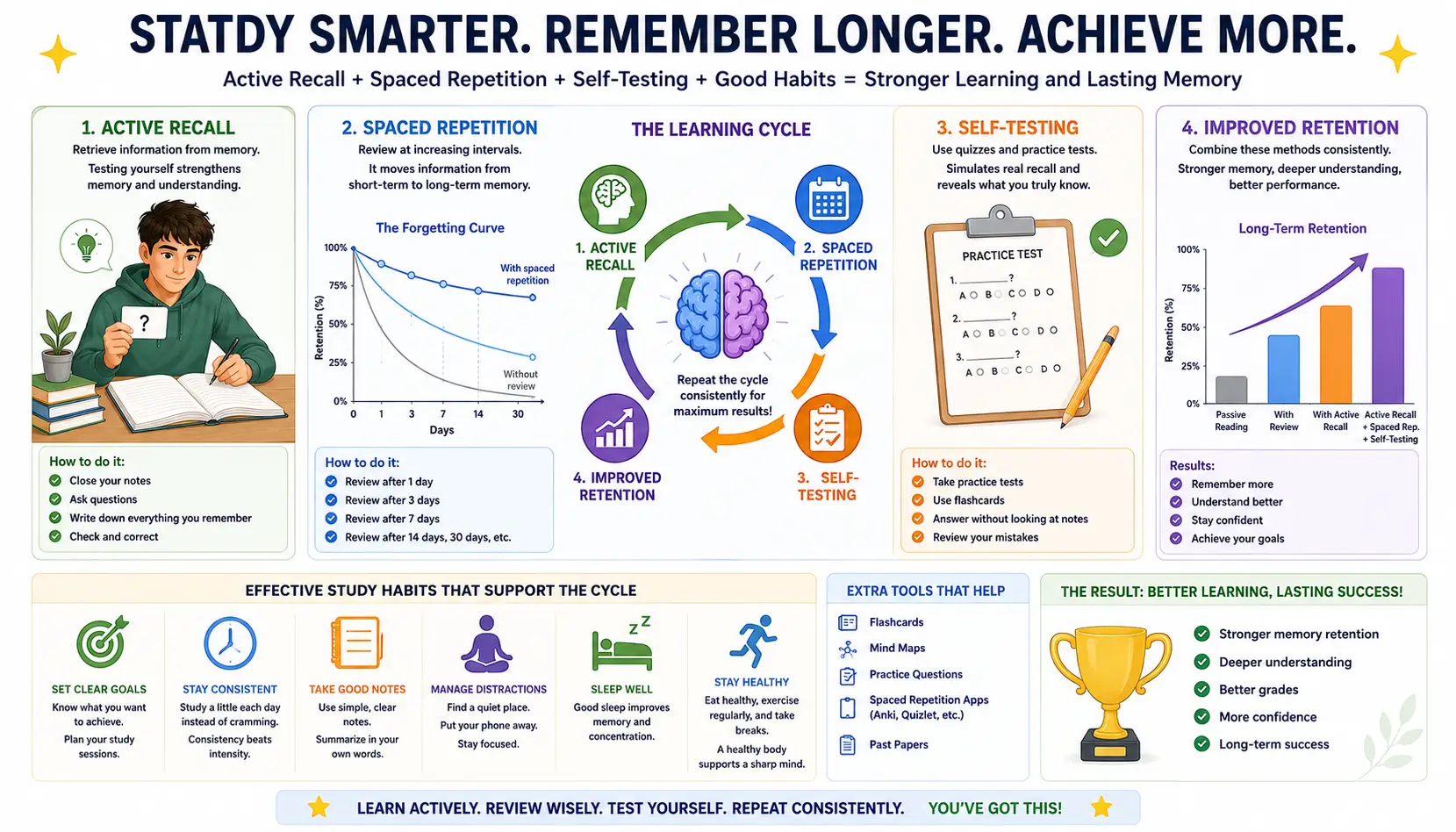
Active recall is one of the most powerful learning strategies ever studied.
Instead of rereading material, learners attempt to retrieve information from memory without looking at notes.
This retrieval process strengthens neural pathways and makes future recall easier.
Examples include:
- Answering practice questions.
- Using flashcards.
- Explaining concepts from memory.
- Writing summaries without notes.
- Self-testing after study sessions.
Active recall directly challenges memory and creates stronger long-term retention than passive review.
Readers interested in the science behind retrieval can explore Active Recall and Retrieval Practice.
Method #2: Apply Spaced Repetition
This same principle is also described as Distributed Practice, especially when study sessions are spread over time instead of compressed into one block.
One reason students forget information quickly is that learning sessions are often compressed into a single period.
Spacing learning across multiple sessions dramatically improves retention.
This approach works because each review occurs when memories are beginning to weaken.
The retrieval effort strengthens memory traces and slows forgetting.
A simple schedule might include reviews:
- 1 day later
- 3 days later
- 1 week later
- 2 weeks later
- 1 month later
Spaced repetition directly combats forgetting and is one of the most reliable findings in learning science.
Learn more about this system in Spaced Repetition and Anki Flashcards.
Method #3: Use the Feynman Technique
Teaching is one of the fastest ways to identify gaps in understanding.
The Feynman Technique encourages learners to explain concepts in simple language as if teaching a beginner.
If explanations become confusing or incomplete, knowledge gaps become obvious.
This process forces deeper understanding rather than superficial memorization.
The method is especially effective for science, mathematics, psychology, and technical subjects.
Method #4: Interleave Different Subjects and Skills
Many learners study one topic for hours before moving on to something else.
This approach, known as blocked practice, can create short-term familiarity but often produces weaker long-term retention.
Interleaving takes a different approach.
Instead of studying one topic continuously, learners rotate between related concepts or skills.
For example:
- Math → Science → History
- Algebra → Geometry → Statistics
- Vocabulary → Reading → Writing
This constant switching forces the brain to identify differences, strengthen retrieval, and improve problem-solving flexibility.
Research suggests interleaving may initially feel more difficult, but often produces superior long-term learning.
Learn more in Interleaving.
Method #5: Reduce Cognitive Load During Study Sessions
Learning becomes harder when working memory is overloaded.
Working memory has limited capacity, meaning too much information at once can reduce comprehension and retention.
To study more effectively:
- Break large topics into smaller chunks.
- Focus on one learning objective at a time.
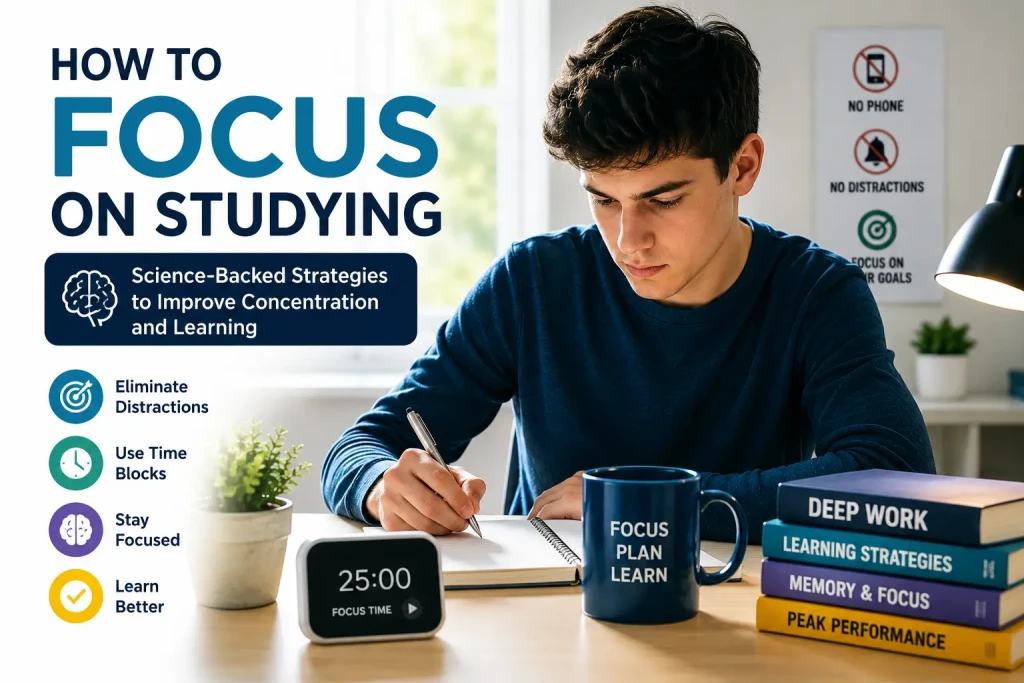
- Remove distractions.
- Use structured notes.
- Review concepts in logical order.
Reducing cognitive load allows more mental resources to be allocated toward learning and memory formation.
Readers interested in this topic can explore Cognitive Load Theory.
Method #6: Build Strong Memory Connections
Memory improves when new information connects to existing knowledge.
Instead of memorizing isolated facts, effective learners actively create meaningful associations.
Examples include:
- Relating new concepts to personal experiences.
- Using analogies and comparisons.
- Creating visual images.
- Connecting ideas across different subjects.
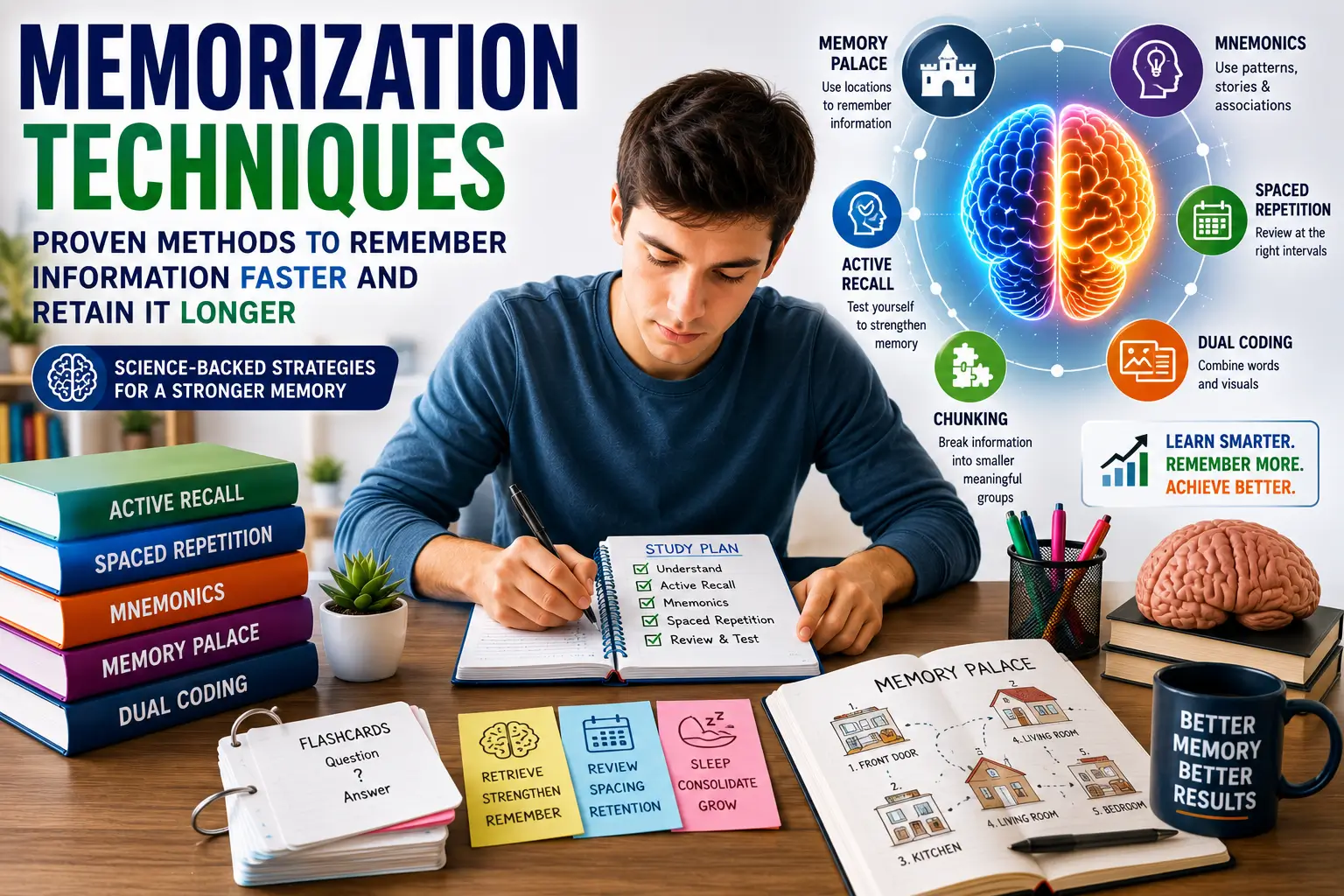
- Using mnemonic techniques.
The more connections a memory has, the easier it becomes to retrieve later.
This principle is supported by research on memory encoding and elaborative rehearsal.
For additional reading, see Elaborative Rehearsal and Memory Encoding.
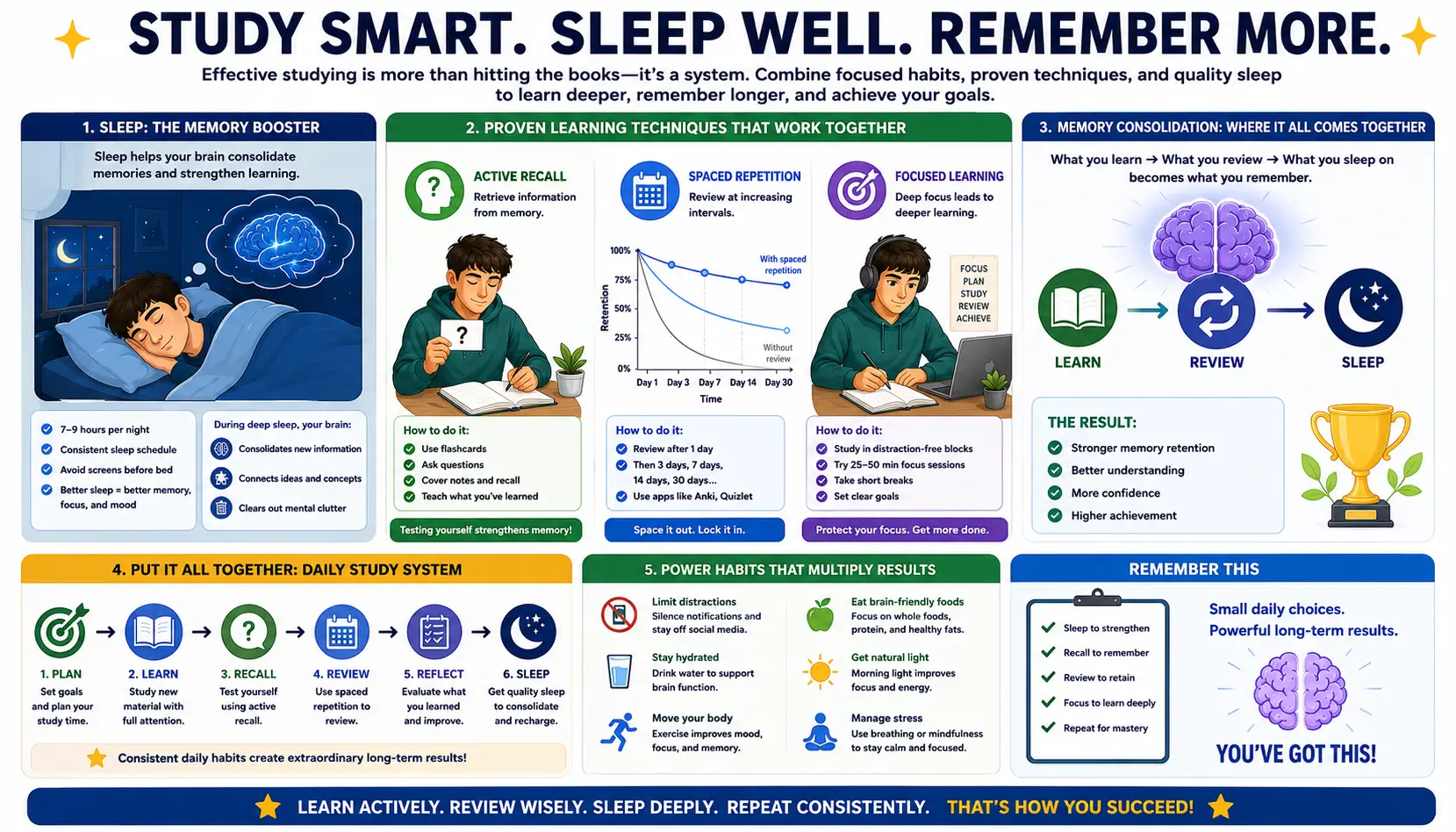
Method #7: Prioritize Sleep and Recovery
Studying effectively is not only about what happens while learning.
Much of memory formation occurs after studying ends.
During sleep, the brain consolidates newly learned information and transfers important memories into more stable long-term storage systems.
Insufficient sleep can impair:
- Attention
- Memory encoding
- Recall accuracy
- Learning efficiency
- Problem-solving ability
Consistent sleep habits are among the simplest and most effective ways to improve academic performance.
Research published by sleep and memory researchers has repeatedly shown that sleep plays a critical role in memory consolidation and long-term retention.
Creating an Effective Study System
To make that system sustainable week after week, use a structured plan like Study Schedule.
Rather than relying on a single technique, the most successful learners combine multiple evidence-based strategies.
A practical study system might look like this:
- Preview material before learning.
- Take organized notes.
- Use active recall after each session.
- Schedule spaced reviews.
- Interleave related topics.
- Monitor cognitive load.
- Prioritize consistent sleep.
When these methods work together, learning becomes faster, more efficient, and more durable.
Supporting Long-Term Academic Success
Because effective studying ultimately depends on stronger encoding, retention, and recall, this topic also connects closely with How to Improve Memory.
Effective studying is not about spending the most hours with books open.
It is about using learning strategies that align with how memory actually works.
By focusing on retrieval practice, spaced repetition, deep understanding, interleaving, and recovery, learners can dramatically improve retention while reducing wasted effort.
The science of learning consistently shows that better methods often matter more than more time.
Related Topics
- Active Recall: The Science-Backed Study Method for Long-Term Memory
- Spaced Repetition: The Proven System for Remembering More in Less Time
- Interleaving: The Study Technique That Improves Long-Term Learning
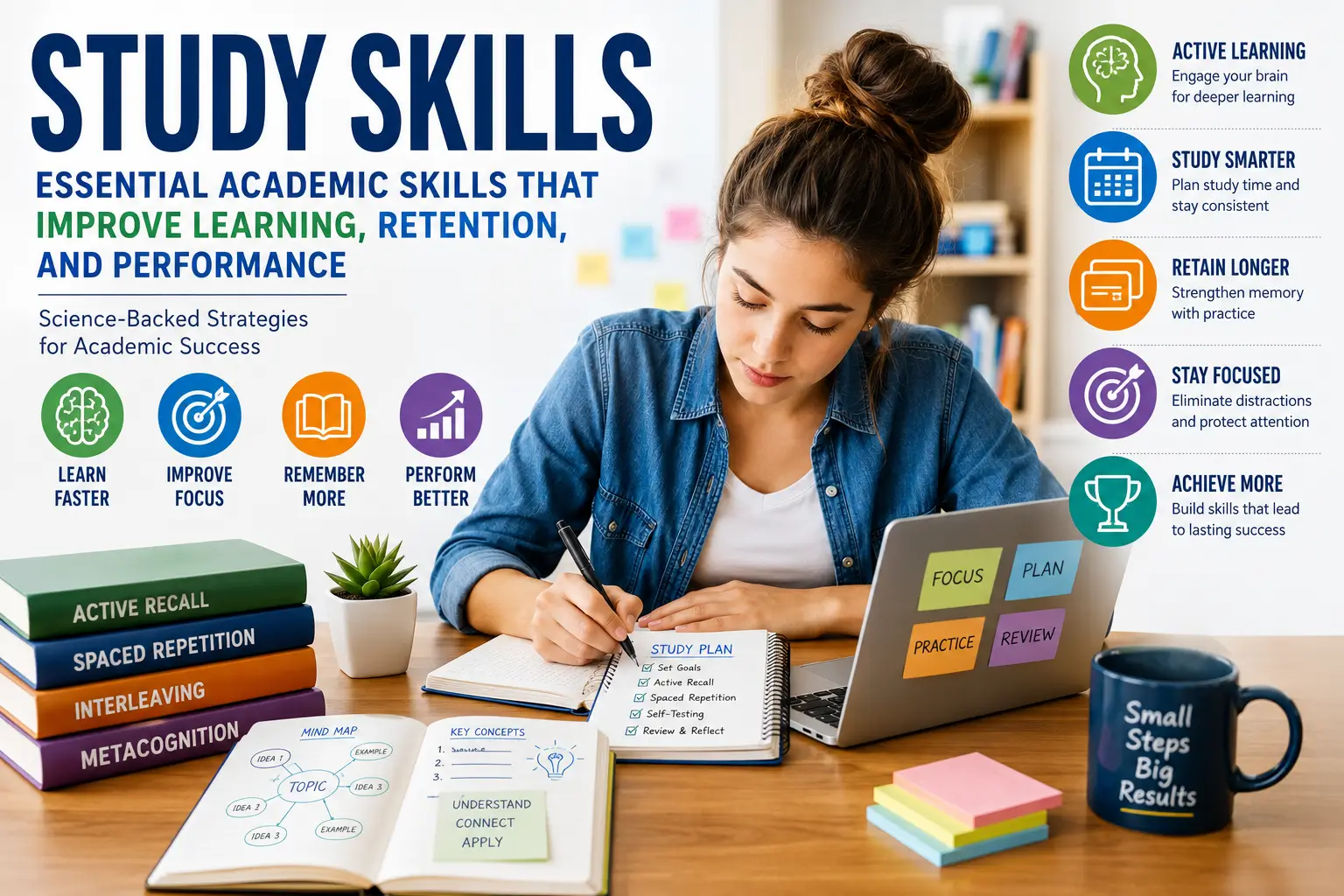
- Study Skills: Essential Academic Skills That Improve Learning, Retention, and Performance
Sources:
https://www.apa.org/education-career/k12/learning-science
https://www.learninghowtolearn.org
https://pmc.ncbi.nlm.nih.gov/articles/PMC5113738/