
Now Reading: Encoding Specificity Principle: The Psychology Behind Memory Retrieval and Recall
-
01
Encoding Specificity Principle: The Psychology Behind Memory Retrieval and Recall
Encoding Specificity Principle: The Psychology Behind Memory Retrieval and Recall
Have you ever noticed that a piece of information suddenly becomes easier to remember when you return to the place where you first learned it?
Perhaps a familiar smell brings back a forgotten childhood memory.
Maybe hearing a specific song instantly reminds you of a particular event from years ago.
These experiences reflect one of the most important concepts in cognitive psychology: the Encoding Specificity Principle.
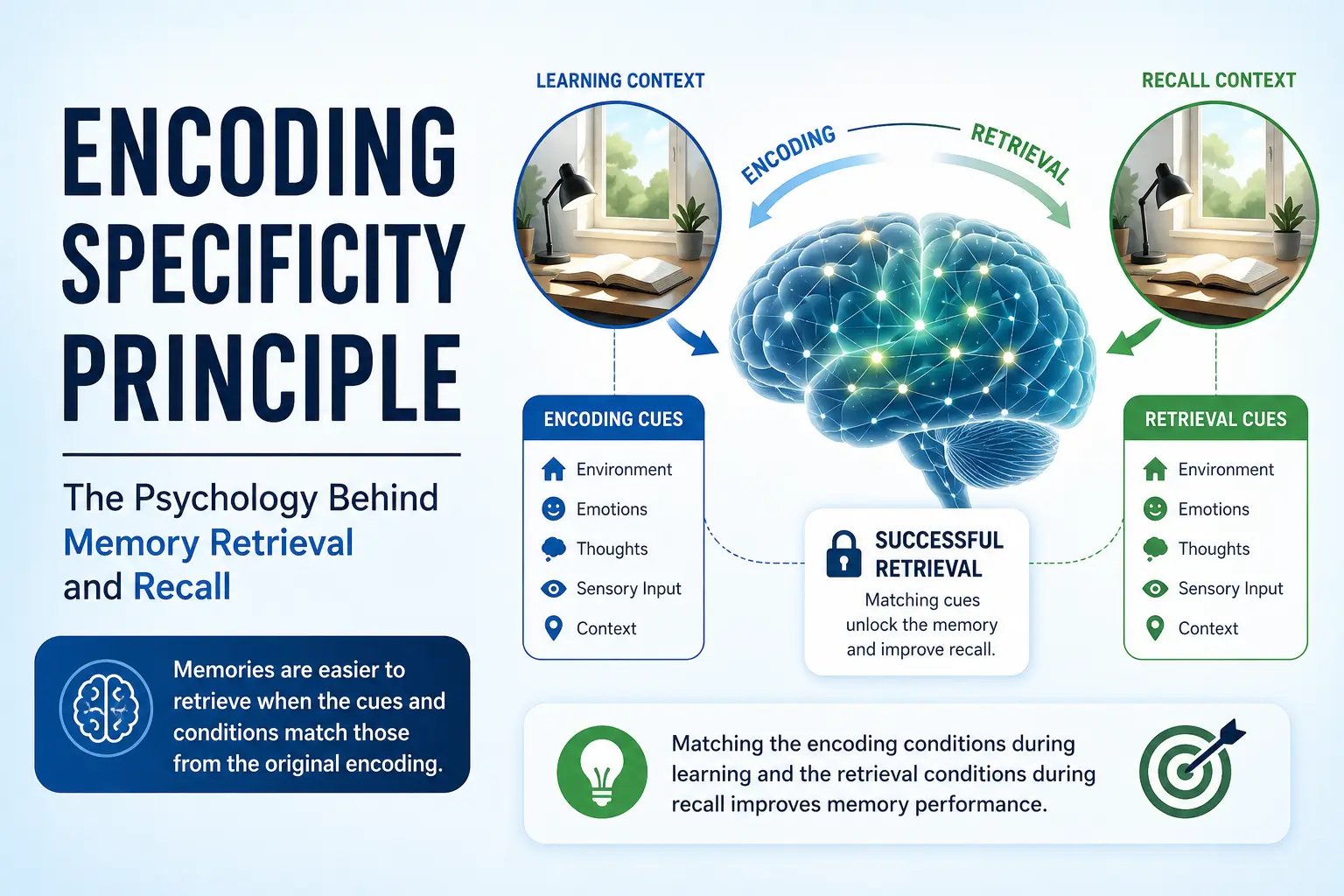
First proposed by psychologist Endel Tulving, the encoding specificity principle suggests that memory retrieval becomes more effective when the conditions present during recall resemble the conditions that existed when the memory was originally formed.
In simple terms, memories are often easier to access when the retrieval cues available at recall match the cues available during learning.
This principle helps explain why retrieval failure can occur in one situation, while the same information suddenly becomes accessible in another.
It also provides valuable insights for students, professionals, and anyone interested in improving memory performance.
What Is the Encoding Specificity Principle?
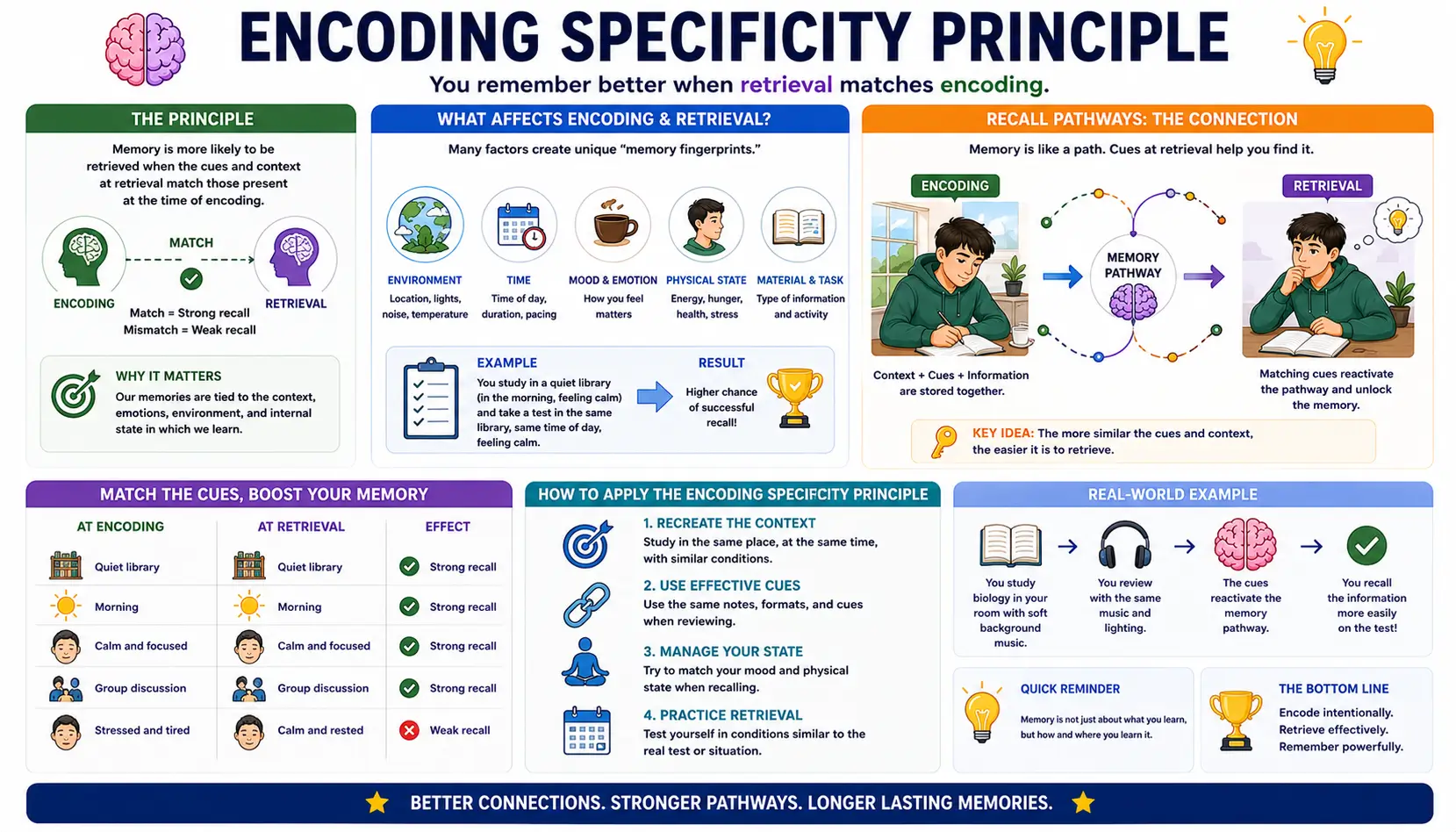
The encoding specificity principle states that information stored in memory becomes linked to the environmental, emotional, cognitive, and contextual cues present during learning.
When those same cues are available later, memory retrieval becomes more efficient.
The theory emerged from decades of research into how memories are encoded and retrieved.
Researchers discovered that successful recall is not determined solely by how strongly information is learned.
The availability of relevant retrieval cues also plays a major role.
For example, if a student studies in a quiet library and takes an exam in a similar quiet environment, retrieval may be easier than if the testing environment is noisy and distracting.
The memory itself contains information about both the content being learned and the context in which it was learned.
This concept closely relates to Context-Dependent Memory, which demonstrates how environmental cues influence recall.
How Memory Encoding Creates Retrieval Paths
Memory formation is not simply a process of storing isolated facts.
During learning, the brain records numerous details surrounding an experience.
- Location
- Sounds
- Smells
- Emotional state
- Thought patterns
- Environmental context
- Associated information
These elements become part of the memory trace.
Later, any of these cues may help activate the stored information.
This process works through mechanisms discussed in Memory Encoding, where information becomes transformed into a lasting memory representation.
The more meaningful associations attached to a memory, the greater the number of potential retrieval routes available later.
This is one reason why deeper learning often produces stronger recall.


Classic Research Supporting the Theory
One of the most influential studies investigating encoding specificity was conducted by Endel Tulving and Donald Thomson in the 1970s.
Participants learned lists of words under specific cue conditions.
Researchers later tested recall using different cues.
Interestingly, cues that seemed weaker often produced better recall when they matched the original learning context.
The findings challenged earlier assumptions that stronger semantic relationships always create better retrieval.
Instead, the results showed that matching the original encoding conditions can be more important than cue strength alone.
This discovery significantly advanced understanding of memory retrieval processes and remains a cornerstone of modern cognitive psychology.
Researchers continue to observe similar effects across educational, clinical, and neuroscience settings.
Encoding Specificity vs Context-Dependent Memory
The two concepts are closely related but not identical.
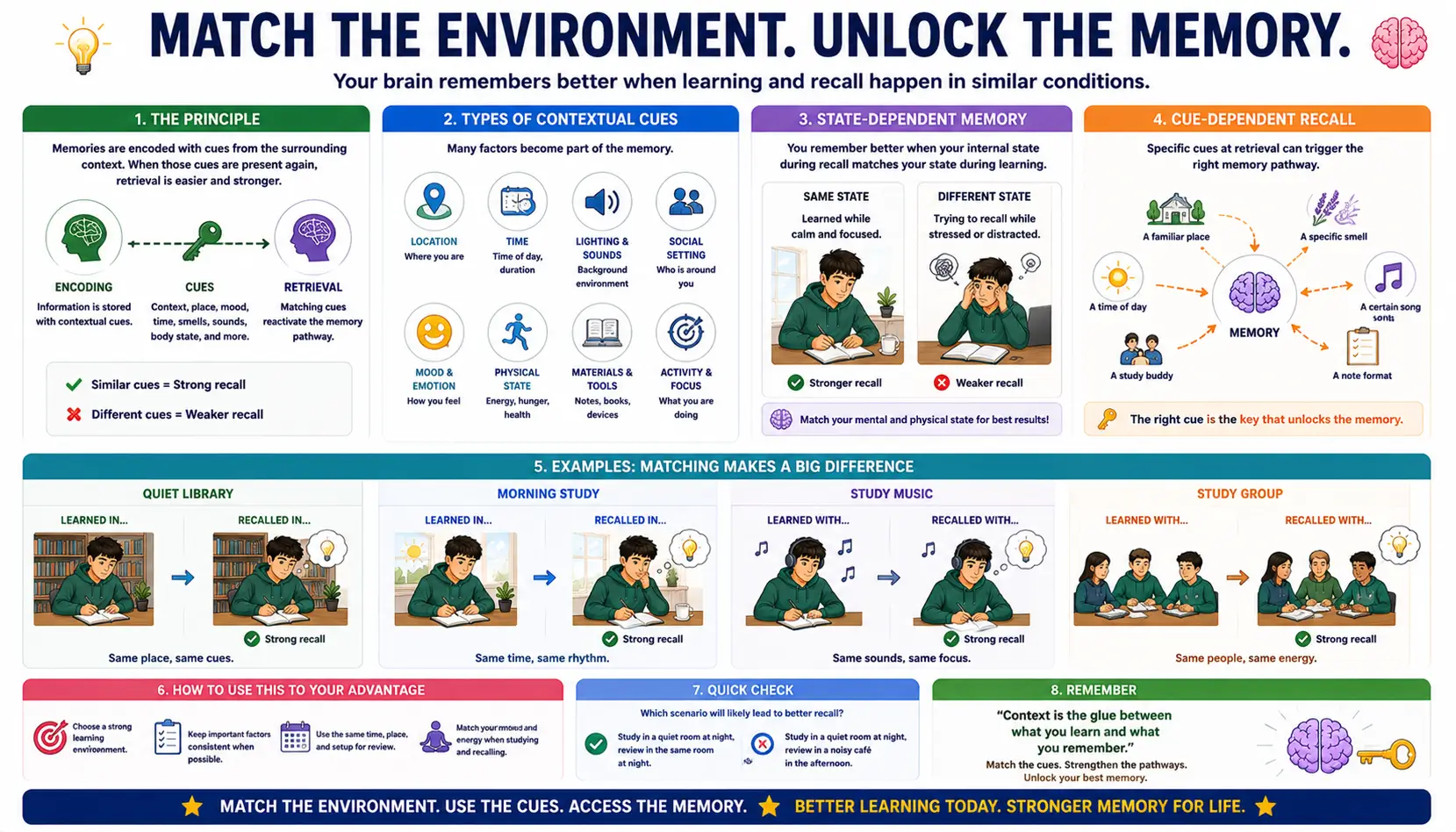
Context-dependent memory focuses specifically on environmental factors such as location and surroundings.
The encoding specificity principle is broader.
It includes all forms of information present during encoding.
- Physical environment
- Emotional state
- Mental state
- Associated concepts
- Sensory information
- Internal physiological conditions
In this sense, context-dependent memory can be viewed as one application of encoding specificity.
Similarly, State-Dependent Memory represents another specialized example where internal conditions influence recall.
Why Retrieval Cues Matter So Much
To see how cue-dependent remembering works in practice, explore retrieval cues and how they help stored information become accessible again.
Many people assume forgetting means information has disappeared from memory.
In reality, retrieval failure often occurs because the necessary cues are unavailable.
Memories may remain stored yet temporarily inaccessible.
This distinction has important implications for learning and memory improvement.
Effective recall frequently depends on identifying the right cue rather than strengthening storage itself.
Research on Memory Retrieval demonstrates that cue availability often determines whether information can be successfully accessed.
For example, remembering someone’s name may become difficult until another detail about that person suddenly triggers recall.
The memory was present all along, but the correct retrieval cue was missing.
Encoding Specificity in Education
Students can use this principle to improve academic performance.
One effective strategy involves recreating learning conditions during review sessions.
Another involves generating multiple retrieval cues during initial learning.
Helpful approaches include:
- Studying concepts in multiple contexts
- Using visual and verbal associations
- Creating personal examples
- Connecting new information to existing knowledge
- Practicing retrieval under different conditions
These methods increase the number of potential retrieval pathways available during exams.
Techniques such as Elaborative Rehearsal work particularly well because they create numerous meaningful connections during encoding.
Encoding Specificity in Everyday Life
The effects of encoding specificity extend far beyond classrooms and laboratories.
People encounter these memory processes every day without realizing it.
A familiar perfume may instantly trigger memories of a specific person.
Returning to a childhood home can reactivate memories that seemed forgotten.
A song heard years ago may suddenly bring back vivid details from a particular period of life.
These experiences occur because sensory and contextual cues become linked to stored information during encoding.
When those cues reappear, retrieval becomes easier.
This process also helps explain why autobiographical memories often feel highly vivid and emotionally rich.
Researchers studying Episodic Memory have found that contextual information plays a major role in reconstructing personal experiences.
Can Encoding Specificity Improve Long-Term Learning?
For a broader map of how encoding, storage, retrieval, and forgetting fit together, visit the Complete Guide to Memory.
Yes.
One of the most practical applications of encoding specificity involves deliberately creating multiple retrieval cues during learning.
When information is connected to various contexts, concepts, and experiences, recall becomes more flexible.
Instead of depending on a single cue, the brain gains multiple access points to the same memory.
Research suggests that learners who build richer associations often experience stronger retention and improved recall performance over time.
This is one reason techniques such as Active Recall and Retrieval Practice are so effective.
Each retrieval attempt strengthens access pathways while creating additional cues that support future recall.
Over time, memories become easier to access across a wider range of situations.
Practical Strategies Based on Encoding Specificity
You do not need a laboratory to benefit from this principle.
Several evidence-based learning techniques naturally leverage encoding specificity.
1. Create Multiple Associations
Connect new information to personal experiences, existing knowledge, images, stories, and examples.
The more connections created during encoding, the more retrieval routes become available later.
2. Use Active Recall Frequently
Rather than repeatedly reviewing notes, test yourself regularly.
Retrieval itself strengthens cue-dependent access to information.
3. Study in Different Environments
Learning in multiple locations prevents memories from becoming overly dependent on a single context.
This often improves transfer and flexibility during real-world recall situations.
4. Simulate Testing Conditions
Practicing under conditions similar to future exams may improve retrieval success.
Many students benefit from recreating exam environments during review sessions.
5. Link Information Together
Organizing information into meaningful structures creates additional retrieval cues.
Methods such as Chunking and Mnemonics work partly because they expand retrieval pathways.

Why the Encoding Specificity Principle Remains Important
Modern neuroscience continues to support the idea that successful remembering depends on both storage and retrieval.
Learning is not simply about placing information into memory.
It is also about creating effective routes back to that information when it is needed.
The encoding specificity principle provides a framework for understanding why some memories seem effortless to access while others remain temporarily hidden.
By recognizing the importance of retrieval cues, learners can design study strategies that improve recall, retention, and long-term knowledge transfer.
Whether you are preparing for exams, learning professional skills, or simply trying to remember important information, understanding how encoding and retrieval interact can make memory far more reliable.