
Now Reading: The Testing Effect: Why Self-Testing Beats Re-Reading for Memory Retention
-
01
The Testing Effect: Why Self-Testing Beats Re-Reading for Memory Retention
The Testing Effect: Why Self-Testing Beats Re-Reading for Memory Retention
Most people think tests are only used to measure what you know.
You study first, take the test later, and then the score tells you how well you learned the material.
But learning science shows something more interesting: testing does not only measure memory. It can also strengthen memory.
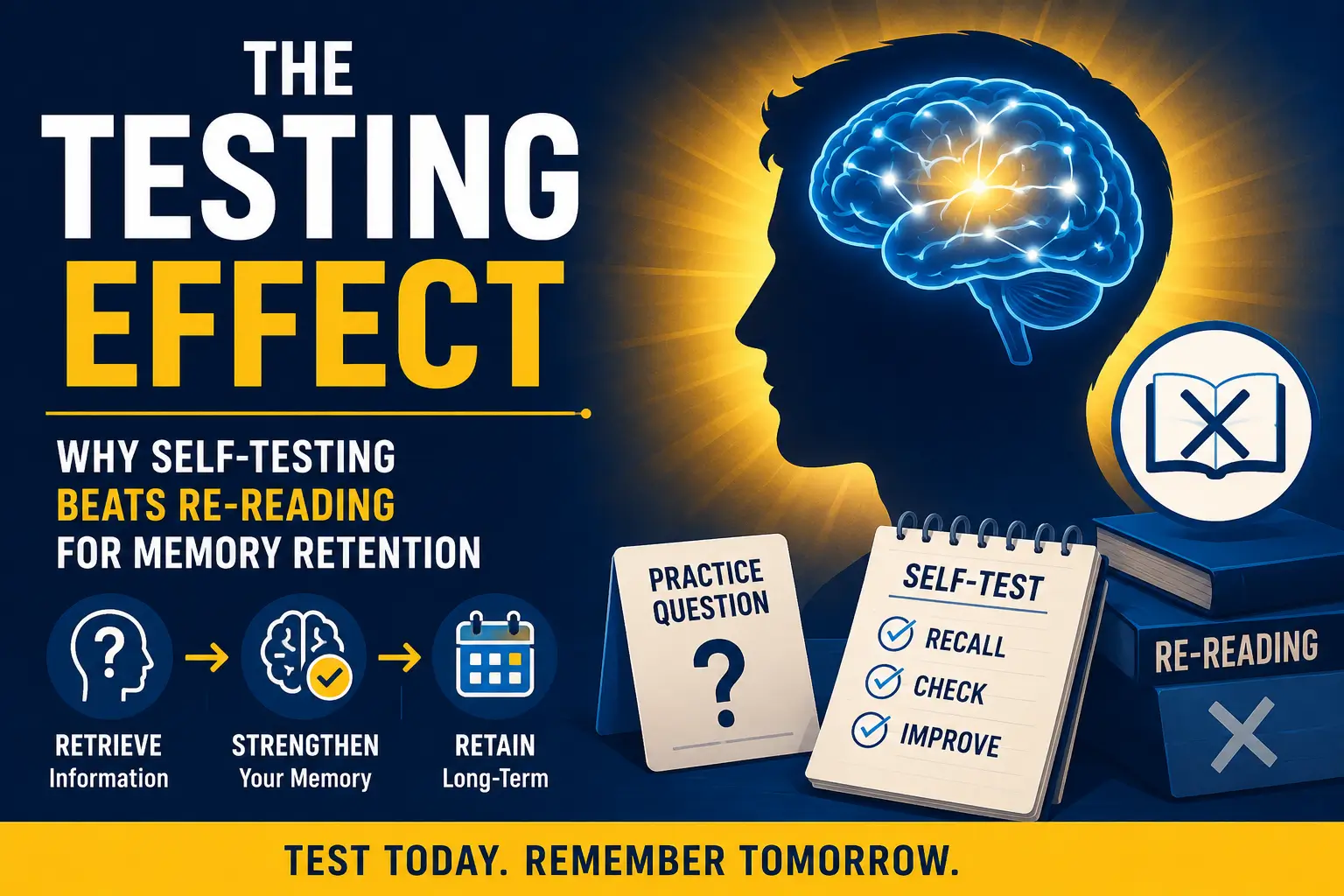
This is known as the testing effect.
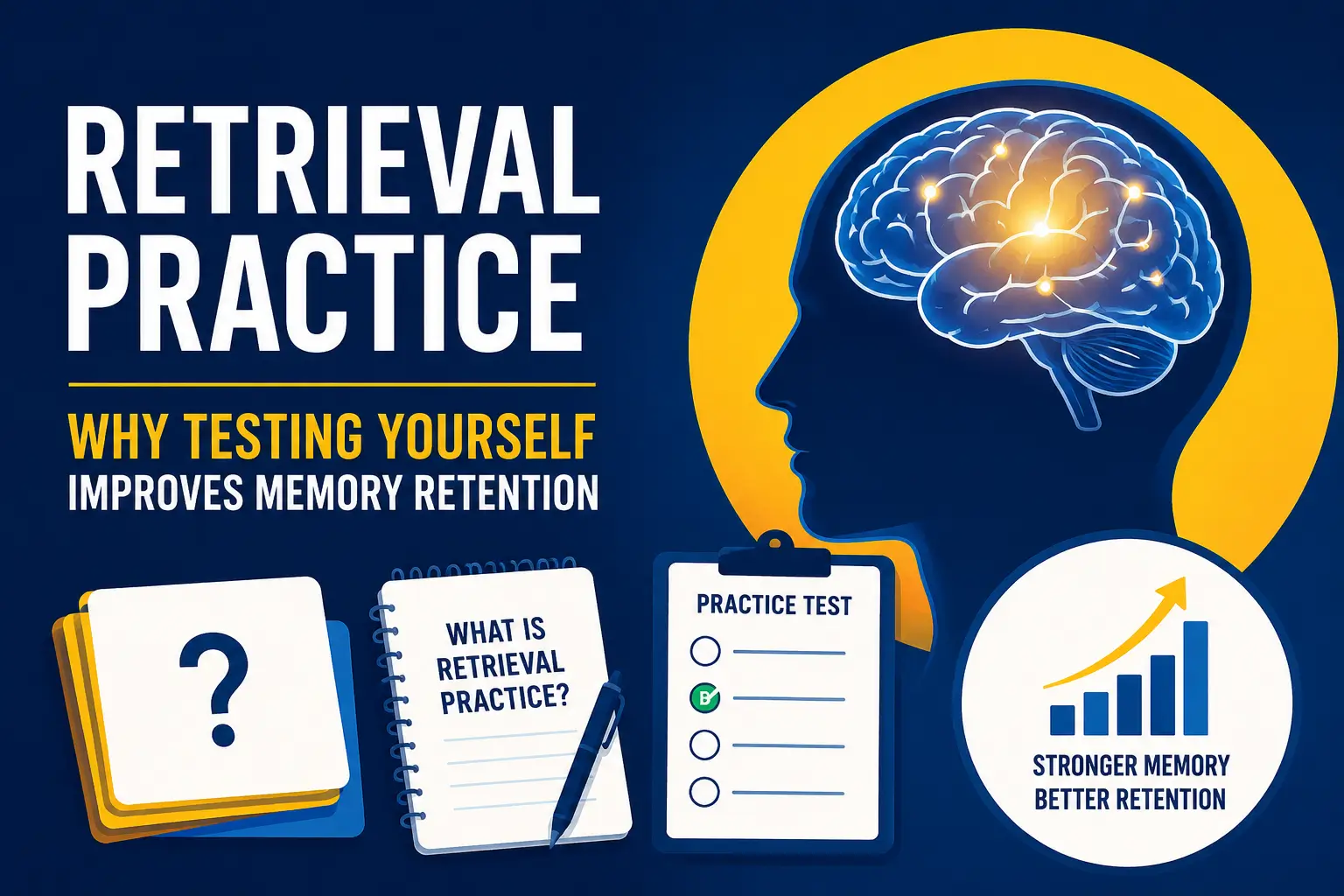
The testing effect explains why students who regularly quiz themselves often remember more than students who spend the same amount of time rereading notes. It also explains why Active Recall and Retrieval Practice are so powerful for long-term learning.
If you want to remember information longer, self-testing should not be something you do only at the end of studying. It should become part of the learning process itself.
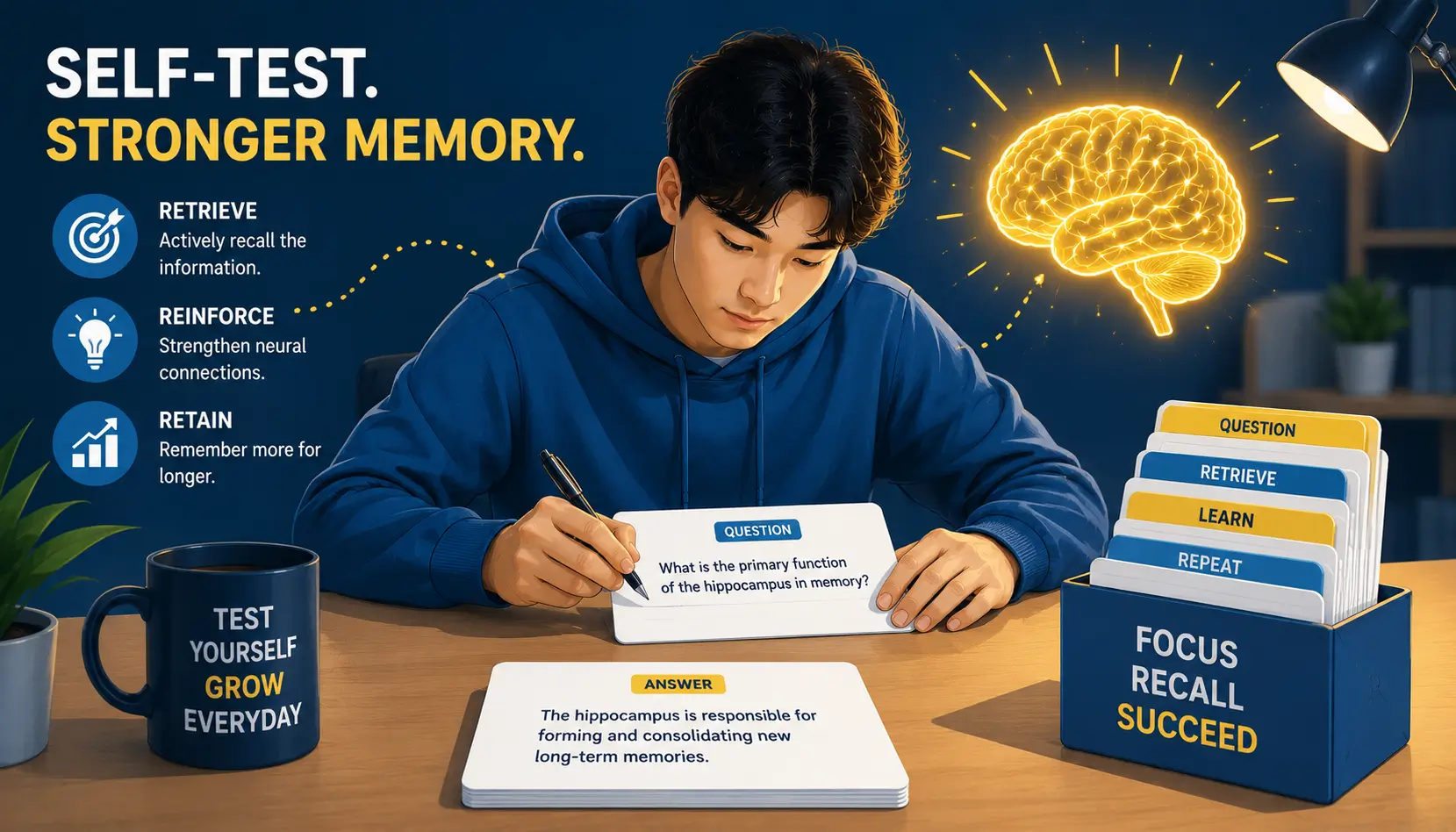
What Is the Testing Effect?
The testing effect is the finding that retrieving information through tests or quizzes improves long-term retention more effectively than simply reviewing the same material again.
In simple terms:
Trying to remember information makes that information easier to remember later.
This does not mean every test must be formal, stressful, or graded. The testing effect can happen through simple low-pressure activities such as flashcards, practice questions, blank-page summaries, mock exams, or explaining an answer out loud before checking your notes.
The important part is retrieval.
You must attempt to pull the answer from memory before seeing it again.
Why Re-Reading Feels Better Than It Works
Rereading feels smooth. You look at familiar notes, recognize the words, and feel like the material is becoming easier.
That feeling can be misleading.
Recognition is not the same as recall.
When you reread, the answer is already in front of you. Your brain does not have to search very hard. But in an exam, presentation, interview, or real conversation, you usually need to retrieve information without seeing the answer first.
This is where self-testing becomes more realistic.
Self-testing asks the same question real life asks:
Can you produce the information when it is not visible?
🔬 What Research Says About the Testing Effect
The testing effect has been studied for decades, but one of the most widely cited studies is by Henry Roediger and Jeffrey Karpicke. Their research found that taking memory tests can improve long-term retention, even when compared with additional studying.
Source: https://pubmed.ncbi.nlm.nih.gov/16507066/
A major review of learning techniques also identified practice testing as one of the most useful evidence-based strategies for improving student learning.
Source: https://pubmed.ncbi.nlm.nih.gov/26173288/
The takeaway is clear: tests are not just evaluation tools. Used correctly, they are learning tools.
How Self-Testing Strengthens Memory
Self-testing works because it repeatedly activates recall memory, the process of retrieving stored information without being given the answer. Memory is strengthened when your brain successfully retrieves information.
Each retrieval attempt activates the mental pathway connected to that information. If you successfully remember the answer, that pathway becomes easier to use again. If you fail, the mistake shows you exactly where your knowledge is weak.
This is why self-testing is useful even when you get answers wrong.
A wrong answer is not wasted effort. It is feedback.
When you correct the mistake, the contrast between what you thought and what is true can make the correct information more memorable.
The Testing Effect vs Active Recall
The testing effect is closely connected to active recall, because both approaches strengthen memory by forcing the brain to retrieve information instead of simply reviewing it. The testing effect and active recall are closely related, but they are not exactly the same.
Active Recall is the broad method of pulling information from memory.
The testing effect is the scientific result showing that testing yourself improves future retention.
So active recall is the practice.
The testing effect is one of the reasons the practice works.
This is also why Retrieval Practice is often discussed alongside the testing effect. All three ideas belong to the same learning family.
Good Tests Are Not Always High-Pressure Tests
When many people hear the word “test,” they think of stress, grades, deadlines, and performance anxiety.
But the testing effect does not require that kind of pressure.
In fact, low-stakes testing is often ideal for learning.
Examples include:
- Answering five questions after reading a chapter
- Using flashcards for key terms
- Writing a short summary from memory
- Taking a practice quiz with no grade
- Explaining a concept before checking your notes
The goal is not to punish mistakes.
The goal is to create retrieval.
How to Use the Testing Effect While Studying
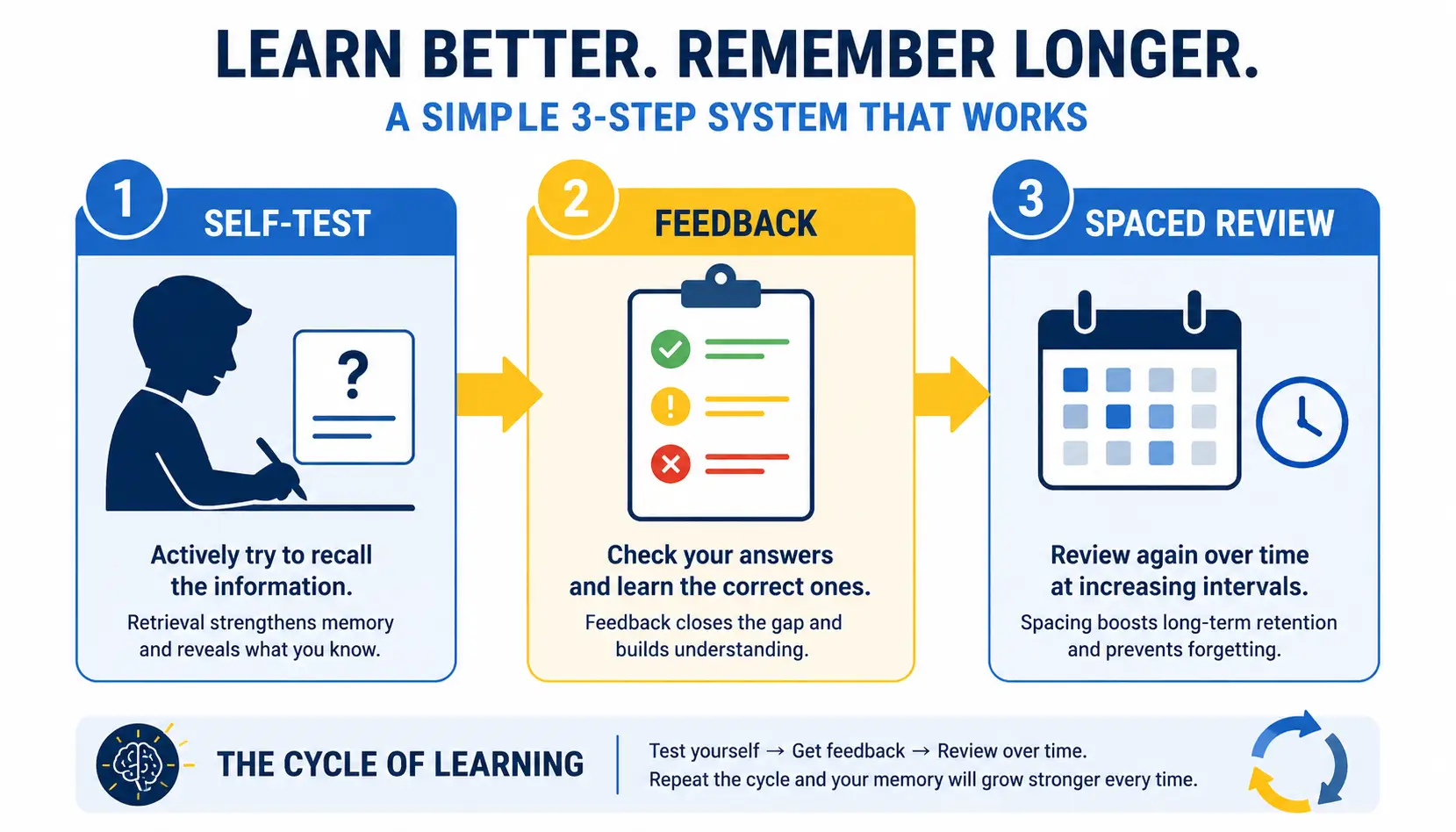
You can apply the testing effect with a simple study routine:
- Read or watch a small section of material.
- Close the source.
- Ask yourself questions about what you just learned.
- Answer without looking.
- Check the correct answer.
- Mark what you missed.
- Return to those weak areas later.
This turns studying into a feedback loop.
Instead of guessing whether you know the material, you test whether you can retrieve it.
Flashcards and the Testing Effect
Flashcards are one of the easiest ways to use the testing effect.
But not all flashcards are equally effective.
A weak flashcard only encourages recognition. A strong flashcard forces recall.
For example, this is weak:
“Active recall is a method where you ______ information from memory.”
This is stronger:
“What is active recall, and why does it improve memory?”
The second version requires a real answer.
For digital learning, Anki Flashcards can be especially powerful because they combine self-testing with review scheduling.
Why Feedback Matters
Testing yourself is powerful, but feedback makes it more useful.
If you answer incorrectly and never check the correct answer, you may strengthen confusion. That is why the best self-testing systems include immediate or delayed feedback.
After each test, ask:
- What did I remember correctly?
- What did I miss?
- Why did I miss it?
- When should I test this again?
The final question connects the testing effect with Spaced Repetition.
Testing tells you what needs review. Spacing tells you when to review it.
Testing Effect and Spaced Repetition
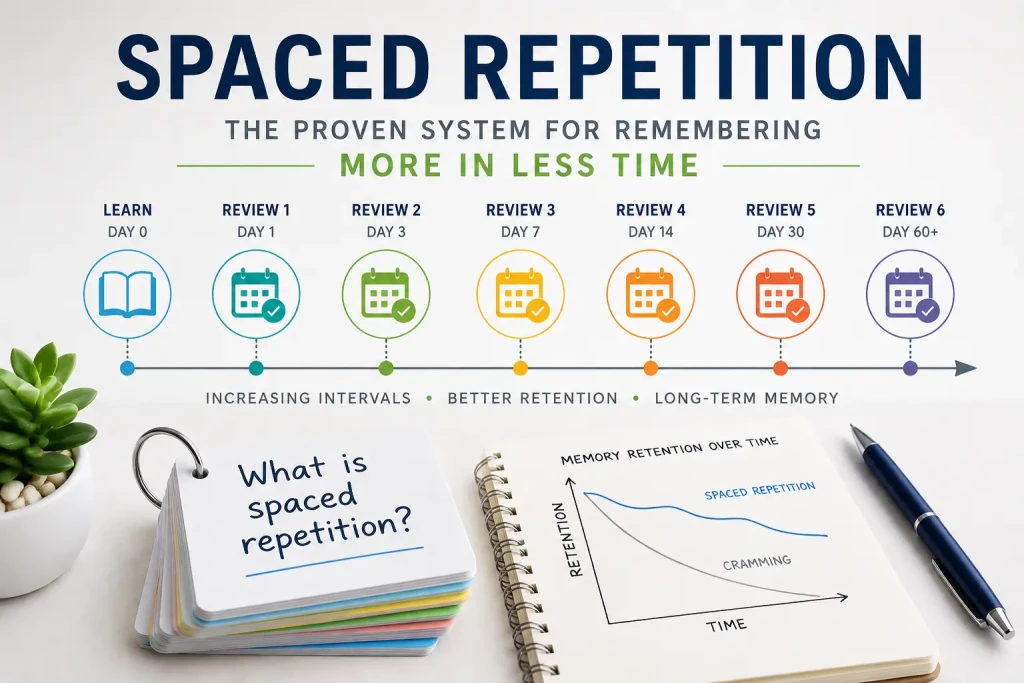
The testing effect becomes even stronger when reviews are spaced over time.
If you test yourself once, you strengthen memory.
If you test yourself repeatedly at well-timed intervals, you build more durable retention.
This is why systems like the Leitner System remain useful. Easy cards move to less frequent review. Difficult cards return more often.
The same principle appears in modern digital tools, especially spaced repetition apps.
Together, testing and spacing help solve two problems:
- Testing improves retrieval strength.
- Spacing reduces forgetting over time.
Common Mistakes With Self-Testing
Checking the Answer Too Quickly
If you look at the answer immediately, you lose much of the benefit. Give your brain time to search before checking.
Only Testing Easy Material
Many learners prefer questions they already know. But growth usually comes from the questions that expose weakness.
Using Only Multiple-Choice Questions
Multiple-choice quizzes can be useful, but they often rely on recognition. Whenever possible, include open-ended questions that require true recall.
Testing Once and Moving On
One successful retrieval is helpful, but long-term learning usually requires repeated retrieval over time.
Where the Testing Effect Helps Most
The testing effect is useful whenever information needs to be remembered later.
That includes:
- School exams
- Professional certifications
- Language learning
- Medical or legal study
- Technical training
- Public speaking
- Book learning
The method is especially powerful when the final goal requires independent recall rather than simple recognition.
Memory Performance Is More Than Study Technique
Self-testing can dramatically improve learning, but memory performance also depends on broader cognitive health.
Sleep, stress, nutrition, movement, and attention all influence how well the brain stores and retrieves information.
For example, Sleep and Memory Consolidation plays a major role in stabilizing what you learn after study sessions.
Readers interested in supporting memory from a broader wellness angle can also explore Advanced Memory Formula, which provides more information about nutritional support for healthy memory and cognitive function.
A Better Way to Think About Tests
Tests do not have to be something you fear.
They can become one of your most useful learning tools.
Instead of waiting until the end of a study session to find out what you know, use testing throughout the process.
Ask questions early.
Make mistakes early.
Correct those mistakes early.
That is how self-testing turns uncertainty into stronger memory.