
Now Reading: Procedural Memory Explained: How the Brain Learns Skills and Habits
-
01
Procedural Memory Explained: How the Brain Learns Skills and Habits
Procedural Memory Explained: How the Brain Learns Skills and Habits
How do you ride a bicycle without consciously thinking about every movement?
How can experienced drivers operate a vehicle while holding a conversation?
Why does typing on a keyboard become automatic after years of practice?
These abilities rely on a powerful memory system known as procedural memory.
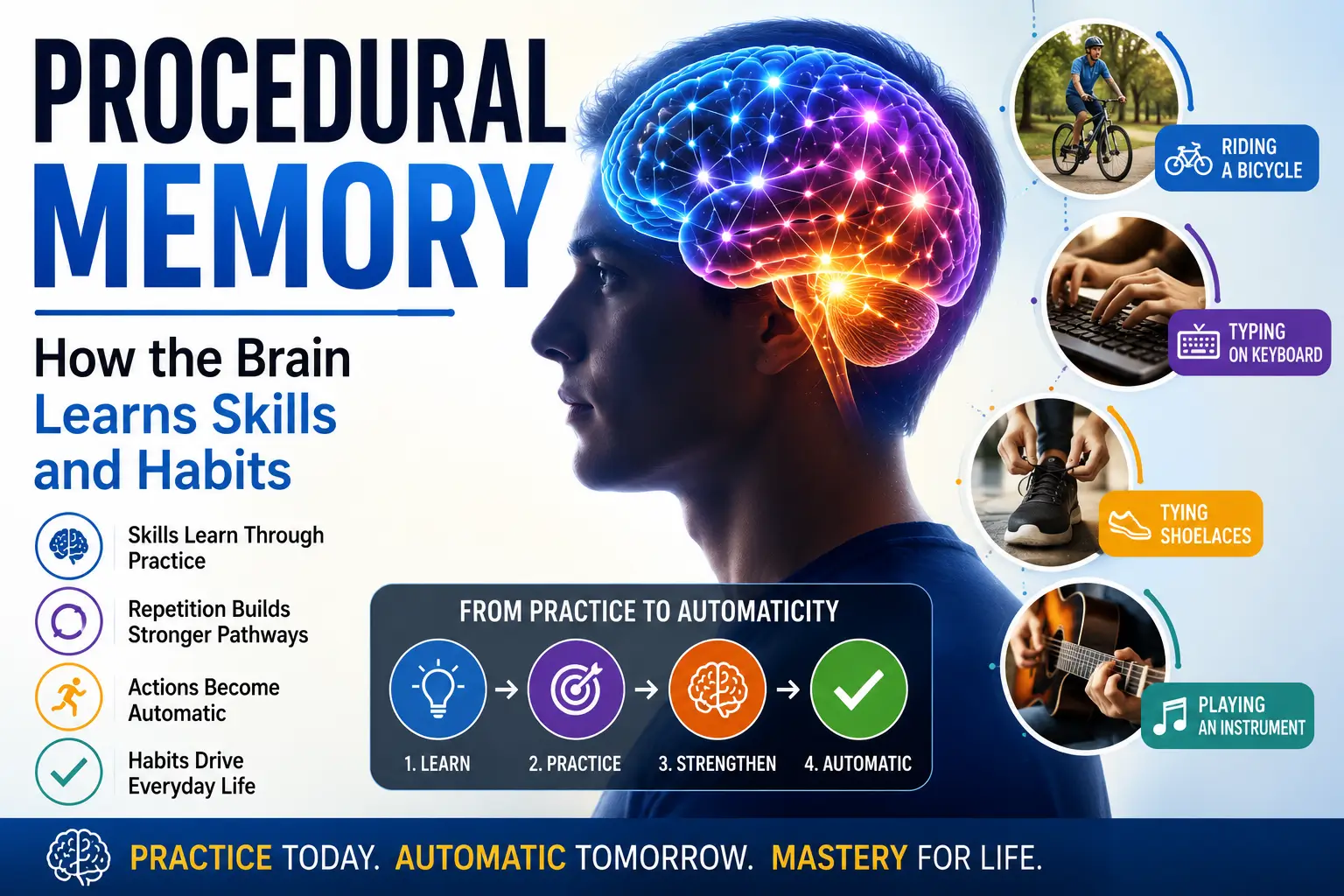
Procedural memory allows people to learn and perform skills without consciously recalling every step involved.
It is responsible for many of the habits, routines, and automatic behaviors that make daily life efficient.
Without procedural memory, even simple tasks would require enormous mental effort.
What Is Procedural Memory?
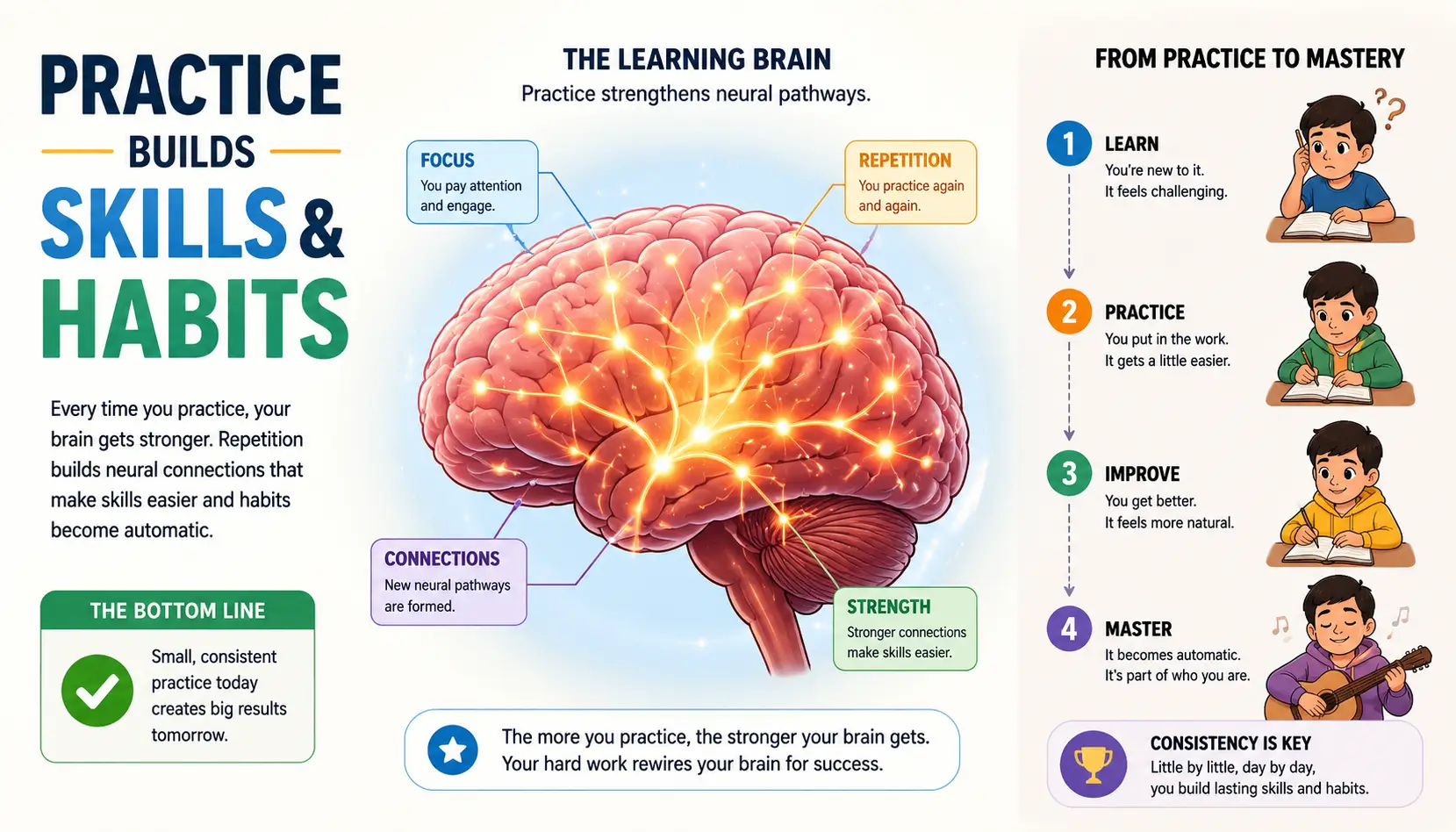
Procedural memory is a type of long-term memory responsible for storing skills, habits, and learned actions.
Unlike facts or personal experiences, procedural memories focus on how to do things.
These memories often operate automatically and require little conscious attention once they are well established.
Procedural memory is sometimes referred to as “skill memory.”
Examples of Procedural Memory
Procedural memory supports countless everyday activities.
- Riding a bicycle
- Driving a car
- Typing on a keyboard
- Tying shoelaces
- Playing a musical instrument
- Swimming
- Using common tools
Many of these activities initially require significant attention but eventually become automatic through practice.


Why Procedural Memory Matters
Procedural memory allows the brain to automate frequently performed actions.
Once a skill becomes automatic, fewer cognitive resources are required to perform it.
This frees attention for other tasks and improves efficiency.
Procedural memory helps people function effectively in complex environments.
🔬 The Science Behind Procedural Memory
Procedural memory is classified as a form of implicit memory.
Unlike explicit memory systems that involve conscious recall, procedural memories can often be demonstrated through performance rather than verbal explanation.
The basal ganglia and cerebellum play important roles in skill acquisition and habit formation.
Repeated practice strengthens neural pathways that support automatic performance.
Source: https://www.ncbi.nlm.nih.gov/books/NBK470173/
Procedural memory allows people to know how to perform a skill without consciously recalling instructions.
Procedural Memory vs Declarative Memory
For the consciously reportable side of learning, compare this system with declarative memory, which stores facts, knowledge, and personal experiences.
Procedural memory differs significantly from declarative memory systems.
Declarative memory involves facts and experiences that can be consciously described.
Procedural memory involves actions that are demonstrated rather than explained.
For example:
- Knowing the rules of cycling is declarative knowledge.
- Actually riding a bicycle is procedural memory.
Both systems contribute to learning, but they store different types of information.
How Procedural Memories Form
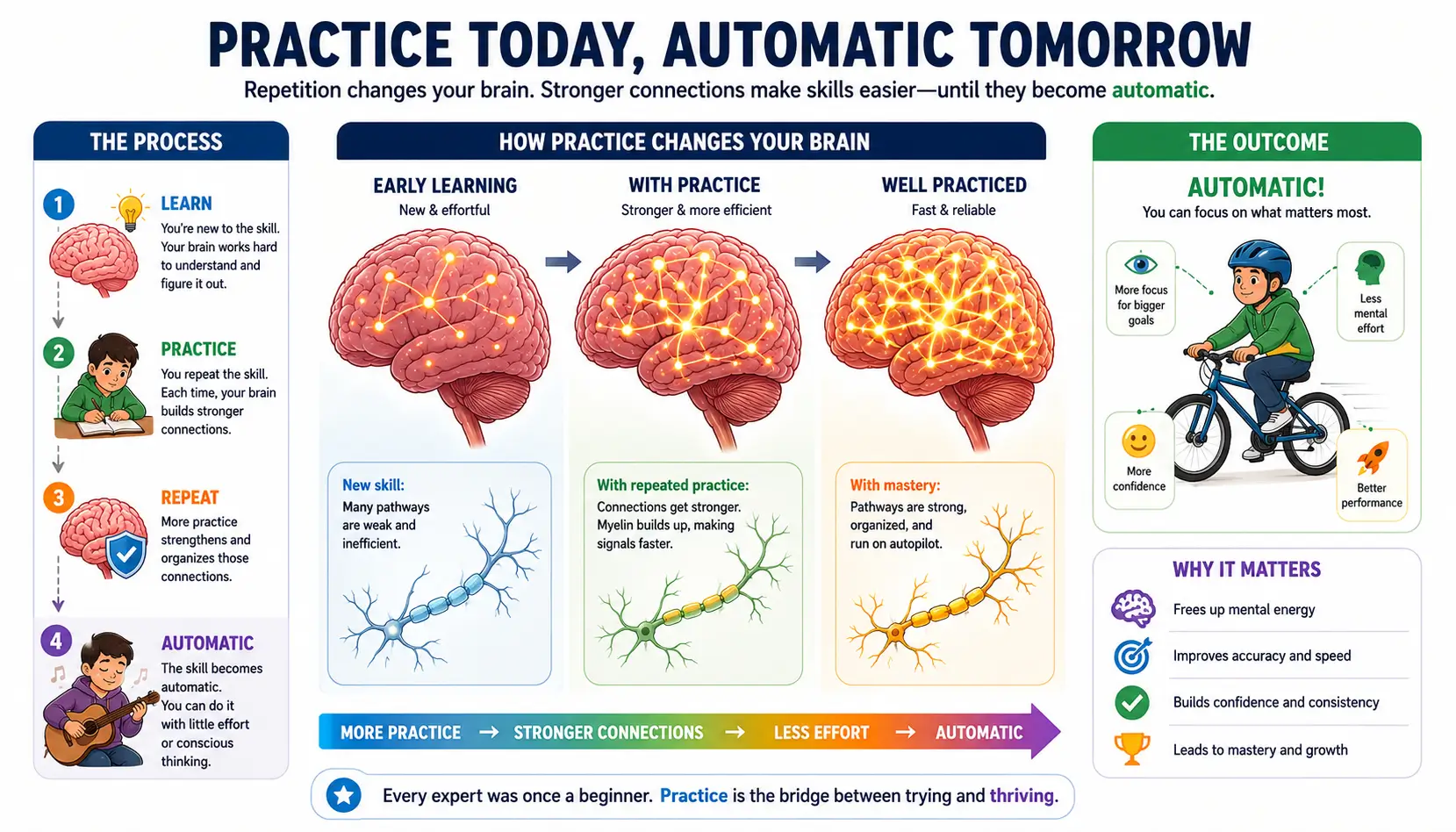
Procedural memories develop through repetition and practice.
During the early stages of learning, actions require conscious attention and effort.
With repeated performance, neural pathways become more efficient.
Eventually, the behavior can be executed with minimal conscious control.
This transition from effortful to automatic performance is one of the defining features of procedural learning.
The Role of Repetition
This pattern also fits the logic of distributed practice, where skills improve more reliably when training is spaced across multiple sessions.
Repetition is essential for procedural memory development.
Each practice session strengthens the neural circuits associated with a skill.
This is why athletes, musicians, and professionals often perform repetitive training exercises.
Consistent practice helps transform deliberate actions into automatic behaviors.
The brain becomes more efficient with every successful repetition.
Procedural Memory and Habit Formation
Because repeated routines gradually become automatic, this section also connects naturally to study habits and how effective behaviors are built over time.
Many habits rely on procedural memory.
Repeated behaviors gradually become automatic and require less conscious effort.
Examples include brushing your teeth, locking the door, or following a morning routine.
Procedural memory helps maintain consistency by reducing the need for active decision-making.
Habits are often procedural memories in action.
Procedural Memory and Skill Acquisition
Learning a new skill often follows a predictable pattern.
Initially, performance may be slow and error-prone.
Over time, practice improves speed, accuracy, and confidence.
Eventually, the skill becomes integrated into procedural memory.
This process explains why experts can perform complex tasks with remarkable efficiency.
Procedural Memory and Muscle Memory
The term “muscle memory” is often used to describe highly practiced skills.
In reality, muscles do not store memories.
Instead, the brain develops procedural memory pathways that allow movements to be performed efficiently and automatically.
These neural adaptations make complex actions feel natural after sufficient practice.
Procedural memory is the foundation behind what people commonly call muscle memory.
Automaticity: When Skills Become Effortless
One of the defining features of procedural memory is automaticity.
Automaticity occurs when a skill can be performed with little conscious attention.
Examples include:
- Typing without looking at the keyboard
- Driving familiar routes
- Playing practiced musical pieces
- Performing routine work tasks
Automaticity increases efficiency and reduces cognitive workload.
It allows attention to be directed toward higher-level tasks.
Procedural Memory and Sleep
Research suggests that sleep plays an important role in procedural memory consolidation.
After practice, the brain continues strengthening skill-related neural pathways during sleep.
This process contributes to improved performance over time.
Many studies have shown that adequate sleep supports learning and skill development.
Practice and recovery work together to build stronger procedural memories.
Learn more in Sleep and Memory Consolidation.
Procedural Memory vs Episodic Memory
Procedural memory differs significantly from Episodic Memory.
Episodic memory stores personal experiences.
Procedural memory stores learned skills.
For example:
- Remembering your first driving lesson is episodic memory.
- Knowing how to drive years later is procedural memory.
The two systems often work together during learning.
Procedural Memory vs Semantic Memory
Semantic Memory stores facts, concepts, and knowledge.
Procedural memory stores actions and skills.
A person may know the rules of chess through semantic memory while relying on procedural memory to execute familiar strategies efficiently.
Different memory systems contribute unique strengths to learning and performance.
How to Improve Procedural Memory
Procedural memory improves primarily through practice and repetition.
Several strategies can help accelerate skill development.
- Practice consistently
- Break complex skills into smaller components
- Use focused training sessions
- Allow adequate recovery and sleep
- Gradually increase difficulty
- Review mistakes and adjust performance
Deliberate practice often produces stronger results than mindless repetition.
Why Experts Perform Differently
Experts possess highly developed procedural memory systems.
Years of practice allow complex actions to be executed rapidly and accurately.
Because many aspects of performance become automatic, experts can devote more attention to strategy, creativity, and decision-making.
Procedural memory plays a major role in professional expertise.
Procedural Memory in Everyday Life
Although procedural memory is often discussed in sports and music, it influences countless daily activities.
Walking, cooking, driving, typing, and household routines all rely on procedural memory.
Many behaviors become so automatic that people rarely notice the memory systems supporting them.
Procedural memory quietly powers much of everyday life.
Procedural memory transforms repeated practice into automatic performance.
The Skill Learning System of the Brain
For the wider context connecting skill memory to other memory systems, see the complete guide to memory.
Procedural memory allows people to acquire, refine, and automate skills.
Through repetition, practice, and consolidation, complex actions become efficient and reliable.
This system enables humans to develop expertise across countless domains.
Whether learning to ride a bicycle or mastering a profession, procedural memory helps turn effort into ability.
Supporting Skill Development and Cognitive Performance
Procedural memory depends on effective practice, quality sleep, attention, and long-term brain health.
Many people combine evidence-based learning strategies with broader approaches that support cognitive performance and healthy aging.
Readers interested in memory-supportive nutritional strategies can learn more about Advanced Memory Formula.
Related Topics
- Working Memory Explained: The Brain System Behind Learning, Focus, and Recall
- Episodic Memory Explained: How Your Brain Stores Personal Experiences
- Semantic Memory Explained: How Your Brain Stores Facts, Concepts, and Knowledge
- Memory Consolidation Explained: How Your Brain Turns Learning Into Long-Term Memory