
Now Reading: Brain Exercises for Memory: Science-Backed Ways to Strengthen Recall and Cognitive Function
-
01
Brain Exercises for Memory: Science-Backed Ways to Strengthen Recall and Cognitive Function
Brain Exercises for Memory: Science-Backed Ways to Strengthen Recall and Cognitive Function
Many people assume memory is a fixed ability.
They believe some individuals are naturally gifted with excellent recall while others simply have poor memories.
Modern neuroscience suggests a different story.
Like physical fitness, memory can often be improved through training and consistent practice.
The brain changes in response to experience, repetition, and mental challenge.
This ability, known as neuroplasticity, allows neural networks to strengthen over time.
As a result, targeted brain exercises can help improve memory performance, increase mental flexibility, and support long-term cognitive health.
While no exercise can instantly transform memory overnight, research suggests that certain activities can significantly strengthen recall and learning ability when practiced consistently.
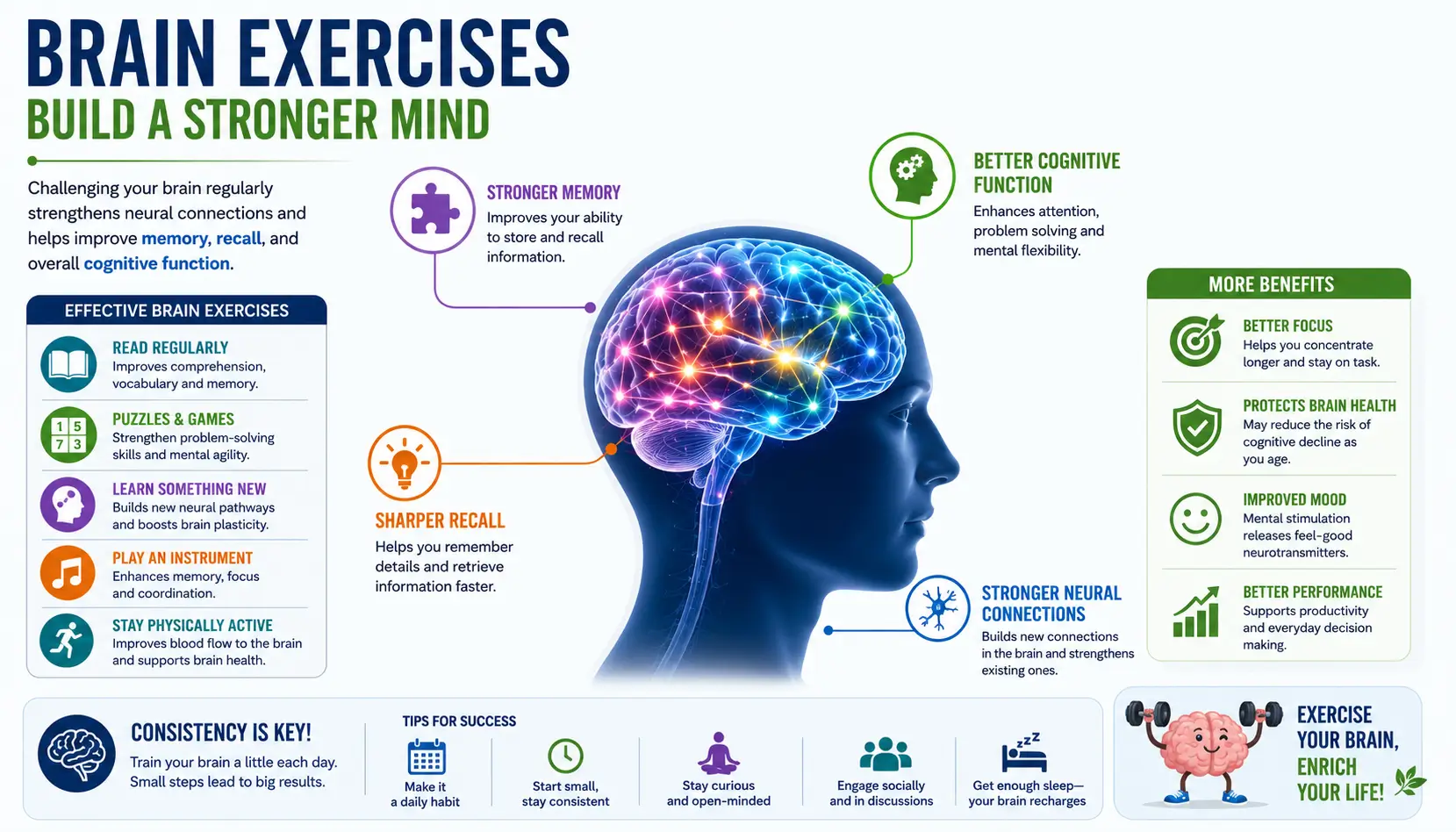
Can Memory Really Be Improved?
Scientists once believed the adult brain was largely fixed.
Research now shows the brain remains adaptable throughout life.
Neural pathways strengthen when they are used repeatedly.
New connections form when learners encounter challenges that require active thinking and problem solving.
This means memory performance is influenced not only by genetics but also by lifestyle, learning habits, and mental activity.
Brain exercises help stimulate these processes by encouraging attention, retrieval, processing, and cognitive flexibility.
How Brain Exercises Support Memory
Effective brain exercises typically engage several memory systems simultaneously.
They often require learners to:
- Retrieve information from memory
- Maintain attention during mentally demanding tasks
- Recognize patterns
- Solve problems
- Process information deeply
- Connect new information with existing knowledge
These activities strengthen the cognitive processes involved in learning and recall.


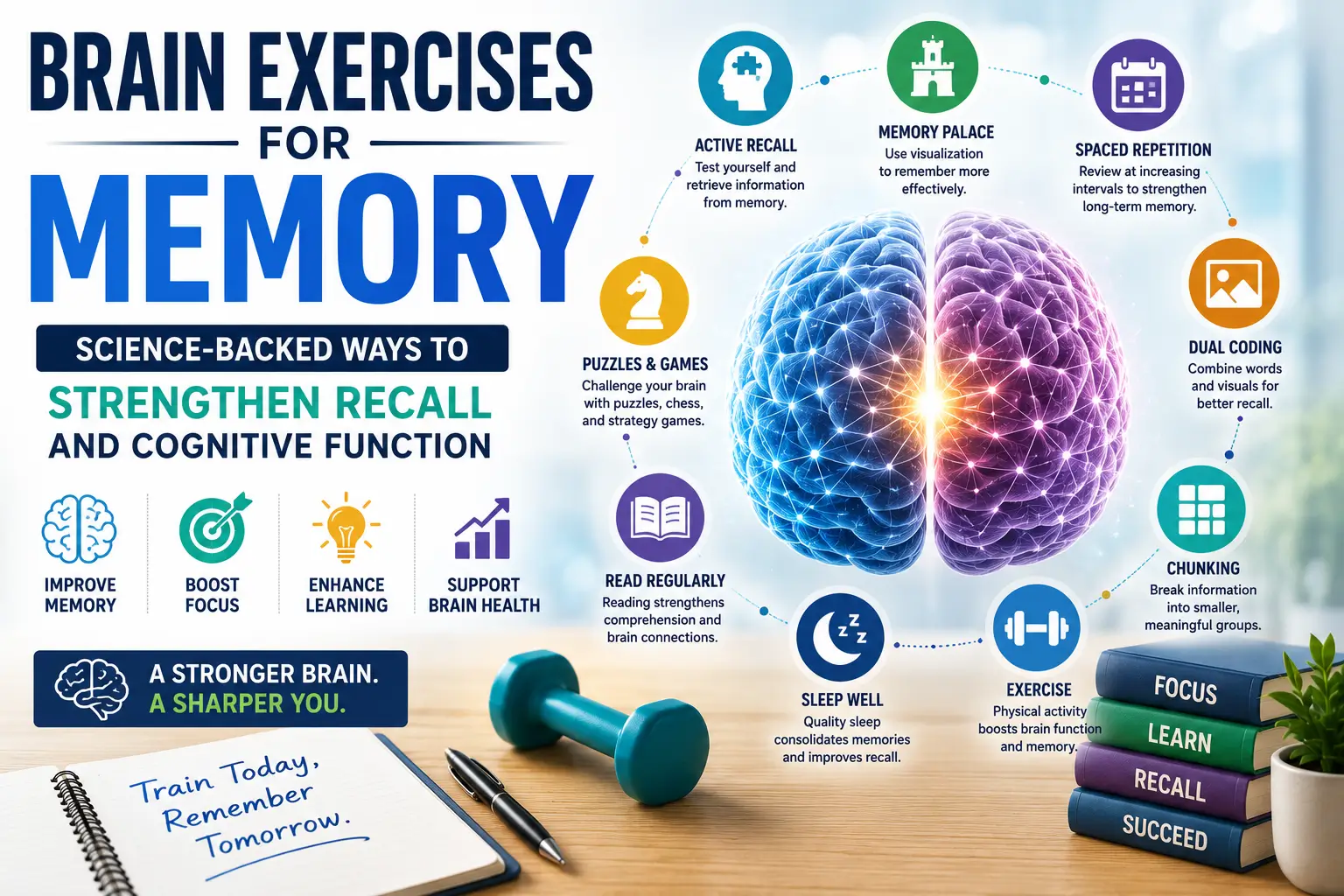
Exercise #1: Active Recall Practice
One of the most effective memory exercises is Active Recall.
Instead of reviewing information repeatedly, learners attempt to retrieve it without looking at notes.
Examples include:
- Answering questions from memory
- Summarizing lessons without references
- Teaching concepts aloud
- Using self-tests
Every successful retrieval strengthens neural pathways associated with recall.
Research consistently identifies retrieval-based learning as one of the most powerful memory-building activities available.
Exercise #2: Memory Palace Training
The Memory Palace Technique remains one of the most famous memory systems ever developed.
This method involves associating information with familiar locations inside an imagined environment.
The brain is exceptionally skilled at remembering places and visual imagery.
By linking information to mental locations, learners create stronger retrieval cues.
The technique has been used by memory competitors, students, and professionals for decades.
Exercise #3: Spaced Repetition Reviews
Spaced Repetition is both a study method and a powerful memory exercise.
Rather than reviewing information continuously, learners revisit material at gradually increasing intervals.
This process strengthens retention while reducing forgetting.
Repeated retrieval over time reinforces neural pathways more effectively than massed review sessions.
Many memory experts consider spaced repetition one of the most efficient tools for long-term knowledge retention.
Exercise #4: Dual Coding Activities
Dual Coding combines verbal and visual learning.
Learners create diagrams, mind maps, sketches, and visual representations alongside written information.
Using multiple processing channels creates additional retrieval pathways.
This makes information easier to understand and remember.
Dual coding is particularly useful when learning complex concepts.
Exercise #5: Chunking Information
Chunking helps the brain process information more efficiently.
Instead of memorizing isolated details, learners organize information into meaningful groups.
This reduces cognitive load and improves recall.
Phone numbers, language vocabulary, formulas, and historical dates are often easier to remember when grouped into logical units.
Chunking remains one of the simplest and most effective memory exercises available.
Exercise #6: Learning Something New
Novelty challenges the brain.
Learning a new skill, language, instrument, or hobby forces neural networks to adapt.
This mental stimulation supports neuroplasticity and cognitive flexibility.
Activities that require sustained learning often engage multiple brain systems simultaneously.
As a result, continuous learning may contribute to stronger long-term cognitive performance.
Exercise #7: Puzzles and Strategy Games
Mental challenges can provide valuable opportunities to exercise memory and cognitive skills.
Activities such as:
- Crossword puzzles
- Sudoku
- Chess
- Logic puzzles
- Strategy games
often require planning, pattern recognition, working memory, and problem-solving.
While puzzles alone are unlikely to dramatically increase intelligence, they can help maintain cognitive engagement and support mental flexibility.
The greatest benefits usually occur when these activities are combined with broader learning habits and healthy lifestyle practices.
Exercise #8: Reading for Memory Development
If reading is your main learning channel, see How to Remember What You Read for practical strategies that turn reading into stronger retention.
Reading is one of the most accessible brain exercises available.
When reading, the brain processes language, builds mental models, connects ideas, and stores new information.
These processes strengthen attention, comprehension, and memory systems.
Regular reading also expands knowledge networks, making it easier to connect and retrieve information in the future.
Both fiction and non-fiction reading can contribute to cognitive development when practiced consistently.
Research published by the National Institutes of Health has highlighted the important relationship between lifelong cognitive engagement and brain health.
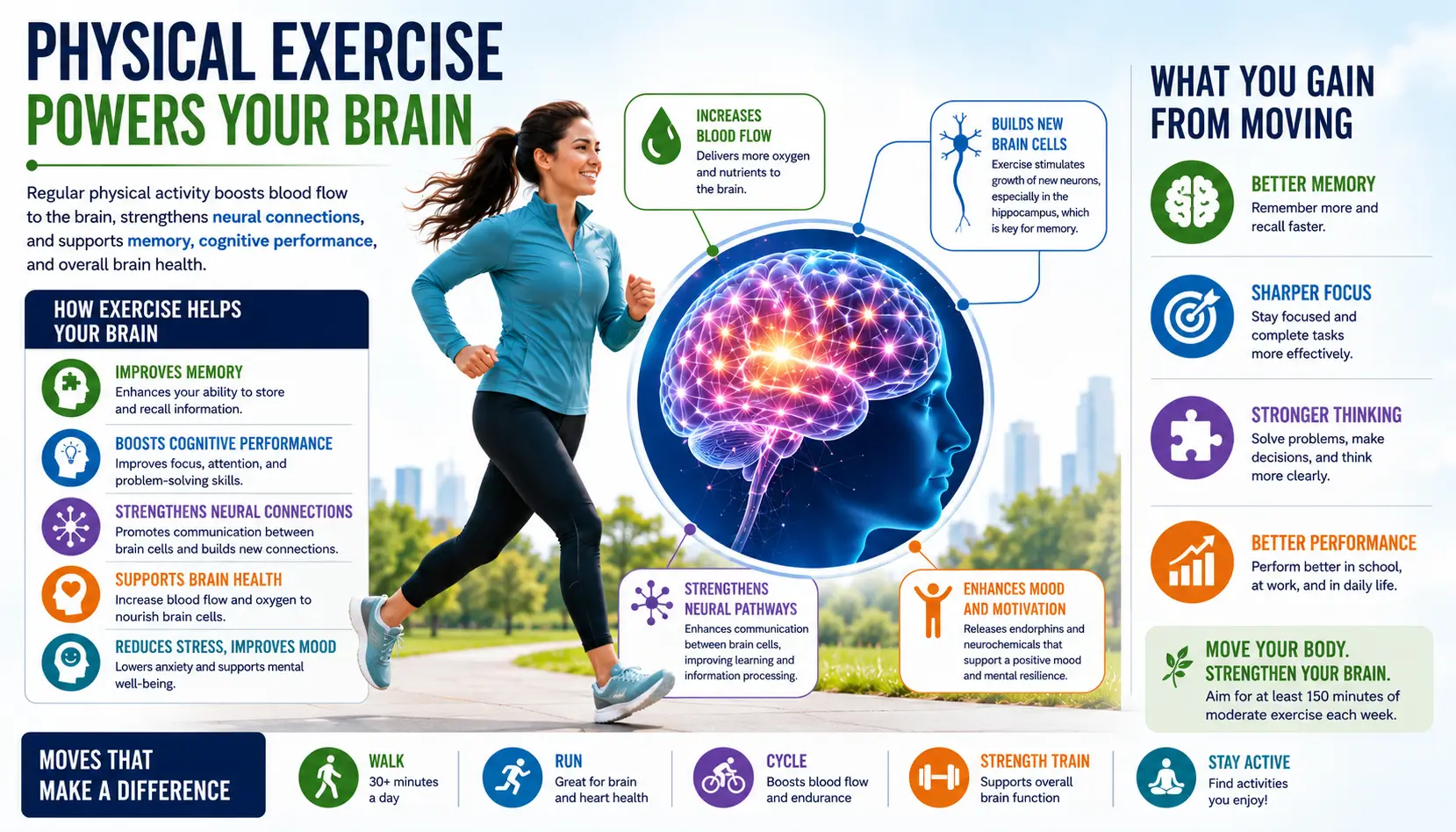
Exercise #9: Physical Exercise for Brain Health
Some of the most effective memory exercises occur outside the classroom.
Physical activity improves circulation and supports healthy brain function.
Research has linked regular exercise with improvements in memory, attention, and executive function.
Activities such as walking, cycling, swimming, and resistance training may all contribute to cognitive performance.
Even moderate movement performed consistently can benefit brain health over time.
Exercise #10: Sleep-Based Memory Training
Many people think memory improvement happens only during active practice.
However, sleep plays a critical role in strengthening newly learned information.
During sleep, the brain organizes and stabilizes memories through a process known as Memory Consolidation.
Without sufficient sleep, learning efficiency and recall often decline.
Protecting sleep quality may be one of the most powerful memory-enhancing habits available.
Exercise #11: Retrieval Challenges
These exercises depend on recall itself, which is explored in more detail in Recall Memory.
Retrieval itself acts as a memory workout.
Every time information is recalled, the associated neural pathway becomes stronger.
Simple retrieval exercises include:
- Recalling yesterday’s learning without notes
- Summarizing a chapter from memory
- Explaining concepts to another person
- Creating practice quizzes
These activities repeatedly activate the brain systems responsible for long-term recall.
Over time, retrieval becomes faster and more reliable.
Building a Daily Memory Exercise Routine
The most effective memory programs do not depend on a single exercise.
Instead, they combine several complementary activities.
A practical daily memory routine might include:
- 10 minutes of Active Recall practice
- 10 minutes of Spaced Repetition review
- 20 minutes of focused reading
- Physical activity or walking
- A consistent sleep schedule
This combination engages multiple cognitive systems while supporting long-term brain health.
Consistency matters more than intensity.
Small daily improvements often produce larger results than occasional intensive efforts.
What Science Says About Brain Training
For a broader overview of how recall, encoding, forgetting, and cognitive performance work together, read The Complete Guide to Memory.
Researchers generally agree that mentally stimulating activities support cognitive performance.
However, the strongest evidence favors broad learning experiences rather than narrow training programs.
Activities that combine learning, retrieval, attention, physical movement, and healthy recovery appear to provide the greatest overall benefits.
In other words, the most effective memory exercises are often those that challenge the brain in meaningful and varied ways.
Memory improves when the brain is regularly challenged, actively engaged, and given time to recover.
Brain exercises can strengthen recall, support cognitive flexibility, and improve learning efficiency.
While no single activity guarantees perfect memory, consistent mental engagement combined with healthy lifestyle habits creates the conditions for stronger long-term cognitive performance.
Whether through retrieval practice, reading, learning new skills, physical exercise, or quality sleep, small daily actions can have a meaningful impact on memory over time.
Readers interested in supporting cognitive performance through both lifestyle strategies and nutritional approaches can learn more about Advanced Memory Formula.
Related Topics
- How to Improve Memory: Science-Backed Strategies for Better Recall and Cognitive Function
- Working Memory Explained: The Brain System Behind Learning, Focus, and Recall
- Memory Retention: How to Improve Learning, Recall, and Information Storage
- Memory Palace Technique: How to Build a Mental System for Better Recall