
Now Reading: Study Skills: Essential Academic Skills That Improve Learning, Retention, and Performance
-
01
Study Skills: Essential Academic Skills That Improve Learning, Retention, and Performance
Study Skills: Essential Academic Skills That Improve Learning, Retention, and Performance
Why do some students consistently perform well while others spend long hours studying yet struggle to remember what they learned?
The answer often has less to do with intelligence and more to do with study skills.
Effective learning is rarely the result of natural talent alone.
Research in educational psychology consistently shows that successful learners develop systems, habits, and strategies that allow them to process information more efficiently.
These abilities are commonly referred to as study skills.
Study skills are the practical tools learners use to acquire knowledge, organize information, improve comprehension, strengthen memory, and perform better academically.
Whether you are preparing for school exams, professional certifications, university courses, or self-directed learning projects, strong study skills can dramatically improve both learning efficiency and long-term retention.
In fact, many of the most effective study skills are supported by decades of cognitive science research.
Methods such as Active Recall, Spaced Repetition, and Interleaving have repeatedly demonstrated superior results compared to passive studying techniques.
Rather than studying harder, highly effective learners focus on studying smarter.
Understanding and applying the right study skills can help anyone learn faster, remember more information, and reduce wasted study time.
What Are Study Skills?
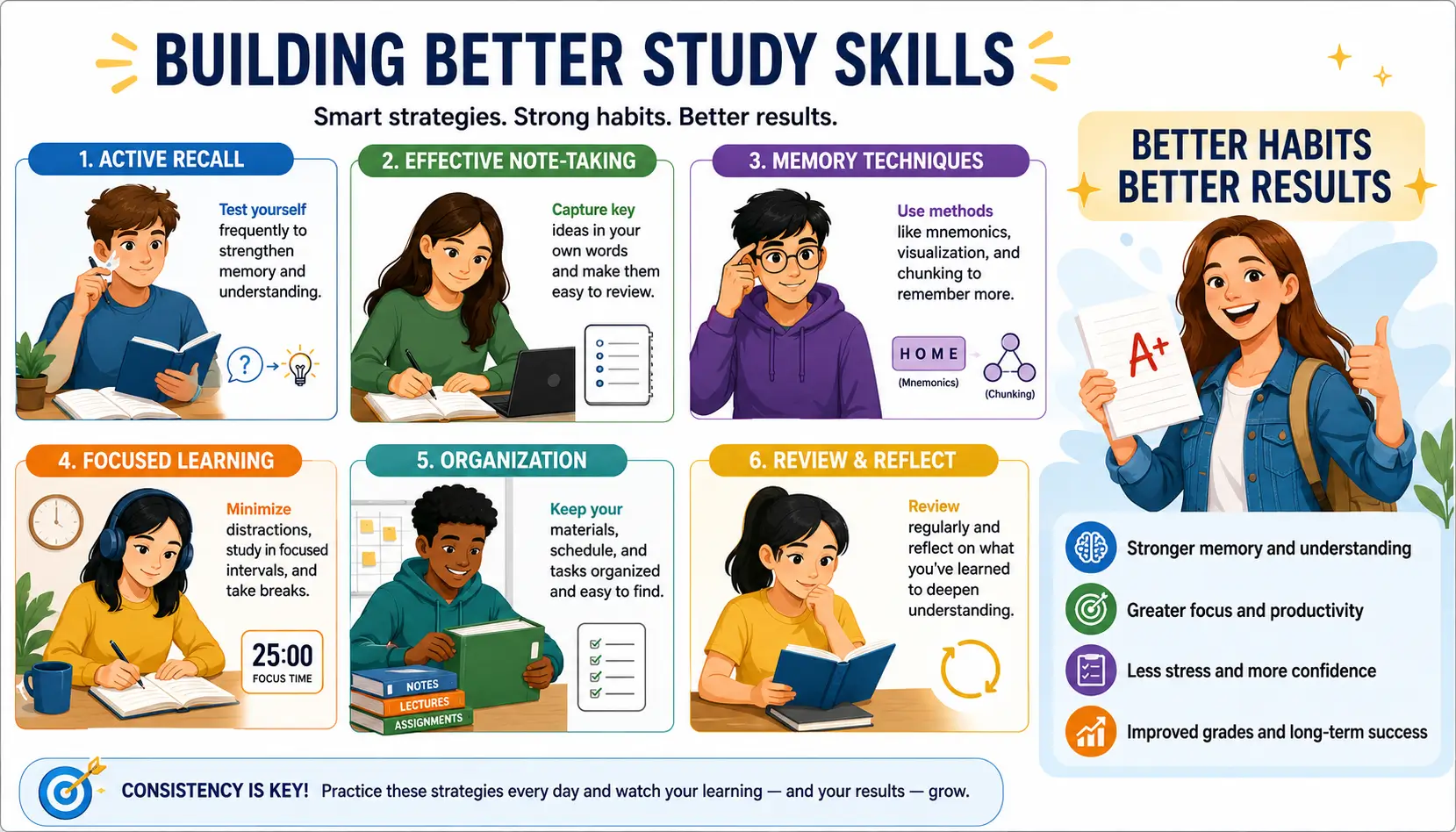
Study skills are the collection of techniques, behaviors, and learning strategies that improve educational performance.
They help learners absorb information more effectively, retain knowledge longer, manage study time efficiently, and apply learned concepts successfully.
Strong study skills combine cognitive science principles with practical learning behaviors.
They allow students to transform information into durable knowledge rather than temporary memorization.
Examples of important study skills include:
- Active Recall
- Time Management
- Goal Setting
- Organization
- Note-Taking
- Metacognitive Awareness
- Spaced Repetition
- Concentration Management
- Self-Testing
- Critical Thinking
These skills work together to create an efficient learning system.
Why Study Skills Matter More Than Intelligence
Many people believe academic success depends primarily on intelligence.
While cognitive ability certainly influences learning, educational research consistently shows that learning strategies often play an even larger role.
A student with average intelligence and strong study skills frequently outperforms a naturally gifted student with poor learning habits.
This occurs because effective study skills improve:
- Memory formation
- Information retrieval
- Attention control
- Learning efficiency
- Knowledge retention
- Problem-solving ability
Students who rely solely on rereading often create an illusion of learning.
They become familiar with material but struggle to recall it later.
Effective study skills focus on strengthening actual memory rather than creating a false sense of familiarity.

Study Skill #1: Active Recall
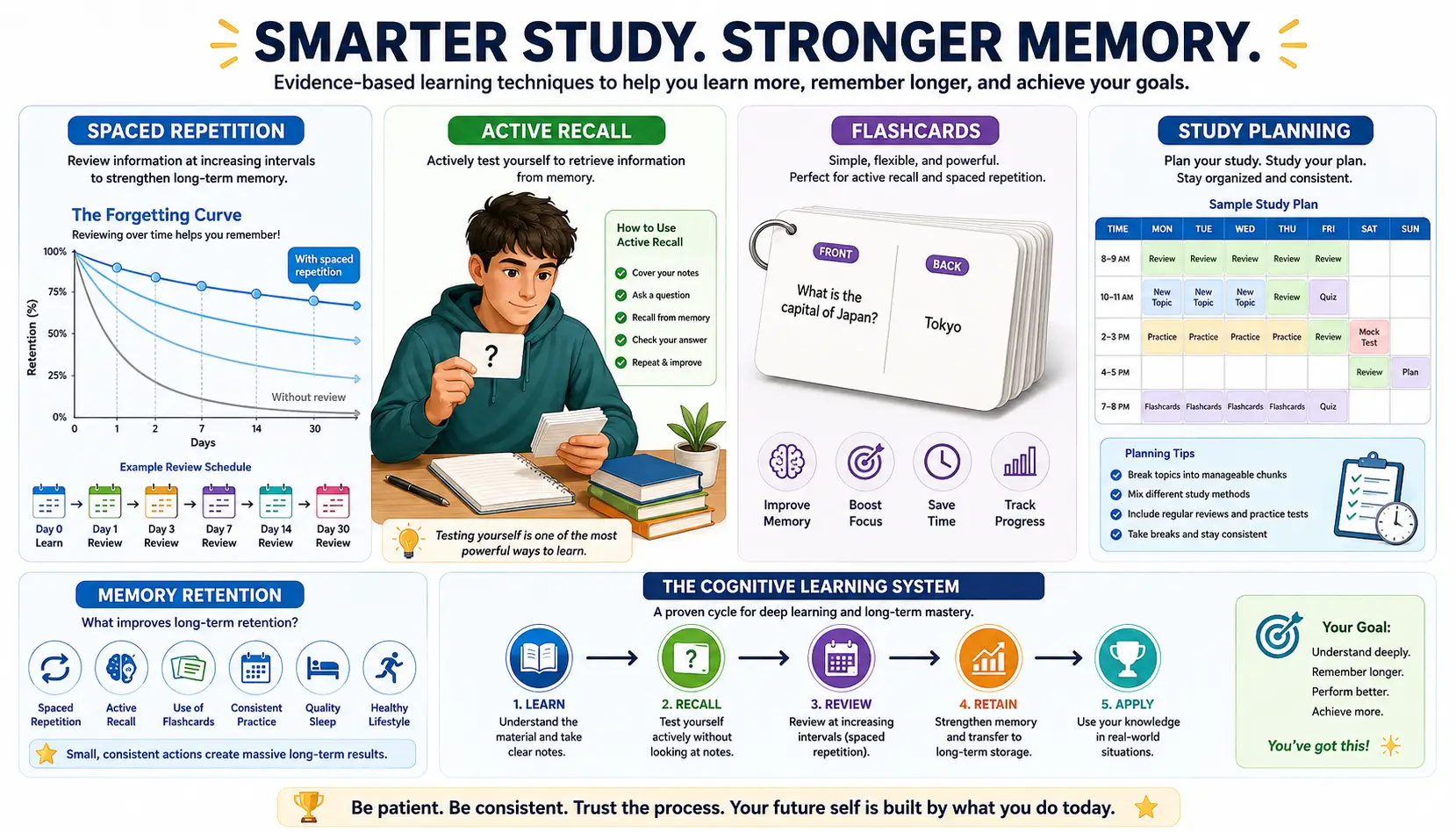
Among all evidence-based learning techniques, few are as powerful as Active Recall.
Instead of passively reviewing information, learners actively retrieve it from memory.
This retrieval process strengthens neural pathways and improves future recall.
Examples include:
- Answering practice questions
- Using flashcards
- Explaining concepts aloud
- Teaching information to another person
- Writing summaries from memory
Research by cognitive psychologists Henry Roediger and Jeffrey Karpicke demonstrated that retrieval practice significantly improves long-term retention compared to repeated studying.
Study after study continues to confirm the effectiveness of active recall for learning.
Readers interested in this topic should also explore:
Retrieval Practice: Why Testing Yourself Improves Memory Retention
and
The Testing Effect: Why Self-Testing Beats Re-Reading for Memory Retention.
Study Skill #2: Effective Time Management
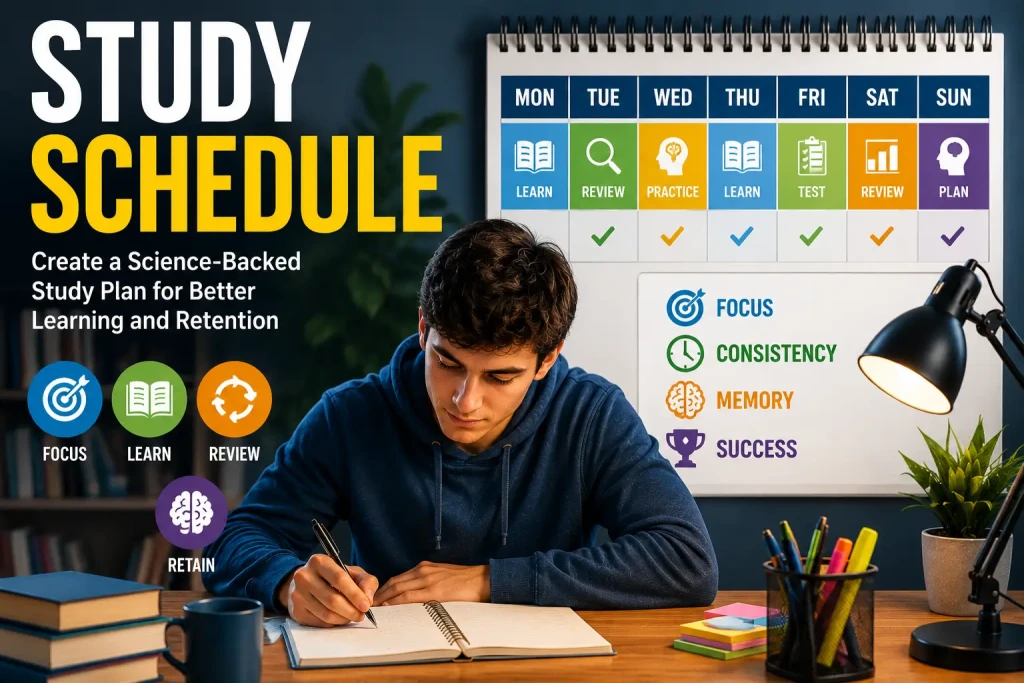
For a more actionable planning framework, see Study Schedule.
Learning requires consistency.
One of the biggest mistakes students make is waiting until deadlines approach before beginning serious study.
Cramming may improve short-term performance, but it rarely produces durable learning.
Strong time-management skills help learners distribute effort across multiple sessions.
Effective strategies include:
- Weekly planning
- Study calendars
- Daily objectives
- Task prioritization
- Progress tracking
When study sessions are scheduled consistently, learning becomes more efficient and less stressful.
Study Skill #3: Understanding How Memory Works
Strong learners understand that memory is not a simple storage system.
Information must pass through multiple stages before becoming long-term knowledge.
These stages include:
- Encoding
- Consolidation
- Storage
- Retrieval
Understanding these processes helps learners choose more effective study methods.
For example, knowing that memory strengthens through retrieval naturally leads to greater use of self-testing techniques.
Readers who want a deeper understanding of memory processes can explore:
https://memoryperformancelab.com/memory-encoding/
https://memoryperformancelab.com/memory-consolidation/
https://memoryperformancelab.com/memory-retrieval/
Study Skill #4: Strategic Note-Taking
Good notes serve as a bridge between learning and recall.
However, simply copying information word-for-word rarely promotes deep understanding.
Effective note-taking requires active processing.
Successful learners often summarize information using their own words, identify key concepts, and create meaningful connections between ideas.
Popular note-taking approaches include:
- Cornell Notes
- Outline Method
- Mind Mapping
- Concept Mapping
- Visual Note-Taking
These approaches encourage deeper processing and improve retention.
The psychological foundation behind this process can be understood through Levels of Processing Theory.
Study Skill #5: Metacognitive Awareness
One of the characteristics that separates high-performing learners from struggling learners is metacognition.
Metacognition refers to the ability to evaluate your own understanding and learning process.
Rather than assuming they understand a topic, effective learners regularly ask themselves:
- Do I actually understand this concept?
- Could I explain it to someone else?
- Can I solve a problem without looking at my notes?
- Which topics still feel unclear?
This self-monitoring process helps learners identify weaknesses before exams reveal them.
Students who actively monitor their understanding tend to make better study decisions and avoid wasting time on ineffective strategies.
Learn more about this process in Metacognition: How Thinking About Thinking Improves Learning and Memory.
Study Skill #6: Using Spaced Repetition Instead of Cramming
Cramming remains one of the most common study mistakes.
Unfortunately, information learned during intense last-minute study sessions is often forgotten quickly.
Spaced repetition offers a far more effective alternative.
This technique involves reviewing information at increasing intervals over time.
Each review strengthens memory traces and reduces forgetting.
The approach is directly supported by research surrounding the Ebbinghaus Forgetting Curve.
Instead of fighting forgetting after it happens, spaced repetition helps prevent it.
Many learners combine spaced repetition with flashcard systems such as:
- Anki
- Leitner System
- Digital flashcards
- Question banks
Readers can learn more from:
https://memoryperformancelab.com/spaced-repetition/
https://memoryperformancelab.com/anki-flashcards/
https://memoryperformancelab.com/leitner-system/
Study Skill #7: Improving Focus During Study Sessions
If concentration is the main bottleneck, read How to Focus on Studying for more targeted strategies.
Attention is the gateway to learning.
If attention is fragmented, memory formation suffers.
Modern learners face more distractions than ever before.
Smartphones, social media notifications, messaging apps, and multitasking all compete for cognitive resources.
Research consistently demonstrates that multitasking reduces learning effectiveness.
Strong study skills therefore include deliberate attention management.
Effective learners often:
- Turn off notifications
- Study in distraction-free environments
- Use focused work sessions
- Schedule regular breaks
- Avoid switching between tasks unnecessarily
Protecting your attention span improves both comprehension and retention.
Study Skill #8: Managing Cognitive Load
The human brain has limited working memory capacity.
Trying to process too much information simultaneously creates cognitive overload.
This reduces learning efficiency and increases mental fatigue.
Strong learners naturally manage cognitive load by breaking complex information into smaller components.
Common strategies include:
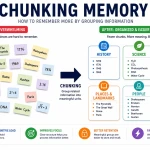
- Chunking information
- Studying one concept at a time
- Using visual aids
- Creating structured learning sequences
- Building foundational knowledge before advanced topics
The scientific foundation for this approach is explained in:
https://memoryperformancelab.com/cognitive-load-theory/
and
https://memoryperformancelab.com/chunking-memory/
Study Skill #9: Learning Through Teaching
One of the fastest ways to identify knowledge gaps is attempting to teach what you have learned.
If you cannot explain a concept clearly, you probably do not understand it deeply enough.
This principle forms the foundation of the Feynman Technique.
Teaching forces learners to simplify complex ideas, organize information logically, and retrieve knowledge from memory.
The process strengthens understanding while revealing weak areas that require additional review.
Many students discover that explaining concepts aloud dramatically improves learning efficiency.
Study Skill #10: Building Consistent Study Habits
Study skills become most effective when supported by strong study habits.
Consistency often beats intensity.
A learner who studies effectively for thirty minutes each day typically outperforms someone who studies five hours only before an exam.
Strong study habits reduce decision fatigue and make learning automatic.
Examples include:
- Maintaining a regular study schedule
- Reviewing material daily
- Setting weekly learning goals
- Tracking progress
- Using structured study routines
Readers can continue with:
https://memoryperformancelab.com/study-habits/
Study Skill #11: Developing Long-Term Learning Systems
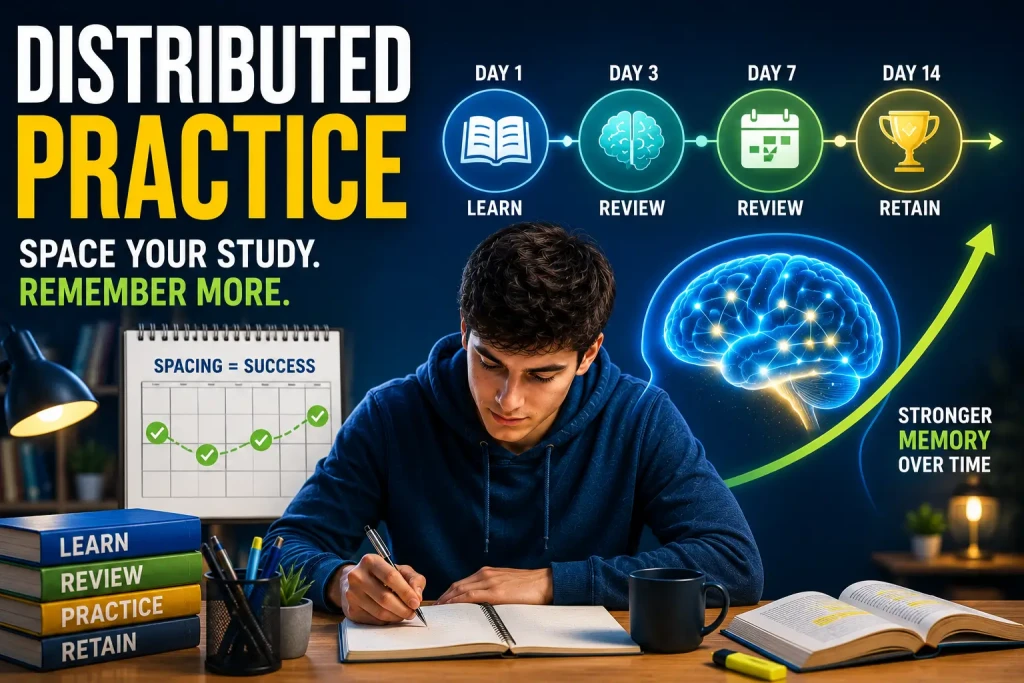
One of the key ideas behind durable learning systems is Distributed Practice, which explains why spreading study over time improves retention.
The highest-performing learners do not depend on motivation alone.
They build systems.
These systems combine multiple evidence-based learning techniques into a repeatable framework.
A highly effective learning system might include:
- Active Recall
- Spaced Repetition
- Interleaving
- Weekly Planning
- Goal Tracking
- Self-Assessment
- Regular Review Sessions
Together, these practices create a sustainable approach to learning that produces lasting results.
The Connection Between Study Skills and Academic Performance
Academic success is rarely determined by a single factor.
Strong study skills improve performance because they strengthen the entire learning process.
Students with effective study skills typically:
- Learn information faster
- Retain information longer
- Experience less exam anxiety
- Perform better on assessments
- Develop greater confidence
- Become more independent learners
These benefits extend far beyond school.
Professional development, career advancement, certifications, and lifelong learning all depend on the same fundamental skills.
Many of the world’s most successful learners are not necessarily the smartest individuals in the room.
They are often the people who have mastered effective learning systems.
Understanding how memory works, applying evidence-based learning techniques, and developing consistent study habits can dramatically improve educational outcomes over time.
For learners seeking a complete roadmap to better learning and memory performance, combining study skills with proven memory strategies creates one of the most powerful learning systems available.
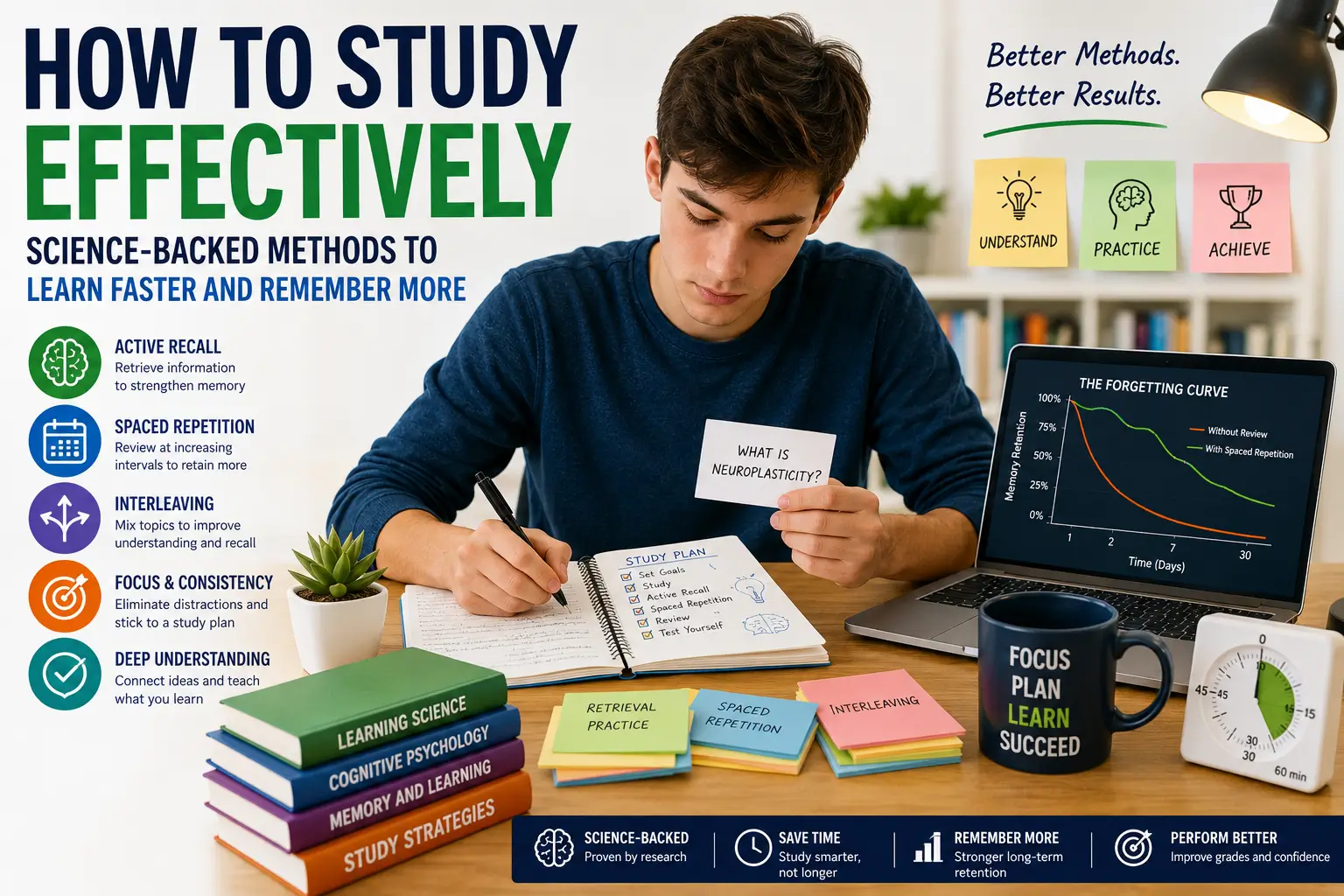
A useful next step is exploring How to Study Effectively, where many of these concepts are combined into a complete learning framework.
Related Topics
- Study Techniques: Evidence-Based Methods to Learn Faster and Remember More
- Study Habits: The Daily Practices That Improve Learning, Focus, and Memory
- How to Study Effectively: Science-Backed Methods to Learn Faster and Remember More
- Active Recall
- Spaced Repetition
- Interleaving
- The Feynman Technique
- Metacognition