
Now Reading: Prospective Memory Explained: How Your Brain Remembers Future Tasks and Intentions
-
01
Prospective Memory Explained: How Your Brain Remembers Future Tasks and Intentions
Prospective Memory Explained: How Your Brain Remembers Future Tasks and Intentions
Have you ever remembered to take medication at exactly the right time?
Or suddenly recalled that you needed to send an important email later in the day?
Perhaps you remembered to buy groceries while passing a store on your way home.
These situations rely on a powerful memory system known as prospective memory.
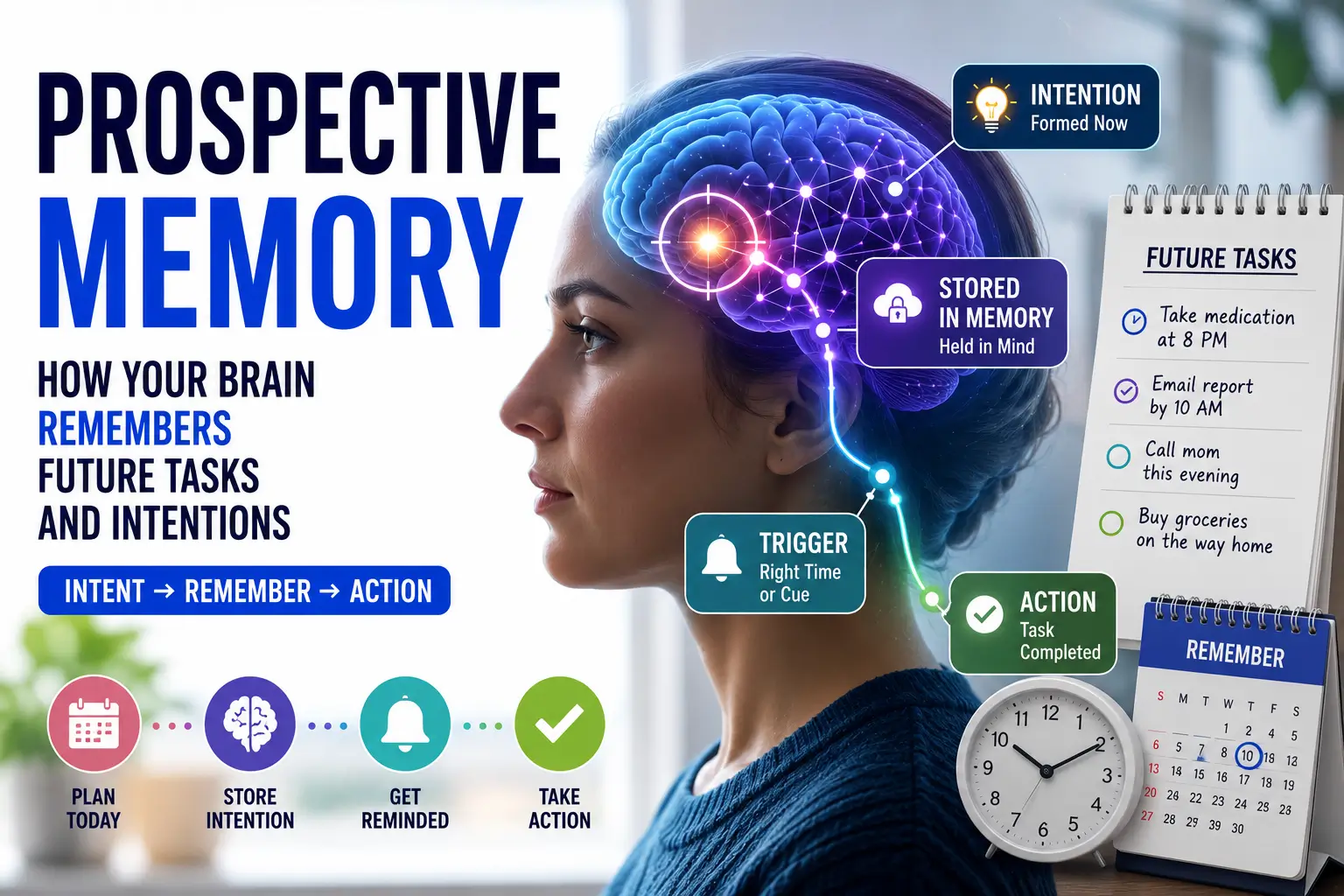
Prospective memory allows people to remember intentions and actions that must be performed in the future.
It helps bridge the gap between planning and action.
Without prospective memory, daily life would become far more difficult to manage.
Many important responsibilities depend on this often-overlooked aspect of memory.
What Is Prospective Memory?
Prospective memory is the ability to remember to perform an intended action in the future.
Unlike remembering something from the past, prospective memory focuses on remembering something that has not happened yet.
It involves forming an intention and successfully carrying it out when the appropriate moment arrives.
Researchers sometimes describe prospective memory as “remembering to remember.”
Examples of Prospective Memory
Prospective memory plays a role in countless everyday activities.
- Taking medication at a scheduled time
- Attending a meeting
- Returning a phone call
- Paying a bill before a deadline
- Sending an important email
- Picking up groceries after work
- Wishing someone a happy birthday
Many daily responsibilities depend on prospective memory functioning effectively.


Why Prospective Memory Matters
Success in school, work, and personal life often depends on remembering future intentions.
People who frequently forget planned tasks may struggle with productivity, organization, and time management.
Strong prospective memory helps ensure that important responsibilities are completed on time.
It supports independence and effective daily functioning.
🔬 The Science Behind Prospective Memory
Prospective memory involves several cognitive systems working together.
Attention, executive function, planning, and memory retrieval all contribute to successful future remembering.
The prefrontal cortex plays a particularly important role because it helps maintain intentions until the appropriate moment arrives.
Researchers view prospective memory as one of the most complex forms of everyday memory.
Source: https://www.ncbi.nlm.nih.gov/books/NBK470386/
Prospective memory allows people to carry intentions from the present into the future.
Prospective Memory vs Retrospective Memory
Prospective memory is often contrasted with retrospective memory.
Retrospective memory involves remembering information from the past.
Prospective memory involves remembering actions that must occur in the future.
For example:
- Remembering where you parked your car is retrospective memory.
- Remembering to move your car before parking restrictions begin is prospective memory.
Both systems are important, but they serve different functions.
How Prospective Memory Works
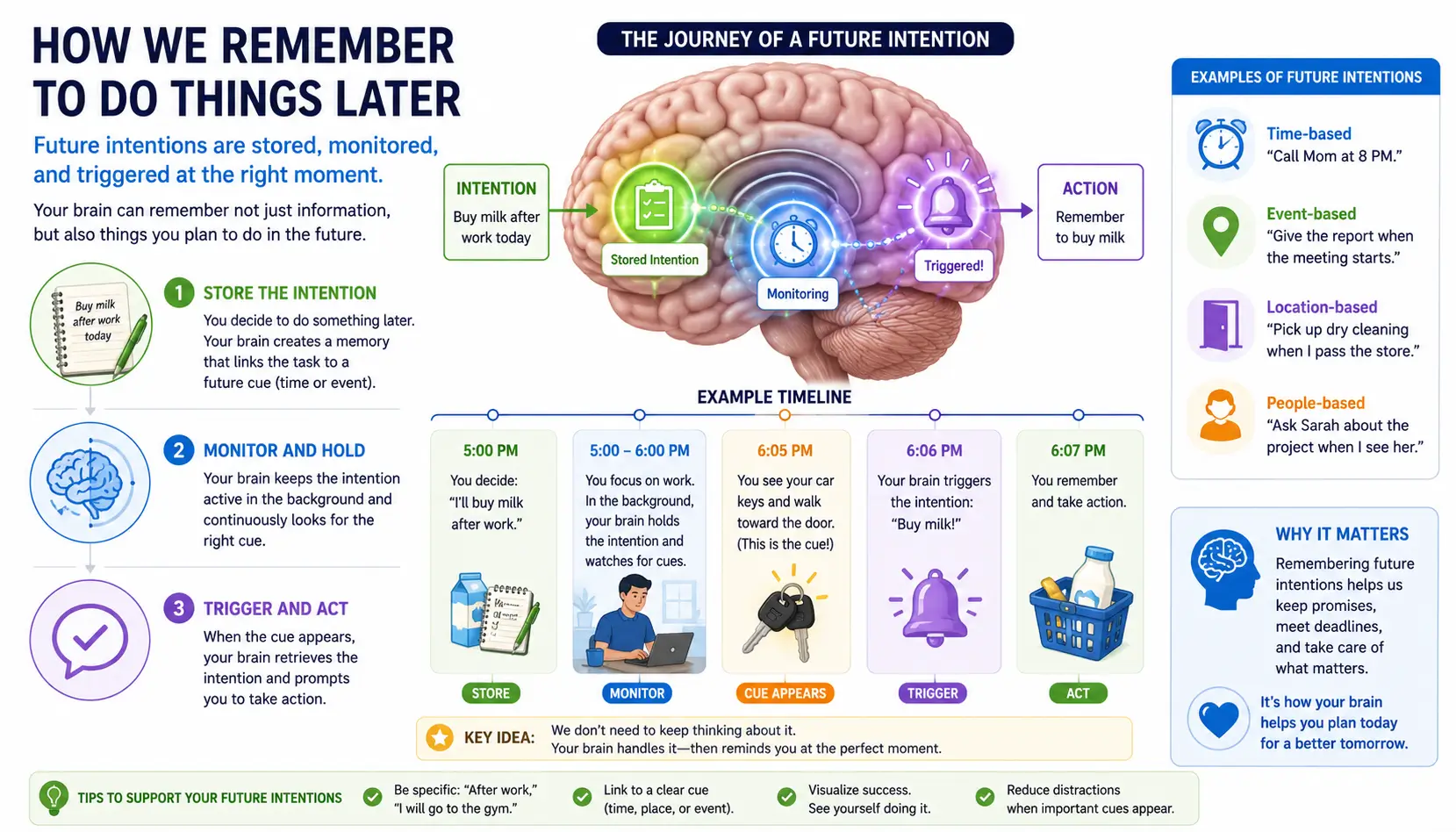
Successful prospective memory generally involves several stages.
- Forming an intention
- Retaining that intention over time
- Recognizing the correct cue or moment
- Executing the intended action
Failure can occur at any stage.
A person may forget the intention entirely or simply miss the appropriate cue.
Event-Based Prospective Memory
Because these tasks depend on triggers in the environment, they overlap closely with retrieval cues and how external signals activate stored intentions.
Event-based prospective memory occurs when a future action is triggered by a specific event.
Examples include:
- Giving a message to a friend when you see them
- Asking a question when a meeting begins
- Returning a book when visiting a library
The event serves as a retrieval cue that activates the intention.
This form of prospective memory often relies heavily on environmental triggers.
Time-Based Prospective Memory
Time-based prospective memory occurs when an action must be performed at a particular time.
Examples include:
- Taking medication at 8 PM
- Joining a meeting at noon
- Calling someone tomorrow morning
Unlike event-based tasks, time-based tasks often require greater self-monitoring.
There may be no external cue to trigger the memory automatically.
Prospective Memory and Attention
Attention plays a major role in future remembering.
Even when an intention is stored successfully, distractions can interfere with retrieval.
Busy environments, multitasking, and cognitive overload may increase the likelihood of forgetting intended actions.
This is one reason managing your attention span and reducing distractions can support prospective memory performance.
Prospective Memory and Working Memory
Working Memory helps maintain intentions during ongoing activities.
While completing one task, people often keep future goals active in the background.
Working memory and prospective memory frequently interact to support effective planning and execution.
Together, they help transform intentions into completed actions.
Prospective Memory and Retrieval Cues
Many future intentions are triggered by retrieval cues.
A retrieval cue is a signal that reminds a person to perform a planned action.
These cues may come from the environment, other people, or internal reminders.
For example, seeing a pharmacy may remind someone to pick up medication.
The stronger the cue, the more likely the intended action will be remembered.
Why We Forget Future Tasks
In many cases, the intention still exists in memory but cannot be accessed at the right moment, which makes retrieval failure a useful related concept.
Failures of prospective memory are common.
People often forget future intentions because attention becomes focused on other activities.
Stress, fatigue, distractions, and cognitive overload can all interfere with future remembering.
Sometimes the intention itself is remembered, but the cue is missed.
In other situations, the intention may never be successfully retrieved at all.
The Role of Memory Retrieval
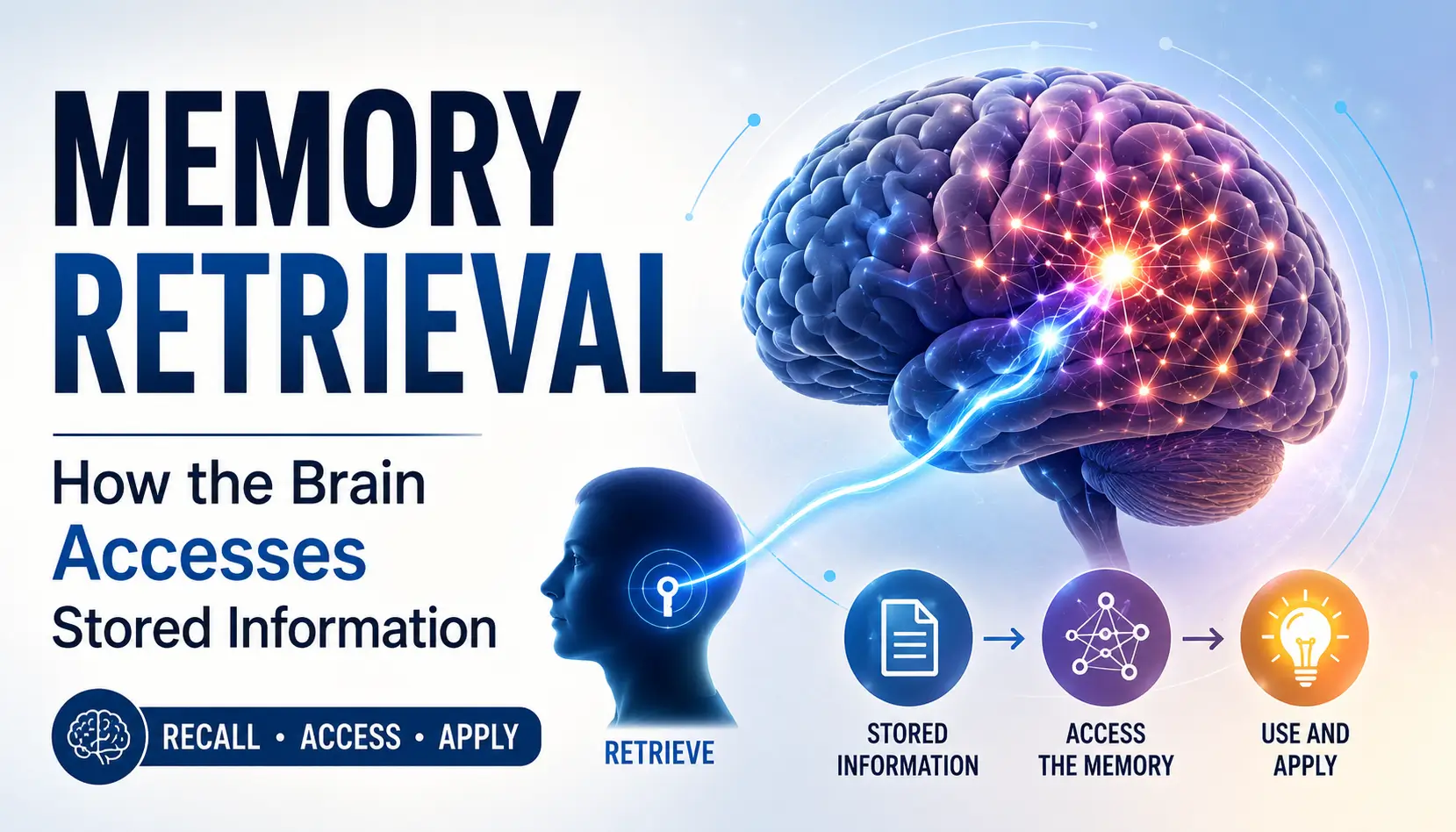
Prospective memory relies heavily on Memory Retrieval.
When the appropriate cue appears, the brain must retrieve the stored intention.
If retrieval fails, the planned action may never occur.
This illustrates why retrieval processes are essential for effective prospective memory.
Remembering future actions often depends on successful recall at exactly the right moment.
Prospective Memory and Aging
Researchers have studied how prospective memory changes across the lifespan.
Some aspects of future remembering can become more difficult with age, particularly when tasks require self-monitoring.
However, older adults often compensate by using external reminders and organizational systems.
Calendars, alarms, notes, and routines can significantly improve performance.
Prospective memory can remain highly effective when supported appropriately.
How Technology Supports Prospective Memory
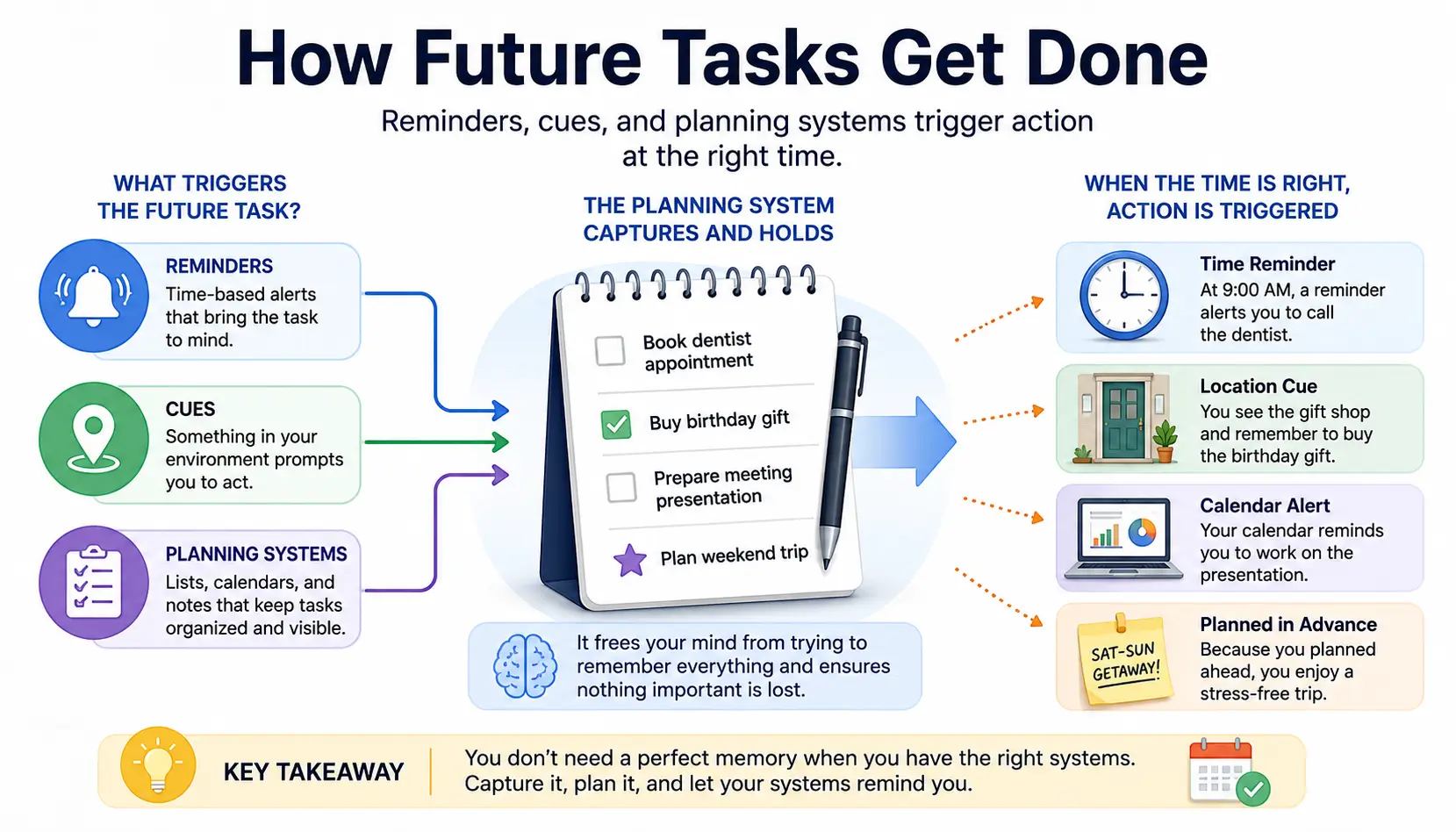
Modern technology frequently acts as an external memory system.
Smartphones, calendars, reminder apps, and digital assistants help reduce the burden on prospective memory.
These tools provide cues that trigger intended actions at the correct time.
Many people rely on technology to support future remembering in daily life.
External reminders can dramatically improve task completion rates.
Strategies to Improve Prospective Memory
Several evidence-based techniques can strengthen prospective memory performance.
- Create implementation intentions
- Use reminders and alarms
- Associate tasks with existing routines
- Reduce distractions
- Use written task lists
- Improve sleep quality
- Strengthen attention management skills
These strategies increase the likelihood that future intentions will be remembered when needed.
The Power of Implementation Intentions
Implementation intentions are specific plans that connect an action to a future cue.
Instead of saying:
“I need to exercise tomorrow.”
A person might say:
“When I finish breakfast tomorrow, I will go for a 20-minute walk.”
This creates a strong mental link between a cue and an action.
Research suggests implementation intentions can significantly improve prospective memory performance.
Prospective Memory in Education and Work
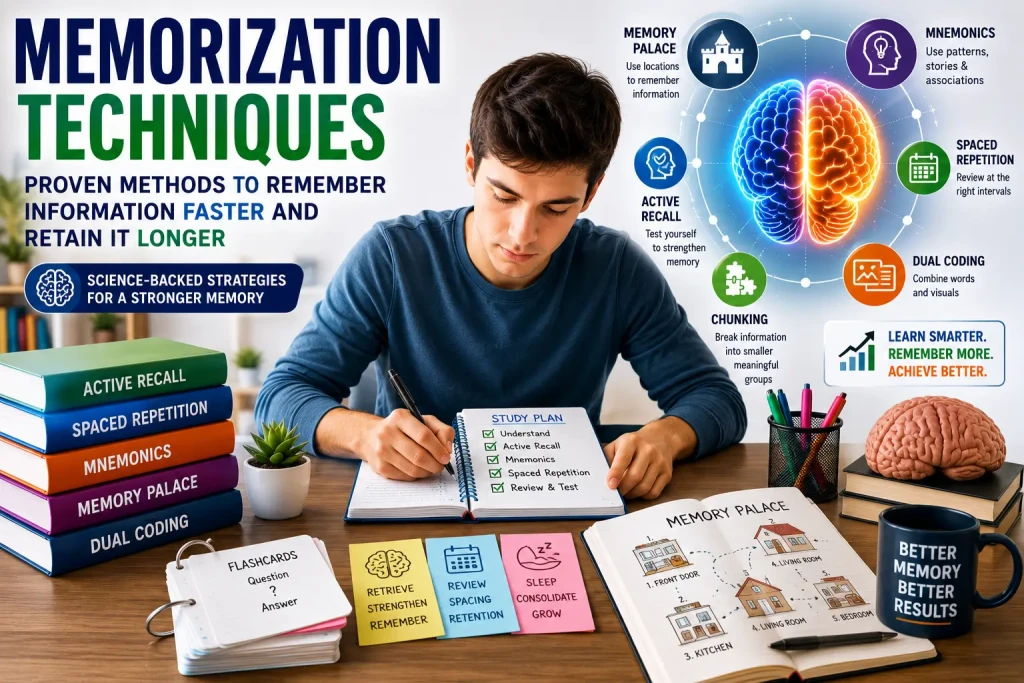
For students in particular, future remembering becomes easier when deadlines and review blocks are externalized through a structured study schedule.
Students and professionals rely on prospective memory constantly.
Assignments, deadlines, meetings, appointments, and responsibilities all require future remembering.
Strong prospective memory supports productivity and organization.
Poor prospective memory can lead to missed opportunities and forgotten commitments.
Managing future intentions effectively is a valuable life skill.
Prospective Memory and Everyday Success
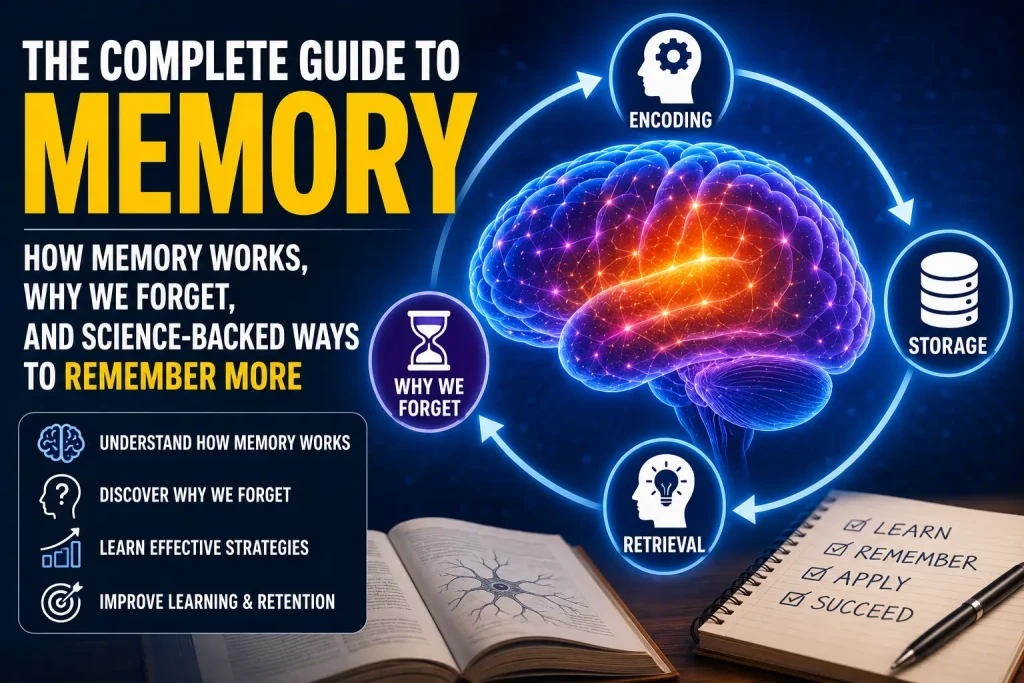
To see how future remembering fits into the wider architecture of human memory, visit the complete guide to memory.
Many daily achievements depend on remembering to perform intended actions.
People often focus on recalling past information, but future remembering is equally important.
Prospective memory helps transform plans into completed actions.
It serves as a bridge between intention and behavior.
Prospective memory is the system that helps future plans become real-world actions.
Without prospective memory, even the best intentions could easily be forgotten.
Supporting Memory Beyond Future Remembering
Prospective memory works best when supported by healthy cognitive habits, quality sleep, effective planning, and strong attention control.
Many people combine evidence-based memory strategies with broader approaches that support long-term brain performance.
Readers interested in memory-supportive nutritional strategies can learn more about Advanced Memory Formula.