
Now Reading: Semantic Memory Explained: How Your Brain Stores Facts, Concepts, and Knowledge
-
01
Semantic Memory Explained: How Your Brain Stores Facts, Concepts, and Knowledge
Semantic Memory Explained: How Your Brain Stores Facts, Concepts, and Knowledge
How do you know that Paris is the capital of France?
How do you recognize that a dog is an animal?
How do you understand concepts such as gravity, mathematics, language, or history?
You probably did not learn these facts from a single personal experience.
Instead, they are stored in a powerful memory system known as semantic memory.
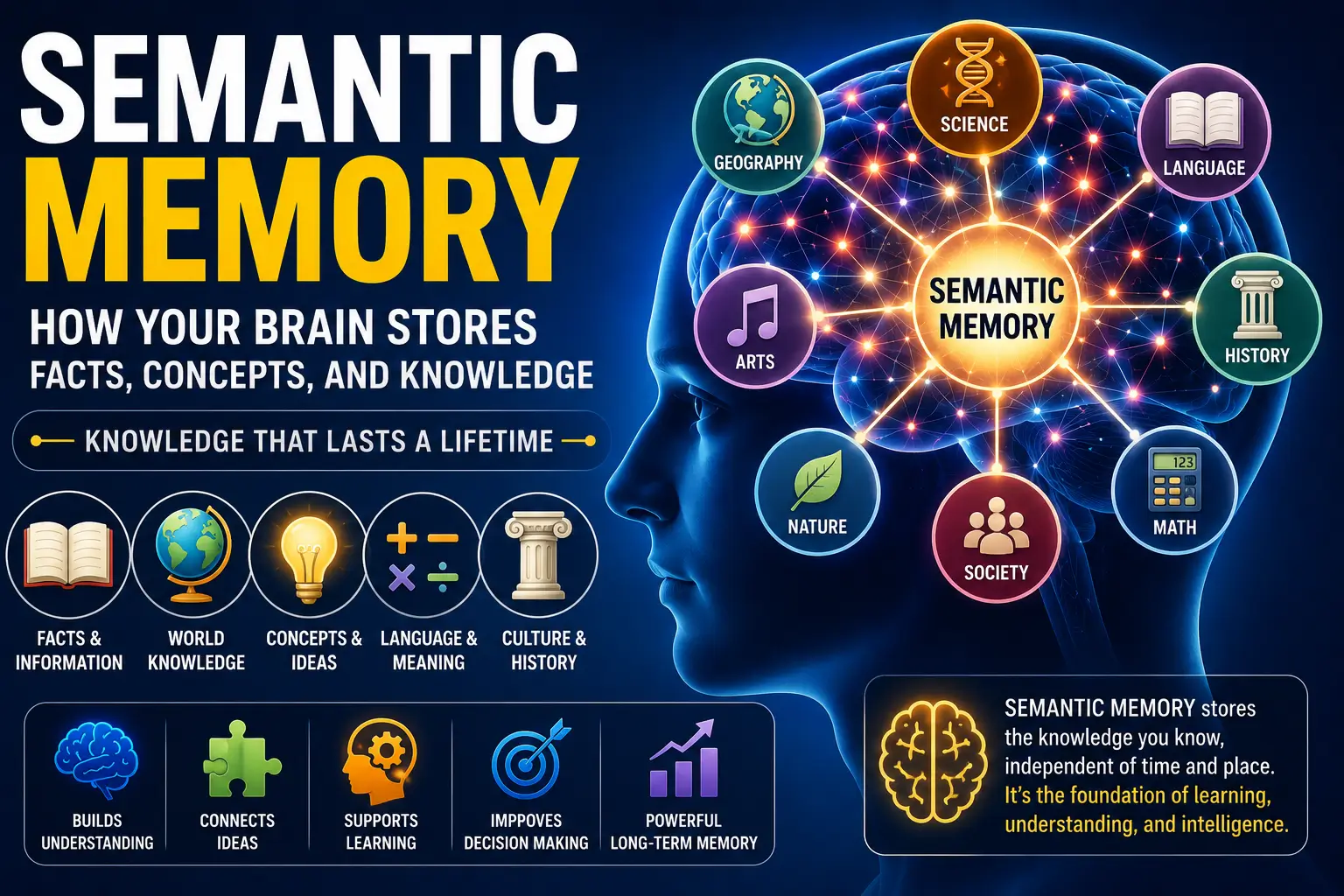
Semantic memory allows people to store facts, concepts, meanings, and general knowledge about the world.
It forms a major part of long-term memory and plays a critical role in education, communication, reasoning, and decision-making.
Without semantic memory, much of what we know would be impossible to access.
What Is Semantic Memory?
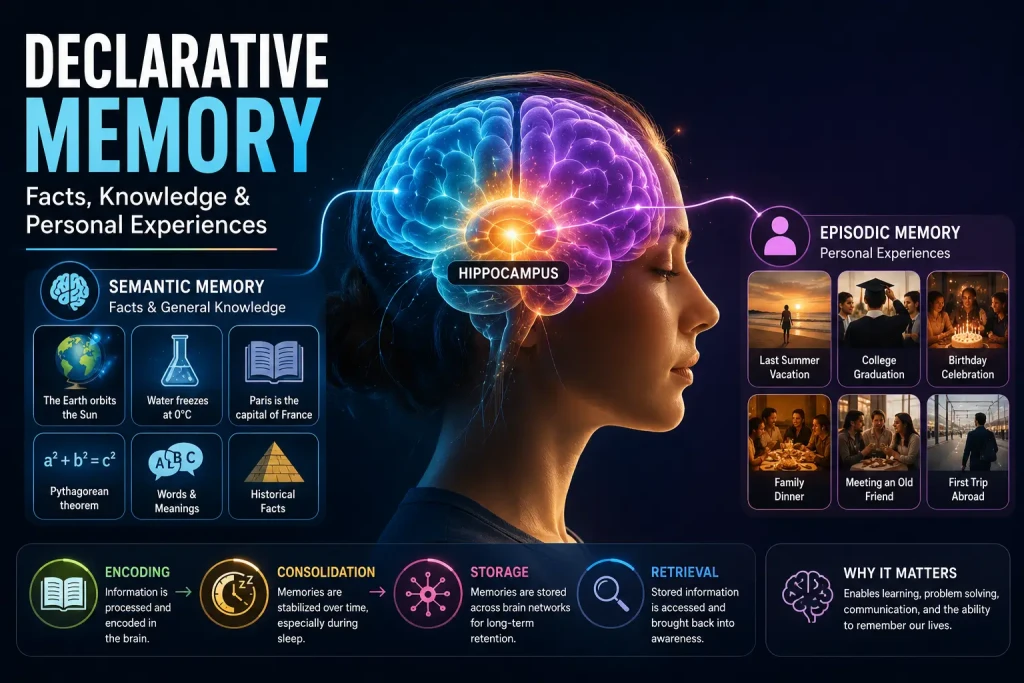
Semantic memory is commonly treated as part of declarative memory, the wider system for consciously accessible facts and knowledge.
Semantic memory is a type of long-term memory responsible for storing general knowledge.
Unlike personal experiences, semantic memories are not tied to a specific time or place.
They represent information that people know rather than events they personally experienced.
Examples include:
- Vocabulary and language knowledge
- Historical facts
- Scientific concepts
- Mathematical principles
- Geographical information
- General world knowledge
Semantic memory helps individuals understand and interact with the world around them.
Why Semantic Memory Matters
Nearly every learning activity depends on semantic memory.
Reading, writing, problem-solving, communication, and professional expertise all rely on stored knowledge.
The more knowledge a person possesses, the easier it often becomes to acquire additional knowledge.
This is because semantic memory creates frameworks that help organize new information.
Knowledge builds upon knowledge.

🔬 The Science Behind Semantic Memory
The concept of semantic memory was introduced by cognitive psychologist Endel Tulving.
He proposed that semantic memory differs from episodic memory because it stores knowledge that is independent of specific personal experiences.
While episodic memory allows people to remember events, semantic memory allows them to remember facts.
Together, these systems form important components of long-term memory.
Source: https://www.ncbi.nlm.nih.gov/books/NBK537287/
Semantic memory stores what we know, while episodic memory stores what we have experienced.
Semantic Memory vs Episodic Memory
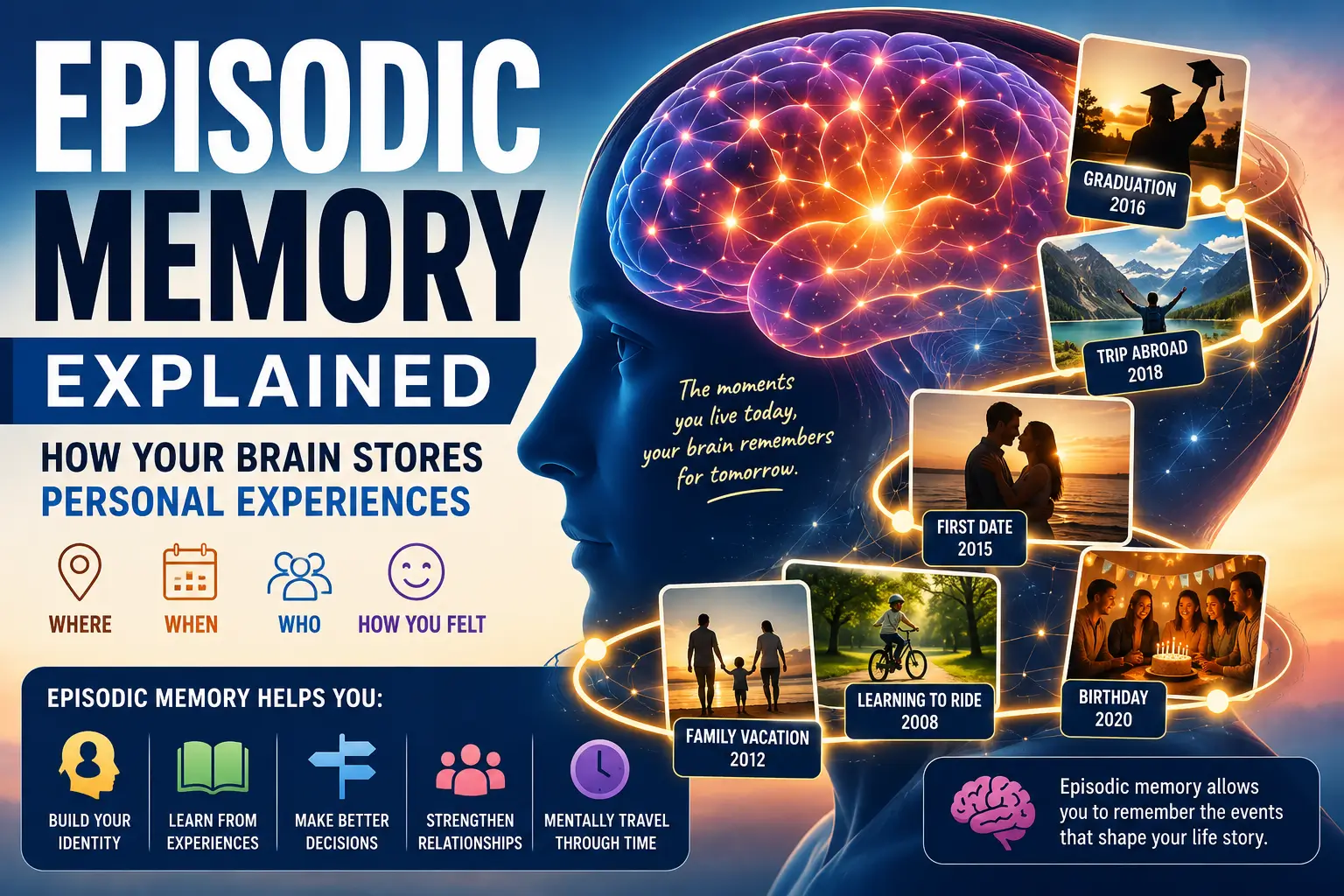
Semantic memory is often compared to Episodic Memory.
Although both belong to long-term memory, they serve different purposes.
Consider the following example:
- Remembering your graduation ceremony is episodic memory.
- Knowing what graduation means is semantic memory.
Episodic memory focuses on personal experiences.
Semantic memory focuses on knowledge and meaning.
The two systems frequently interact during learning and recall.
How Semantic Memories Are Created
Semantic memories begin with Memory Encoding.
Information is processed, interpreted, and connected to existing knowledge structures.
As understanding grows, new concepts become integrated into semantic memory networks.
The richer these connections become, the easier future retrieval often becomes.
Meaningful learning strengthens semantic memory.
Why Understanding Improves Memory
Understanding plays a major role in semantic memory formation.
Information that is deeply understood is often easier to retain than information that is merely memorized.
This is one reason techniques such as Elaborative Rehearsal are so effective.
Creating explanations, examples, and connections encourages deeper processing.
Deep processing generally produces stronger semantic memories.
Semantic Memory and Education
Schools, universities, and training programs depend heavily on semantic memory.
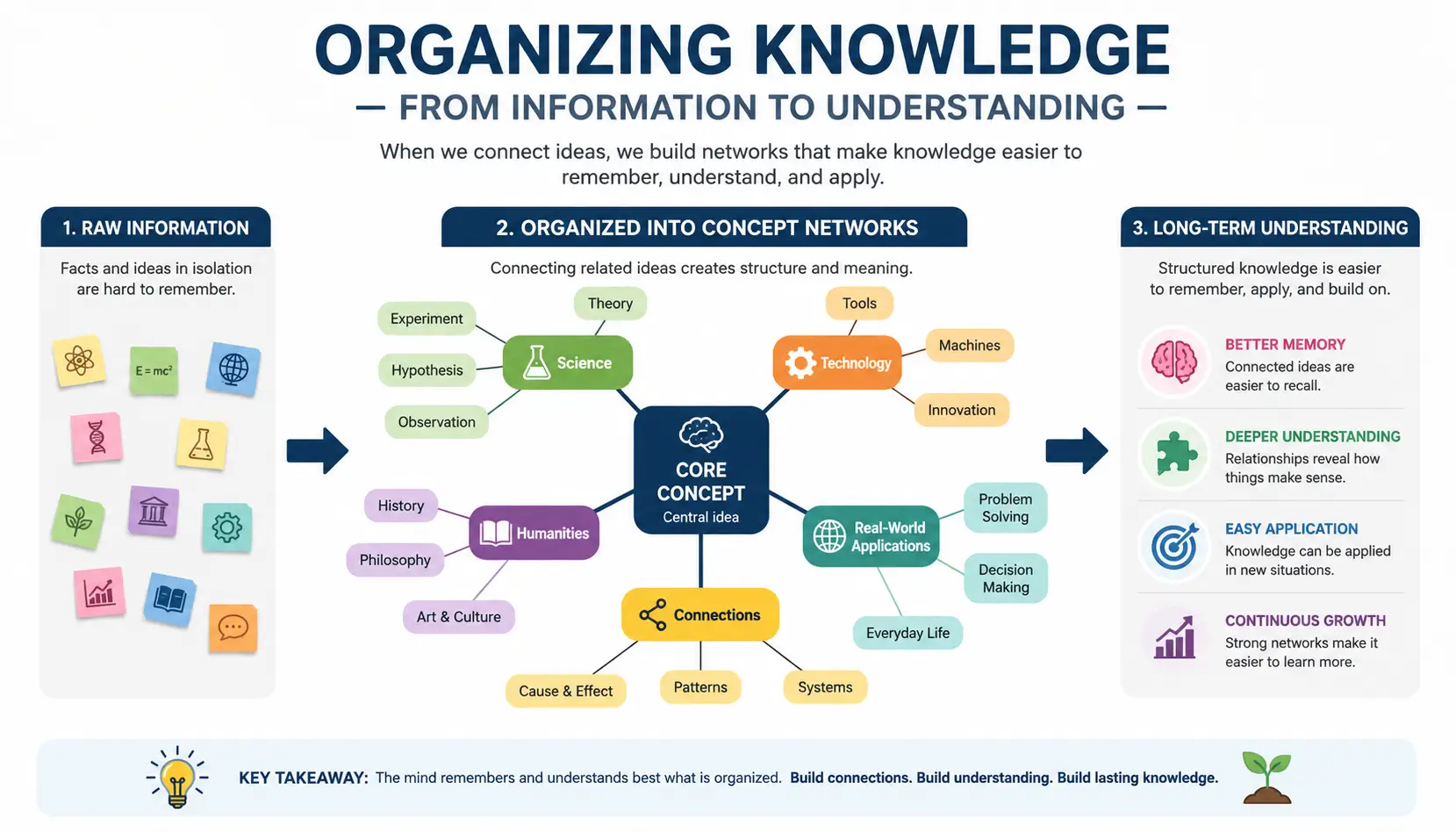
Students build knowledge by gradually expanding networks of concepts and facts.
Every new idea becomes easier to understand when it can connect to existing knowledge.
This process helps explain why prior knowledge is one of the strongest predictors of future learning success.
The Role of Retrieval in Semantic Memory
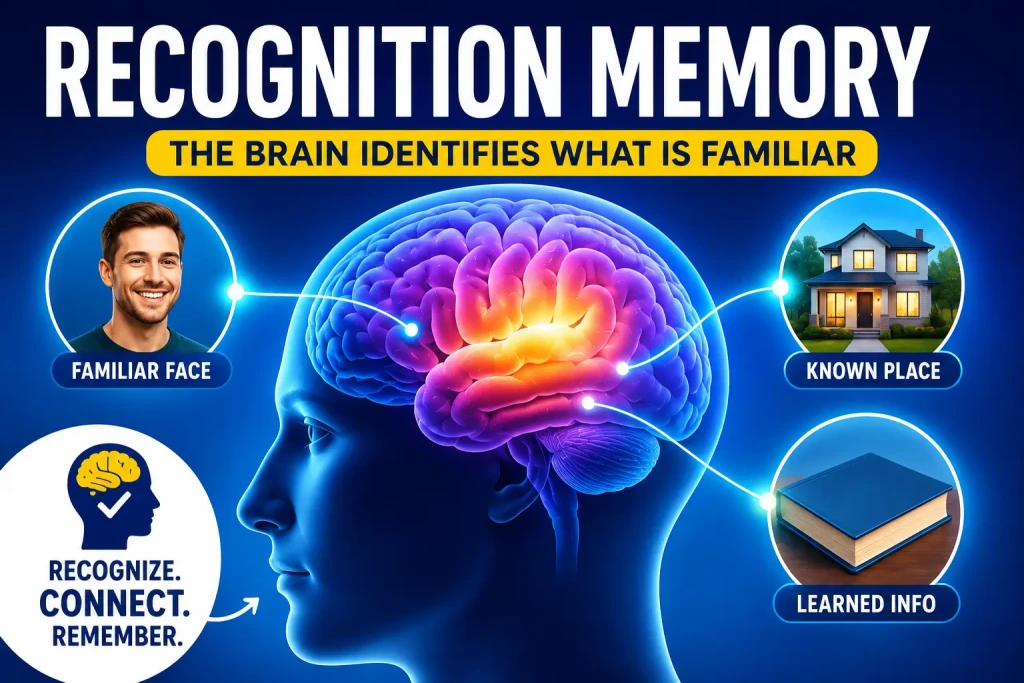
Depending on the task, this knowledge may be accessed through recall memory or through recognition memory when the correct answer is presented.
Knowledge becomes more accessible when it is regularly retrieved.
This is why Active Recall and Retrieval Practice are so effective.
Each successful retrieval strengthens memory pathways and improves accessibility.
The more often information is recalled, the more likely it is to remain available in the future.
Retrieval helps transform fragile knowledge into durable knowledge.
Semantic Memory and Long-Term Retention
Semantic memory forms the foundation of long-term knowledge retention.
When information becomes integrated into semantic memory, it often remains accessible for extended periods.
This process contributes directly to Memory Retention.
The stronger knowledge becomes connected to existing concepts, the more durable it often becomes.
Well-organized knowledge networks support both retention and recall.
How Semantic Networks Work
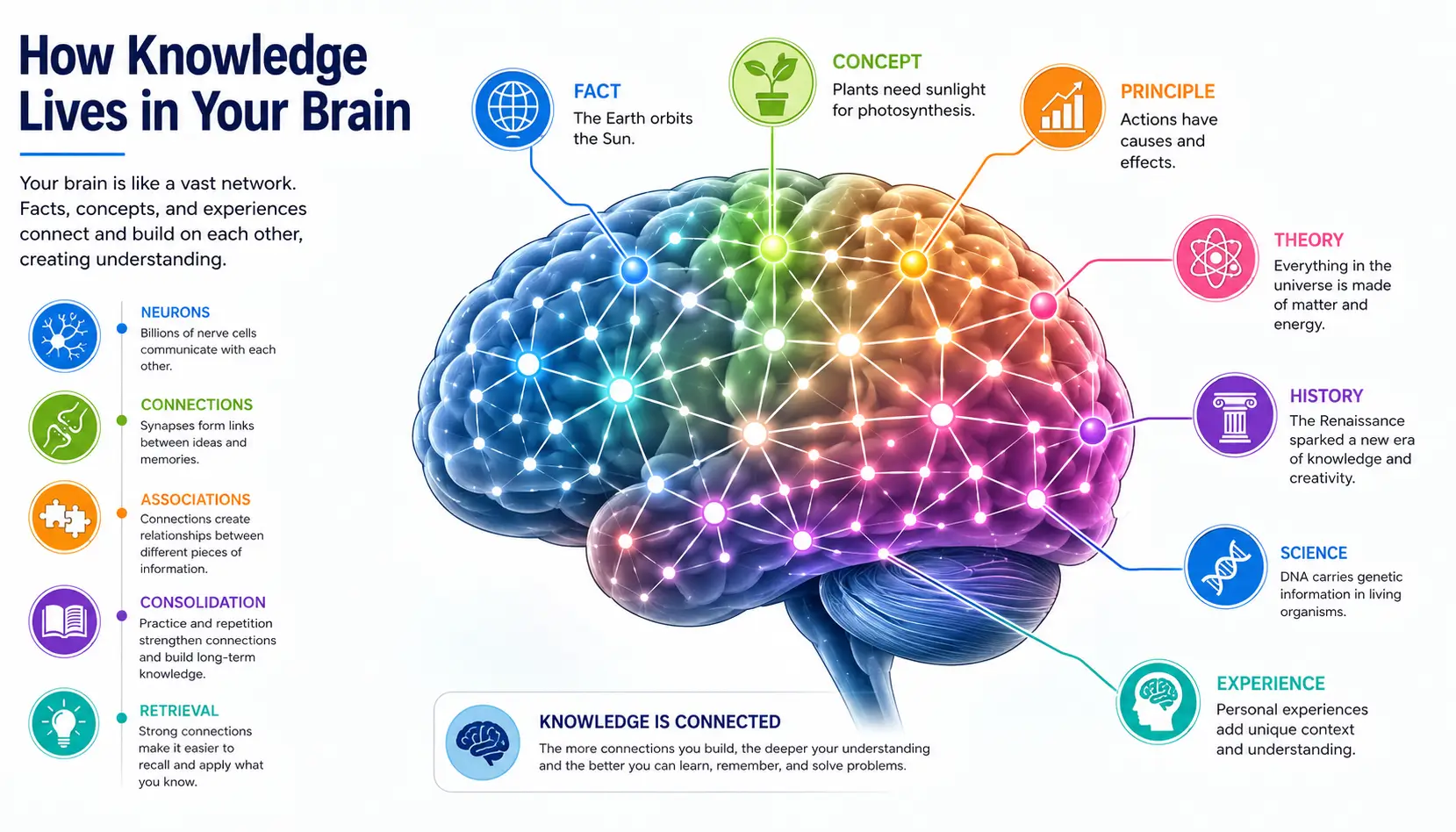
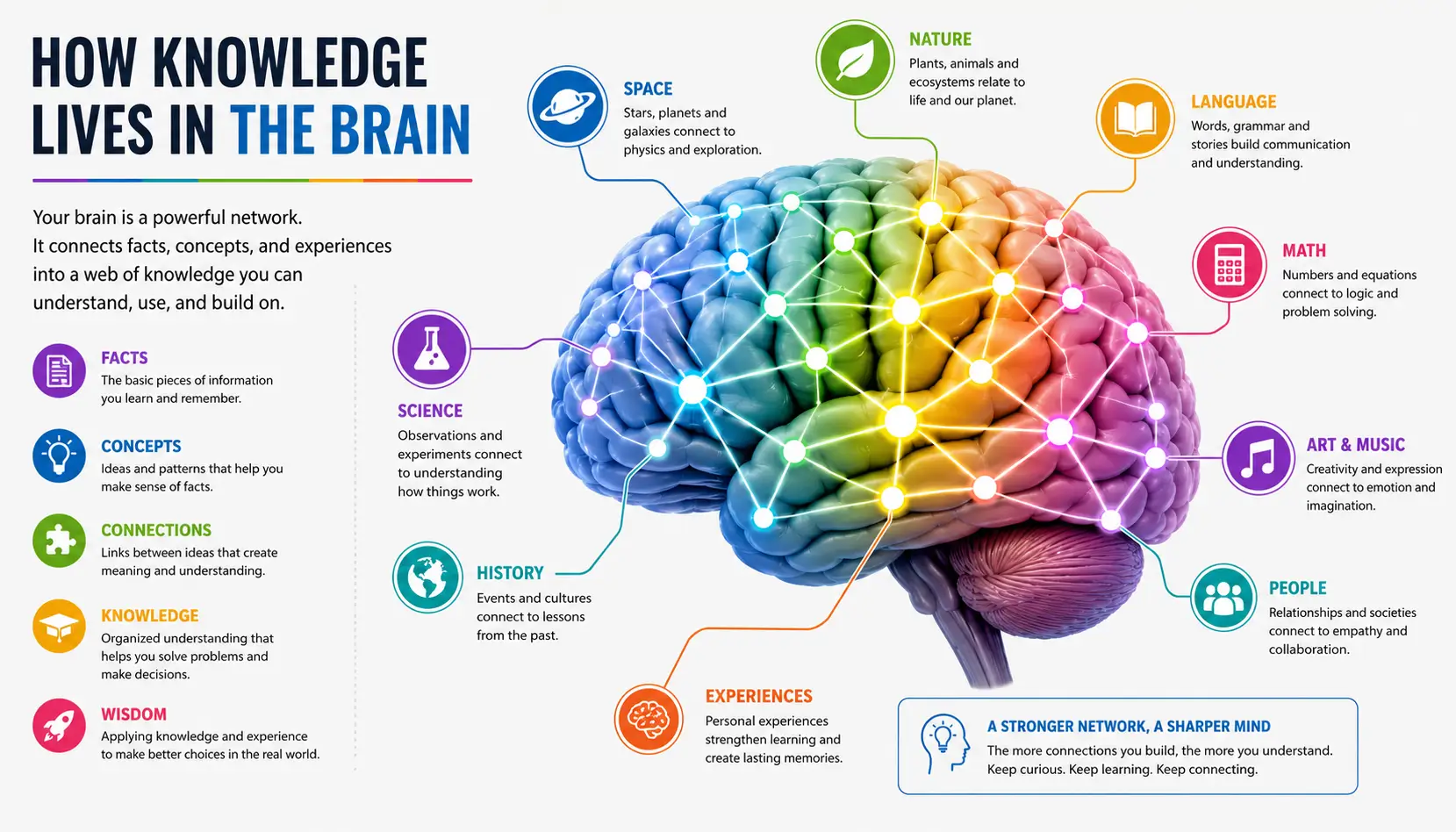
Researchers often describe semantic memory as a network of interconnected concepts.
Each idea is linked to related information.
For example, the concept of “bird” may connect to:
- Animals
- Feathers
- Flying
- Nests
- Eggs
When one concept is activated, related concepts can become easier to retrieve.
This network structure helps explain how knowledge is organized and accessed efficiently.
This process is closely related to semantic priming, where exposure to one concept can make related information easier to recognize or process. For example, seeing the word “doctor” may help someone recognize the word “nurse” more quickly.
Why Connections Improve Learning
New information is often remembered more effectively when it connects to existing knowledge.
Instead of storing isolated facts, the brain builds interconnected networks of meaning.
This is one reason learners who possess strong background knowledge often learn new material faster.
The more connections a concept has, the more retrieval pathways become available.
Learning becomes easier when information has somewhere meaningful to fit.
Semantic Memory and Dual Coding
Dual Coding can strengthen semantic memory by combining verbal and visual representations.
When concepts are supported by both words and images, learners gain multiple routes for retrieval.
Visual diagrams, concept maps, and illustrations often help reinforce understanding.
These additional representations support stronger semantic memory formation.
Knowledge becomes easier to retrieve when it can be accessed in multiple ways.
Semantic Memory and Expertise
Experts in any field often possess highly developed semantic memory networks.
Years of learning create extensive knowledge structures that allow information to be processed quickly and efficiently.
Rather than remembering isolated facts, experts understand how concepts relate to one another.
This interconnected knowledge supports deeper understanding and improved problem-solving.
Expertise is often built upon the gradual expansion of semantic memory.
Can Semantic Memory Improve Over Time?
Yes.
Semantic memory continues developing throughout life.
Every new concept, fact, skill, and insight has the potential to expand existing knowledge networks.
Lifelong learning helps strengthen and enrich semantic memory.
Knowledge accumulation is one of the defining characteristics of human cognition.
Ways to Strengthen Semantic Memory
These same principles are also useful in practical study settings, especially when trying to memorize faster without relying on passive review.
Several evidence-based learning strategies can support semantic memory development.
- Active Recall
- Retrieval Practice
- Spaced Repetition
- Dual Coding
- Elaborative Rehearsal
- The Feynman Technique
These approaches encourage deeper understanding, stronger encoding, and more reliable retrieval.
Consistent practice helps transform information into lasting knowledge.
Semantic Memory and Everyday Life
Semantic memory influences nearly every daily activity.
Reading a book, understanding language, recognizing objects, solving problems, and making decisions all depend on stored knowledge.
Many cognitive abilities that people take for granted rely heavily on semantic memory systems.
Without access to facts and concepts, navigating everyday life would become far more difficult.
The Knowledge System of the Brain
For a broader overview of how semantic knowledge fits into the full memory system, visit the complete guide to memory.
Semantic memory serves as the brain’s knowledge database.
It stores facts, meanings, concepts, vocabulary, and understanding accumulated throughout life.
Unlike episodic memory, which preserves experiences, semantic memory preserves knowledge.
Together, these systems allow people to learn from both experience and information.
Semantic memory is the system that allows knowledge to survive beyond individual experiences.
The ability to acquire, organize, and retrieve knowledge is one of the most powerful features of human cognition.
Supporting Learning Beyond Knowledge Acquisition
Strong semantic memory depends on more than exposure to information.
Sleep, memory consolidation, retrieval practice, focused attention, and overall cognitive health all influence how knowledge develops over time.
Many learners combine evidence-based learning strategies with broader approaches that support long-term brain performance.
Readers interested in memory-supportive nutritional strategies can learn more about Advanced Memory Formula.